

Personnel costs are rarely static. While organizations using dedicated workforce planning platforms report 30 percent faster planning cycles, the deeper financial drain remains hidden within organizational misalignment. You recognize that human potential is your primary lever, yet quantifying the drag of "silent attrition" remains an elusive challenge. Proving the roi of workforce analytics requires a shift from historical reporting to the prediction of structural resonance.
Precision drives performance. You'll discover how to quantify the structural value of workforce intelligence, moving from surface-level engagement scores to measurable financial impact. We provide a clear framework for calculating ROI, offering evidence that alignment directly accelerates organizational velocity. We'll examine how to prevent burnout-related costs and synchronize individual purpose with enterprise goals. This guide outlines a methodical approach to identifying ROI gaps and utilizing the Ikigai Intelligence Framework to transform your workforce into a resilient, high-velocity asset. By integrating human-centric outcomes with technical intelligence, you can secure a future grounded in institutional reliability and intellectual depth.
Key Takeaways
- Quantify the financial drag of silent attrition by identifying the precise moment employee disengagement begins to erode your balance sheet.
- Establish a rigorous framework for measuring the roi of workforce analytics through the lens of strategic velocity and operational efficiency.
- Deploy the Employee Human Signal Index (EHSI) to transition from reactive crisis management to predictive burnout prevention.
- Conduct an Alignment Audit to baseline current turnover costs and surface the structural gaps hindering institutional performance.
- Integrate the Sugihara Bridge Model to pair AI-driven intelligence with expert human judgment, ensuring sustainable, long-term structural improvement.
Beyond Productivity: The Hidden Financial Architecture of Workforce Alignment
Traditional enterprise metrics often prioritize raw activity; however, sophisticated People analytics focuses on the deeper architecture of human interaction. We define the roi of workforce analytics as the measurable delta between an organization’s current operational output and its maximum aligned potential. Most leadership teams focus on visible output, yet the true financial weight lies in the structural integrity of the workforce. When individual purpose diverges from the corporate mission, the resulting friction acts as a tax on every initiative. This misalignment creates a gap that standard accounting fails to capture.
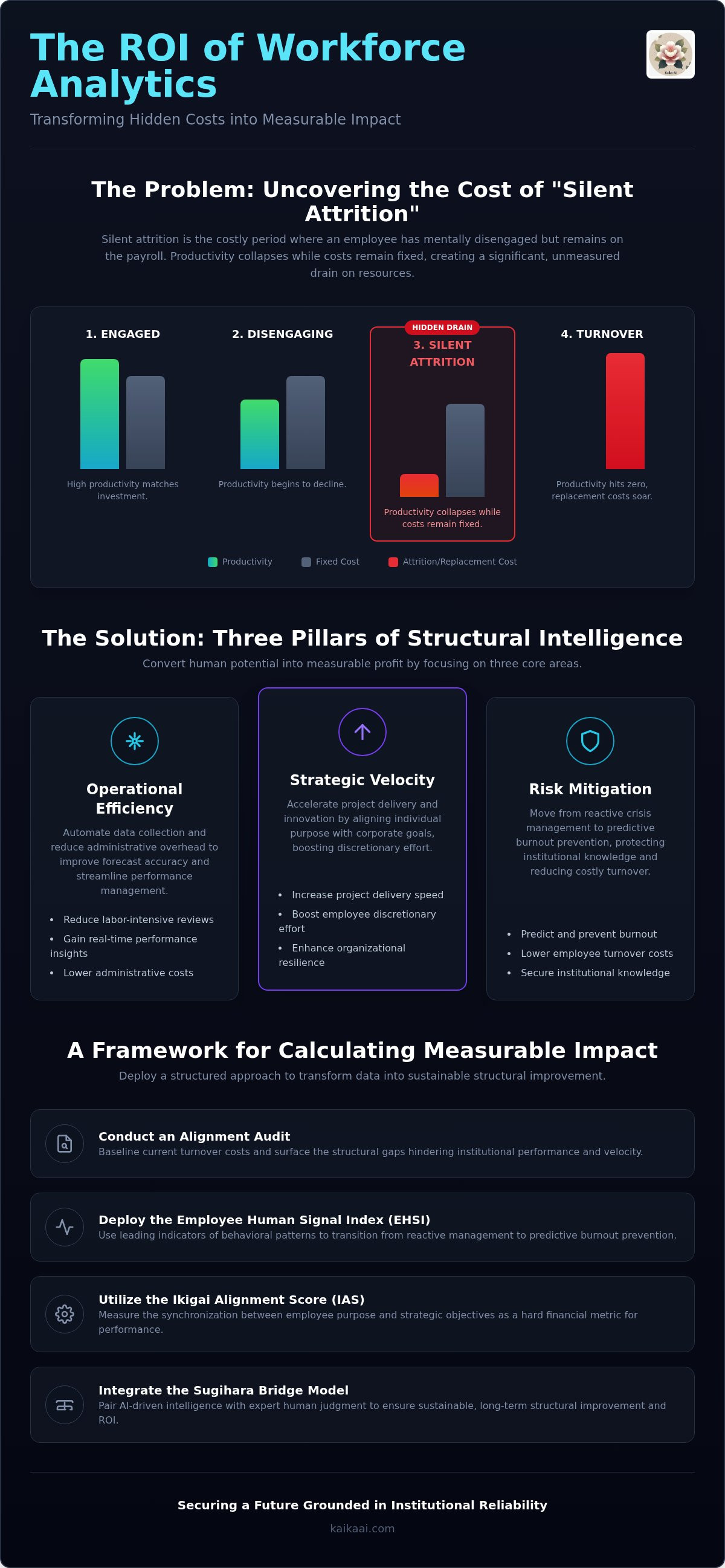
The most significant threat to the balance sheet is "silent attrition." This phenomenon represents the period, often lasting several months, where an employee has mentally disengaged but remains on the payroll. During this phase, productivity collapses while costs remain fixed. Legacy engagement surveys fail here because they act as lagging indicators, capturing dissatisfaction only after the damage is done. To secure a high roi of workforce analytics, leaders must shift toward leading indicators that signal misalignment before it manifests as a resignation letter.
To better understand this concept, watch this helpful video:
The Cost of Silence in Large Organizations
In global enterprises, the financial impact of a single disengaged high-performer is magnified by the scale of their influence. Silent attrition triggers a productivity dip that ripples through cross-functional teams, creating friction costs that stall departmental synergy. Projects slow down; communication breaks; the collective velocity of the organization begins to decay. The Human Signal Index (HSI) provides a quantifiable measure of behavioral patterns that serves as a predictive baseline for organizational health. By identifying these signals early, executives can intervene before the "silence" turns into a total loss of talent and institutional knowledge.
The Ikigai Alignment Score (IAS) as a Financial Metric
Structural alignment is not a soft HR concept; it is a hard financial requirement. The Ikigai Alignment Score (IAS) measures the synchronization between an employee's sense of purpose and the company's strategic objectives. High IAS scores correlate directly with increased discretionary effort and accelerated project delivery velocity. When employees see their work as an extension of their own mission, they navigate obstacles with greater resilience. For a deeper look at the technology facilitating this synchronization, see The Definitive Guide to Workforce Alignment Software. Investing in alignment ensures that every dollar spent on payroll drives the organization toward its ultimate strategic destination.
The ROI of Workforce Analytics: Three Pillars of Structural Intelligence
Quantifying the financial impact of human systems requires a transition from fragmented HR reporting to a unified model of structural value. We categorize the roi of workforce analytics into three distinct pillars: operational efficiency, strategic velocity, and risk mitigation. Each pillar represents a specific node where organizational alignment converts human potential into measurable profit. When these elements are synchronized, the enterprise moves from reactive management to a state of predictive excellence.
Pillar 1: Operational Efficiency and Admin Reduction
Legacy performance management relies on labor-intensive, retrospective reviews that consume significant management hours. Modern intelligence platforms automate the collection of performance data, providing real-time dashboards that improve forecast accuracy by 25 percent compared to spreadsheet-based methods. This transition eliminates the administrative friction traditionally levied on middle management, allowing leaders to focus on mentorship rather than data reconciliation. By streamlining these internal workflows, companies recover the capacity needed to drive high-stakes strategic initiatives.
Pillar 2: Strategic Velocity and Goal Cascading
Strategic velocity measures the speed of organizational response to market fluctuations, quantifying how quickly a mission-critical pivot reaches the frontline. Alignment software ensures that corporate objectives cascade through every layer of the enterprise without losing conceptual weight. This synchronization allows for a more agile deployment of resources in competitive environments. For a detailed exploration of this technical integration, see AI in Employee Engagement. High-velocity organizations maintain their edge by ensuring every contributor understands their specific role in the collective mission.
The final pillar focuses on talent optimization and the mitigation of operational risks. Extending employee tenure through purpose-fit alignment significantly lowers the cost-per-hire, while predictive analytics identify systemic burnout before it necessitates expensive legal or operational interventions. If you're ready to identify these hidden financial levers within your own structure, consider scheduling an Alignment Audit to baseline your current performance. The true roi of workforce analytics is found in the intersection of operational resilience and human harmony.
Strategic Attrition Prevention: The High Stakes of Burnout Prediction
Burnout represents a profound structural failure with severe fiscal consequences rather than a simple morale issue. Replacing a high-level professional typically costs between 1.5 to 2 times their annual salary when accounting for recruitment, specialized onboarding, and the vacuum of lost productivity. Securing a high roi of workforce analytics requires leadership to move beyond reactive crisis management. By identifying psychological strain through the Employee Human Signal Index (EHSI), organizations protect their human capital before replacement costs become unavoidable. This index provides a clinically-grounded baseline for intervention, ensuring that strategic momentum remains uninterrupted by preventable talent loss.
The integration of clinical psychology into AI data interpretation is a necessity for responsible leadership. Within the Sugihara Bridge Model, AI-driven data is interpreted by human consultants to ensure that insights remain grounded in organizational reality. This clinical interpretation ensures that findings are not just technically accurate but also ethically sound and practically applicable. The financial consequences of ignoring these human signals include:
- Direct Recruitment Costs: Expenses for search firms and the internal labor of the talent acquisition team.
- Onboarding Friction: The reduced output during the three to six months required for a new hire to reach peak performance.
- Institutional Knowledge Drain: The intangible loss of historical context and specialized skills that depart with an employee.
Clinically-Informed Burnout Detection
Self-reported surveys frequently fail because employees often mask stress until they reach a definitive breaking point. Behavioral signals offer a more reliable perspective on organizational health by capturing patterns that precede conscious disengagement. The EHSI utilizes clinical foundations to interpret these signals, providing a level of depth that traditional HR tools lack. This predictive capability is essential for modern corporate governance, where transparency and ethical data use are paramount. For a detailed examination of these predictive markers, explore our guide on Leading Indicators of Employee Burnout. This shift toward behavioral intelligence addresses the root causes of systemic strain before they manifest as operational failures.
The ROI of Psychological Stamina
Operational resilience depends on the collective psychological stamina of your workforce. When an organization monitors human signals proactively, it constructs a durable buffer against market volatility and internal friction. Kaika AI identifies burnout risk during the early stages of misalignment, well before the "silent attrition" phase begins to drain the balance sheet. This proactive stance ensures workforce sustainability, which significantly influences long-term enterprise valuation. By treating human potential as a finite yet renewable resource, leaders ensure their growth strategies remain supported by a resilient talent pool; to help employees manage the personal financial stressors that often contribute to burnout, you might check out Watni. This methodology transforms workforce health into a measurable driver of financial stability and institutional excellence. The roi of workforce analytics is ultimately found in the sustained vitality of the organization.
Building the Business Case: A Framework for Calculating Measurable Impact
Executives require a methodical structure to transform human behavior into financial outcomes. Proving the roi of workforce analytics necessitates a shift from qualitative observation to quantitative rigor. This framework establishes five critical phases to isolate the financial impact of alignment, moving beyond simple headcounts to address the structural health of the entire enterprise. By quantifying these variables, leadership can present a business case grounded in institutional reliability.
The following table outlines the primary financial levers used to calculate the return on investment within this framework:
| ROI Component | Financial Driver | Measurement Logic |
|---|---|---|
| Attrition Mitigation | Reduction in turnover costs | Preventing the 1.5x to 2x salary loss per high-performer departure. |
| Strategic Velocity | Accelerated time-to-value | Quantifying the revenue gain from 10% faster initiative execution. |
| Administrative Recovery | Operational efficiency | Calculating hours saved by automating manual performance audits. |
| Alignment Dividend | Cross-departmental synergy | Measuring the reduction in "friction costs" during multi-node projects. |
Step-by-Step ROI Calculation for CHROs
Calculating the cost of a single disengaged high-performer requires more than just salary considerations. You must account for the "synergy dividend" lost when cross-departmental alignment fails and communication breaks down. An 87 percent employee honesty rate ensures that the underlying data remains a reliable foundation for CFOs during rigorous financial modeling. When the data is accurate, the business case becomes undeniable. By using precise human signal data, leadership can estimate the total financial recovery possible through proactive intervention before disengagement becomes permanent.
The Alignment Audit: Identifying ROI Gaps
The Ikigai Intelligence Framework allows leaders to map purpose-performance correlations with architectural precision. This process is particularly vital for Japanese enterprises facing unique alignment challenges during large-scale workforce transformations. As these organizations evolve, maintaining structural integrity requires a platform that understands the intersection of culture and performance. For deeper insights into these methodologies, see The Executive Guide to Data-Driven Kaizen Platforms.
Structural improvement isn't a one-time event but a process of continuous refinement. The Sugihara Bridge Model pairs AI measurement with human consultant judgment to bridge the gap between data and action, ensuring that technical insights translate into operational resilience. If your organization is ready to quantify its alignment potential and secure a measurable return, you should schedule an Alignment Audit to begin your baseline assessment.
From Data to Kaizen: Securing Long-Term ROI with the Sugihara Bridge Model
Raw data is a static asset; its value remains latent until it is converted into architectural change. While many platforms offer automated dashboards that track keystrokes or idle time, software alone is insufficient for achieving deep structural alignment. True roi of workforce analytics emerges when technical intelligence is synthesized with expert human judgment. This synthesis ensures that the signals captured by the platform translate into sustainable operational resilience rather than temporary productivity spikes. To bridge the gap between algorithmic insight and leadership action, we utilize a methodical approach that respects the complexity of human systems.
AI-Driven Measurement Meets Human Judgment
The Sugihara Bridge Model serves as the definitive framework for enterprise-grade strategic integration. Within this model, AI-driven measurements provide the foundation, yet human consultants interpret these signals with the necessary cultural nuance. Sensitive workforce signals, such as shifts in the Ikigai Alignment Score, require a level of context that purely automated systems cannot provide. This dual approach supports CHROs during high-stakes workforce transformations, ensuring that data points lead to precise executive architectural consultations. By pairing predictive technology with clinical expertise, organizations avoid the pitfalls of "black box" decision-making and maintain institutional trust.
The Continuous Improvement (Kaizen) Loop
Securing long-term ROI requires moving beyond "one-off" interventions toward a systemic culture of performance. We facilitate this transition through Collective Kaizen Workshops, designed to close the loop on data insights by empowering teams to co-create structural improvements. This process treats organizational synergy as a compounding interest, where small, data-driven adjustments lead to massive gains in strategic velocity over time. When alignment becomes a continuous practice, the organization builds a durable buffer against external market volatility. For a deeper analysis of this methodology, see our framework on Operational Resilience for Leadership.
The future of workforce intelligence lies in the intersection of technical precision and human potential. Our long-term vision includes a dual listing on the TSE and ASX by 2032, reflecting our commitment to institutional reliability and global category leadership. By implementing the Sugihara Bridge Model, enterprise leaders don't just measure their workforce; they evolve it. This disciplined approach ensures that the roi of workforce analytics is reflected not only in the quarterly balance sheet but in the enduring resilience and excellence of the organization's most vital asset.
Architecting the Future of Organizational Excellence
True structural transformation requires more than passive data collection; it demands a rigorous commitment to alignment. By shifting your focus from surface-level activity to deep-seated purpose-mission fit, you unlock the genuine roi of workforce analytics. You've seen how identifying silent attrition and utilizing a clinically-validated burnout index can prevent the massive financial drain associated with talent loss. Our academic partnership with Waseda University and a pilot NPS of 72 among participants demonstrate the institutional reliability of this architectural approach to human capital.
Sustainable performance isn't a static achievement but a process of continuous evolution. Integrating the Sugihara Bridge Model ensures that every technical signal is filtered through expert human judgment, creating a resilient connection between data and strategic action. This methodical synchronization of individual potential and enterprise goals is the foundation of future excellence. You're invited to Request Early Access to the Kaika AI Alignment Platform and begin architecting a more harmonious, high-velocity organization. The path to structural integrity starts with a single, data-driven realization.
Frequently Asked Questions
What is the typical timeframe to see ROI from workforce analytics?
Visible gains in administrative automation often appear within the first 30 days of implementation. However, achieving the comprehensive roi of workforce analytics through structural alignment usually requires a six to twelve-month cycle to account for behavioral shifts. This duration ensures that data reflects sustained cultural transformation rather than temporary fluctuations. By allowing for a full business cycle, leadership can accurately measure the compounding benefits of organizational synergy and improved talent retention.
How does workforce alignment impact the bottom line in large enterprises?
Alignment acts as a force multiplier for strategic execution. In large enterprises, reducing the gap between executive vision and frontline action recovers significant lost productivity. By synchronizing individual purpose with corporate mission, organizations eliminate the fiscal waste inherent in misaligned efforts. This structural integrity ensures that every dollar of payroll spend drives the enterprise toward its primary objectives. High-alignment organizations typically outperform their peers in both project delivery speed and operational resilience.
Is the ROI of workforce analytics higher for remote or in-office teams?
Both models offer high returns, but the specific measurement levers differ. Remote teams utilize workforce analytics to replace physical cues with digital behavioral signals, ensuring cohesion across distributed nodes. In-office teams benefit from optimized collaboration and reduced departmental silos. Regardless of the physical workspace, the primary financial return stems from the synchronization of human potential with operational goals. Analytics provides the visibility needed to manage performance effectively in any environment.
How do you calculate the cost savings of preventing employee burnout?
Leadership calculates burnout prevention by quantifying the avoided replacement costs of high-performers, which frequently reach 200% of an annual salary. This calculation includes search fees, onboarding labor, and the vacancy's impact on team velocity. By utilizing predictive indices, organizations intervene before these costs materialize. This proactive stance ensures that talent investments remain secure while maintaining the psychological stamina of the workforce. Reducing burnout also lowers long-term healthcare and disability-related expenditures.
Can workforce analytics identify silent attrition before it happens?
Proving the roi of workforce analytics involves identifying disengagement patterns months before a formal resignation occurs. By tracking shifts in human signals, leaders can detect the productivity decay that characterizes silent attrition. This foresight allows for structural reintegration before the talent loss becomes a permanent financial liability. Analytics transforms "gut feelings" about employee morale into actionable, data-driven interventions. This early detection is critical for maintaining institutional knowledge and strategic momentum.
How does the Sugihara Bridge Model improve the ROI of AI tools?
The Sugihara Bridge Model improves ROI by filtering AI-driven data through expert human interpretation. Automated tools often lack the cultural nuance required for sensitive leadership decisions. Pairing technical precision with clinical judgment ensures that interventions are ethically sound and strategically effective. This model prevents the common pitfall of over-relying on raw algorithms, which can lead to misaligned management actions. It creates a trusted feedback loop that enhances both data accuracy and leadership confidence.
What is the financial impact of a high Ikigai Alignment Score (IAS)?
A high Ikigai Alignment Score (IAS) indicates that employees find their work personally meaningful, which drives significant discretionary effort. This intrinsic motivation accelerates project delivery and improves operational resilience. The financial result is a more agile organization capable of outperforming competitors through superior execution. High IAS scores also correlate with lower recruitment costs, as aligned employees are more likely to become long-term brand advocates. This alignment turns human potential into a sustainable competitive advantage.
Does workforce analytics help reduce administrative costs in HR?
Workforce analytics automates performance auditing and planning cycles, reducing manual labor by up to 40% in many organizations. This recovery of administrative time allows HR leaders to transition from data reconciliation to high-level strategic consulting. The result is a lower cost-of-service for the HR function and improved accuracy in talent forecasting. By replacing spreadsheets with integrated intelligence platforms, enterprises eliminate the "reporting tax" that traditionally burdens middle management. These savings contribute directly to the overall efficiency of the organization.
More Articles

Building an Employee Burnout Early Warning System: The Executive Framework for Predictive Alignment

Aligning Individual and Organizational Goals: A Strategic Framework for Workforce Intelligence
