High engagement scores are often the loudest warning signs of impending institutional collapse. You've likely seen the data: satisfaction ratings remain high even as high-performance teams suffer from invisible burnout and fragmented synergy. This paradox exists because traditional metrics capture fleeting sentiment rather than structural alignment. Integrating ai in employee engagement isn't about automating HR surveys; it's about deploying a sophisticated workforce alignment intelligence platform that bridges the gap between individual purpose and the rigorous requirements of organizational architecture.
You understand that a resilient, high-velocity workforce requires more than just a positive culture. It demands a systematic synchronization of human potential with strategic goals. This article demonstrates how AI-driven insights transform engagement from a static, retrospective metric into a dynamic engine for operational resilience and growth. We'll explore the transition toward real-time visibility into organizational health and the measurable correlation between purpose-driven alignment and sustainable productivity.
Key Takeaways
- Shift from retrospective sentiment analysis to proactive, real-time intelligence that synchronizes individual output with global organizational architecture.
- Understand how utilizing ai in employee engagement moves beyond superficial metrics to measure Workforce Velocity, the actual speed of mission-aligned progress.
- Identify and bridge the Alignment Gap by cascading high-level corporate strategy into individualized goals that resonate with personal purpose.
- Follow a structured integration framework, beginning with a rigorous Alignment Audit to expose invisible burnout patterns and structural inefficiencies.
- Leverage a Workforce Alignment Intelligence Platform to ensure long-term operational resilience through the continuous synchronization of human potential and performance.
Beyond Sentiment: The Evolution of AI in Employee Engagement
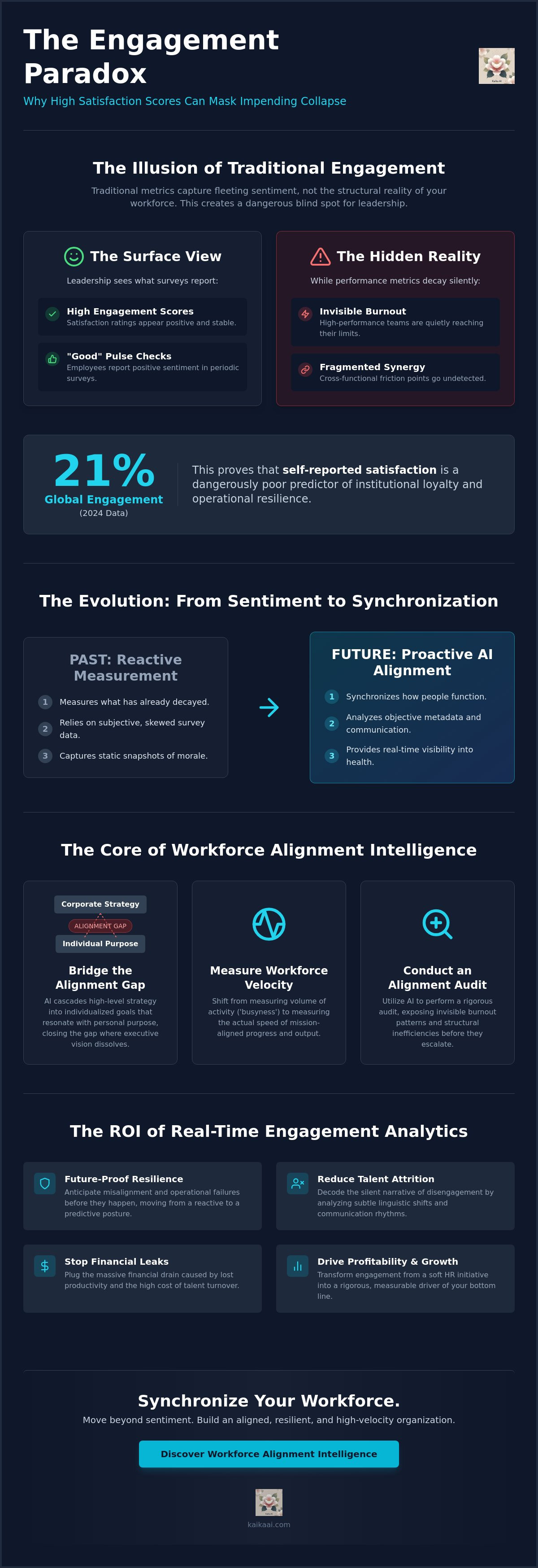
Traditional Employee engagement models have reached a structural ceiling. For decades, leadership relied on retrospective annual surveys, a methodology that captures static snapshots of morale rather than the fluid reality of organizational movement. These systems are inherently reactive. They measure what has already decayed. The integration of ai in employee engagement represents a fundamental architectural shift: moving from measuring how people feel to synchronizing how they function within the enterprise machine.
The attrition waves of 2024 and 2025 exposed the fatal flaw in sentiment-based metrics. While many organizations reported "good" pulse scores, they remained blind to invisible burnout patterns and fragmented departmental synergy. Global engagement levels dropped to 21% in 2024, proving that self-reported satisfaction is a poor predictor of institutional loyalty. AI transcends these limitations by deploying Natural Language Processing to decode the silent narrative. It analyzes subtle linguistic shifts and communication rhythms that precede a resignation long before a human manager detects a change in tone.
From Pulse Surveys to Predictive Intelligence
Self-reported data is notoriously unreliable in high-stakes environments. Employees often respond to surveys through a lens of self-preservation or survey fatigue, leading to skewed datasets. AI bypasses this subjectivity by identifying patterns in metadata, such as collaboration velocity and cross-functional friction points. This is the transition from monitoring workforce behavior to modeling it. By analyzing the structural integrity of team interactions, predictive intelligence anticipates misalignment before it manifests as operational failure.
The ROI of Real-Time Engagement Analytics
Disengagement isn't just a cultural deficit; it's a massive financial leak. In global enterprise divisions, the cost of talent attrition and lost productivity represents a significant drain on capital. Engagement ROI is the measurable delta between stagnant human capital and the accelerated workforce velocity achieved through precise mission alignment. Linking real-time analytics directly to operational resilience ensures that every adjustment in the organizational architecture contributes to the bottom line. By integrating professional development from Trainetics Academy, companies can better empower their workforce to meet these strategic demands, transforming engagement from a soft HR initiative into a rigorous driver of profitability and growth.
The Architectural Core: Mapping Individual Purpose to Global Strategy
Strategy is a structural commitment. Yet, most executive visions dissolve at the middle management layer because of a profound Alignment Gap. This gap is the distance between a high-level corporate mission and the daily operational reality of the individual contributor. When employees cannot perceive their personal purpose within the organizational architecture, engagement becomes a hollow metric. Modern ai in employee engagement strategies solve this by treating alignment as a technical engineering challenge rather than a vague cultural ideal. It's about building a bridge between the "what" of the business and the "why" of the human.
Workforce Alignment Intelligence represents a new category of leadership tool designed for the complexities of global scale. It functions by cascading complex corporate objectives into actionable, individualized targets. This isn't a manual top-down directive. Instead, it's a dynamic synchronization that ensures every unit of energy expended by the workforce contributes directly to the global strategy. By utilizing these intelligence platforms, executives gain real-time visibility into whether the workforce is actually moving in the intended direction or merely performing "busyness."
Synchronising Personal and Professional 'Why'
The psychological science of performance in 2026 is clear. Purpose is the primary driver of velocity. AI-driven platforms now map individual skillsets and intrinsic motivations to mission-critical organizational needs with mathematical precision. This process reduces the friction inherent in traditional goal-setting. By performing an automated Alignment Audit, leadership can identify exactly where personal purpose has drifted from the strategic path. This allows for immediate, surgical recalibration of roles and responsibilities to maximize both human fulfillment and operational output.
Breaking Silos with AI-Powered Synergy
Organizational silos are the graveyards of innovation. They create invisible barriers that prevent the flow of intelligence across global divisions. AI facilitates a state of Collective Kaizen by identifying hidden experts and connecting disparate team goals in real-time. It doesn't just track output; it measures the structural strength of cross-functional bonds within the organizational matrix. This visibility allows leaders to foster synergy where it was previously impossible, ensuring that departmental goals never conflict with the overarching mission. Through this lens, engagement becomes a measure of how well the entire system breathes together.
Velocity vs. Volume: Redefining Productivity through Engagement
Productivity is frequently misinterpreted as a function of volume. In many enterprise environments, "busyness" acts as a structural cloaking device, masking deep-seated disengagement behind a facade of frantic activity. High volume does not equate to high velocity. While volume measures the sheer quantity of tasks completed, Workforce Velocity measures the speed of mission-aligned progress. Integrating ai in employee engagement allows leadership to distinguish between these two states. It provides the analytical precision required to identify when a team is moving fast but in the wrong direction, or worse, when they're simply spinning their wheels in a state of cognitive friction.
The danger of the volume-centric mindset is that it inevitably leads to "Silent Attrition." This is the period where an employee has mentally disconnected from the organizational mission but continues to produce a standard level of output. They're present, but their contribution lacks the creative resonance and strategic intent necessary for growth. AI identifies this drift by correlating productivity data with engagement signals, spotting the subtle decay in mission-alignment long before a resignation letter is drafted. It transforms engagement from a subjective feeling into a measurable component of operational velocity.
The Burnout Prediction Framework
High-performance cultures often suffer from a specific pathology: over-alignment. This occurs when an individual's sense of purpose is so tightly coupled with their role that it leads to unsustainable effort and eventual cognitive fatigue. AI-driven intelligence platforms monitor predictive indicators of this fatigue by analyzing metadata patterns that suggest a breakdown in resilience. Rather than waiting for a crisis, organizations can deploy proactive Operational Resilience Training. This shift moves the enterprise from reactive mental health support to a model of systemic stamina, ensuring that high-velocity teams remain sustainable over long-term strategic cycles.
Measuring Operational Resilience
Resilience is the structural ability of a workforce to maintain its velocity under significant stress. It's the ultimate test of an organization's architectural integrity. AI allows leadership to stress-test these structures by identifying engagement gaps that appear during enterprise-wide transformations or market shifts. By utilizing ai in employee engagement, executives can visualize the "load-bearing capacity" of their teams in real-time. This visibility ensures that the workforce possesses the collective stamina required to navigate complexity without sacrificing the synchronization between individual purpose and global strategy.
Implementation Strategy: The Three-Phase Integration Framework
Transitioning from theoretical velocity to operational reality requires a methodical, architectural approach. Integration isn't a singular event; it's a structural evolution. The successful deployment of ai in employee engagement follows a rigorous three-phase framework designed to ensure the technology strengthens the organizational spine rather than just adding digital noise. This progression moves the enterprise from a state of reactive guesswork to one of disciplined, data-driven synchronization.
The framework begins with Phase 1: The Alignment Audit. This initial diagnostic identifies structural mission gaps where individual effort has drifted from the strategic center. It provides a baseline of current organizational health. Phase 2 follows with Architectural Consultation. During this stage, the system's intelligence is mapped directly to leadership mindsets. This ensures that the insights produced by the AI are interpreted through the lens of executive vision. Finally, Phase 3 establishes Continuous Kaizen. This phase creates a self-correcting loop that uses real-time data to drive incremental, systemic improvements in how the workforce synchronizes with its purpose.
A significant barrier to adoption is the "Black Box" objection. Many leaders fear that AI-driven decisions lack transparency or accountability. Overcoming this resistance requires a commitment to transparent governance. By demystifying the algorithmic process and showing exactly how inputs lead to strategic recommendations, organizations can prove that the intelligence is a tool for empowerment. It's not a hidden arbiter of career paths but a clear mirror reflecting the health of the collective.
The Executive Alignment Mindset
Preparing leadership for a transition to data-driven people operations is a strategic necessity. This evolution requires specific workshops aimed at synchronizing executive vision with AI-derived insights. To facilitate this shift, Business With AI Strategist provides expert consultancy and strategic implementation services designed for SME teams and entrepreneurs. The goal is to ensure the technology serves as an "exoskeleton" for leadership. It doesn't replace the human intuition of a visionary leader. Instead, it enhances it by providing a high-resolution map of the workforce's internal dynamics, allowing for more precise and confident decision-making.
Ethical AI Governance and Privacy
Trust is the currency of engagement. Implementing these systems requires strict adherence to global privacy standards, including GDPR and Japanese Privacy Standards. By focusing on anonymized sentiment analysis and clear data ethics, organizations build a foundation of psychological safety. Systemic improvement through data-driven Kaizen enhances collective performance by identifying structural friction while maintaining the absolute anonymity of the individual contributor. This balance ensures that the pursuit of excellence never compromises the integrity of the individual.
Future-Proofing Corporate Governance with Kaika AI
Governance is a function of clarity. In the complex enterprise landscape of 2026, leadership requires more than just oversight; it demands a high-resolution map of the organization's internal synchronization. The Kaika AI Workforce Alignment Intelligence Platform serves as this essential architectural bridge. By generating real-time alignment scores for every employee, the platform transforms the abstract concept of purpose into a measurable operational asset. This isn't merely about tracking sentiment. It's about ensuring that the individual's "Ikigai," or reason for being, remains perfectly coupled with the corporate mission.
Security and trust are the cornerstones of this technological integration. In a global market where data ethics are paramount, Kaika AI provides the strategic advantage of Japanese-grade security. The platform is built to exceed international standards, maintaining strict SOC2 compliance and adhering to the most rigorous Japanese privacy protocols. This foundational commitment ensures that the pursuit of ai in employee engagement never compromises the sanctity of individual data. It allows executives to lead with confidence, knowing their organizational health is monitored within a fortress of institutional reliability.
The Kaika Methodology: Beyond Software
True evolution requires a framework that extends beyond the digital interface. The Kaika methodology combines advanced AI tools with high-impact strategic integration. Through Collective Kaizen Workshops and Executive Consultation, we translate raw data into structural change. This comprehensive approach reduces attrition by identifying predictive burnout patterns long before they impact the bottom line. It's a proactive defense against disengagement. We're currently offering early access to our 2026 Workforce Alignment Platform for visionary leaders ready to synchronize their workforce velocity with their strategic intent.
Building the Resilient Enterprise of 2026
The long-term value of a synchronized workforce is found in its collective stamina. As global markets fluctuate, the resilient enterprise remains steady, powered by a high-velocity workforce that understands its "why." Positioning your organization as a leader in ethical AI and human potential isn't just a branding exercise. It's a commitment to a future where technology serves the human spirit. Redefining the role of ai in employee engagement as a guardian of potential ensures your company remains an attractive destination for top-tier talent. The path to this future begins with a precise understanding of your current state. Take the first step toward systemic order and Request an Alignment Audit with Kaika AI today.
Mastering the Architecture of Human Potential
The transition from superficial sentiment to structural alignment represents the final frontier of modern leadership. Alignment is the engine. True organizational resilience emerges when individual purpose is perfectly synchronized with global strategy. By prioritizing workforce velocity over simple task volume, organizations create a sustainable ecosystem of high-performance and individual fulfillment. Integrating ai in employee engagement allows for the precise synchronization of personal "Why" with global corporate missions. This architectural approach ensures that every unit of energy contributes to systemic growth rather than invisible friction.
Our framework secures this future through a rigorous Three-Phase Strategic Integration Methodology and real-time burnout risk identification. We've built a platform that respects individual integrity by adhering to strict Japanese Privacy Standards while delivering the data-driven clarity required for global scale. The resilient enterprise of 2026 is one that breathes in unison with its people, moving with a singular, focused velocity. The path to institutional harmony is no longer a philosophical ideal; it's a technical reality.
Secure Early Access to the Kaika AI Alignment Platform
The opportunity to lead this evolution is yours to command. Your organization's potential is waiting to be unlocked.
Frequently Asked Questions
How does AI actually measure employee engagement without being intrusive?
AI measures engagement by analyzing structural communication patterns and metadata rather than individual message content. It identifies subtle shifts in collaboration velocity and response rhythms to model organizational health in real-time. This non-intrusive methodology ensures privacy while providing a high-resolution map of team dynamics. It allows leadership to detect friction points in the organizational architecture without resorting to disruptive surveillance methods or repetitive surveys.
Can AI predict employee burnout before it happens?
Predictive intelligence identifies burnout by detecting linguistic changes and cognitive fatigue indicators before they manifest as performance failure. By correlating productivity data with engagement signals, AI spots the "Silent Attrition" that precedes a resignation. This proactive visibility allows for surgical interventions through Operational Resilience Training. It transforms mental health support from a reactive benefit into a strategic component of institutional stamina and long-term sustainability.
What is the difference between AI sentiment analysis and workforce alignment?
Sentiment analysis captures a fleeting snapshot of how employees feel, whereas workforce alignment measures the structural synchronization between individual purpose and corporate strategy. Feeling satisfied doesn't guarantee mission-aligned progress. Utilizing ai in employee engagement focuses on the latter, ensuring that every unit of human energy contributes directly to the organizational vision. It moves beyond simple mood tracking to facilitate systemic order and operational velocity.
How do AI engagement tools comply with strict privacy standards like those in Japan?
Enterprise-grade platforms maintain compliance through rigorous anonymization and adherence to global protocols like SOC2 and Japanese Privacy Standards. These systems focus on aggregate team health rather than individual monitoring. By prioritizing data ethics, organizations build a foundation of psychological safety. This architectural approach ensures that the pursuit of excellence and high-velocity performance never compromises the fundamental privacy rights or the trust of the workforce.
Will AI-driven engagement platforms replace the role of HR managers?
AI engagement platforms act as an exoskeleton for HR professionals rather than a replacement. They automate the complex diagnostic work of identifying alignment gaps and burnout risks across global divisions. This technical support frees HR managers to focus on high-value strategic consultation and human-centric outcomes. It provides the high-resolution data necessary for visionary leadership to make more precise, impactful decisions regarding their human capital.
How does Kaika AI integrate with existing enterprise productivity tools?
Kaika AI functions as a seamless layer within the existing organizational architecture, connecting to enterprise productivity tools via secure APIs. It gathers passive metadata from standard workflows without requiring additional manual input from the workforce. This integration ensures that the platform provides real-time visibility into organizational health without disrupting daily operations. It creates a continuous loop of intelligence that supports the natural rhythm of the enterprise.
What is 'Workforce Velocity' and why should executives track it?
Workforce Velocity is the measurable speed of mission-aligned progress within an organization. It's a critical KPI because it distinguishes strategic movement from the hollow "busyness" of high task volume. Executives should track velocity to ensure that the workforce isn't just active, but is actually advancing the corporate mission. High velocity indicates a synchronized architecture where individual purpose and organizational goals are perfectly coupled for maximum impact.
How long does it take to see an ROI from AI in employee engagement?
ROI from ai in employee engagement often begins with the immediate insights gained from an initial Alignment Audit. These diagnostics identify structural inefficiencies and mission gaps that can be addressed through surgical leadership interventions. While systemic shifts in attrition rates and operational resilience typically materialize over six to twelve months, the increase in workforce velocity and strategic clarity provides measurable value shortly after the initial integration phase.
Disclaimer
#Disclaimer
At Kaika AI, we believe the future belongs to organizations that combine human wisdom with artificial intelligence responsibly. The articles, research, insights, and thought leadership published on this website are intended to educate, inform, and encourage meaningful conversations about the future of work, organizational intelligence, AI, leadership, and innovation.
While our content is developed through rigorous research and may be generated, curated, or enhanced using artificial intelligence, every effort is made to ensure it reflects thoughtful analysis, practical relevance, and responsible AI practices. However, no representation or warranty is made regarding the completeness, accuracy, or suitability of the information for every individual or organizational circumstance.
The ideas, opinions, frameworks, and recommendations shared by Kaika AI are provided for educational and informational purposes only. They should not be interpreted as legal, financial, medical, psychological, human resources, cybersecurity, or other professional advice. Organizations and individuals should seek qualified professional guidance before making strategic, legal, or operational decisions.
Where articles reference third-party organizations, products, services, academic research, industry reports, or public data, such references are provided solely to support discussion and analysis. Unless explicitly stated, they do not imply endorsement, partnership, or affiliation.
Artificial intelligence is a powerful decision-support technology—not a replacement for human judgment. Kaika AI advocates for responsible, transparent, and human-centered AI adoption. We encourage readers to critically evaluate information, consider their unique context, and combine AI-generated insights with professional expertise and sound decision-making.
The content published on this website may be updated, revised, or removed as knowledge, technology, regulations, and best practices continue to evolve.
To the fullest extent permitted by applicable law, Kaika AI, its affiliates, contributors, and partners disclaim liability for any direct, indirect, incidental, consequential, or other losses arising from the use of, or reliance upon, the information provided on this website.
By accessing or using this website, you acknowledge that you have read, understood, and agree to this Disclaimer.
Kaika AI
'Building trusted organizational intelligence for the AI Era'


