
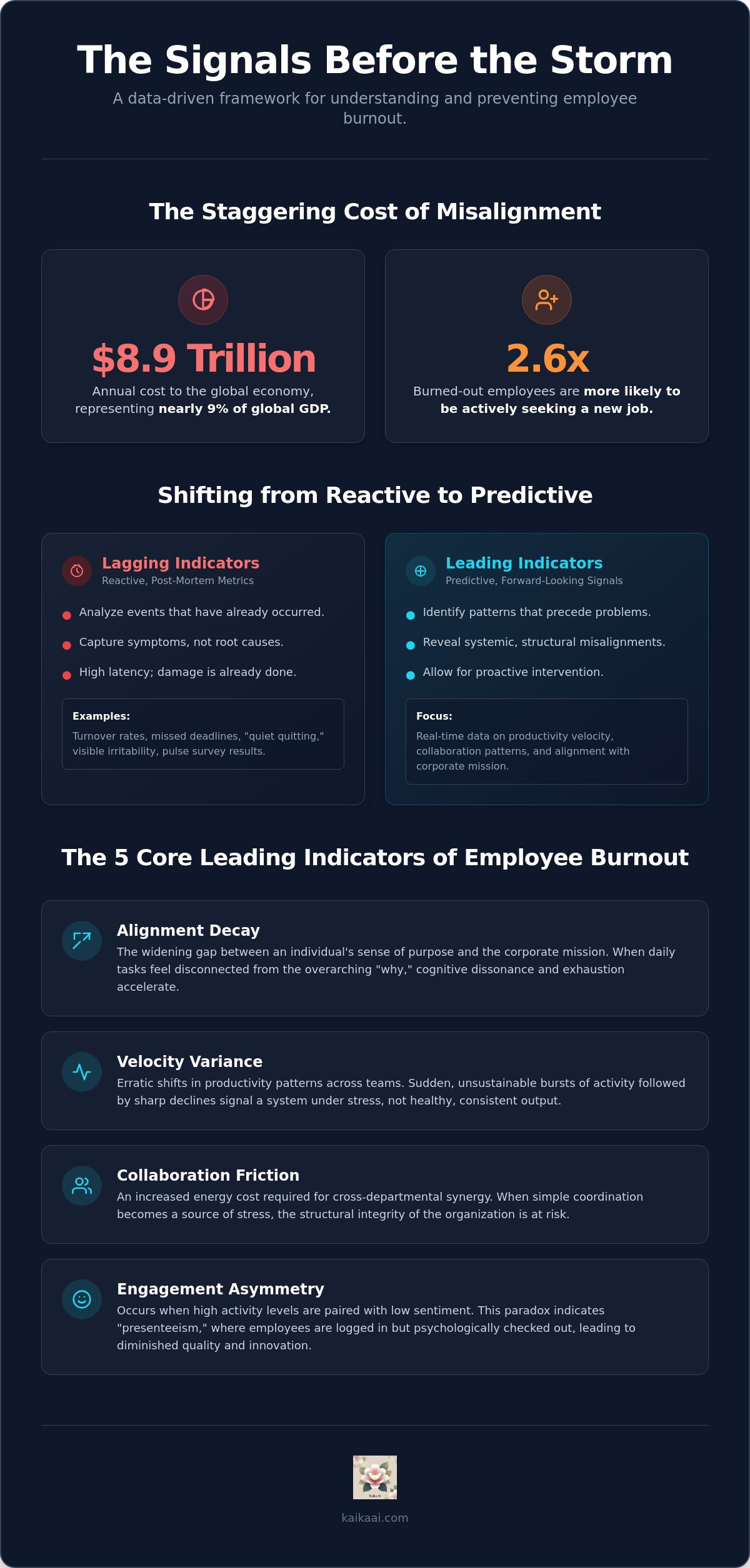
Low employee engagement costs the global economy $8.9 trillion annually, representing nearly 9% of global GDP. Most executive leaders view this loss as an inevitable friction of doing business, yet the reality is far more systemic. Burnout is not merely a consequence of high workload; it is the friction caused by a structural misalignment between individual purpose and organizational velocity. By the time an employee signals exhaustion in a traditional survey, the damage is already done. Identifying the leading indicators of employee burnout requires a shift from reactive observation to predictive intelligence.
You recognize that the high cost of top talent attrition is unsustainable, especially when burned-out employees are 2.6 times more likely to be actively seeking a new job. This guide provides a sophisticated framework to move beyond subjective mental health assessments toward objective, data-driven resilience. We will examine the structural data patterns that precede attrition and outline how to synchronize human potential with enterprise goals. You will learn to transform your workforce data into a strategic asset that ensures long-term organizational harmony and measurable performance stability.
Key Takeaways
- Distinguish between lagging attrition data and forward-looking behavioral signals to move from reactive crisis management to predictive organizational resilience.
- Identify the structural leading indicators of employee burnout, focusing on alignment decay and velocity variance within departmental productivity patterns.
- Evaluate the technical architecture required to integrate predictive attrition intelligence into global enterprise systems while maintaining rigorous compliance standards.
- Operationalize a three-phase framework for collective resilience that transforms detection into strategic, mission-oriented workforce harmony.
- Leverage a Workforce Alignment Intelligence Platform to synchronize individual purpose with corporate velocity and secure long-term talent retention.
Leading vs. Lagging Indicators: Redefining Burnout Detection
Executive leadership often operates in a state of retroactive awareness. We analyze turnover rates and productivity dips as if they were the primary problems, rather than the final echoes of a structural failure. While Occupational Burnout is often categorized by its visible symptoms, waiting for these symptoms to manifest is a high-risk management strategy. Traditional pulse surveys suffer from a fatal latency; they capture how an employee felt last week, not the trajectory of their engagement for the next quarter. This lag creates a blind spot where organizational friction erodes talent long before it appears on a spreadsheet. True resilience isn't found in the capacity to endure stress, but in the architectural integrity of the system itself. Shifting your focus toward leading indicators of employee burnout allows for a transition from individual psychology to structural organizational intelligence. We must look at the mechanics of work, not just the emotions of workers.
The Failure of Lagging Indicators
Missed deadlines aren't warnings; they're post-mortem metrics. The "Quiet Quitting" phenomenon is simply late-stage burnout that has reached its terminal phase. When a high-performer displays irritability or withdrawal, you aren't seeing a personality shift. You're seeing the collapse of a psychological contract that was damaged months ago. The annual cost of burnout-related lost productivity and turnover in the U.S. is estimated to be $322 billion. Relying on observable symptoms means you're already paying that tax. These lagging indicators represent a failure of detection, not a lack of effort. They mask deeper systemic misalignments that traditional engagement tools are too slow to capture. When management reacts only to visible exhaustion, they've already conceded the most valuable asset: the employee's trust in the organization's sustainability.
The Power of Predictive Workforce Intelligence
Predictive workforce intelligence identifies the decay of synchronization before it results in a total system failure. The leading indicators of employee burnout are the subtle, structural shifts in data that occur before any behavioral change is visible to a manager. These signals reside in the variance of productivity velocity and the widening gap between daily operations and corporate mission. Real-time intelligence allows for the identification of attrition risk by monitoring the synchronization of effort and outcome across the entire enterprise architecture. Leading indicators are the early-stage friction between effort and perceived purpose. By shifting focus toward these predictive signals, leadership moves from crisis mitigation to the active preservation of organizational harmony. This proactive stance ensures that the velocity of the organization remains balanced with the resilience of its human capital.
The 5 Core Leading Indicators of Employee Burnout
Traditional management focuses on workload as the sole driver of exhaustion, yet evidence suggests that structural misalignment is the true catalyst. Identifying the leading indicators of employee burnout requires a lens that views the organization as a synchronized system of human potential. When these signals appear, they act as early-stage friction points that, if left unaddressed, lead to total attrition. Understanding early signs and recognition strategies is critical for maintaining high-performance stability across global enterprise architectures.
- Alignment Decay: This is the widening gap between an individual's sense of purpose and the corporate mission. When daily operations feel disconnected from the overarching "why," cognitive dissonance accelerates exhaustion.
- Velocity Variance: Erratic shifts in productivity patterns across departments often signal a system under stress. Sudden bursts of activity followed by sharp declines suggest unsustainable effort rather than healthy output.
- Collaboration Friction: An increased energy cost required for cross-departmental synergy indicates a breakdown in organizational harmony. When simple coordination becomes a source of stress, the structural integrity of the team is at risk.
- Engagement Asymmetry: This occurs when high activity levels are paired with low sentiment scores. Employees may be "productive" on paper while internally withdrawing from the organizational culture.
- Digital Exhaustion: Patterns in communication frequency and after-hours connectivity provide a data-driven map of overextension. Constant digital presence is a precursor to a total collapse in resilience.
To move beyond observation, leaders should conduct an Alignment Audit to identify where these friction points are currently eroding talent retention.
Measuring Alignment Decay
Quantifying the disconnect between daily tasks and organizational goals requires more than a simple survey. It demands an analysis of mission-critical gaps in employee sentiment. When purpose alignment fails, long-term resilience vanishes. Sophisticated intelligence tools can now detect these subtle shifts by analyzing the language of collaboration and the synchronization of effort. Identifying this decay early allows leadership to re-anchor the workforce to the corporate mission before the friction becomes terminal.
Workforce Velocity and Productivity Patterns
Healthy high performance has a rhythmic, sustainable quality. In contrast, "sprint fatigue" is characterized by frantic, erratic output that lacks a coherent operational flow. Distinguishing between these two states is essential for maintaining operational resilience. By tracking internal synergy and velocity variance, organizations can identify which departments are operating at an unsustainable pace. This predictive approach transforms productivity data into a protective shield, ensuring that organizational speed never compromises the integrity of the human capital driving it.
Evaluating a Burnout Prediction Platform: A Buyer’s Framework
Selecting a technical solution to monitor the leading indicators of employee burnout is a high-stakes strategic decision that demands more than a cursory review of features. It requires a transition from superficial engagement tools toward a robust, enterprise-grade architecture designed for systemic observation. A true prediction platform doesn't merely collect sentiment; it maps the structural friction within your organizational design. Executive leaders must prioritize platforms that offer deep integration with existing enterprise tech stacks, ensuring that data flow is continuous, automated, and non-disruptive. Without this architectural synchronization, workforce intelligence remains siloed, leading to fragmented insights that fail to drive meaningful change.
Predictive accuracy is the cornerstone of this framework. While basic tools rely on simplistic sentiment analysis, sophisticated platforms employ complex modeling to identify the subtle shifts in velocity and alignment that precede attrition. This standard of professional-grade data precision is increasingly visible in other forecasting sectors; for instance, you can check out Auspex Terminal to see how analytics are applied in prediction markets. Actionability is the second pillar. Your leadership team doesn't require more noise or vanity metrics; they need precise, structural insights into the leading indicators of employee burnout that lead directly to operational adjustments. Scalability is equally vital for global organizations where cross-departmental data must be processed with both speed and precision. A platform must be capable of maintaining its predictive integrity as it scales across diverse geographies and complex reporting lines.
Enterprise-Grade Security and Privacy
Trust is the fundamental prerequisite for effective workforce intelligence. Navigating the "surveillance" objection requires transparent data governance and a firm commitment to anonymized, aggregated intelligence. When employees understand that the platform monitors system health and organizational harmony rather than individual performance, cultural resistance fades. Verifying compliance with strict enterprise privacy protocols, including Japanese and global data standards, is a non-negotiable requirement. This rigorous approach to privacy ensures that the pursuit of organizational resilience doesn't compromise the psychological safety of the workforce. It transforms the platform from a monitoring tool into a shared asset for collective stability.
From Data to Strategic Decision Making
Raw data is an administrative liability, yet visualized risk is a strategic asset. Executive dashboards must transform complex datasets into a clear, architectural narrative of organizational health. This allows leadership to move from the reactive nature of annual audits to the proactive velocity of real-time analytics. Successful adoption typically follows a phase-based integration methodology, often beginning with a targeted Alignment Audit before moving toward full-scale deployment. This methodical transition ensures that the intelligence provided is cumulative, leading the executive team through a logical process of strategic realization and long-term talent preservation.
Operationalizing Resilience: From Detection to Kaizen
Detection without operationalization is merely an exercise in observation. Once you identify the leading indicators of employee burnout, the focus must shift from identifying risk to structural correction. This requires a transition from individual intervention to systemic evolution. Resilience isn't a static state; it's a dynamic capability built through continuous alignment and the disciplined removal of organizational friction. Leaders must move beyond reactive crisis management and embrace a methodical framework that transforms workforce intelligence into sustainable performance velocity. This evolution demands a shift in executive mindset, prioritizing the long-term integrity of the human system over the short-term gains of unsustainable sprints.
Phase-Based Strategic Integration
Operationalizing resilience begins with a structured, three-phase approach to organizational health. The process starts with an Alignment Audit to establish a baseline and identify specific risk clusters where friction is highest. This diagnostic phase ensures that interventions are targeted rather than generic. The second phase involves implementing real-time monitoring via a Workforce Alignment Intelligence Platform, paired with executive consultations to interpret data through a strategic lens. Finally, the organization scales this intelligence across specialized divisions, ensuring that every department maintains its synchronization with the corporate mission. This phased methodology creates a cumulative effect, building a foundation of resilience that is both measurable and scalable.
The Role of Leadership in Systemic Recovery
Leadership must abandon superficial solutions like "wellness days" in favor of structural workload adjustments. True recovery happens when the architectural stressors of the job are addressed at their source. This requires a leadership mindset that views organizational velocity as a marathon of synchronized effort rather than a series of disjointed sprints. By aligning individual purpose with corporate goals through transparent, data-driven communication, executives can eliminate the cognitive dissonance that often precedes exhaustion. When leadership prioritizes the structural harmony of the workforce, they don't just prevent burnout; they unlock a higher level of collective potential. It's about moving from a culture of endurance to a culture of sustainable excellence.
To facilitate this transition, organizations should utilize Collective Kaizen Workshops to realign teams and establish a continuous feedback loop for workforce health. These workshops move beyond theory, providing a practical space for teams to identify friction points and co-create the structural adjustments necessary for long-term stability. By integrating these practices into the operational fabric of the company, you ensure that the leading indicators of employee burnout are met with immediate, systemic refinement. This commitment to continuous improvement transforms the organization into a self-healing system, capable of maintaining high performance even in high-stakes environments.
The Kaika AI Advantage: Synchronizing Purpose to Prevent Attrition
The transition from reactive crisis management to predictive organizational resilience requires a technological partner capable of mapping the human-centric nuances of the enterprise. While traditional tools struggle to interpret the leading indicators of employee burnout, the Kaika AI Workforce Alignment Intelligence Platform provides a sophisticated lens into the structural integrity of your teams. It moves beyond simple activity tracking to identify the hidden friction points where effort and purpose diverge. By synthesizing real-time productivity metrics with nuanced purpose-alignment scores, the platform offers an architectural view of workforce health. This precision allows executive leadership to intervene with strategic accuracy, ensuring that organizational velocity is never achieved at the expense of human potential.
Predictive attrition intelligence is not merely about retention; it's about the optimization of collective energy. When an organization identifies the leading indicators of employee burnout early, it gains the opportunity to re-anchor its talent to the core corporate mission. Kaika AI serves as the bridge between high-level strategic objectives and the daily operational reality of the workforce. It transforms abstract sentiment into actionable, data-driven insights that prioritize long-term stability and measurable structural impact. This is the evolution of management, moving from the observation of symptoms to the engineering of harmony.
Beyond Engagement: Total Workforce Alignment
Traditional engagement metrics often fail because they ignore the "Hidden Correlation" between individual purpose and performance velocity. Kaika AI identifies this critical intersection, providing a technical edge that common pulse surveys cannot replicate. Built with Japanese-standard security and AI precision, the platform ensures that data governance is as rigorous as the intelligence it produces. This commitment to security allows for a deep, anonymized analysis of communication patterns and digital exhaustion without compromising trust. The result is a comprehensive map of mission-critical gaps, identified through the lens of an Alignment Audit, allowing for the immediate correction of systemic stressors.
Building the Future of Work
Visionary executive leadership understands that institutional resilience is the ultimate competitive advantage in a global market. Kaika AI is the preferred choice for organizations that value the intersection of technology and human behavior, offering a disciplined framework for evolution. The long-term ROI of this approach is found in reduced attrition rates, improved alignment between employee purpose and corporate goals, and a sustained increase in operational velocity. By adopting this predictive framework, you aren't just solving a retention problem; you're building a futuristic, grounded organization capable of enduring high-stakes performance demands with composed excellence.
Request early access to the Kaika AI platform and start your Alignment Audit today.
Securing the Architecture of Organizational Resilience
The pursuit of organizational excellence demands a transition from reactive crisis management toward a disciplined, predictive framework. By identifying the structural leading indicators of employee burnout, leadership moves beyond the observation of symptoms to the engineering of sustainable velocity. This guide has outlined the necessity of synchronizing individual purpose with corporate mission, establishing a foundation where performance and human potential coexist in harmony. True resilience isn't found in the capacity to endure friction, but in the architectural integrity of the system itself.
Kaika AI provides the technical edge required to operationalize this vision. Our platform, strictly compliant with Japanese privacy standards, utilizes a three-phase strategic integration methodology to transform workforce data into a strategic asset. You can now access real-time alignment and burnout risk metrics that empower proactive decision-making. It's time to move from the uncertainty of lagging data to the precision of predictive intelligence. Every structural adjustment you make today strengthens the long-term stability of your global enterprise.
Request early access to Kaika AI and secure your Alignment Audit to begin your journey toward total workforce synchronization. Your commitment to structural harmony ensures a future of uncompromising excellence and collective potential.
Frequently Asked Questions
What are the most accurate leading indicators of employee burnout?
The most precise signals include alignment decay, velocity variance, and digital exhaustion patterns. These leading indicators of employee burnout identify the structural friction between effort and purpose long before behavioral changes manifest. By monitoring the synchronization of departmental output and the frequency of after-hours connectivity, leadership can detect the early-stage erosion of human capital before it results in terminal attrition.
How does a burnout prediction platform differ from a standard engagement survey?
A prediction platform provides real-time, objective intelligence while standard surveys offer subjective, retrospective data. Traditional surveys capture a static moment in time, often suffering from significant latency and respondent bias. In contrast, predictive intelligence maps the continuous trajectory of workforce synchronization, allowing for immediate architectural adjustments rather than reactive post-mortems that occur after the damage is done.
Can AI really predict when an employee is about to quit?
AI identifies high-probability risk clusters by analyzing subtle shifts in productivity velocity and collaboration friction. While it doesn't predict individual intent with absolute certainty, it recognizes the data signatures that precede attrition with remarkable accuracy. This allows executives to address the systemic misalignments that drive turnover, transforming raw workforce data into a proactive shield for talent retention.
Is burnout prediction software compliant with employee privacy laws?
Enterprise-grade platforms prioritize rigorous data governance and compliance with global and Japanese privacy standards. By utilizing anonymized and aggregated intelligence, these systems focus on organizational health rather than individual surveillance. Transparent protocols ensure that the pursuit of resilience doesn't compromise the psychological safety or the legal rights of the workforce, maintaining a culture of trust.
What is the ROI of implementing a workforce alignment intelligence platform?
The primary return on investment is the substantial reduction in attrition costs and the preservation of institutional knowledge. Given that burnout-related lost productivity costs the U.S. economy $322 billion annually, the financial impact of proactive intervention is significant. Improved alignment between individual purpose and corporate goals also drives higher operational velocity and long-term performance stability across the enterprise architecture.
How do we integrate burnout prediction into our existing HR tech stack?
Integration occurs through an API-first architecture designed for seamless synchronization with existing enterprise systems. This ensures that workforce intelligence is not siloed but flows directly into executive dashboards for immediate strategic action. A methodical, phase-based integration approach minimizes disruption while building a cumulative feedback loop that continuously refines the health and resilience of the organization.
How can managers use predictive data without creating a culture of surveillance?
Leadership must frame predictive data as a tool for systemic improvement rather than individual monitoring. By focusing on departmental friction and workload imbalances, managers can address structural issues that hinder collective performance. Transparent communication regarding data usage reinforces a mission-oriented culture where intelligence is used to support human potential and remove obstacles to harmony, not to police behavior.
What is the difference between workforce velocity and simple productivity?
Productivity measures the volume of output while workforce velocity measures the speed of synchronized progress toward a strategic mission. Simple productivity can often mask unsustainable effort and impending burnout. Velocity accounts for the structural alignment and the rhythmic sustainability of the work, ensuring that organizational speed is balanced with human resilience and long-term mission success.
Disclaimer
#Disclaimer
At Kaika AI, we believe the future belongs to organizations that combine human wisdom with artificial intelligence responsibly. The articles, research, insights, and thought leadership published on this website are intended to educate, inform, and encourage meaningful conversations about the future of work, organizational intelligence, AI, leadership, and innovation.
While our content is developed through rigorous research and may be generated, curated, or enhanced using artificial intelligence, every effort is made to ensure it reflects thoughtful analysis, practical relevance, and responsible AI practices. However, no representation or warranty is made regarding the completeness, accuracy, or suitability of the information for every individual or organizational circumstance.
The ideas, opinions, frameworks, and recommendations shared by Kaika AI are provided for educational and informational purposes only. They should not be interpreted as legal, financial, medical, psychological, human resources, cybersecurity, or other professional advice. Organizations and individuals should seek qualified professional guidance before making strategic, legal, or operational decisions.
Where articles reference third-party organizations, products, services, academic research, industry reports, or public data, such references are provided solely to support discussion and analysis. Unless explicitly stated, they do not imply endorsement, partnership, or affiliation.
Artificial intelligence is a powerful decision-support technology—not a replacement for human judgment. Kaika AI advocates for responsible, transparent, and human-centered AI adoption. We encourage readers to critically evaluate information, consider their unique context, and combine AI-generated insights with professional expertise and sound decision-making.
The content published on this website may be updated, revised, or removed as knowledge, technology, regulations, and best practices continue to evolve.
To the fullest extent permitted by applicable law, Kaika AI, its affiliates, contributors, and partners disclaim liability for any direct, indirect, incidental, consequential, or other losses arising from the use of, or reliance upon, the information provided on this website.
By accessing or using this website, you acknowledge that you have read, understood, and agree to this Disclaimer.
Kaika AI
'Building trusted organizational intelligence for the AI Era'


