The most sophisticated enterprise strategy remains a theoretical exercise if the underlying human architecture operates in fragmented silos. You've likely felt the friction of invisible productivity gaps where departmental objectives clash with the singular corporate mission. This systemic dissonance isn't just an HR inconvenience; it's a structural failure that erodes organizational velocity. Implementing robust workforce alignment software has evolved from a digital luxury into a core requirement for institutional resilience. As the global workforce management market scales toward a projected 13.09 billion dollars by late 2026, the distinction between high-velocity enterprises and stagnant ones will be defined by their ability to synchronize purpose with performance in real time.
It's frustrating to watch top-tier talent succumb to burnout because their daily efforts feel disconnected from a larger, meaningful outcome. We understand that traditional surveys are too slow to capture the pulse of a modern, global workforce. This guide will demonstrate how modern workforce alignment intelligence transforms these fragmented environments into synchronized, high-velocity enterprises. We'll explore the transition from headcount-based planning to skills-based synchronization, the impact of the EU AI Act on worker management, and the specific metrics required to prove the ROI of your human capital.
Key Takeaways
- Distinguish between static systems of record and dynamic workforce alignment software to evolve your organizational architecture into a proactive system of intelligence.
- Deploy predictive analytics to detect latent burnout patterns and productivity gaps, safeguarding your human capital before attrition compromises performance.
- Apply a strategic selection framework for enterprise intelligence layers that emphasizes architectural integrity and rigorous global data security.
- Transition from departmental fragmentation to systematic synchronization by adopting the data-driven "Collective Kaizen" improvement cycle.
- Integrate technical precision with human potential through a Workforce Alignment Intelligence Platform to achieve sustained, mission-oriented velocity.
The Architecture of Synchronization: Defining Workforce Alignment Software
True organizational excellence requires more than a simple collection of talented individuals; it demands a precise, structural harmony between human intent and corporate strategy. Modern workforce alignment software serves as this essential intelligence layer. It's not a mere administrative utility. Instead, it's a sophisticated framework designed to ensure that every micro-action taken at the departmental level contributes directly to the macro-objectives of the global enterprise. This goes beyond the outdated concept of "cascading goals," which often results in a diluted, top-down mandate. We're now moving toward a state of synchronized purpose-driven velocity, where the mission is felt and acted upon in real time across every division.
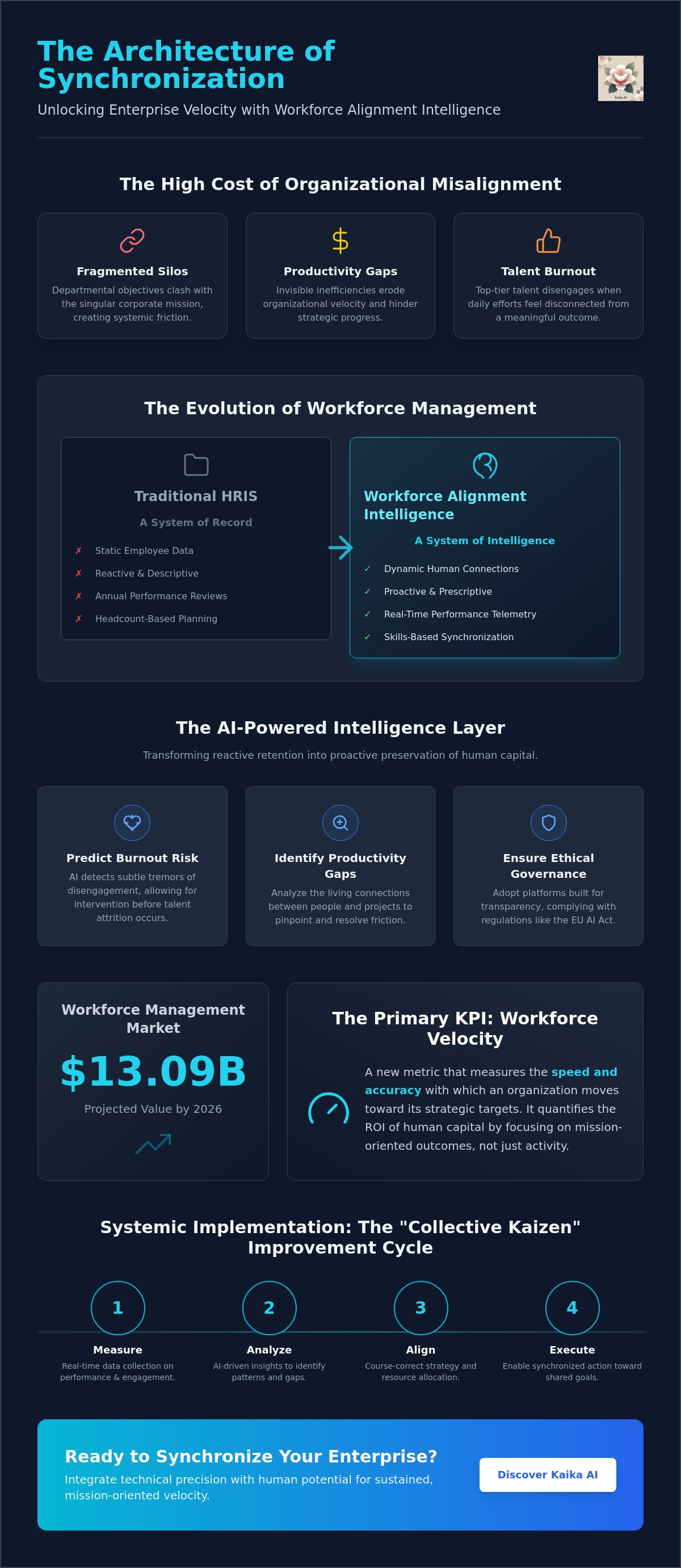
The distinction between traditional Human Resource Information Systems (HRIS) and alignment platforms is fundamental. An HRIS is a system of record; it's a digital filing cabinet for payroll, benefits, and static employee data. In contrast, alignment platforms are systems of intelligence. They don't just store data; they analyze the living connections between people, projects, and performance. By 2026, the traditional annual performance review has become an architectural liability. Leaders now require real-time telemetry to maintain Strategic alignment, allowing for immediate course corrections before small deviations become systemic failures.
Beyond HR Analytics: The Intelligence Layer
Traditional analytics are descriptive, merely telling you what happened last quarter. Workforce alignment intelligence is prescriptive. It utilizes advanced monitoring to identify where individual employee purpose intersects with the corporate mission architecture. When these two forces align, productivity is no longer a forced output but a natural byproduct of engagement. This dynamic synergy monitoring replaces static goal-tracking, allowing leadership to see how effectively teams are collaborating toward high-stakes outcomes. It's about moving from a reactive posture to a proactive, visionary stance that anticipates needs before they manifest as crises.
The ROI of Organizational Synergy
The cost of misalignment is often invisible but always catastrophic. It manifests in lost velocity, departmental friction, and high attrition rates within global divisions. By implementing workforce alignment software, executives can finally quantify the ROI of human capital through a primary KPI: Workforce Velocity. This metric measures the speed and accuracy with which an organization moves toward its strategic targets. Reducing cross-departmental friction through better alignment doesn't just improve morale; it creates a lean, resilient structure capable of navigating the complexities of global scale with uncompromising precision and speed.
The Intelligence Layer: How AI Predicts Performance and Burnout Risk
High-performance cultures often walk a razor's edge between peak velocity and systemic collapse. In the current strategic climate, waiting for a high-value contributor to submit a resignation letter is a fundamental failure of leadership intelligence. Modern workforce alignment software integrates advanced machine learning to transform reactive retention into proactive preservation. It functions as a digital nervous system, detecting the subtle tremors of disengagement before they manifest as attrition. This isn't about intrusive surveillance; it's about maintaining the architectural integrity of the human capital that drives the enterprise.
The regulatory landscape is also evolving to meet these technological shifts. With the EU AI Act classifying worker management systems as high-risk, organizations must adopt platforms that prioritize transparency and ethical data governance. By focusing on the intersection of technology and human behavior, leaders can move beyond the limitations of legacy HR systems. This transition ensures that the organization remains resilient, even as global market demands intensify.
Burnout Prediction: The Early Warning System
Effective strategic workforce planning now requires a sophisticated understanding of cognitive load and emotional stamina. AI models analyze nuanced shifts in communication patterns, task completion velocity, and collaborative engagement to identify burnout markers. When the system detects these patterns, it triggers a strategic pivot. Instead of the traditional, futile exit interview, leadership can deploy targeted Operational Resilience Training. This approach preserves the individual's well-being while maintaining mission-critical momentum. Data serves as a bridge for growth rather than a tool for punitive oversight.
Productivity Metrics in the Age of AI
We must redefine productivity for the modern era. Raw hours worked are a legacy metric that fails to capture true value in a knowledge-driven economy. Modern intelligence layers view productivity as alignment-adjusted output. This perspective accounts for how well an individual's efforts synchronize with the broader mission architecture. It's particularly vital for measuring internal synergy in hybrid environments where physical proximity no longer serves as a proxy for collaboration. By utilizing real-time statistics, teams can engage in Collective Kaizen, a state of continuous, data-driven refinement. This ensures the enterprise remains a synchronized, high-velocity entity. If your current systems lack this predictive depth, consider an Alignment Audit to identify latent risks in your organizational structure.
Evaluating Enterprise Alignment Platforms: A Strategic Selection Framework
Selecting workforce alignment software is an exercise in architectural foresight rather than a standard procurement task. For the executive leadership team, the stakes involve the very pulse of the enterprise's operational velocity. A common pitfall is treating this selection as a simple "software installation" intended to check a box for HR analytics. In reality, the most successful global organizations seek "Strategic Integration." This approach recognizes that the software must serve as a living intelligence layer, one that is capable of translating abstract corporate values into measurable, synchronized outcomes. You must distinguish between platforms that offer a chaotic bundle of features and those built upon a disciplined, results-driven methodology.
The selection process should be guided by a rigorous criteria list that emphasizes structural impact over superficial trends:
- Structural Compatibility: Does the platform architecture map naturally to your existing global divisions and departmental silos?
- Intelligence Depth: Can the system provide prescriptive insights that drive decision-making, or does it merely offer descriptive charts of past failures?
- Ethical Alignment: Does the AI framework respect the delicate balance between high-performance expectations and human potential?
Security and Privacy: The Enterprise Mandate
Privacy standards in Japan, particularly following the 2026 amendments to the Act on the Protection of Personal Information (APPI), represent the current global gold standard for human capital data. These regulations demand enhanced transparency for biometric data and strict rules for third-party transfers, making them essential for cloud-based vendors. When evaluating workforce alignment software, prioritize platforms that utilize advanced data anonymization. This ensures that sentiment analysis remains focused on systemic health rather than individual surveillance. Establishing this trust requires an initial Executive Consultation to ensure the platform’s security architecture aligns with both legal mandates and institutional ethics.
Methodology vs. Features: The Three-Phase Integration
A feature-heavy tool without a guiding methodology is a liability. Sophisticated leaders prioritize platforms that propose a comprehensive framework for evolution. This usually manifests as a three-phase structural journey: diagnostic realization, technical synchronization, and operational resilience. We recommend that an Alignment Audit always precedes technical implementation. This audit exposes the invisible friction points that traditional surveys miss. By identifying these gaps early, the subsequent implementation of a Workforce Alignment Intelligence Platform becomes a catalyst for Collective Kaizen, transforming the organization through a systematic, data-driven cycle of improvement.
Systemic Implementation: Moving from Strategy to Collective Kaizen
Transformation begins when strategy ceases to be a static document and becomes a living pulse within the organization. Systemic implementation of workforce alignment software demands a fundamental shift in the executive leadership mindset. It requires moving from a legacy command-and-control posture to one of architectural synchronization. Leaders must view the enterprise not as a rigid hierarchy but as a high-velocity system where every node must be perfectly tuned to the mission's frequency. This transition is anchored in the concept of Collective Kaizen. It's a continuous, data-driven improvement cycle that utilizes real-time intelligence to refine organizational structures. By treating alignment as a dynamic state rather than a one-time goal, the enterprise builds the capacity for perpetual evolution.
Phase 1: The Alignment Audit
The journey toward synchronization starts with a Mission-Critical Alignment Audit. This diagnostic phase identifies the invisible gaps between high-level strategic intent and the operational reality within specialized global divisions. We don't just look at output; we map individual employee purpose against corporate objectives to discover where structural friction resides. This isn't a passive survey. It's an intensive architectural review of your human capital. During the Executive Consultation phase, we establish the foundation for your workforce alignment software, ensuring that the intelligence layer is calibrated to your specific institutional goals. Without this initial clarity, technical implementation risks merely automating existing dysfunctions rather than solving them. We ensure the system is built to support your unique mission architecture from day one.
Phase 2 & 3: Velocity and Resilience
Once the structural foundation is secure, the focus shifts to velocity and resilience. Real-time dashboards provide team leads and department heads with the telemetry needed to maintain alignment in a volatile market. However, data alone is insufficient for long-term success. We integrate Operational Resilience Training to ensure that high performance is sustainable and doesn't lead to the burnout patterns that erode institutional memory. The process culminates in iterative workshops where team members engage in the structural refinement of their own workflows. These sessions turn raw data into permanent structural excellence by empowering employees to close the gap between their daily tasks and the organization's primary mission. To begin this transformation, your leadership team can engage in Collective Kaizen Workshops to turn raw intelligence into a synchronized competitive advantage.
Kaika AI: The Future of Workforce Alignment Intelligence
Kaika AI isn't simply a software vendor; it's the definitive partner for global enterprises seeking to bridge the gap between abstract strategy and operational reality. By positioning itself at the intersection of high-tech enterprise terminology and deep organizational psychology, the Kaika Workforce Alignment Intelligence Platform provides a level of structural insight that generic HR tools cannot replicate. This is where the Bold Innovator meets the Strategic Sage. We don't just offer a service. We propose a comprehensive framework for the evolution of human potential within the modern corporation. Our workforce alignment software acts as the central nervous system for your organization, ensuring that every individual's purpose is perfectly synchronized with the collective mission.
The Kaika Methodology: Built for Global Scale
The strength of our approach lies in a disciplined, three-phase integration methodology that moves beyond simple software deployment. We recognize that technical tools are only as effective as the strategic foundation they inhabit. This is why our process begins with a Mission Critical Alignment Audit to expose latent friction points and invisible productivity gaps. Unlike standard procurement cycles, we prioritize Executive-Level Architectural Consultations to ensure the platform’s logic mirrors your institutional hierarchy. This methodical progression ensures that the intelligence layer we install is both futuristic in its capabilities and grounded in established management principles. It's a journey from diagnostic realization to sustained, mission-oriented velocity.
Join the Evolution: Request Early Access
Achieving true operational resilience in a volatile market requires more than just reactive adjustments. It demands a proactive commitment to organizational harmony and data-driven precision. As we navigate the complexities of 2026, the distinction between high-velocity enterprises and those burdened by fragmentation has never been clearer. Kaika AI offers an exclusive opportunity for visionary leaders to secure a competitive advantage through early access to our workforce alignment software. This isn't just an upgrade to your existing tech stack; it's a strategic move toward a more resilient, synchronized future. The stakes are high, and the window for this level of structural transformation is narrow. We invite you to Synchronize your workforce with Kaika AI today and lead your organization toward its highest potential.
Architecting the Synchronized Enterprise
The transition from fragmented departmental silos to a unified organizational velocity is no longer a strategic option; it's an existential necessity for global leadership. We've analyzed how modern workforce alignment software serves as the essential intelligence layer required to bridge the gap between high-level strategic intent and daily operational performance. By integrating real-time burnout prediction and productivity metrics, you can finally safeguard your human capital while maintaining an uncompromising focus on excellence. This evolution demands a disciplined, three-phase strategic integration methodology that prioritizes structural integrity over superficial features.
Adhering to the most rigorous global benchmarks, such as high-level Japanese privacy standards, ensures your data governance remains as resilient as your workforce. It's time to move beyond descriptive analytics and embrace a prescriptive framework that fosters Collective Kaizen across every division. The future of enterprise leadership belongs to those who treat alignment as a dynamic, living system. We invite you to Request Early Access to the Kaika AI Workforce Alignment Platform and begin your transformation today. Your journey toward a synchronized, high-velocity future starts with this single, strategic step.
Frequently Asked Questions
What is the primary difference between workforce alignment software and traditional HR analytics?
Workforce alignment software functions as a proactive system of intelligence rather than a mere system of record. While traditional HR analytics provide descriptive, historical summaries of past events, alignment platforms offer prescriptive insights that synchronize individual employee purpose with the broader corporate mission architecture. This shift allows executive leadership to move beyond static reporting toward real-time operational synchronization and systematic excellence.
How does AI predict employee burnout without violating privacy?
AI models identify burnout patterns through the analysis of anonymized metadata and aggregate communication rhythms rather than individual surveillance. By focusing on systemic health markers and cognitive load trends, the platform maintains institutional integrity while adhering to the 2026 amendments of Japan's Act on the Protection of Personal Information. This methodology ensures predictive accuracy without compromising the ethical boundaries of employee privacy or psychological safety.
Can workforce alignment platforms integrate with existing ERP or HRIS systems?
Seamless integration with existing ERP and HRIS systems is a core architectural requirement for modern workforce alignment software. The platform serves as a strategic intelligence layer that pulls data from these legacy systems of record to provide a unified, synchronized view of organizational health. This connectivity ensures that the new intelligence layer enhances your current infrastructure without requiring a total system replacement.
What are the three phases of strategic workforce integration?
The strategic workforce integration framework follows a disciplined, three-phase methodology: diagnostic realization, technical synchronization, and operational resilience. The process begins with an Alignment Audit to identify invisible friction points; it's followed by the deployment of real-time dashboards and culminates in sustained performance training. This architectural progression ensures that the synchronization of your enterprise is both systematic and cumulative.
How does aligning employee purpose with organizational goals impact the bottom line?
Synchronizing individual purpose with organizational goals directly accelerates Workforce Velocity, reducing the hidden costs of departmental friction and high-talent attrition. When human capital is architecturally aligned, organizations realize a clear ROI through increased operational precision and faster execution of high-stakes strategic initiatives. This synergy transforms fragmented effort into a measurable competitive advantage that shows up in the final fiscal report.
What security standards should I look for in an enterprise workforce intelligence platform?
Executives should prioritize platforms that meet the global gold standard of Japanese privacy regulations and SOC2 compliance. As the EU AI Act classifies worker management systems as high-risk, look for architectures that emphasize data anonymization and transparent algorithmic governance. These standards ensure that your workforce alignment software remains secure, ethical, and legally resilient in an increasingly complex global regulatory landscape.
How long does a typical Workforce Alignment Audit take for a global enterprise?
For a global enterprise, a comprehensive Alignment Audit typically spans four to eight weeks depending on the complexity of the organizational structure and the number of specialized divisions. This period allows for a thorough diagnostic of mission-alignment gaps and the completion of necessary executive consultations. The result is a precise architectural foundation that informs every subsequent phase of your systematic implementation.
What is Workforce Velocity and why is it a critical KPI in 2026?
Workforce Velocity is a primary KPI that measures the speed and accuracy with which an organization moves toward its strategic objectives. In the high-stakes environment of 2026, it serves as a critical indicator of organizational health, moving beyond raw productivity metrics to measure true mission-driven momentum. High velocity indicates a synchronized enterprise where every individual effort is perfectly tuned to the corporate mission frequency.
Disclaimer
#Disclaimer
At Kaika AI, we believe the future belongs to organizations that combine human wisdom with artificial intelligence responsibly. The articles, research, insights, and thought leadership published on this website are intended to educate, inform, and encourage meaningful conversations about the future of work, organizational intelligence, AI, leadership, and innovation.
While our content is developed through rigorous research and may be generated, curated, or enhanced using artificial intelligence, every effort is made to ensure it reflects thoughtful analysis, practical relevance, and responsible AI practices. However, no representation or warranty is made regarding the completeness, accuracy, or suitability of the information for every individual or organizational circumstance.
The ideas, opinions, frameworks, and recommendations shared by Kaika AI are provided for educational and informational purposes only. They should not be interpreted as legal, financial, medical, psychological, human resources, cybersecurity, or other professional advice. Organizations and individuals should seek qualified professional guidance before making strategic, legal, or operational decisions.
Where articles reference third-party organizations, products, services, academic research, industry reports, or public data, such references are provided solely to support discussion and analysis. Unless explicitly stated, they do not imply endorsement, partnership, or affiliation.
Artificial intelligence is a powerful decision-support technology—not a replacement for human judgment. Kaika AI advocates for responsible, transparent, and human-centered AI adoption. We encourage readers to critically evaluate information, consider their unique context, and combine AI-generated insights with professional expertise and sound decision-making.
The content published on this website may be updated, revised, or removed as knowledge, technology, regulations, and best practices continue to evolve.
To the fullest extent permitted by applicable law, Kaika AI, its affiliates, contributors, and partners disclaim liability for any direct, indirect, incidental, consequential, or other losses arising from the use of, or reliance upon, the information provided on this website.
By accessing or using this website, you acknowledge that you have read, understood, and agree to this Disclaimer.
Kaika AI
'Building trusted organizational intelligence for the AI Era'


