
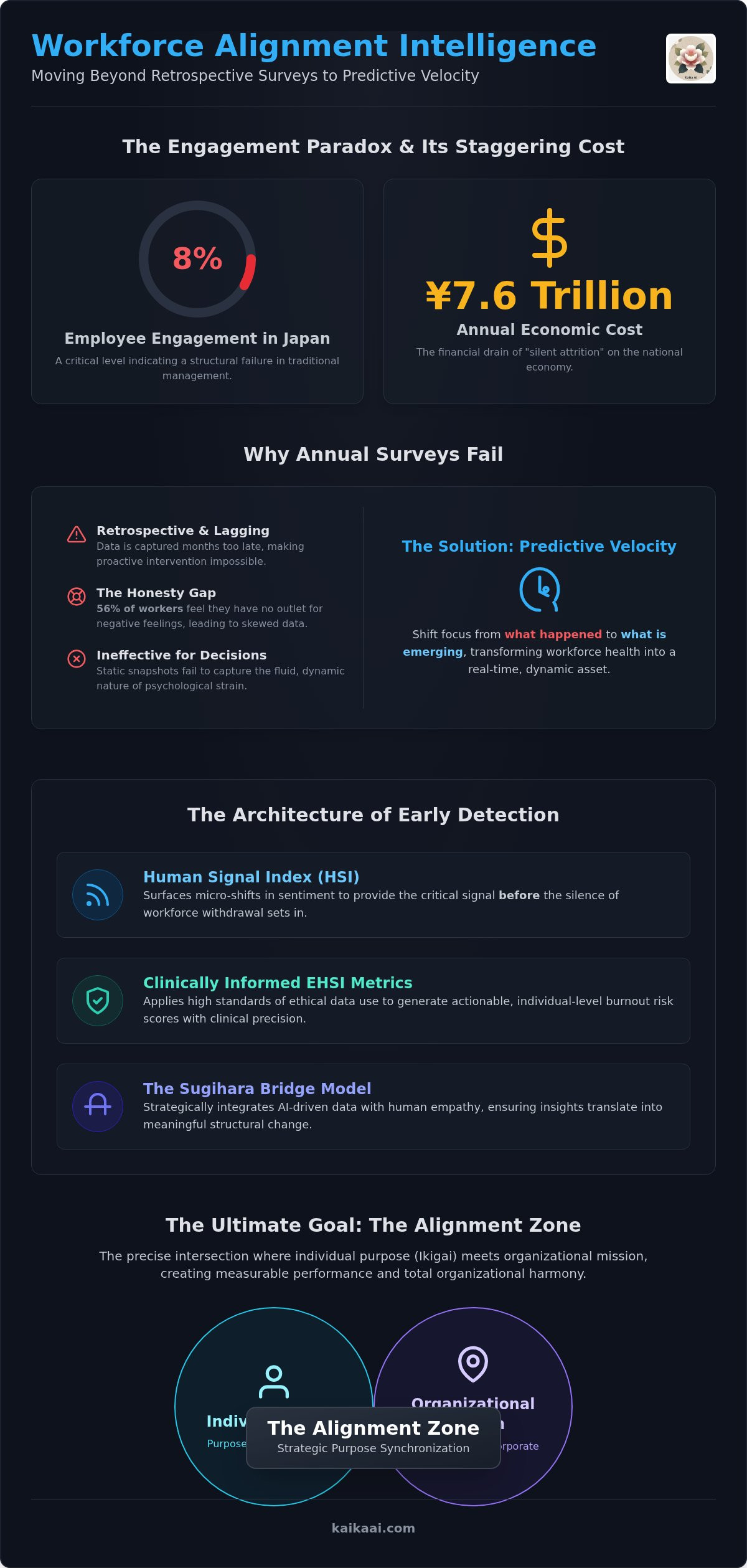
While daily stress levels have marginally declined, employee engagement in Japan remains stagnant at a critical 8%. This engagement paradox reveals a structural failure in traditional management; compliance-based measures identify distress but fail to cultivate purpose. You understand the high stakes of silent attrition. It's a quiet drain on organizational velocity that costs the economy ¥7.6 trillion each year. Most executive leaders realize that annual surveys provide only a distorted, retrospective view of workforce health.
Modern leadership requires more than retrospective data points. By implementing sophisticated workplace stress analytics, you gain real-time visibility into the invisible currents of burnout. This article explores how predictive intelligence surfaces human truth before it manifests as institutional turnover. We'll outline a framework for aligning individual Ikigai with corporate mission, transforming workforce health from a vague sentiment into a measurable driver of performance. You'll learn to move beyond clinical symptom tracking toward a model of total organizational harmony that pairs technical intelligence with strategic human consulting.
Key Takeaways
- Move beyond retrospective annual surveys by adopting predictive velocity to identify silent attrition before top talent disengages.
- Utilize the Human Signal Index (HSI) to surface micro-shifts in sentiment, providing the necessary signal before the silence of workforce withdrawal.
- Apply clinically informed EHSI metrics to maintain high standards of ethical data use while securing actionable burnout risk scores at the individual level.
- Integrate AI measurement with human empathy through the Sugihara Bridge Model to ensure data insights lead to meaningful structural change.
- Implement advanced workplace stress analytics to synchronize individual Ikigai with organizational missions, driving measurable operational resilience and performance.
The Evolution of Workforce Intelligence: Beyond Reactive Surveys
Traditional enterprise systems often mistake historical reporting for strategic foresight. Most HR departments rely on data that is fundamentally retrospective, capturing employee sentiment weeks or months after the initial friction occurs. This delay creates a dangerous latency in leadership response. Modern workplace stress analytics prioritize predictive velocity, transforming workforce health from a static report into a dynamic operational asset. By shifting the focus from what happened to what is emerging, leaders can protect their most valuable human capital before disengagement takes root.
True resilience exists within the "Alignment Zone." This is the precise intersection where individual purpose meets organizational mission. When these elements drift apart, the resulting friction manifests as job strain, a condition that degrades both cognitive performance and systemic health. For the CHRO, the most perilous metric isn't a low satisfaction score; it's the silence of disengaged employees who have ceased to provide feedback. This "silent attrition" represents a complete withdrawal from the organizational narrative, making it nearly impossible to rectify without advanced intelligence.
To better understand the physiological and psychological nuances of how we process pressure, watch this insightful presentation:
The Failure of Annual Engagement Surveys
Annual surveys suffer from a persistent honesty gap that renders them largely ineffective for high-stakes decision making. Research indicates that while 56% of workers feel their workplace offers no outlet for negative feelings, many remain hesitant to share truths in formal, non-anonymous settings. Static data points fail to capture the fluid nature of psychological strain. A snapshot taken in October cannot predict a burnout crisis in December. Organizations need continuous workforce alignment intelligence to replace these rigid, antiquated feedback loops with fluid measurement systems that respect the dynamic reality of the modern workplace.
Defining Workforce Alignment Intelligence
Leaders must move beyond the superficiality of "employee satisfaction" toward "Strategic Purpose Synchronization." This evolution requires a sophisticated blend of AI and organizational psychology. By surfacing behavioral patterns that precede disengagement, workplace stress analytics allow leaders to intervene before attrition becomes inevitable. The Ikigai Intelligence Framework (IIF) represents a new category of enterprise software designed for this purpose. It treats human potential as an architectural priority, ensuring that every individual's daily effort contributes to a larger, shared vision of excellence and institutional reliability.
Surfacing the Human Signal Index (HSI): The Architecture of Early Detection
The Human Signal Index (HSI) serves as the architectural foundation for early detection in modern governance. While traditional productivity metrics focus on output, HSI surfaces the underlying human truth that dictates long-term systemic stability. It identifies micro-shifts in sentiment that precede macro-level failures. By deploying sophisticated workplace stress analytics, leadership can recognize these patterns before they crystallize into silent attrition. This transition from reactive observation to predictive intelligence is essential for maintaining operational resilience in large-scale enterprises.
Understanding these leading indicators of employee burnout allows executives to move beyond the limitations of visible behavioral changes. Often, by the time a manager notices irritability or withdrawal, the psychological strain has already compromised the employee's alignment with the corporate mission. The integration of workplace stress analytics into existing management frameworks provides the strategic velocity needed to address these challenges before they impact the bottom line.
Identifying Behavioral and Sentiment Signals
Disengagement rarely happens overnight. It begins with subtle changes in communication velocity and sentiment intensity. Advanced AI models distinguish between healthy, high-velocity performance and the high-risk strain that leads to exhaustion. While OSHA guidance on workplace stress provides a baseline for identifying physical and environmental hazards, HSI penetrates deeper into the psychological fabric of the workforce. It enables leaders to hear the signal before the silence of withdrawal occurs, ensuring that the organizational narrative remains inclusive and transparent.
The Economic Impact of Early Detection
The financial implications of undetected stress are staggering. In Japan alone, presenteeism accounts for ¥7.3 trillion in annual productivity losses, far outweighing the cost of absenteeism. Early-signal detection provides a direct ROI by preventing turnover in specialized divisions where replacement costs are highest. HSI data does not just track risk; it informs high-level architectural consultations that restructure work flows for maximum harmony. Our pilot programs demonstrate the efficacy of this approach by achieving high levels of transparency and engagement.
- Identify micro-shifts in sentiment before they escalate into systemic turnover.
- Reduce the ¥7.3 trillion burden of presenteeism through proactive intervention.
- Enhance organizational transparency with an 87% employee honesty rate.
- Align individual purpose with corporate strategy to secure long-term performance.
Leaders who prioritize these insights can effectively bridge the gap between individual purpose and corporate strategy through a professional Workforce Alignment Intelligence Platform.
Clinical Precision in Corporate Governance: The EHSI Framework
Corporate governance requires a level of precision that traditional HR tools simply cannot provide. While medical diagnostics offer deep psychological insights, they remain impractical for daily enterprise monitoring. The Employee Human Signal Index (EHSI) bridges this gap by providing a clinically informed metric designed for the speed of modern business. By integrating workplace stress analytics into the core of corporate oversight, leadership can measure psychological stamina and operational resilience at scale. This framework does not just identify problems; it provides a structural methodology for maintaining institutional health.
Our collaboration with clinical psychologists ensures that every data point reflects a responsible understanding of human behavior. This partnership transforms raw data into actionable intelligence, allowing executives to monitor workforce resilience metrics with confidence. In an era where the U.S. Surgeon General emphasizes Workplace Mental Health & Well-Being as a critical priority, organizations must adopt tools that offer both clinical depth and strategic utility. The EHSI framework provides the necessary rigor to treat workforce health as a foundational pillar of enterprise risk management.
Ethical Data Use and Psychological Safety
Trust is the currency of any successful alignment strategy. We've engineered the EHSI framework to meet stringent Japanese and global privacy standards, ensuring that enterprise-grade security protects every individual signal. Clinical oversight is not a secondary feature; it's a primary safeguard. It prevents the misuse of data and ensures that burnout risk factors are addressed through supportive intervention rather than punitive action. Maintaining this transparency between leadership and the workforce is essential. When employees feel safe, honesty rates rise. Our pilot results confirm this, showing an 87% honesty rate among participants who trust the system's integrity.
From Individual Strain to Collective Resilience
Individual metrics gain their true power when aggregated to reveal systemic patterns. By analyzing EHSI data across departments, leadership can identify "hot zones" where structural friction is highest. This allows for targeted intervention without compromising individual privacy. These insights directly inform Operational Resilience Training, ensuring that resources are deployed where they can have the most significant impact. This approach supports a broader AI for organizational health strategy. It moves the organization away from reactive firefighting toward a model of continuous, systemic synchronization. You aren't just managing stress; you're architecting a culture of sustainable high performance.
The Sugihara Bridge Model: Strategic Integration of AI and Human Judgment
Technology alone cannot solve the complexities of human disengagement. While AI provides the necessary speed and scale to process vast datasets, human consultants provide the essential context and empathy required for strategic intervention. The Sugihara Bridge Model represents this synthesis, serving as a hybrid framework that pairs high-velocity workplace stress analytics with seasoned executive wisdom. This approach ensures that sensitive workforce signals receive rigorous human interpretation before any executive action occurs, respecting the cultural nuances inherent in both Japanese and global corporate environments.
Relying solely on automated reporting risks creating a clinical distance between leadership and the workforce. By integrating human judgment into the analytical loop, organizations can move from mere observation to meaningful synchronization. This three-phase methodology transforms raw data into a comprehensive framework for organizational evolution, ensuring that technology serves the human mission rather than the other way around.
Phase 1: The Alignment Audit
The process begins with an intensive Alignment Audit designed to identify the individual-to-organization purpose gap. This phase establishes the baseline for the Ikigai Alignment Score (IAS), providing a clear architectural view of current systemic health. We don't just look for stress; we look for the friction points where cross-departmental synergy has broken down. Identifying these mission-critical gaps early allows for a more focused application of resources during the integration phase.
Phase 2: Real-Time Intelligence Integration
Once the baseline is established, we deploy the AI-powered workforce alignment platform to provide continuous monitoring. This isn't a static tool but a dynamic intelligence layer that establishes immediate feedback loops between the Ikigai Intelligence Framework (IIF) and leadership dashboards. A core component of this phase involves training internal stakeholders on the "Signal-First" mindset. By utilizing workplace stress analytics in real-time, managers learn to recognize the subtle shifts in sentiment that precede organizational drift, allowing for micro-adjustments before problems escalate.
Phase 3: Collective Kaizen and Structural Evolution
The final phase focuses on long-term systemic health through Collective Kaizen Workshops. These data-driven sessions address the specific friction points identified by the HSI and IAS metrics. We refine the organizational architecture based on continuous feedback, ensuring that structural changes are grounded in human truth. This methodical evolution connects every finding to broader continuous performance management software goals, creating a culture where resilience and excellence are engineered into the daily workflow.
Discover how this hybrid intelligence model can stabilize your organization by requesting a comprehensive Alignment Audit today.
Hearing the Signal: Why Kaika AI is the Definitive Alignment Platform
Kaika AI represents the synthesis of philosophical depth and technical precision. While many tools attempt to track exhaustion through surface-level metrics, our platform architecturally addresses the systemic root of disengagement. By merging the principles of Ikigai with high-velocity workplace stress analytics, we provide executive leadership with a comprehensive framework for total organizational synchronization. We don't just identify risk; we surface the human truth that allows a CHRO to act with strategic confidence before talent departs. Our role is to serve as a visionary partner in your workforce transformation journey.
The modern enterprise requires more than a software provider; it needs a methodology for resilience. We've designed our platform to bridge the gap between individual potential and institutional goals. This alignment is the only sustainable way to maintain performance in a high-stakes global economy. By choosing a platform grounded in both data and human purpose, you're investing in the long-term structural integrity of your organization.
The Ikigai Advantage
Peak performance isn't a byproduct of pressure; it's the result of alignment. When an employee's work sits at the intersection of their skills, their passions, and the organization's mission, they enter a state of sustainable excellence. Alignment-driven organizations consistently outperform their peers because they've eliminated the internal friction that drains cognitive energy and leads to burnout. By synchronizing individual purpose with corporate goals, you transform the workplace from a site of potential strain into a hub of collective resilience. This synchronization ensures that every micro-action contributes to the macro-velocity of the enterprise.
Securing Early Access to Workforce Intelligence
The transition from reactive stress management to proactive workforce alignment requires a partner invested in institutional stability. Our pilot programs in Tokyo have already demonstrated the power of this approach, achieving an NPS of 72 and an 87% employee honesty rate. These results aren't accidental; they're the product of rigorous data validation through partnerships with Waseda University and Tokyo Innovation Base (TiB). We ensure that every signal we surface is grounded in academic and technical rigor.
As we work toward our vision of a dual TSE/ASX listing by 2032, we remain focused on building the trust necessary for global enterprise scale. This vision ensures that Kaika AI remains a reliable pillar of your corporate governance strategy for decades to come. We invite you to join the next phase of workforce alignment software evolution and secure the future of your human capital. By acting now, you position your organization as a leader in the new era of purpose-driven performance.
Architecting the Future of Workforce Resilience
Predictive intelligence represents the final frontier of corporate governance. By replacing retrospective surveys with high-velocity workplace stress analytics, leadership can finally address the structural root causes of silent attrition. The integration of the Ikigai Intelligence Framework ensures that individual purpose and organizational mission move in perfect synchronization. This approach has already demonstrated significant impact through our pilot programs, achieving an 87% employee honesty rate and a participant NPS of 72. Our strategic partnerships with Waseda University and Tokyo Innovation Base continue to validate the scientific rigor behind our methodology.
The transition from reactive management to proactive synchronization is no longer optional for global enterprises. Organizations that prioritize human truth through the Sugihara Bridge Model will secure a definitive competitive advantage in the new era of performance. It is time to move beyond the silence of disengagement and build a culture of operational resilience and shared purpose. We invite you to lead this evolution. Request early access to the Kaika AI Workforce Alignment Platform and begin your journey toward total organizational harmony today.
Frequently Asked Questions
What is workplace stress analytics and how does it differ from traditional HR tools?
Workplace stress analytics represents a strategic shift from retrospective reporting to predictive intelligence. Traditional HR tools often rely on static annual surveys that capture data after disengagement has already occurred. In contrast, our platform provides real-time visibility into the invisible currents of burnout and sentiment. This architectural approach surfaces the human truth beneath productivity metrics, allowing leaders to act with strategic velocity before friction leads to systemic turnover or silent attrition.
How does Kaika AI ensure employee privacy while tracking burnout signals?
We maintain enterprise-grade security compliant with stringent Japanese privacy standards to protect all individual workforce signals. The system focuses on surfacing aggregate trends and high-risk signals rather than invasive individual monitoring. By ensuring transparency and psychological safety, we've achieved an 87% honesty rate in our pilot programs. This ethical framework builds institutional trust, ensuring that data serves as a bridge for alignment rather than a tool for surveillance.
What is the Ikigai Alignment Score (IAS) and why is it important for retention?
The Ikigai Alignment Score (IAS) measures the precise synchronization between an individual's sense of purpose and the organization's mission. High retention rates depend on this structural harmony; when employees find meaning in their daily output, productivity rises and attrition falls. The IAS identifies gaps in this alignment before they manifest as disengagement. By monitoring this metric, CHROs can architect a culture where personal fulfillment and corporate excellence are inextricably linked.
Can workplace stress analytics predict when an employee is likely to resign?
Yes, workplace stress analytics identifies the specific behavioral and sentiment micro-shifts that precede the silence of resignation. Our Human Signal Index (HSI) surfaces these early indicators, allowing management to intervene while there's still time to act. By detecting patterns of high-risk strain and purpose drift, the platform provides the predictive velocity needed to prevent silent attrition. This foresight transforms retention from a reactive struggle into a proactive operational strategy.
How does the Sugihara Bridge Model combine AI with human consulting?
The Sugihara Bridge Model is a hybrid architecture where AI provides speed and scale while human consultants provide context and empathy. AI-driven measurement identifies the signals of workforce friction, but these sensitive data points receive human interpretation before executive action occurs. This ensures that interventions are nuanced and culturally resonant. By pairing technical intelligence with seasoned strategic judgment, we bridge the gap between raw data and meaningful organizational evolution.
Is the Ikigai Intelligence Framework suitable for non-Japanese corporations?
While our framework is Japan-first in design, the universal principles of Ikigai apply to any global enterprise seeking operational resilience. The intersection of skill, passion, and mission is a fundamental driver of human potential worldwide. Our vision for a dual TSE/ASX listing by 2032 reflects our commitment to global institutional stability. The framework provides a scalable methodology for alignment that respects local cultural nuances while maintaining high standards of data-driven precision.
What clinical standards are used to develop the Employee Human Signal Index (EHSI)?
The Employee Human Signal Index (EHSI) is a clinically informed metric co-developed with clinical psychologists to ensure the responsible detection of psychological strain. Unlike generic engagement scores, the EHSI uses validated psychological risk factors to flag burnout before it reaches a critical stage. This clinical oversight ensures that workplace stress analytics remain ethical and accurate. It provides leaders with the rigor required to treat workforce health as a foundational architectural priority.
How quickly can an organization see results after implementing Kaika AI?
Organizations begin surfacing workforce truths immediately through the initial Alignment Audit phase of our methodology. This baseline assessment identifies mission-critical gaps in cross-departmental synergy and individual purpose synchronization within the first few weeks. As the platform integrates, real-time feedback loops provide continuous visibility into organizational health. Rapid identification of departmental hot zones allows leadership to execute data-driven Kaizen workshops, leading to measurable improvements in engagement and operational velocity.
Disclaimer
#Disclaimer
At Kaika AI, we believe the future belongs to organizations that combine human wisdom with artificial intelligence responsibly. The articles, research, insights, and thought leadership published on this website are intended to educate, inform, and encourage meaningful conversations about the future of work, organizational intelligence, AI, leadership, and innovation.
While our content is developed through rigorous research and may be generated, curated, or enhanced using artificial intelligence, every effort is made to ensure it reflects thoughtful analysis, practical relevance, and responsible AI practices. However, no representation or warranty is made regarding the completeness, accuracy, or suitability of the information for every individual or organizational circumstance.
The ideas, opinions, frameworks, and recommendations shared by Kaika AI are provided for educational and informational purposes only. They should not be interpreted as legal, financial, medical, psychological, human resources, cybersecurity, or other professional advice. Organizations and individuals should seek qualified professional guidance before making strategic, legal, or operational decisions.
Where articles reference third-party organizations, products, services, academic research, industry reports, or public data, such references are provided solely to support discussion and analysis. Unless explicitly stated, they do not imply endorsement, partnership, or affiliation.
Artificial intelligence is a powerful decision-support technology—not a replacement for human judgment. Kaika AI advocates for responsible, transparent, and human-centered AI adoption. We encourage readers to critically evaluate information, consider their unique context, and combine AI-generated insights with professional expertise and sound decision-making.
The content published on this website may be updated, revised, or removed as knowledge, technology, regulations, and best practices continue to evolve.
To the fullest extent permitted by applicable law, Kaika AI, its affiliates, contributors, and partners disclaim liability for any direct, indirect, incidental, consequential, or other losses arising from the use of, or reliance upon, the information provided on this website.
By accessing or using this website, you acknowledge that you have read, understood, and agree to this Disclaimer.
Kaika AI
'Building trusted organizational intelligence for the AI Era'


