
The most significant risk to your enterprise isn't a market shift; it's the silent attrition of top talent that occurs when leadership lacks structural visibility. You've likely felt the sting of an unexpected resignation from a key player who seemed perfectly aligned just weeks prior. Traditional annual reviews are static relics that provide lagging data, often arriving far too late to prevent burnout or mission drift. Transitioning to real-time employee performance tracking allows you to move past these snapshots and embrace a resilient, data-driven approach to workforce synchronization.
This guide demonstrates how real-time intelligence transforms performance management into a dynamic system of collective Kaizen. You'll learn to identify the subtle human signals of disengagement before they manifest as costly turnover. We'll examine the shift from surveillance to strategic alignment, showing you how to build a high-performance culture rooted in transparency and measurable ROI. You'll discover a framework for predictive burnout indexing that protects your human capital while ensuring every individual remains anchored to your organizational purpose.
Key Takeaways
- Shift from reactive annual reviews to proactive leading indicators that identify organizational drift and mission misalignment in their earliest stages.
- Implement real-time employee performance tracking to synchronize individual purpose with corporate objectives through the Ikigai Alignment Score (IAS).
- Detect the signal before the silence by identifying burnout and disengagement risks before they manifest as silent attrition among top-tier talent.
- Resolve the surveillance paradox by framing performance intelligence as a transparent tool for employee empowerment and structural resilience.
- Follow a structured five-phase implementation framework to scale workforce alignment intelligence across global divisions and foster a culture of Collective Kaizen.
The Evolution of Workforce Intelligence: Beyond Static Performance Reviews
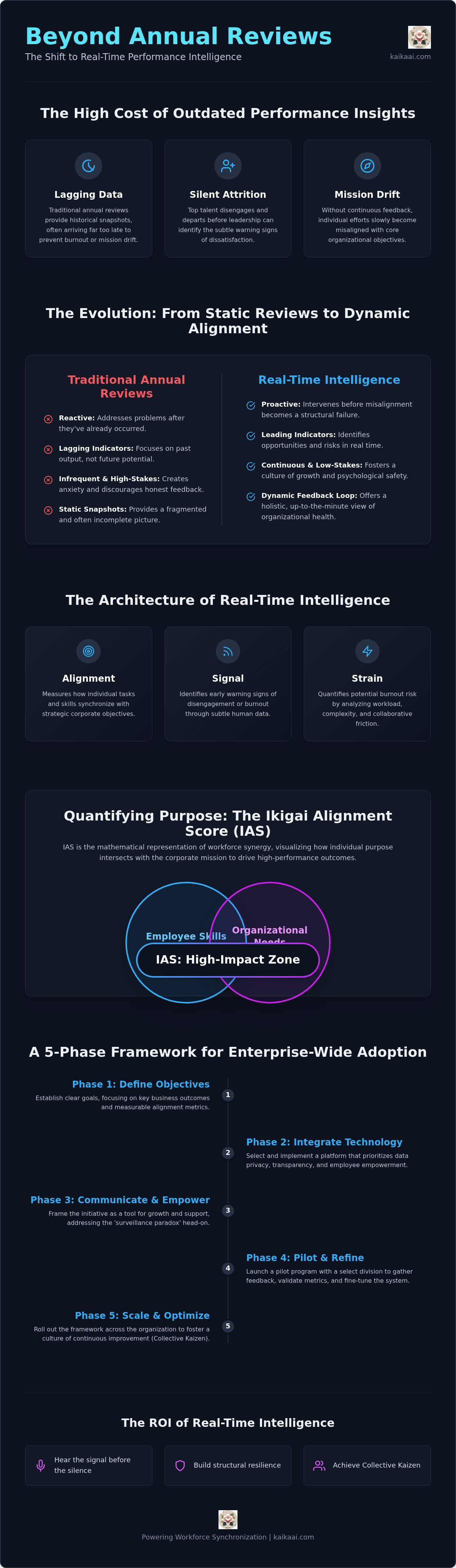
Real-time employee performance tracking is the architectural foundation of the modern, synchronized enterprise. It functions as a continuous feedback loop that captures the pulse of organizational health, moving beyond the fragmented, historical snapshots of the past. While traditional annual reviews rely on lagging indicators that document what has already occurred, real-time intelligence provides leading indicators. These signals allow executives to intervene before misalignment becomes a structural failure.
A historical employee monitoring overview reveals that past methods focused heavily on supervision and control. Modern intelligence, however, prioritizes structural alignment and human potential. This shift is essential for addressing silent attrition, the invisible disengagement of top-tier talent. When leadership lacks real-time visibility, the cost of this attrition manifests as lost velocity and diminished innovation long before the first resignation letter arrives. Workforce alignment is the ultimate driver of organizational speed; it ensures every individual's efforts are mathematically and philosophically synchronized with the corporate mission.
To better understand how these tracking mechanisms function in a practical setting, watch this helpful video:
Why Traditional Performance Metrics Fail in 2026
Static KPIs fail because they prioritize historical output over future potential. This focus creates blind spots in cross-departmental synergy, leaving leaders blind to the structural cracks forming within the workforce. High-stakes, infrequent evaluations often trigger anxiety rather than growth, causing top talent to feel like a metric rather than a mission-critical partner. When data is gathered only once a year, the resulting misalignment acts as friction, slowing the velocity of the entire enterprise and obscuring the path to collective excellence.
The Strategic Shift to Continuous Alignment
The transition to real-time employee performance tracking isn't about surveillance; it's about structural harmony. It transforms management from a policing function into a synchronization engine. AI intelligence now allows leaders to surface the human truth beneath operational data, identifying the subtle signals of strain or misalignment. This approach fosters a culture of collective Kaizen, where ongoing optimization becomes the standard. By aligning individual purpose with the corporate mission, organizations build a resilient architecture capable of sustaining high-stakes performance without the risk of burnout. Supporting this transition requires high digital proficiency, which is why achievewithnate.co.nz offers personalized digital confidence coaching and technology training.
The Architecture of Real-Time Tracking: Metrics that Matter
Modern performance intelligence requires a fundamental shift from measuring volume to measuring velocity and structural integrity. Executives must look beyond simple task completion to understand the underlying architecture of their workforce. This architecture rests on three critical pillars: Alignment, Signal, and Strain. While legacy tools focus on time-tracking and output, sophisticated real-time employee performance tracking surfaces the qualitative truths that drive long-term resilience and organizational harmony.
To move beyond surface-level metrics, leadership requires a framework that distinguishes between "busy work" and "mission-critical impact." This distinction is the difference between an organization that is merely functioning and one that is thriving. By quantifying the intersection of human potential and corporate objectives, you create a transparent environment where excellence is both visible and sustainable.
Measuring the Ikigai Alignment Score (IAS)
Purpose-mapping is no longer a soft concept; it's a strategic necessity that correlates directly with high-performance outcomes. By using AI to quantify the intersection of employee skill and organizational need, leaders ensure every contributor is positioned for maximum impact. IAS is the mathematical representation of workforce synergy. This metric allows leadership to visualize how individual aspirations fuel the collective mission, reducing the friction caused by misaligned roles and ensuring that talent remains anchored to the corporate purpose.
The Human Signal Index: Detecting Disengagement Early
The Human Signal Index (HSI) identifies behavioral patterns that precede disengagement, offering a "signal before the silence" of resignation. There is a profound difference between active work and aligned contribution. While an employee may appear productive on paper, their HSI might reveal a lack of resonance with the current project trajectory. Recent research on performance monitoring effects suggests that the methodology of data collection significantly impacts psychological safety and cognitive output. To truly optimize your team, you might consider an Alignment Audit to establish a baseline for these critical human signals.
EHSI and the Prevention of Structural Burnout
The Employee Human Signal Index (EHSI) focuses on strain, providing clinically informed insights into burnout risk at an individual level. Unlike traditional metrics that flag burnout only after performance drops, EHSI detects the subtle behavioral shifts that indicate exhaustion. This predictive capability allows for proactive intervention, protecting your most valuable human capital from the high-stakes pressure of global enterprise. By integrating these specific indices into your real-time employee performance tracking framework, you build a system that is both uncompromisingly focused on excellence and deeply committed to organizational harmony.
Addressing the Surveillance Paradox: Privacy vs. Empowerment
The primary barrier to adopting real-time employee performance tracking is the 'surveillance paradox.' Executives often fear that continuous visibility will be perceived as a 'Big Brother' intrusion, damaging the very culture they seek to optimize. This perception only holds true when tracking is used as a punitive tool. When implemented as a framework for empowerment, real-time intelligence provides employees with the transparency they need to own their growth and align their daily efforts with a larger purpose.
Trust is the currency of high-performance organizations. Kaika AI achieves an 87% employee honesty rate in pilot studies because the system is designed for mutual benefit, not one-sided oversight. By providing individuals with direct access to their own alignment data, the platform fosters a culture of self-synchronization. This transparency must be supported by enterprise-grade security and rigorous privacy compliance; it ensures that sensitive behavioral data remains protected and ethically managed at every level of the global enterprise.
The Ethics of AI in Performance Management
Responsible AI requires more than just technical precision; it demands a commitment to transparency and bias mitigation. In our framework, individual-level data is handled with clinical sensitivity. We don't just track output; we measure human state. This is why our burnout prediction models are developed in collaboration with clinical psychologists. These experts ensure that the algorithms detect the subtle signs of cognitive strain without infringing on personal privacy. By focusing on structural health rather than individual fault, leadership can intervene with empathy, transforming a potential crisis into an opportunity for operational resilience.
The Sugihara Bridge Model: Hybrid AI-Human Interpretation
AI is a powerful diagnostic tool, but it lacks the nuance of human empathy. The Sugihara Bridge Model serves as the essential link between data-driven insights and executive judgment. It ensures that sensitive workforce signals are never interpreted in a vacuum. By pairing real-time intelligence with human context, organizations build a more resilient trust architecture. This hybrid approach allows leaders to verify AI findings through direct engagement, ensuring that every strategic adjustment is grounded in both mathematical truth and human reality. It's not just about data; it's about building a sustainable bridge between technology and behavior.
Implementing a Real-Time Performance Framework in 5 Steps
Deploying a sophisticated intelligence system requires a methodical, phase-based approach to ensure structural integrity across the global enterprise. Real-time employee performance tracking isn't a plug-and-play utility; it is a fundamental evolution in how an organization synchronizes its human capital. Successful implementation moves through five distinct architectural phases, transitioning from baseline discovery to a self-optimizing culture of collective excellence. This progression ensures that the technology serves the mission rather than becoming a mere administrative burden.
- Phase 1: Architectural Consultation and Baseline Alignment Audit. Define the current state of organizational health and identify the structural gaps between executive vision and frontline execution.
- Phase 2: Integrating Real-Time Data Streams. Establish secure, continuous data feeds across all global divisions to provide a unified intelligence layer that captures behavioral and operational signals.
- Phase 3: Mindset Development for Leadership and Management. Equip executives with the psychological and analytical tools needed to interpret real-time signals without reverting to punitive management styles.
- Phase 4: Establishing Continuous Feedback Loops. Utilize the philosophy of Collective Kaizen to foster ongoing, incremental optimization where feedback becomes a catalyst for growth rather than a source of anxiety.
- Phase 5: Scaling Success and Measuring Attrition Reduction. Expand successful alignment models across the entire enterprise while quantifying the measurable ROI on talent retention and operational velocity.
Conducting a Mission-Critical Alignment Audit
The first step in any structural transformation is identifying the specific friction points between strategic intent and operational execution. A mission critical alignment audit serves as the diagnostic foundation for this entire process. It sets the baseline for workforce velocity and engagement, surfacing the invisible barriers that prevent top talent from reaching their full potential. Without this initial baseline, tracking becomes a directionless exercise in data collection rather than a strategic tool for organizational evolution.
Developing a Leadership Mindset for Data-Driven Growth
Technology provides the signal, but leadership provides the interpretation. Executives must be trained to hear the signal of workforce disengagement or burnout long before it manifests as silent attrition. Understanding workforce resilience metrics allows managers to shift from reactive firefighting to proactive workforce architecture. This mindset shift ensures that real-time employee performance tracking is used to empower teams, fostering a high-stakes environment that remains psychologically safe and sustainably productive. By focusing on the intersection of human truth and operational data, leaders can build an organization that is both disciplined and resilient.
To begin your organization's journey toward total synchronization, you should schedule a comprehensive Executive Consultation to map your specific alignment needs.
Kaika AI: Hearing the Signal Before the Silence
Kaika AI stands as the definitive category leader in Workforce Alignment Intelligence, offering a sophisticated response to the structural complexities of global enterprise scale. Our platform utilizes a Japan-first design grounded in the Ikigai philosophy to establish a seamless bridge between organizational necessity and individual fulfillment. This isn't merely a monitoring utility; it is a fundamental architecture for structural synchronization. By adopting the Ikigai Intelligence Framework, enterprises gain a dynamic system that transforms real-time employee performance tracking into a proactive catalyst for organizational harmony. This methodology allows leadership to hear the signal before the silence of disengagement, ensuring that mission-critical talent remains deeply anchored to the corporate purpose.
Strategic Partnerships and Academic Credibility
Academic rigor and institutional credibility are woven into the very fabric of our intelligence framework. Through our strategic partnership with Waseda University and our operational presence within the Tokyo Innovation Base, we maintain an uncompromising standard of data ethics and psychological precision. We prioritize the detection of leading indicators of employee burnout through our clinically informed EHSI index. This capability provides CHROs with the predictive insights required to protect their most valuable human capital assets. It represents a definitive shift from reactive crisis management to proactive workforce architecture, ensuring that every strategic intervention is grounded in both mathematical truth and clinical sensitivity.
Future-Proofing Your Organization for 2032 and Beyond
The resilient enterprise of 2032 requires a level of synchronization that legacy systems simply cannot provide. Our vision for a globally aligned workforce is supported by a strategic trajectory toward a dual listing on the Tokyo Stock Exchange (TSE) and the Australian Securities Exchange (ASX). This institutional expansion reflects our commitment to reliability, transparency, and global reach. Real-time employee performance tracking serves as the primary engine for this long-term operational resilience, providing the structural visibility necessary to navigate extreme market volatility. We're currently inviting a select cohort of forward-thinking CHROs and executive leaders to join our pilot program. This is your opportunity for early access to a framework that doesn't just measure output but proposes a comprehensive evolution for the modern leadership mindset.
For organizations that require this level of structural visibility in a physical command center environment, you can find out more about how Activu Corporation supports mission-critical control rooms with advanced visual intelligence.
Architecting a Resilient Path to Organizational Harmony
The transition from static, historical reviews to dynamic workforce intelligence represents a fundamental shift in the modern leadership mindset. By adopting real-time employee performance tracking, organizations replace lagging indicators with predictive signals that protect human capital and ensure mission alignment. This architectural evolution fosters a culture of collective Kaizen where transparency drives velocity rather than fear. It's a strategic move toward structural resilience that allows leaders to synchronize individual purpose with corporate objectives in an era of extreme market volatility.
Kaika AI provides the necessary framework to hear the signal before the silence of disengagement. Our platform utilizes clinically-informed burnout indices and has demonstrated an 87% employee honesty rate in pilot studies. These specific capabilities allow executives to reduce attrition through early-signal detection, ensuring that top-tier talent remains anchored to the organizational mission. It's time to move beyond the surveillance paradox and embrace a system built on mutual trust and measurable ROI. Your workforce is ready for the clarity that total alignment brings.
Request Early Access to the Kaika AI Workforce Alignment Platform and begin your journey toward total organizational synchronization today.
Frequently Asked Questions
Is real-time employee performance tracking ethical?
Yes, real-time employee performance tracking is ethical when its primary objective is workforce alignment rather than punitive surveillance. It empowers individuals by providing transparency into their own performance data. Our framework ensures that data serves the employee's growth journey. This trust-based design is why pilot programs have achieved an 87% employee honesty rate, transforming data collection into a collaborative effort for organizational harmony.
How does real-time tracking differ from traditional time-tracking software?
Real-time employee performance tracking measures the velocity of aligned contribution, while traditional software focuses on the raw volume of hours worked. Legacy tools prioritize attendance and task duration. Modern intelligence platforms analyze how deeply individual efforts resonate with the corporate mission. This shift allows executives to move from monitoring output to synchronizing high-impact talent with specific strategic objectives.
Can AI accurately predict employee burnout before it happens?
AI accurately predicts burnout by identifying the subtle behavioral shifts that precede clinical exhaustion. The Employee Human Signal Index (EHSI) utilizes clinically informed data to detect strain before it impacts operational output. This predictive capability allows leadership to intervene early, protecting human capital from the high-stakes pressure of global enterprise. It's about hearing the signal before the silence of disengagement occurs.
What is the Ikigai Alignment Score and how is it calculated?
The Ikigai Alignment Score (IAS) is a mathematical representation of workforce synergy. It's calculated by quantifying the intersection of an employee's specific skill set and the organization's strategic needs. This metric surfaces the human truth beneath operational data, helping leaders visualize how individual purpose fuels the collective mission. It serves as a diagnostic tool for identifying mission-fit and structural friction within the workforce.
How much time does it take to implement a real-time tracking platform?
Implementation follows a structured five-phase methodology that varies based on organizational scale. An initial Alignment Audit can provide baseline insights within days. However, full integration across global divisions typically requires a methodical rollout over several months. This architectural approach ensures that real-time data streams are securely established and that leadership mindsets are properly developed for data-driven growth and collective Kaizen.
What happens if the AI detects a high burnout risk in a specific department?
Detection of high burnout risk triggers a proactive intervention strategy rather than a punitive response. Leadership uses these insights to adjust workloads, re-align roles, or provide targeted support through Operational Resilience Training. This approach prevents silent attrition and maintains structural integrity. It ensures that departmental velocity remains sustainable without compromising the long-term health of the human capital involved.
How does the Sugihara Bridge Model ensure human judgment in AI data?
The Sugihara Bridge Model pairs AI-driven data with human executive judgment to prevent workforce signals from being interpreted in a vacuum. By requiring a human in the loop, the model ensures that strategic adjustments remain grounded in reality. This partnership between technology and behavior builds organizational resilience. It maintains the trust architecture necessary for high-performance cultures while avoiding the pitfalls of purely algorithmic decision-making.
Is Kaika AI compliant with international data privacy standards?
Compliance with international data privacy standards is a core architectural requirement of our platform. We utilize enterprise-grade security protocols to protect individual-level behavioral data at every stage of the intelligence cycle. Our framework prioritizes ethical data use and transparency, ensuring that sensitive signals are managed with clinical sensitivity. This commitment to privacy is essential for maintaining institutional reliability and global scale.
Disclaimer
#Disclaimer
At Kaika AI, we believe the future belongs to organizations that combine human wisdom with artificial intelligence responsibly. The articles, research, insights, and thought leadership published on this website are intended to educate, inform, and encourage meaningful conversations about the future of work, organizational intelligence, AI, leadership, and innovation.
While our content is developed through rigorous research and may be generated, curated, or enhanced using artificial intelligence, every effort is made to ensure it reflects thoughtful analysis, practical relevance, and responsible AI practices. However, no representation or warranty is made regarding the completeness, accuracy, or suitability of the information for every individual or organizational circumstance.
The ideas, opinions, frameworks, and recommendations shared by Kaika AI are provided for educational and informational purposes only. They should not be interpreted as legal, financial, medical, psychological, human resources, cybersecurity, or other professional advice. Organizations and individuals should seek qualified professional guidance before making strategic, legal, or operational decisions.
Where articles reference third-party organizations, products, services, academic research, industry reports, or public data, such references are provided solely to support discussion and analysis. Unless explicitly stated, they do not imply endorsement, partnership, or affiliation.
Artificial intelligence is a powerful decision-support technology—not a replacement for human judgment. Kaika AI advocates for responsible, transparent, and human-centered AI adoption. We encourage readers to critically evaluate information, consider their unique context, and combine AI-generated insights with professional expertise and sound decision-making.
The content published on this website may be updated, revised, or removed as knowledge, technology, regulations, and best practices continue to evolve.
To the fullest extent permitted by applicable law, Kaika AI, its affiliates, contributors, and partners disclaim liability for any direct, indirect, incidental, consequential, or other losses arising from the use of, or reliance upon, the information provided on this website.
By accessing or using this website, you acknowledge that you have read, understood, and agree to this Disclaimer.
Kaika AI
'Building trusted organizational intelligence for the AI Era'


