
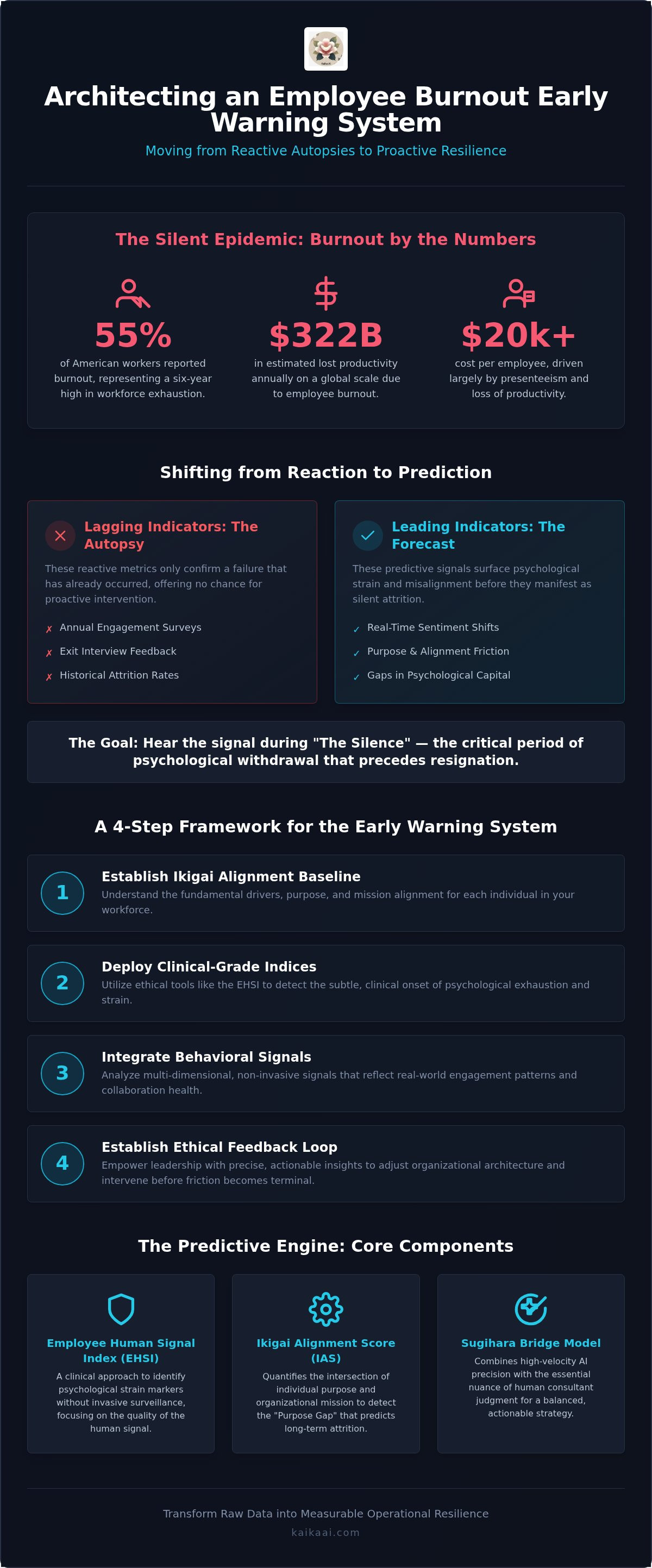
55% of American workers reported experiencing burnout in late 2025, representing a six year high in workforce exhaustion. This isn't a mere HR headache; it's a structural threat to your mission's velocity. Most leaders rely on annual surveys that deliver lagging data, essentially performing an autopsy on talent you've already lost. To maintain operational resilience, you must architect a proactive employee burnout early warning system that surfaces psychological strain and mission misalignment before they manifest as silent attrition.
You understand that high performance requires more than just compliance; it demands a deep synchronization between individual Ikigai and corporate goals. This article provides the executive framework to build a predictive attrition model using the Ethical Human Sentiment Index (EHSI) and the Sugihara Bridge Model. We'll examine how to turn abstract human potential into measurable organizational synergy through ethical, data driven people operations that hear the signal before the silence.
Key Takeaways
- Identify why traditional lagging indicators fail to detect the period of psychological withdrawal that precedes formal resignation.
- Architect a sophisticated employee burnout early warning system by measuring the friction between individual purpose and organizational architecture.
- Distinguish between invasive activity surveillance and ethical workforce intelligence to preserve trust and ensure data honesty.
- Transform raw sentiment data into executive-level architectural consultations that drive measurable operational resilience.
- Utilize the Sugihara Bridge Model to combine high-velocity AI precision with the essential nuance of human consultant judgment.
The Anatomy of the Silence: Why Traditional Burnout Detection Fails
Burnout is not a sudden collapse. It is a slow, structural erosion of purpose. Leaders often miss the critical period of psychological withdrawal we call "The Silence." During this phase, a high performer remains physically present but has already begun the process of internal resignation. To capture this shift, organizations need a robust employee burnout early warning system. Relying on attrition rates or exit interviews is akin to studying an autopsy to prevent a disease. These lagging indicators only confirm a failure that has already occurred.
Traditional annual engagement surveys suffer from a velocity gap. In the high stakes environment of 2026, a static snapshot taken once a year cannot account for the rapid shifts in workforce sentiment. This creates a disparity between "Workforce Data," which measures superficial activity like login times or task completion, and "Human Truth," which reveals the actual alignment between an individual's work and their personal mission. A deeper understanding of occupational burnout reveals that it is fundamentally a crisis of meaning, not just a matter of workload. When leaders prioritize data over truth, they ignore the friction that eventually leads to systemic failure.
The High Cost of Reactive People Operations
Reactive management carries a heavy price. Globally, burnout links to an estimated $322 billion in lost productivity annually. On a micro level, research from the American Journal of Preventive Medicine indicates that the cost per employee ranges from $3,999 to $20,683, driven largely by presenteeism. When individual purpose and corporate goals fall out of synchronization, productivity decay follows. Stalled strategic initiatives often find their root cause in this unmeasured psychological strain. Without an employee burnout early warning system, these fiscal leaks remain invisible until the talent has already walked out the door.
Moving from Lagging to Leading Indicators
Executives must pivot toward leading indicators to maintain operational resilience. These metrics include sentiment shifts, purpose friction, and alignment gaps. Real time metrics provide the precision required for modern corporate governance, allowing leaders to adjust the organizational architecture before friction becomes terminal. This transition enables a move from defensive posturing to proactive optimization. The Human Signal Index (HSI) serves as a predictive instrument that quantifies subtle shifts in employee engagement before they escalate into total disengagement.
Architecting the Employee Burnout Early Warning System
Constructing a resilient organization requires a shift from monitoring activity to understanding alignment. An effective employee burnout early warning system functions through a four-step structural integration. First, you must establish a baseline of Individual Ikigai Alignment to understand the fundamental drivers of your talent. Second, deploy clinical-grade indices to detect the subtle onset of psychological exhaustion. Third, integrate multi-dimensional behavioral signals that reflect real-world engagement patterns. Finally, establish an ethical feedback loop that empowers leadership to intervene with precision before friction becomes terminal.
The Employee Human Signal Index (EHSI): A Clinical Approach
The Employee Human Signal Index (EHSI) represents the core of this predictive capability. Developed under the guidance of clinical psychologists like Michelle Kwamboka, this index identifies markers of psychological strain without resorting to invasive surveillance. Unlike traditional tools that monitor keystrokes or screen time, the EHSI focuses on the quality of the human signal. It distinguishes between healthy, high-stakes work stress and the systemic erosion that characterizes chronic exhaustion. By prioritizing system-level change for burnout, the EHSI provides leaders with the intelligence needed to adjust the organizational environment before a high performer reaches the point of no return.
Measuring the Ikigai Alignment Score (IAS)
The Ikigai Alignment Score (IAS) complements clinical data by quantifying the intersection of individual purpose and the organizational mission. When a "Purpose Gap" emerges, it creates alignment friction that serves as a primary predictor of long-term attrition. If an employee's personal drive no longer synchronizes with corporate objectives, the resulting friction consumes psychological capital at an unsustainable rate. Measuring these gaps allows for a proactive Alignment Audit to restore structural integrity. This data driven approach ensures that workforce sustainability is not left to chance but is managed as a critical business metric.
Integrating these signals into a unified framework allows executives to move beyond guesswork. By combining clinical indices with alignment scores, you create a multi-dimensional view of organizational health. This intelligence enables a shift from reactive crisis management to a model of continuous optimization. When leadership can see the "signal before the silence," they can implement structural adjustments that preserve both human potential and enterprise velocity.
Surveillance vs. Intelligence: The Ethical Divide
Surveillance is the enemy of truth. When enterprises deploy invasive tools to track keystrokes or capture screens, they don't capture engagement. They capture performance theater. This surveillance culture artificially inflates activity metrics while deepening the very burnout it claims to prevent. Employees who feel watched don't share their struggles; they mask them. To build a functional employee burnout early warning system, you must cross the ethical divide from surveillance to workforce alignment intelligence. This shift moves the focus from monitoring behavior to hearing the signal before the silence.
The efficacy of this predictive framework rests on an 87% honesty rate achieved in recent pilot programs. This high fidelity data is only possible through radical transparency and a commitment to psychological safety. When individuals understand how their data is used to improve their work life harmony, they provide authentic signals rather than defensive noise. This approach respects Japanese privacy standards and global enterprise security protocols, ensuring that intelligence never descends into intrusion. By prioritizing trust, organizations can gather the high stakes data necessary to maintain operational resilience without compromising the human spirit.
The Trust Paradox in Workforce Analytics
Trust is the currency of alignment. Transparency in data collection doesn't decrease participation; it increases weekly completion rates by fostering a sense of shared mission. When leadership communicates the intent of an employee burnout early warning system, they transform the technology from a watchdog into a supportive infrastructure. You can learn more about AI in employee engagement and how it synchronizes purpose with organizational architecture. This shift allows employees to view AI as a tool for collective evolution rather than a mechanism for individual punishment. It creates a feedback loop where honesty is valued over compliance.
Responsible AI and Ethical Data Governance
Ethical integrity starts with anonymization and architectural rigor. For large scale enterprises, sentiment analysis must focus on structural patterns rather than individual surveillance. This ensures that leadership identifies early signs and recognition strategies without compromising personal dignity. CHROs play a vital role here, acting as the architects of ethical data governance. They must ensure that AI applications remain transparent and focused on measurable business outcomes. By adhering to clinical psychologist led development standards, organizations maintain a high stakes focus on performance while fostering a warm, philosophical commitment to human potential. This balance is essential for long term sustainability in a competitive global market.
Operationalizing the Warning System: A Strategic Framework
Intelligence without application is merely noise. To hear the signal before the silence, executives must integrate a sophisticated employee burnout early warning system into their operational DNA. It isn't enough to collect sentiment; you must translate that intelligence into architectural adjustments. This process shifts the focus from managing individuals to optimizing the organizational environment. By moving from raw data collection to executive level architectural consultations, leaders can address structural friction before it compromises enterprise velocity.
The Three-Phase Integration Methodology
Operationalizing workforce intelligence follows a methodical, three-phase progression. This structured approach ensures that the transition from data to action remains disciplined and measurable. The following table outlines the architectural progression from initial assessment to sustained operational resilience.
| Phase | Primary Objective | Key Measurement | Strategic Outcome |
|---|---|---|---|
| 1. Alignment Audit | Identify mission critical gaps | Ikigai Alignment Score (IAS) | Structural gap analysis |
| 2. Strategic Synchronization | Deploy predictive frameworks | EHSI and HSI Integration | Real time predictive visibility |
| 3. Operational Resilience | Train leaders for intervention | Intervention Efficacy Rate | Sustained workforce velocity |
Phase 1 begins with the Alignment Audit, which identifies where individual purpose and corporate strategy diverge. Phase 2 moves into Strategic Synchronization, where organizations deploy the Ikigai Intelligence Framework (IIF) to map human potential against operational requirements. Finally, Phase 3 focuses on Operational Resilience Training. This phase prepares the leadership tier to interpret predictive signals and implement structural changes that preserve both talent and performance.
From Signal to Action: The Intervention Protocol
Effective intervention protocols must remain non punitive to preserve the 87% honesty rate essential for data integrity. If the EHSI flags a high risk team, the objective isn't to scrutinize individual output; it's to rebalance the team's mission focus. Leaders use synergy metrics to identify where workload exceeds psychological capacity. You can explore this further in our guide on Operational Resilience for Leadership: A Predictive Workforce Resilience Framework. By focusing on structural rebalancing rather than individual performance, you build a culture of resilience that sustains high performance over the long term.
The ultimate goal of this framework is to move beyond crisis management. When you treat alignment as a core business metric, you create an environment where human potential and corporate goals exist in a state of permanent synchronization. Secure your organization's future and eliminate silent attrition by deploying our Workforce Alignment Intelligence Platform today.
The Sugihara Bridge Model: Why Human Judgment is Non-Negotiable
While AI provides the high velocity required for a modern employee burnout early warning system, it cannot replace the depth of human discernment. Pure surveillance software often misinterprets cultural nuances or psychological subtleties as mere data anomalies. The Sugihara Bridge Model solves this by pairing high performance AI with expert human consultants. This hybrid approach ensures that sentiment data doesn't just sit on a dashboard but transforms into actionable executive strategy. By bridging the gap between technical intelligence and human wisdom, organizations can achieve a Net Promoter Score (NPS) of 72, reflecting a workforce that feels truly understood rather than monitored.
Human judgment is the essential filter that prevents data from becoming noise. In complex enterprise environments, the "signal" of burnout is often wrapped in layers of corporate culture and individual personality. AI can detect the presence of friction, but it requires a strategic sage to interpret the implications for organizational architecture. This ensures that every intervention is precise, respectful, and aligned with the broader mission of the firm.
Refining the Signal with Human Empathy
Consultants provide the essential context behind the "what" delivered by the Employee Human Signal Index (EHSI). While the system flags friction, human experts uncover the underlying "why," whether it's a specific leadership bottleneck or a broader cultural misalignment. This is particularly vital in global enterprises where cultural nuances, such as those found in Japan-first design frameworks, dictate how employees express strain. For a deeper look at these signals, read our guide on Leading Indicators of Employee Burnout: The Executive Guide to Predictive Attrition Intelligence. This human layer prevents the misinterpretation of data and ensures that interventions remain empathetic and effective.
Building Long-Term Institutional Resilience
The Sugihara Bridge Model is more than a diagnostic tool; it's a foundation for institutional resilience. Our academic partnership with Waseda University ensures that the system remains grounded in rigorous organizational psychology. This reliability supports our long term strategic vision, including a projected listing on the TSE or ASX by 2032. By prioritizing the intersection of technology and human judgment, we provide a framework for evolution that scales with global complexity. Leaders who adopt this model don't just prevent burnout; they architect a culture of permanent synchronization and high stakes performance.
Prepare your organization for the future of work. Request early access to the Kaika AI Workforce Alignment Platform today.
Architecting Operational Resilience through Predictive Alignment
Transitioning from reactive attrition management to a proactive employee burnout early warning system is a strategic necessity for the modern enterprise. We've explored how bridging the gap between clinical psychological insights and organizational architecture creates a high fidelity feedback loop. By utilizing the EHSI developed by Michelle Kwamboka, leaders can finally detect the subtle friction that precedes systemic failure. This framework moves beyond simple data collection to provide a roadmap for structural evolution.
The data demonstrates the power of this approach. Pilot programs have achieved an 87% honesty rate, supported by a 72 Net Promoter Score. This isn't about surveillance; it's about deep synchronization. When you combine AI velocity with the human judgment of the Sugihara Bridge Model, you don't just prevent loss. You unlock the full velocity of your collective human potential. Your mission deserves a foundation built on structural integrity and human harmony.
Hear the signal before the silence. Request your Alignment Audit today.
Frequently Asked Questions
What is an employee burnout early warning system?
An employee burnout early warning system is a predictive architectural framework that identifies the subtle indicators of psychological withdrawal before they manifest as resignation. Unlike traditional surveys that provide lagging data, this system surfaces real time signals of mission misalignment and exhaustion. By focusing on leading indicators like sentiment shifts and purpose friction, leaders can implement structural adjustments that maintain organizational velocity and preserve high value talent before silent attrition occurs.
How does Kaika AI predict burnout without monitoring individual screens?
Kaika AI rejects invasive surveillance methods like screen monitoring or keystroke tracking, which often destroy employee trust and data honesty. Instead, our platform utilizes the Ikigai Intelligence Framework to analyze sentiment and behavioral signals. This methodology respects individual privacy while surfacing the human truth beneath workforce data. By prioritizing transparency, we achieved an 87% honesty rate in pilots, ensuring that the intelligence gathered is both accurate and ethically sourced.
What is the Employee Human Signal Index (EHSI)?
The Employee Human Signal Index (EHSI) is a clinically informed measurement tool co-developed with clinical psychologist Michelle Kwamboka. It specifically identifies individual markers of psychological strain and burnout risk by analyzing subtle shifts in engagement patterns. Because the EHSI is grounded in clinical psychology, it provides a responsible way to detect when a high performer is reaching a point of exhaustion. This allows for precise, non punitive interventions that restore structural harmony.
Can an early warning system truly reduce employee attrition?
Yes, a sophisticated employee burnout early warning system significantly reduces attrition by addressing the "Silence," which is the period of psychological withdrawal preceding a formal exit. By detecting alignment friction early, organizations can move from reactive crisis management to proactive optimization. Our pilot data shows that identifying these signals early leads to higher engagement, reflected in a Net Promoter Score (NPS) of 72. This predictive capability preserves institutional knowledge and avoids the high costs of replacing top talent.
How does the Sugihara Bridge Model differentiate Kaika AI from other platforms?
The Sugihara Bridge Model differentiates Kaika AI by utilizing a hybrid architecture that pairs high velocity AI measurement with trained human consultants. Most platforms rely solely on algorithms that often miss cultural nuances or psychological subtleties. Our model ensures that sensitive workforce signals are interpreted with human judgment and empathy. This bridge between technology and wisdom allows for bespoke executive consultations that translate raw data into sophisticated, actionable organizational strategies that software alone cannot provide.
Is the data collected by an early warning system private and secure?
Security and privacy are foundational to our architectural design, adhering strictly to Japanese privacy standards and global enterprise protocols. We believe that transparency is the key to data integrity. When employees understand that their data is used to improve organizational alignment rather than for surveillance, they engage more deeply. This trust based approach resulted in a 74% weekly completion rate during our initial pilots, proving that ethical data governance strengthens rather than weakens intelligence outcomes.
How long does it take to see results from a workforce alignment platform?
While our platform provides real time metrics immediately upon deployment, systemic results typically follow our three phase strategic integration methodology. The initial Alignment Audit identifies mission critical gaps within the first few weeks. Strategic Synchronization and Operational Resilience training then build the long term capacity for leaders to act on predictive signals. This cumulative process transforms organizational health, moving the enterprise from a state of reactive friction to one of permanent, data driven synchronization.
What is the role of Ikigai in preventing corporate burnout?
Ikigai serves as the philosophical and mathematical baseline for our alignment metrics. We define burnout not merely as a workload issue, but as a terminal state of mission misalignment. By measuring the Ikigai Alignment Score (IAS), we quantify the intersection of an individual's sense of purpose with the organization's mission. When these elements are out of sync, burnout risk increases significantly. Restoring this alignment ensures that work remains a source of vitality and meaning rather than exhaustion.
Disclaimer
#Disclaimer
At Kaika AI, we believe the future belongs to organizations that combine human wisdom with artificial intelligence responsibly. The articles, research, insights, and thought leadership published on this website are intended to educate, inform, and encourage meaningful conversations about the future of work, organizational intelligence, AI, leadership, and innovation.
While our content is developed through rigorous research and may be generated, curated, or enhanced using artificial intelligence, every effort is made to ensure it reflects thoughtful analysis, practical relevance, and responsible AI practices. However, no representation or warranty is made regarding the completeness, accuracy, or suitability of the information for every individual or organizational circumstance.
The ideas, opinions, frameworks, and recommendations shared by Kaika AI are provided for educational and informational purposes only. They should not be interpreted as legal, financial, medical, psychological, human resources, cybersecurity, or other professional advice. Organizations and individuals should seek qualified professional guidance before making strategic, legal, or operational decisions.
Where articles reference third-party organizations, products, services, academic research, industry reports, or public data, such references are provided solely to support discussion and analysis. Unless explicitly stated, they do not imply endorsement, partnership, or affiliation.
Artificial intelligence is a powerful decision-support technology—not a replacement for human judgment. Kaika AI advocates for responsible, transparent, and human-centered AI adoption. We encourage readers to critically evaluate information, consider their unique context, and combine AI-generated insights with professional expertise and sound decision-making.
The content published on this website may be updated, revised, or removed as knowledge, technology, regulations, and best practices continue to evolve.
To the fullest extent permitted by applicable law, Kaika AI, its affiliates, contributors, and partners disclaim liability for any direct, indirect, incidental, consequential, or other losses arising from the use of, or reliance upon, the information provided on this website.
By accessing or using this website, you acknowledge that you have read, understood, and agree to this Disclaimer.
Kaika AI
'Building trusted organizational intelligence for the AI Era'


