
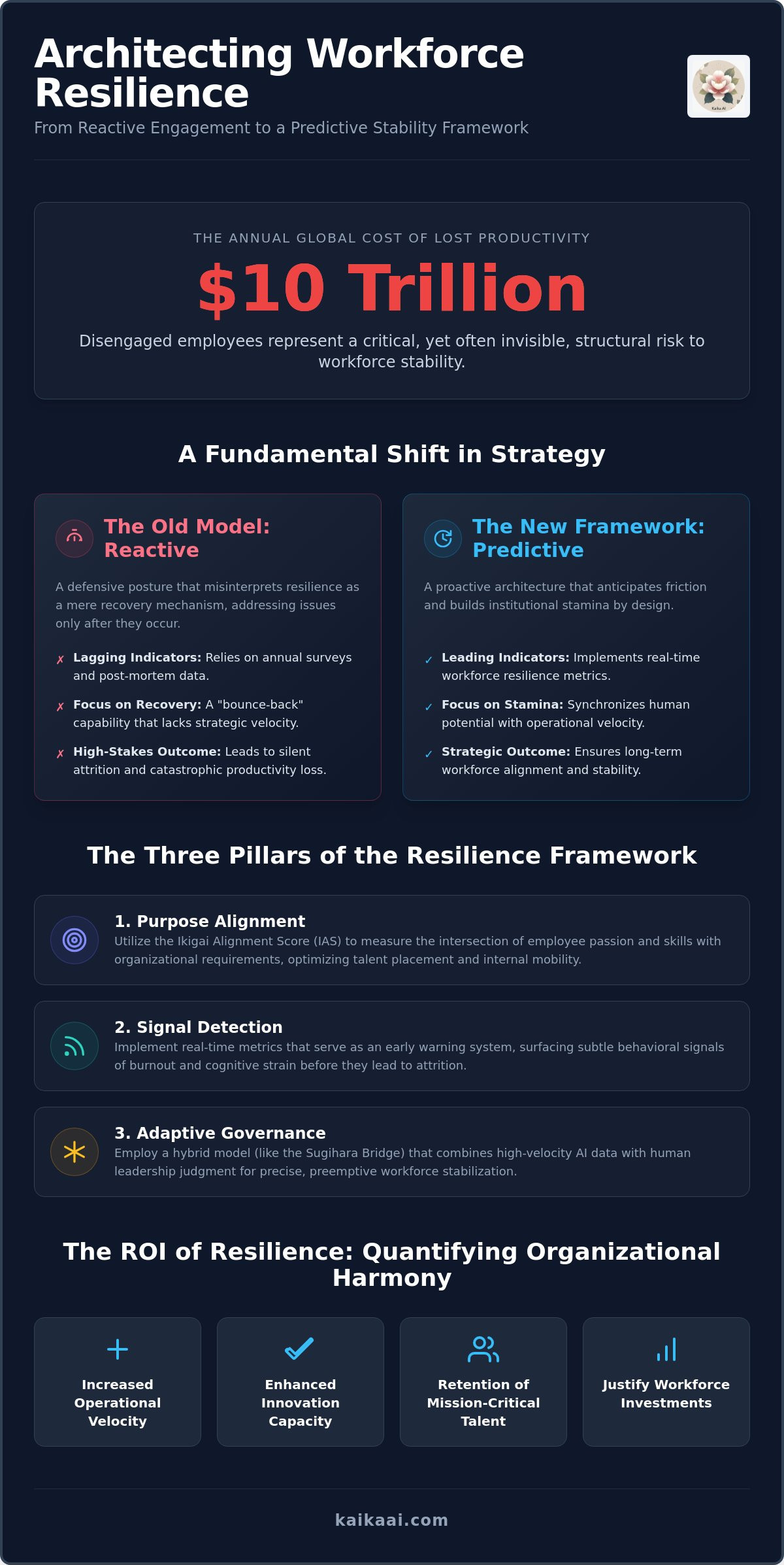
Disengaged employees cost the global economy an estimated $10 trillion in lost productivity annually, yet most executive dashboards remain blind to the structural decay of workforce stability until a critical failure occurs. You've likely felt the frustration of silent attrition, where high performers vanish because the disconnect between individual purpose and corporate mission became an unbridgeable chasm. It's a high-stakes performance crisis that traditional engagement surveys, with their lagging indicators and superficial data points, simply cannot solve.
You'll discover how to architect a predictive institutional framework that transforms workforce resilience metrics into a sophisticated engine for strategic stability. By moving beyond reactive snapshots, this methodology surfaces early warning signals of burnout and cognitive strain before they manifest as exit interviews. We'll examine the transition toward resilience by design, aligning with the measurement-based focus of the updated ISO 22316 standard. This article provides a methodical path to synchronize human potential with operational velocity, offering a measurable way to track organizational synergy and justify workforce investments to the Board with clinical precision.
Key Takeaways
- Shift from reactive survival to a proactive model of institutional stamina by architecting resilience directly into your organizational structure.
- Implement real-time workforce resilience metrics to detect subtle behavioral signals of burnout and prevent the high cost of silent attrition.
- Synchronize individual purpose with corporate mission using the Ikigai Intelligence Framework to ensure long-term workforce alignment and stability.
- Utilize the Sugihara Bridge Model to combine high-velocity AI data with human leadership judgment for precise, preemptive workforce stabilization.
- Quantify organizational harmony by measuring its direct impact on operational velocity, innovation, and the retention of mission-critical talent.
The Architecture of Operational Resilience for Leadership
Leadership often misinterprets resilience as a mere recovery mechanism. This reactive "bounce-back" capability is a defensive posture that lacks the velocity required for strategic dominance. True institutional stamina requires a proactive architectural shift. We define operational resilience as the structural synchronization of human purpose and organizational data. By moving away from the static definitions found in traditional Workplace resilience literature, leaders can build a foundation that anticipates friction rather than merely absorbing the shock.
Traditional engagement metrics are post-mortem tools. They offer a retrospective glance at sentiment, failing to capture the "signal before the silence" of top-tier talent departure. When the disconnect between corporate mission and employee purpose widens, the result is silent attrition. Real-time workforce resilience metrics provide the necessary signal intelligence to bridge this gap. This data ensures that workforce velocity remains aligned with strategic execution, even in the most volatile market conditions. Without this predictive layer, leadership remains blind to the cognitive strain that erodes productivity before it ever appears in an exit interview.
To better understand the shift from reactive risk management to proactive stamina, watch this helpful video:
Key Takeaways for Executive Leadership
- Predictive intelligence: Implementing early warning systems reduces the catastrophic financial impact of silent attrition.
- Purpose alignment: Synchronizing individual Ikigai with the corporate mission acts as the primary catalyst for organizational stability.
- Hybrid governance: Ethical workforce intelligence requires a model that pairs technical measurement with human leadership judgment to ensure transparency.
Resilience as a Strategic Intelligence Asset
Leadership must move beyond qualitative "gut feelings" toward quantitative workforce alignment intelligence. This shift transforms human capital from an expense into a measurable strategic asset. By establishing a rigorous baseline through the Ikigai Intelligence Framework (IIF), organizations can track their health with surgical precision. This process requires enterprise-grade security to manage sensitive human signal data, ensuring that transparency and trust remain central to the architecture. When you treat resilience as a data-driven discipline, you create a systematic order that mirrors the alignment promised by high-performance cultures. It's a methodical approach that moves from high-level visionary statements down to structured, phase-based methodologies for workforce stabilization. Through the consistent application of workforce resilience metrics, the enterprise transitions from a state of fragile endurance to one of anti-fragile growth.
The Three Pillars of the Workforce Resilience Framework
True structural integrity within an enterprise requires more than just reactive measures. It demands a framework built on three foundational pillars that transform raw data into institutional stamina. These pillars-Purpose Alignment, Signal Detection, and Adaptive Governance-create a self-correcting organizational system. This architecture doesn't just survive change; it thrives on it. By implementing sophisticated workforce resilience metrics, leadership can move from a defensive posture to one of strategic synchronization. This systemic approach ensures that every component of the organization remains aligned with the overarching mission, even as market conditions fluctuate.
Pillar 1: Measuring the Ikigai Alignment Score (IAS)
Purpose is the most potent driver of performance. The Ikigai Alignment Score (IAS) measures the critical intersection where an employee’s passion and skills meet organizational requirements. This measurement provides a clear roadmap for internal mobility, allowing leaders to optimize talent placement with surgical precision. When you link individual purpose to corporate performance through clinical-grade measurement, you reduce the friction that leads to burnout. It's about ensuring that the human element of the enterprise is not just utilized but deeply invested in the collective outcome. Organizations seeking this level of clarity often begin with an Alignment Audit to identify mission-critical gaps in their talent architecture.
Pillar 2: The Human Signal Index (HSI) and EHSI
Effective signal detection requires a distinction between general sentiment and deep psychological strain. The Human Signal Index (HSI) captures the broad pulse of the workforce, while the Employee Human Signal Index (EHSI) utilizes clinical rigor to identify individual burnout risk. Co-developed with clinical psychologists, these indices surface the "human truth" beneath standard operational data. This predictive capability allows for board-level burnout risk oversight, moving mental health from a HR concern to a primary governance responsibility. By utilizing these workforce resilience metrics, leadership gains the intelligence necessary to intervene before silent attrition takes hold. Pilot results for these frameworks have demonstrated an 87% honesty rate, providing a level of transparency that traditional surveys simply cannot match.
Pillar 3: Adaptive Governance
Intelligence is only as valuable as the action it informs. Adaptive Governance is the ability of leadership to pivot based on real-time signal intelligence. It represents the transition from "post-mortem" analysis to preemptive workforce stabilization. This pillar ensures that the insights gathered from purpose alignment and signal detection are integrated into the strategic decision-making process. It creates a feedback loop where data informs policy, and policy strengthens the workforce. This systematic order mirrors the harmony promised by the Ikigai Intelligence Framework, ensuring that the organization remains agile, resilient, and uncompromisingly focused on excellence.
Predictive vs. Reactive: A Comparison of Resilience Models
The legacy approach to organizational health is fundamentally defensive. It prioritizes endurance over evolution, treating resilience as a reactive "bounce-back" capability. Traditional HR analytics often rely on retrospective data, forcing leadership into a cycle of post-mortem attrition analysis. This reactive posture is a strategic liability in high-velocity markets. In contrast, AI-powered Workforce Alignment Intelligence creates a proactive shield. By analyzing workforce resilience metrics in real-time, leadership can identify the subtle erosion of institutional stamina before it reaches a breaking point. This shift from reactive recovery to preemptive stabilization is the hallmark of a sophisticated enterprise.
The Fallacy of the Annual Engagement Survey
Annual engagement surveys are structurally flawed for modern business environments. Extreme data latency renders them obsolete before the results are even processed. By the time leadership reviews insights from a bi-annual cycle, the top talent identified as "at risk" has likely already transitioned to a competitor. This delay creates a vacuum where burnout accelerates unnoticed. There is also a persistent "Honesty Gap" in traditional methods. Employees often provide sanitized feedback due to perceived power imbalances or fear of repercussions. Transitioning to a real-time "Human Signal" monitoring approach closes this gap. AI-driven platforms facilitate a significantly higher honesty rate, surfacing the human truth that remains hidden in standard questionnaires. This allows for the continuous calibration of workforce resilience metrics, ensuring the organizational pulse is always visible.
AI-Powered Burnout Prediction: Ethical and Operational Standards
Predictive modeling requires uncompromising ethical standards and structural precision. Implementing burnout prediction tools involves navigating complex global privacy landscapes, including Japan's stringent personal information protection laws. Responsible AI must prioritize transparency and bias mitigation to maintain organizational trust. These systems don't replace human judgment; they provide the intelligence necessary for meaningful intervention. Early-stage interventions, informed by precise data, allow leaders to save high-value talent and maintain operational velocity. This transition enables a culture of continuous improvement. Through Collective Kaizen Workshops, organizations turn signal intelligence into structural agility. The result is a shift from reactive crisis management to a state of perpetual synchronization and organizational harmony.
Implementation: The Sugihara Bridge Model for Leaders
Deploying a resilience framework is not a technical event. It's an architectural intervention. Success depends on the systematic integration of high-velocity data with seasoned human judgment. The Sugihara Bridge Model provides this necessary infrastructure, ensuring that workforce resilience metrics translate into decisive leadership action. Without this bridge, data remains siloed, and the human truth of the organization stays obscured beneath superficial KPIs. Implementation demands more than technical proficiency; it requires architectural precision and a commitment to organizational harmony.
Phase 1: Conducting the Initial Alignment Audit
Every transformation begins with a rigorous baseline. The process starts with an Alignment Audit to identify mission-critical gaps in the workforce architecture. Leaders must establish clear baselines for the Ikigai Alignment Score (IAS) across diverse business units, specifically isolating "High Risk, High Value" segments. These are the individuals whose attrition would cause the most significant strategic disruption. By setting this architectural foundation, the enterprise moves toward sophisticated leadership alignment metrics that measure organizational synergy with clinical precision. This phase ensures that the resilience framework is grounded in the current reality of the workforce rather than executive assumptions.
Phase 2 & 3: Human-AI Synergy and Global Scaling
The Sugihara Bridge Model is designed to prevent the pitfalls of "algorithm-only" decision-making. While AI identifies patterns and psychological strain, human consultants provide the nuanced interpretation required for sensitive workforce signals. This hybrid approach fosters a leadership mindset that values data-driven Kaizen over rigid, top-down commands. As the framework scales globally, it creates a unified language of resilience that persists during mergers, acquisitions, or rapid expansion. Maintaining operational integrity during these high-stakes periods requires a synchronized understanding of workforce resilience metrics across all divisions. This institutional synergy ensures that the organization remains composed and strategic, regardless of external volatility. To begin architecting this stability within your own leadership team, consider scheduling an Executive Consultation to map your strategic path forward.
The ROI of Resilience: Quantifying Organizational Harmony
Institutional harmony isn't a nebulous aspiration. It's a measurable performance multiplier that directly impacts the bottom line. By leveraging workforce resilience metrics, leadership can transform human capital data into a predictable financial asset. This systematic approach moves the organization away from the volatility of reactive management toward a state of strategic stabilization. When purpose and performance are synchronized, the resulting organizational velocity creates a competitive advantage that's difficult for rivals to replicate. It's the difference between an enterprise that merely survives market shifts and one that dictates them.
Hard Metrics: Attrition Reduction and Productivity Gains
Hard metrics provide the clinical evidence needed to justify workforce investments to the Board. Calculating the financial impact of retaining a single high-performing executive reveals the immense value of early signal detection. Beyond simple retention, real-time metrics drive continuous performance improvements by identifying friction points in the workforce architecture. There's a direct correlation between high Ikigai Alignment Scores (IAS) and long-term workforce sustainability. Organizations that prioritize these scores see a significant reduction in the hidden costs of silent attrition, ensuring that mission-critical talent remains engaged and productive. This data-driven precision allows for the reallocation of resources toward growth rather than constant recruitment cycles.
Soft Metrics: Trust, Transparency, and Brand Equity
Soft metrics, while less tangible in a traditional spreadsheet, build the long-term brand equity of the enterprise. Trust and transparency are the foundations of a culture where employees feel "heard" before they become silent. This preemptive engagement prevents the burnout signals that lead to disengagement and eventual turnover. Clinical pilot results for this framework show an 87% honesty rate and a 72 NPS, proving that a data-driven approach can actually enhance the human element of work. Being recognized as a resilient and aligned employer attracts top-tier talent who seek more than just a paycheck; they seek a mission that mirrors their own purpose. Closing the loop between data intelligence and human-centric outcomes creates a future where high performance is sustainable.
The evolution of corporate governance demands a more sophisticated approach to human capital management. By 2026, the adoption of workforce alignment software will be a non-negotiable requirement for leadership teams. This technology provides the necessary oversight to manage burnout risk and ensure organizational synergy with surgical accuracy. It represents a methodical progression from raw signal detection to the realization of a truly harmonious and resilient global enterprise. Investing in these workforce resilience metrics today ensures that your organization remains composed, strategic, and uncompromisingly focused on excellence in the years to come.
Architecting the Future of Institutional Stamina
The transition from reactive survival to proactive institutional stamina requires more than a shift in mindset; it demands a structural evolution. By architecting a framework that synchronizes individual Ikigai with organizational data, you move beyond the limitations of lagging indicators. Integrating precise workforce resilience metrics into your strategic dashboard allows you to hear the signal before the silence of attrition. This methodical approach ensures that your enterprise remains synchronized, agile, and prepared for the complexities of global scale.
Our methodology is grounded in clinical rigor and strategic partnerships with institutions like Waseda University and the Tokyo Innovation Base. Large-scale pilots have demonstrated an 87% employee honesty rate, proving that transparency and trust are achievable through the clinically-informed EHSI for burnout detection. You can transform workforce data into a measurable engine for strategic stability and organizational harmony. It's time to lead with precision. Request early access to the Kaika AI Workforce Alignment Intelligence Platform and begin your journey toward a more resilient, purpose-driven future.
Frequently Asked Questions
What is a workforce resilience framework and why is it essential for executives?
A workforce resilience framework is a predictive architectural system that synchronizes human purpose with organizational data to maintain peak performance through disruption. It's essential because it transforms latent risks into actionable intelligence. Executives use this framework to prevent silent attrition and ensure strategic execution. By monitoring workforce resilience metrics, leadership moves from reactive recovery to institutional stamina. This systematic order protects the enterprise from the massive productivity losses caused by disengagement.
How does the Ikigai Intelligence Framework (IIF) differ from traditional HR tools?
The Ikigai Intelligence Framework (IIF) differs by focusing on the philosophical alignment of purpose rather than superficial engagement scores. Traditional tools often rely on lagging indicators like annual surveys that offer little predictive value. The IIF uses the Ikigai Alignment Score (IAS) to measure the intersection of passion, skill, and mission. This methodology surfaces the human truth beneath operational data. It provides a deeper, more accurate understanding of workforce synchronization than standard HR analytics.
Can AI really predict employee burnout before it happens?
AI identifies the subtle behavioral and sentiment shifts that signal burnout long before it reaches a critical threshold. By utilizing the Employee Human Signal Index (EHSI), our platform detects psychological strain with clinical precision. These early warning signals allow for preemptive stabilization of high-value talent. Unlike reactive exit interviews, this predictive capability enables leadership to intervene while retention is still possible. Pilot results show an 87% honesty rate in these signals.
What is the Sugihara Bridge Model and why does it matter for data privacy?
The Sugihara Bridge Model is a hybrid integration methodology that pairs technical AI measurement with seasoned human leadership judgment. It matters for privacy because it ensures that data isn't just processed by algorithms but interpreted through an ethical, human-centric lens. This model creates a secure bridge between raw signal intelligence and management action. It prevents algorithm-only decision-making, maintaining the transparency and trust necessary for high-stakes enterprise environments and sensitive human capital data.
How do we measure the ROI of a workforce resilience framework?
You measure ROI by tracking the reduction in attrition costs and the acceleration of operational velocity. A robust framework quantifies the financial impact of retaining mission-critical talent who would otherwise leave due to burnout. It also tracks improvements in innovation and productivity linked to high alignment scores. By using workforce resilience metrics, leaders justify investments to the Board with concrete data. This demonstrates a clear link between organizational harmony and bottom-line performance.
Is this framework compliant with strict privacy standards like those in Japan?
The framework features a Japan-first design, ensuring full compliance with the country's stringent personal information protection laws. It meets the highest global standards for data security and ethical AI use. This focus on precision and privacy reflects our commitment to institutional reliability. Leaders can deploy the platform across global divisions with confidence. The architecture prioritizes transparency, ensuring that sensitive human signal data is managed with surgical accuracy and legal integrity.
How long does it take to see results from a workforce alignment intelligence platform?
Most organizations begin surfacing actionable insights within the first 90 days of deploying a workforce alignment intelligence platform. The initial Alignment Audit provides an immediate baseline of mission-critical gaps in the workforce architecture. As data accumulates, the predictive accuracy of the signal detection indices increases. This allows for rapid calibration of leadership strategies. While deep cultural transformation takes time, the shift toward a data-driven resilience posture happens almost immediately after integration.
What is the role of clinical psychologists in workforce resilience?
Clinical psychologists provide the scientific rigor necessary to translate raw data into accurate human signals. They co-developed the Employee Human Signal Index (EHSI) to ensure that burnout detection is grounded in psychological truth rather than mere statistical probability. Their expertise ensures that the framework remains ethical and effective. This partnership between technology and psychology is what allows the platform to surface the human truth beneath enterprise data with uncompromising excellence and precision.
Disclaimer
#Disclaimer
At Kaika AI, we believe the future belongs to organizations that combine human wisdom with artificial intelligence responsibly. The articles, research, insights, and thought leadership published on this website are intended to educate, inform, and encourage meaningful conversations about the future of work, organizational intelligence, AI, leadership, and innovation.
While our content is developed through rigorous research and may be generated, curated, or enhanced using artificial intelligence, every effort is made to ensure it reflects thoughtful analysis, practical relevance, and responsible AI practices. However, no representation or warranty is made regarding the completeness, accuracy, or suitability of the information for every individual or organizational circumstance.
The ideas, opinions, frameworks, and recommendations shared by Kaika AI are provided for educational and informational purposes only. They should not be interpreted as legal, financial, medical, psychological, human resources, cybersecurity, or other professional advice. Organizations and individuals should seek qualified professional guidance before making strategic, legal, or operational decisions.
Where articles reference third-party organizations, products, services, academic research, industry reports, or public data, such references are provided solely to support discussion and analysis. Unless explicitly stated, they do not imply endorsement, partnership, or affiliation.
Artificial intelligence is a powerful decision-support technology—not a replacement for human judgment. Kaika AI advocates for responsible, transparent, and human-centered AI adoption. We encourage readers to critically evaluate information, consider their unique context, and combine AI-generated insights with professional expertise and sound decision-making.
The content published on this website may be updated, revised, or removed as knowledge, technology, regulations, and best practices continue to evolve.
To the fullest extent permitted by applicable law, Kaika AI, its affiliates, contributors, and partners disclaim liability for any direct, indirect, incidental, consequential, or other losses arising from the use of, or reliance upon, the information provided on this website.
By accessing or using this website, you acknowledge that you have read, understood, and agree to this Disclaimer.
Kaika AI
'Building trusted organizational intelligence for the AI Era'


