
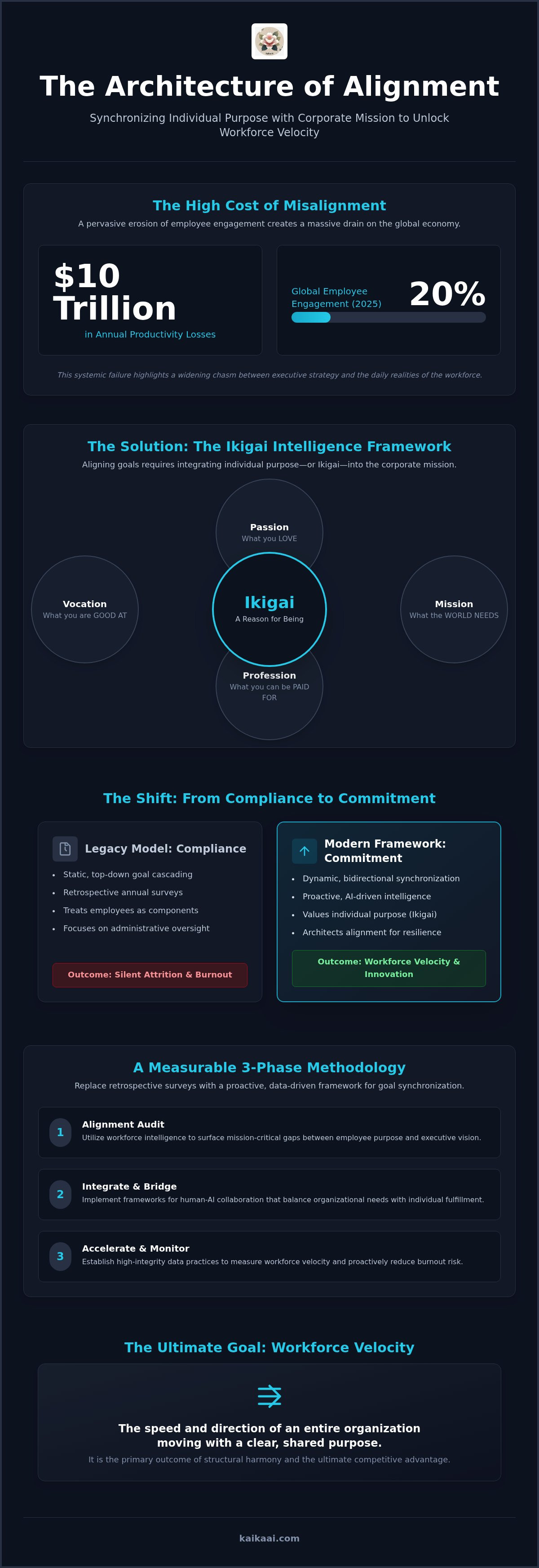
The global economy currently hemorrhages over $10 trillion in productivity losses due to a pervasive erosion of employee engagement, which reached a historic low of 20% in 2025. This systemic failure highlights a widening chasm between executive strategy and the daily realities of the workforce. Most leaders understand that high-stakes performance requires more than just administrative oversight. You recognize the inherent difficulty in aligning individual and organizational goals when the silent attrition of disengagement remains invisible to traditional reporting structures.
This article introduces a sophisticated framework for synchronizing employee purpose with corporate mission through the lens of workforce intelligence. By leveraging AI-driven insights and the Ikigai Intelligence Framework, organizations can move beyond superficial culture initiatives toward a state of structural harmony and measurable resilience. You'll learn how to identify psychological signals before they turn into departures, ensuring that your talent remains both motivated and mission-aligned.
Our analysis explores the transition from static management to dynamic synchronization. We examine the specific methodologies of the Sugihara Bridge Model, the impact of the Human Signal Index on attrition risk, and the architectural steps necessary to improve workforce velocity. This methodical approach transforms human potential from an abstract concept into a precise engine for organizational evolution.
Key Takeaways
- Distinguish between mere strategic compliance and the authentic synchronization of personal purpose with corporate missions to unlock superior performance.
- Apply the Ikigai Intelligence Framework to integrate individual passion and vocation into the broader organizational strategy, building long-term operational resilience.
- Learn a measurable three-phase methodology for aligning individual and organizational goals that replaces retrospective surveys with proactive, AI-driven workforce intelligence.
- Utilize the Alignment Audit to surface mission-critical gaps and implement the Sugihara Bridge Model for a balanced approach to human-AI collaboration.
- Establish high-integrity data practices that ensure transparency and privacy while providing leaders with the visibility needed to reduce burnout and accelerate velocity.
The Architecture of Alignment: Defining Individual and Organizational Goals
True alignment isn't a byproduct of administrative oversight; it's the result of aligning individual and organizational goals through structural synchronization. We define organizational goals as the collective mission, the strategic North Star that dictates an enterprise's path. Individual goals, conversely, represent a person's Ikigai. This philosophical concept encompasses the intersection of passion, mission, vocation, and profession. When these two forces don't meet, you get strategic friction that erodes performance.
Traditional top-down cascading often fails because it treats people like interchangeable components in a legacy system. This approach creates a profound disconnect. Employees might meet their technical KPIs while remaining fundamentally detached from the mission. This leads to "silent attrition," where the body is present but the spirit has already departed. To better understand this concept, watch this helpful video:
When aligning individual and organizational goals, you unlock Workforce Velocity. This metric represents the speed and direction of an entire team moving with shared purpose. It's the byproduct of high-level synchronization. It ensures that every micro-action taken at the departmental level accelerates the macro-vision of the executive board.
The Shift from Compliance to Commitment
Legacy management models settle for compliance. An employee performs tasks to satisfy a contract. An aligned employee works with commitment because their personal Ikigai serves as the fuel for organizational resilience. The contrast is stark. Compliant workers provide labor, but committed workers drive innovation. Misalignment isn't just a cultural issue; it's a structural defect that results in stalled innovation and high burnout rates. You can't command commitment; you can only architect it through alignment.
Alignment as a Strategic Intelligence Asset
Executive leaders must view alignment as a leading indicator of organizational health. Strategic alignment ensures that departmental execution mirrors executive vision with precision. Moving beyond the static, retrospective nature of annual performance reviews is now a requirement for survival. You need real-time data to maintain structural integrity. In a global economy, waiting twelve months to measure engagement is a significant liability. Workforce intelligence must become a core component of corporate governance to ensure the enterprise remains agile and resilient.
The Psychology of Purpose: Integrating Ikigai into Corporate Strategy
While the architecture of an organization provides the skeleton, purpose acts as the nervous system. Integrating the Ikigai philosophy into corporate strategy requires moving beyond simple task management toward a bidirectional synchronization of values. Ikigai represents the intersection of passion, mission, vocation, and profession. It's the reason an individual chooses to invest their cognitive energy in your enterprise. When leaders succeed in aligning individual and organizational goals, they transform a standard workforce into a resilient, self-correcting system.
Traditional employee surveys often fail because they capture superficial sentiment rather than the "Human Truth." While a worker might report high satisfaction on a generic scale, they may still lack a sense of vocational fulfillment. This invisible gap is where silent attrition begins, contributing to the global decline in engagement that reached a low of 20% in 2025. By focusing on enhancing employee engagement through deep purpose, organizations build psychological stamina. This stamina is the primary defense against burnout, especially in high-pressure global markets where the demands on mental capital are constant.
The Four Pillars of Individual Purpose
To architect a purpose-aligned workforce, leaders must understand the four components that constitute an individual's Ikigai. It begins with identifying what employees love and what they are naturally good at. These are the internal drivers of performance. These drivers must then connect to what the organization needs and what it's willing to reward. This creates a balance where personal impact and financial incentives coexist. When an employee sees their unique skills solving a mission-critical organizational problem, the resulting sense of value becomes a powerful retention tool.
Synchronizing Personal Mission with Corporate Vision
Mapping individual aspirations to company OKRs (Objectives and Key Results) is a strategic necessity. This process requires a leadership mindset that views employees as partners in a shared evolution rather than just resources. It also necessitates the use of clinical psychology principles to monitor psychological strain. The Sugihara Bridge Model offers a framework for this, pairing AI-driven intelligence with human judgment to bridge the gap between individual purpose and corporate mission. By measuring the signal before the silence, proactive leaders can identify when an individual's personal mission has drifted from the corporate vision. Using tools like an Alignment Audit can reveal these discrepancies before they manifest as performance failures or cultural erosion. This data-driven approach ensures that the Human Signal remains strong, allowing the organization to maintain its velocity without compromising the well-being of its people.
Structural Barriers to Synergy: Why Traditional Goal-Setting Fails
The silence within an organization is often louder than its loudest dissenters. This phenomenon, known as "The Silence," represents the critical gap between employee sentiment and executive reporting. Most traditional HR infrastructures rely on quarterly or annual surveys that suffer from a significant Honesty Gap. When employees feel their psychological safety is at risk, they default to strategic compliance rather than authentic transparency. This creates a facade of stability while disengagement erodes the foundation of the enterprise. In pilot studies, we've observed an 87% employee honesty rate when the intelligence environment prioritizes alignment over surveillance, yet many firms still struggle with outdated tools.
Retrospective data is a lagging indicator that provides little value in a high-velocity global economy. By the time a survey identifies a trend, the attrition has already begun. Siloed departmental structures further complicate the strategic landscape, preventing the cross-functional aligning individual and organizational goals required for global scale. Without a unified data layer, departments optimize for local KPIs at the expense of the collective mission. This fragmentation leads to duplicated efforts and a breakdown in organizational harmony.
The Failure of Static Performance Metrics
Legacy management relies on lagging indicators like turnover rates and exit interviews. These metrics tell you what went wrong yesterday, not what's breaking today. In contrast, leading indicators focus on behavioral signals and psychological strain. Many organizations utilize standard goal alignment techniques like OKRs, but these often fail when quarterly targets conflict with long-term purpose. This tension creates a "burnout trap" where high performance exists without high alignment. An employee might hit every numerical target while losing their sense of Ikigai, leading to a sudden, catastrophic drop in workforce velocity.
Overcoming the Transparency Paradox
The transparency paradox occurs when employees hide their disengagement until the moment they resign. This defensive behavior stems from a lack of psychological safety and the fear that honesty might jeopardize their standing. To bridge this gap, leaders must implement systemic solutions that prioritize ethical data use and human-centric intelligence. Moving toward a model of AI for Organizational Health allows for the detection of these subtle shifts in sentiment. When you provide a secure environment where individual aspirations are visible, the process of aligning individual and organizational goals becomes a collaborative evolution rather than a top-down mandate. This structural shift ensures the Human Signal remains clear, preventing the silence from becoming a resignation letter.
Implementing a Data-Driven Framework for Goal Synchronization
Strategic evolution requires a transition from static management to dynamic synchronization. Moving toward a data-driven framework for aligning individual and organizational goals involves a rigorous three-phase integration. This methodology moves beyond surface-level engagement to address the structural integrity of the workforce. It ensures that human potential isn't just managed but architecturally integrated into the corporate mission.
Phase 1 begins with the Alignment Audit. This diagnostic process surfaces existing gaps within mission-critical divisions where strategic friction is highest. Phase 2 involves Architectural Consultation. During this stage, we refine the leadership mindset and goal structure to ensure technical KPIs mirror human purpose. Phase 3 establishes Continuous Measurement. By deploying real-time intelligence indices, leaders maintain visibility into the organization’s health and resilience.
Step 1: Measuring the Alignment Gap
Establishing a baseline is the first requirement for structural change. We utilize the Ikigai Alignment Score (IAS) to quantify the distance between individual purpose and corporate mission. This metric identifies high-risk areas where disengagement threatens operational stability. Our partnership with Waseda University validates the accuracy of these measurements. This ensures that the data reflects true psychological alignment rather than superficial survey responses. By establishing this baseline, you can pinpoint exactly where individual aspirations have drifted from the strategic path.
Step 2: Deploying Real-Time Human Signals
Once a baseline exists, the focus shifts to maintaining data freshness. The Human Signal Index (HSI) detects early behavioral shifts that suggest a loss of synchronization. Maintaining a 74% weekly completion rate ensures the intelligence remains actionable and current. We interpret this AI-driven data through the Sugihara Bridge Model. This model pairs machine precision with human judgment, providing a balanced approach to workforce intelligence. It allows CHROs to hear the signal before the silence of attrition begins, enabling proactive intervention rather than reactive damage control.
Step 3: Executing Collective Kaizen
The final stage involves turning intelligence into action through Collective Kaizen. This approach focuses on continuous, data-driven workforce improvement. Through targeted workshops, teams transform alignment data into operational resilience. This process ensures that the organization doesn't just reach alignment but maintains it through constant evolution. For those evaluating technical solutions, Workforce Alignment Software Guide provides a comprehensive overview of tool selection.
Executing this framework requires a disciplined commitment to excellence. Leaders ready to identify their structural vulnerabilities should begin with a comprehensive Alignment Audit to secure their strategic foundation and accelerate performance.
The Future of Workforce Intelligence: Hearing the Signal Before the Silence
The future of executive leadership depends on the ability to maintain structural harmony in an increasingly volatile global market. Artificial intelligence serves as the critical architect in this evolution, enabling a transition from reactive management to a more empathetic and efficient enterprise. By aligning individual and organizational goals through predictive intelligence, leaders can ensure that the human element remains at the core of technical performance. This synchronization isn't just about output; it's about creating a sustainable ecosystem where individual purpose fuels corporate velocity.
Ethical data governance remains the cornerstone of this intelligence. We prioritize Japanese-standard privacy compliance to ensure that transparency doesn't compromise individual security. This commitment to rigorous data ethics allows Kaika AI to position itself as the category leader in workforce alignment intelligence. When employees trust the system, the quality of the data improves, creating a virtuous cycle of institutional reliability and strategic precision. This foundation allows for a deep, data-driven understanding of the human truth beneath the corporate facade.
Predictive Attrition and Burnout Prevention
Maintaining operational integrity requires hearing the signal before the silence of disengagement becomes a resignation. The Employee Human Signal Index (EHSI), developed in collaboration with clinical psychologists, provides the visibility needed to detect psychological strain in real-time. This index allows CHROs to act on behavioral shifts while there's still time to intervene effectively. Our pilot studies demonstrate an 87% employee honesty rate, proving that a framework built on psychological safety yields the most accurate workforce intelligence. By identifying the early markers of burnout, you prevent the erosion of talent before it impacts the bottom line or stalls your strategic momentum.
Building Institutional Resilience for 2032 and Beyond
Resilience is a structural property, not a cultural aspiration. Aligning individual and organizational goals provides the enterprise-grade stability required for long-term growth and global scale. Our vision extends toward 2032, with a planned dual-listing on the Tokyo Stock Exchange (TSE) and Australian Securities Exchange (ASX) to reflect our commitment to global excellence and institutional reliability. This stability ensures that our partners have a reliable framework for navigating the complexities of the human-machine era.
The era of guessing at engagement is over. Leaders must now choose between legacy guesswork and architectural precision. To secure your organization's future and unlock the full potential of your talent, we invite you to request early access to the Ikigai Intelligence Framework. This is your opportunity to move beyond the silence and lead with visionary intelligence that synchronizes human potential with organizational mission.
Architecting the Future of Workforce Resilience
The transition from administrative compliance to strategic synchronization requires a disciplined approach to human intelligence. By aligning individual and organizational goals, executive leaders can transform the silent attrition of disengaged talent into a self-correcting engine of performance. This framework replaces retrospective guesswork with the precision of the Ikigai Intelligence Framework, ensuring that personal purpose remains the primary driver of corporate velocity. You no longer have to wait for exit interviews to understand where your strategy and your people have drifted apart.
Our methodology, developed in partnership with Waseda University and guided by clinical psychologist-led EHSI development, achieves an 87% employee honesty rate. This high-integrity data provides the visibility needed to detect burnout signals before they manifest as performance failures. You now have the architectural tools to move beyond surface-level engagement toward a state of structural harmony and measurable resilience.
The era of guessing at workforce health is over. Secure your organization's strategic foundation by taking the first step toward architectural alignment. Request early access to the Kaika AI Workforce Alignment Intelligence Platform today to synchronize your mission with the untapped potential of your people. Your journey toward visionary excellence begins with a single signal.
Frequently Asked Questions
What is the difference between employee engagement and goal alignment?
Engagement measures an employee's emotional connection or satisfaction with their workplace, which often fluctuates based on short-term environmental factors. Alignment is a deeper structural synchronization of personal purpose with the corporate mission. While engagement focuses on how an employee feels, aligning individual and organizational goals ensures that their daily efforts directly accelerate the company’s strategic vision. This state of alignment creates sustainable workforce velocity rather than temporary satisfaction.
How does AI measure something as personal as purpose or Ikigai?
The Ikigai Intelligence Framework utilizes a proprietary data model to quantify the intersection of passion, mission, vocation, and profession. Instead of relying on static self-reporting, the platform analyzes behavioral and sentiment signals to calculate the Ikigai Alignment Score (IAS). This approach, developed through academic research with Waseda University, transforms abstract human fulfillment into a measurable metric. It allows leaders to monitor organizational health with the same precision as financial performance.
Is workforce alignment software compliant with strict privacy standards?
Kaika AI adheres to enterprise-grade security protocols and Japanese-standard privacy compliance to ensure total data integrity. We prioritize ethical data use by focusing on structural patterns and anonymized signals rather than individual surveillance. This commitment to transparency is why our pilot studies achieved an 87% employee honesty rate. Leaders can trust that their workforce intelligence is gathered responsibly, maintaining the psychological safety required for authentic data collection.
How can a company reduce attrition using predictive human signals?
Reducing attrition requires hearing the signal before the silence of a resignation letter. The Human Signal Index (HSI) surfaces early behavioral shifts that precede disengagement or silent attrition. By identifying these patterns while there is still time to act, CHROs can intervene with targeted support or structural adjustments. This proactive approach prevents the loss of top talent and preserves institutional knowledge before disengagement impacts the bottom line.
What is the Sugihara Bridge Model in workforce intelligence?
The Sugihara Bridge Model is a hybrid architecture that pairs AI-driven measurement with trained human judgment. While the Ikigai Intelligence Framework provides precise data, human consultants interpret these signals within their specific cultural and organizational contexts. This ensures that sensitive workforce data is never reduced to a cold algorithm. It bridges the gap between technical intelligence and human-centric outcomes to maintain organizational harmony and strategic precision.
How often should an organization measure its alignment score?
Effective workforce intelligence requires a continuous stream of data rather than annual snapshots. We maintain a 74% weekly completion rate in our pilot programs because high-velocity enterprises need real-time visibility into their structural health. Regular measurement allows leaders to detect shifts in the Ikigai Alignment Score immediately. This frequency ensures that strategic execution remains synchronized with employee purpose, allowing for rapid adjustments in a fast-paced global economy.
Can goal alignment prevent employee burnout?
Yes, aligning individual and organizational goals serves as a primary defense against burnout. The Employee Human Signal Index (EHSI), co-developed with a clinical psychologist, specifically flags psychological strain before it leads to exhaustion. When an individual’s personal Ikigai is synchronized with their professional tasks, they develop higher psychological stamina. This alignment ensures that high performance is sustainable and doesn't come at the cost of long-term employee well-being.
What are the first steps for a CHRO to implement an alignment framework?
The process begins with a comprehensive Alignment Audit to establish a baseline of current structural synchronization. CHROs should identify mission-critical divisions where disengagement risks are highest and strategic friction is most evident. Following the audit, the organization moves into architectural consultation to refine leadership mindsets and goal structures. This phased approach ensures that the transition to a data-driven workforce intelligence model is methodical, secure, and focused on excellence.
Disclaimer
#Disclaimer
At Kaika AI, we believe the future belongs to organizations that combine human wisdom with artificial intelligence responsibly. The articles, research, insights, and thought leadership published on this website are intended to educate, inform, and encourage meaningful conversations about the future of work, organizational intelligence, AI, leadership, and innovation.
While our content is developed through rigorous research and may be generated, curated, or enhanced using artificial intelligence, every effort is made to ensure it reflects thoughtful analysis, practical relevance, and responsible AI practices. However, no representation or warranty is made regarding the completeness, accuracy, or suitability of the information for every individual or organizational circumstance.
The ideas, opinions, frameworks, and recommendations shared by Kaika AI are provided for educational and informational purposes only. They should not be interpreted as legal, financial, medical, psychological, human resources, cybersecurity, or other professional advice. Organizations and individuals should seek qualified professional guidance before making strategic, legal, or operational decisions.
Where articles reference third-party organizations, products, services, academic research, industry reports, or public data, such references are provided solely to support discussion and analysis. Unless explicitly stated, they do not imply endorsement, partnership, or affiliation.
Artificial intelligence is a powerful decision-support technology—not a replacement for human judgment. Kaika AI advocates for responsible, transparent, and human-centered AI adoption. We encourage readers to critically evaluate information, consider their unique context, and combine AI-generated insights with professional expertise and sound decision-making.
The content published on this website may be updated, revised, or removed as knowledge, technology, regulations, and best practices continue to evolve.
To the fullest extent permitted by applicable law, Kaika AI, its affiliates, contributors, and partners disclaim liability for any direct, indirect, incidental, consequential, or other losses arising from the use of, or reliance upon, the information provided on this website.
By accessing or using this website, you acknowledge that you have read, understood, and agree to this Disclaimer.
Kaika AI
'Building trusted organizational intelligence for the AI Era'


