What if the most significant threat to your organizational resilience isn't a competitor's strategy, but the silent attrition you can't yet see? Most leaders recognize the inherent friction in traditional reviews, where a lack of real-time visibility leads to a profound disconnect between employee purpose and corporate objectives. It's a common frustration that suggests your current systems may be failing to capture the true velocity of your talent.
This guide illustrates how a data-driven Kaizen platform elevates standard continuous performance management software into a sophisticated workforce alignment intelligence system. You'll discover how to transform static evaluations into a dynamic engine for collective growth and early signal detection. We'll examine the methodologies required to foster a culture of continuous improvement, ensuring that every individual's performance is synchronized with your strategic vision for measurable, long-term impact.
Key Takeaways
- Transition from retrospective evaluations to a continuous optimization model that maintains organizational harmony in high-velocity environments.
- Quantify the alignment between individual mission and corporate objectives using the Ikigai Intelligence Framework and proprietary alignment indices.
- Deploy predictive analytics to detect early signals of burnout, mitigating silent attrition through the Employee Human Signal Index.
- Evolve beyond basic continuous performance management software by implementing a phased methodology that balances technical intelligence with strategic human judgment.
- Realize measurable ROI by eliminating the financial burden of the "Attritional Tax" and synchronizing workforce execution at scale.
Beyond the Annual Review: The Rise of Continuous Performance Management
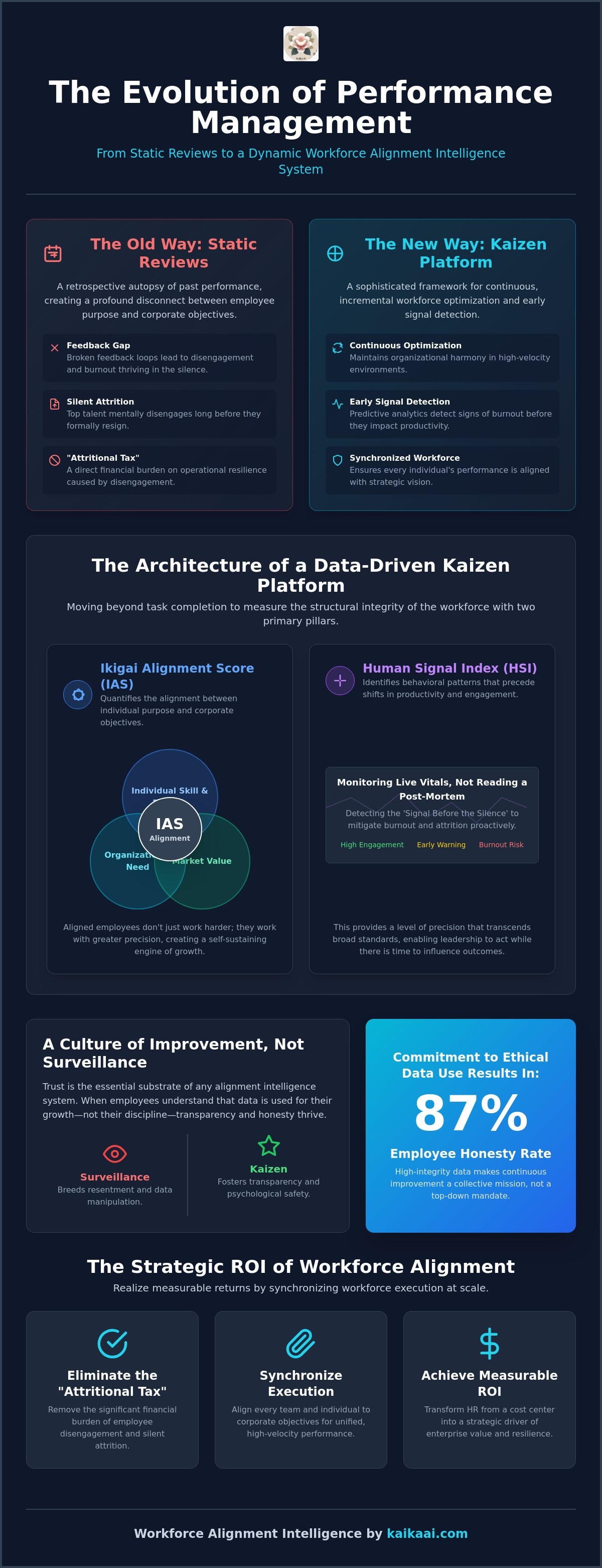
The traditional annual performance review is an architectural failure in the modern enterprise. In a high-velocity global economy, waiting twelve months to calibrate individual contributions against shifting corporate objectives is a strategic liability. Static, retrospective evaluations offer little more than an autopsy of past performance; they fail to provide the real-time intelligence required for proactive leadership. This obsolescence has necessitated a shift toward the data-driven Kaizen platform, a sophisticated framework designed for continuous, incremental workforce optimization.
This evolution represents a transition from simply managing output to synchronizing organizational synergy across every division. While standard continuous performance management software often focuses on task completion, a Kaizen-led approach integrates the Continual Improvement Process into the daily flow of work. It moves beyond superficial metrics to address the human truth beneath the data. Traditional HR analytics often miss the subtle shifts in sentiment and alignment that precede a decline in productivity, leaving leaders blind to the structural integrity of their teams.
The Cost of the Feedback Gap
Delayed intervention carries a heavy financial burden. When feedback loops are broken, disengagement and burnout thrive in the silence. This "feedback gap" manifests as silent attrition, where top talent mentally checks out long before they formally resign. The financial impact of this disengagement is a direct tax on operational resilience. Leaders can't afford to guess at workforce health. Success in a volatile market requires quantifying team synergy to identify friction points before they escalate into systemic failures.
Continuous Improvement vs. Continuous Surveillance
Trust is the essential substrate of any alignment intelligence system. There's a critical distinction between responsible AI-driven intelligence and invasive workplace monitoring. Surveillance breeds resentment and data manipulation; Kaizen fosters transparency and psychological safety. When employees understand that data is used for their growth rather than their discipline, honesty rates soar. In focused pilot programs, this commitment to ethical data use has resulted in an 87% employee honesty rate. High-integrity data allows for a culture where continuous improvement is a collective mission rather than a top-down mandate.
The Architecture of a Data-Driven Kaizen Platform
Traditional systems focus exclusively on the output of labor. A data-driven Kaizen platform focuses on the structural integrity of the workforce. It utilizes the Ikigai Intelligence Framework (IIF) to bridge the gap between individual aspirations and the organizational mission. This isn't just a feature set; it's a strategic reimagining of how continuous performance management software functions at an enterprise level. By moving beyond task completion, the platform creates a synchronized ecosystem where personal purpose and corporate velocity are inextricably linked.
The platform relies on two primary pillars: the Ikigai Alignment Score (IAS) and the Human Signal Index (HSI). While the IAS measures the intersection of skill, passion, and organizational need, the HSI identifies behavioral patterns that precede shifts in productivity. These indices provide a level of precision that transcends the broad standards often seen in Federal Performance Management frameworks. Instead of retrospective reports, real-time dashboards enable leadership to act while there is still time to influence outcomes. It's the difference between reading a post-mortem and monitoring a live vitals stream.
Measuring Purpose with the Ikigai Alignment Score
Purpose is a measurable driver of enterprise value. Aligned employees don't just work harder; they work with greater precision. The IAS quantifies this alignment, pinpointing exactly where cross-departmental synergy is lacking. By integrating these metrics into the standard performance workflow, leadership can identify mission-critical gaps before they impact the bottom line. It's about moving from hope to certainty. When an individual's "Ikigai" or reason for being aligns with their role, the resulting engagement becomes a self-sustaining engine of growth.
The Role of Real-Time Productivity Metrics
Static reports are historical artifacts. Real-time metrics track workforce velocity and operational resilience, using AI to identify bottlenecks in complex, multi-divisional architectures. These tools look for the "Signal before the Silence," identifying the subtle friction points that lead to disengagement. Protecting this sensitive data is paramount. Utilizing a secure employee analytics platform ensures that high-stakes intelligence remains confidential and compliant. Strategic leaders recognize that raw data requires a framework for interpretation. To see how this alignment functions in practice, consider scheduling an Alignment Audit to evaluate your current workforce architecture.
Detecting the 'Signal Before the Silence': Burnout and Resilience
Performance isn't merely a measure of current velocity. It's a reflection of structural endurance. While standard continuous performance management software might flag a drop in KPIs after the damage is done, a data-driven Kaizen platform operates with predictive foresight. The Employee Human Signal Index (EHSI) provides the technical resolution necessary to detect psychological fatigue long before it crystallizes into attrition or decreased output. This capability allows leadership to identify the "Signal before the Silence," preserving the organizational harmony essential for long-term workforce sustainability.
Ethical governance remains the foundation of this intelligence. As of July 2026, the regulatory landscape, including the EU AI Act and California's CPRA, demands rigorous transparency and human oversight for AI-supported HR insights. A responsible Kaizen platform doesn't just monitor; it protects. By prioritizing data minimization and psychological safety, organizations can achieve the high levels of trust required for accurate reporting. In pilot programs involving 340 participants, this commitment to ethical transparency contributed to an 87% employee honesty rate, ensuring that the signals detected are grounded in human truth rather than defensive posturing.
Clinical Precision in Performance Intelligence
The EHSI is the result of a deliberate collaboration between AI systems engineers and clinical psychologists. This interdisciplinary approach identifies leading indicators of psychological strain, such as subtle shifts in communication cadence or engagement patterns in high-pressure environments. In large-scale Japanese corporations, these early detection protocols have proven vital. By recognizing these patterns early, executives can intervene with precision, reducing turnover and maintaining the institutional knowledge that is often lost during periods of high stress.
From Burnout to Operational Resilience
Resilience is the primary metric for 2026 leadership. It's no longer enough to track output; executives must measure workforce stamina. A data-driven Kaizen platform enables teams to move from reactive crisis management to dynamic workload adjustment. When intelligence indicates a decline in the EHSI, leadership can re-align teams and redistribute resources to prevent systemic failure. This proactive synchronization ensures that institutional growth isn't sacrificed for short-term gains. Building operational resilience requires a commitment to the "Signal before the Silence" mission, transforming potential vulnerabilities into a framework for collective strength.
Implementing the Sugihara Bridge Model: AI Meets Human Judgment
The transition from legacy systems to a Kaizen-driven architecture requires more than a software installation. It demands a structured methodology that bridges the gap between algorithmic output and executive wisdom. The Sugihara Bridge Model serves as this essential conduit, ensuring that the intelligence gathered by continuous performance management software is translated into meaningful organizational evolution. This hybrid approach acknowledges that while AI can detect patterns, only human judgment can navigate the nuances of corporate culture and individual purpose.
The implementation process follows a methodical, three-phase trajectory. Phase 1 begins with Architectural Consultation, where leadership mindsets are aligned with the Kaizen framework to ensure top-down commitment. Phase 2 involves the precision deployment of the Ikigai Intelligence Framework (IIF) across enterprise divisions, integrating disparate data points into a unified alignment system. Finally, Phase 3 focuses on Collective Kaizen, utilizing structured team alignment workshop ideas to solidify synergy at the departmental level. This progression ensures that the platform becomes a living part of the organizational fabric rather than a superficial overlay.
The Hybrid Intelligence Advantage
Algorithm speed is a powerful tool, yet it lacks the cultural nuance required for high-stakes leadership decisions. The Sugihara Bridge Model utilizes trained consultants to interpret the Human Signal Index (HSI), providing a layer of empathy and strategic foresight that AI cannot replicate. These experts help leaders distinguish between transient stress and systemic burnout risk, ensuring that interventions are both timely and compassionate. Acting on workforce data requires wisdom; a hybrid intelligence model provides the balance necessary to maintain organizational harmony without sacrificing operational velocity.
Scaling Alignment Across Global Divisions
Maintaining a consistent workforce alignment software standard across diverse geographical regions presents unique challenges. Cultural variations in the Ikigai philosophy must be respected while ensuring that strategic goals cascade seamlessly from the C-suite to individual contributors. The Sugihara Bridge Model facilitates this global synchronization by providing a localized yet unified framework for performance. This architectural consistency allows global enterprises to achieve resilience at scale, ensuring every division moves in harmony with the central mission. To begin this transformation within your own organization, consider scheduling a specialized Executive Consultation to map your path toward workforce alignment.
The Strategic ROI of Workforce Alignment Intelligence
Strategic value in the modern enterprise is measured by the structural integrity of its human capital. While legacy continuous performance management software often treats ROI as a byproduct of administrative efficiency, a data-driven Kaizen platform identifies it as the primary outcome of workforce synchronization. The most immediate financial gain is the reduction of the "Attritional Tax." This hidden levy represents the compounded costs of recruitment, lost institutional knowledge, and the disruption of team velocity when top talent departs. By detecting the signal before the silence, leadership can preserve high-value assets and redirect those resources toward innovation.
Operational resilience is further strengthened through accelerated workforce velocity. When individual purpose is synchronized with the corporate mission, goal execution moves from a series of friction-filled steps to a state of collective flow. This alignment is reflected in measurable proof points, including a Net Promoter Score (NPS) of 72 among participants in recent workforce intelligence programs. High-integrity data serves as the foundation for this success. When employees operate within a framework of psychological safety, honesty rates reach 87%, providing executives with a clear, undistorted view of organizational health.
Quantifying the Intangible
Culture is no longer a vague atmospheric quality; it's a measurable performance asset. A data-driven Kaizen platform transforms subjective sentiment into objective indices, allowing for a direct correlation between alignment scores and quarterly revenue targets. When teams move in harmony, the reduction in misdirected effort creates a leaner, more responsive architecture. Workforce alignment ROI is fundamentally defined by the capacity to achieve an 87% employee honesty rate, ensuring that strategic decisions are based on the actual state of the workforce rather than curated reports.
The Future of Corporate Governance
The vision for a dual listing on the Tokyo Stock Exchange (TSE) and the Australian Securities Exchange (ASX) underscores a commitment to global standards of transparency and accountability. This strategic trajectory reflects the increasing demand for proactive intelligence in corporate governance. Preparing for the 2032 workforce landscape requires a shift from reactive management to a philosophy of continuous, incremental evolution. Organizations that embrace this framework today will define the category leadership of tomorrow. The mandate for modern leadership is clear: hear the signal before the silence and secure the future of your institutional resilience.
Securing the Future of Organizational Resonance
The evolution of the modern enterprise requires a decisive shift from managing labor to synchronizing purpose. By integrating the Ikigai Intelligence Framework with the predictive capabilities of the EHSI, leaders can finally address the structural disconnects that drive silent attrition. This transition ensures that every individual’s contribution is calibrated for maximum institutional velocity. Unlike standard continuous performance management software, a data-driven Kaizen platform provides the architectural clarity needed to maintain resilience in a volatile global economy.
Our methodology is grounded in academic rigor through strategic partnerships with Waseda University and remains compliant with the most stringent Japanese privacy standards. This commitment to ethical intelligence is validated by a pilot NPS of 72. True category leadership belongs to those who act on workforce signals with both technical precision and strategic wisdom. The path to lasting excellence starts with a commitment to organizational harmony and collective growth.
Request Early Access to the Kaika AI Alignment Intelligence Platform to begin the process of transforming your workforce into a synchronized engine of growth. Embrace the intelligence required to hear the signal before the silence.
Frequently Asked Questions
What is a data-driven Kaizen platform?
A data-driven Kaizen platform is a sophisticated intelligence system designed for continuous, incremental workforce optimization. It transcends basic task tracking by synchronizing individual purpose with organizational objectives through real-time data. This framework fosters a culture of persistent evolution, ensuring that every departmental shift contributes to the collective mission. It transforms performance from a static administrative requirement into a dynamic engine for institutional resilience and strategic growth.
How does continuous performance management differ from traditional reviews?
Traditional reviews are retrospective autopsies that fail to capture the high-velocity nature of modern business. In contrast, continuous performance management software provides a real-time feedback loop for immediate calibration. It allows leaders to identify friction points as they occur, moving beyond annual evaluations to a state of persistent alignment. This proactive approach ensures that workforce contributions remain synchronized with shifting corporate goals throughout the entire fiscal cycle.
Is the Ikigai Intelligence Framework compatible with Western corporate cultures?
The Ikigai Intelligence Framework is highly compatible with Western cultures because it addresses the universal human need for meaningful work. While the terminology is Japanese, the metrics focus on the intersection of skill, passion, and organizational necessity. This alignment is a global prerequisite for high performance. By quantifying purpose through the Ikigai Alignment Score, the framework provides a structured methodology for mission-critical synchronization across diverse geographical divisions.
How does Kaika AI ensure employee data privacy and security?
Security is maintained through strict adherence to global privacy regulations, including GDPR and California's CPRA. The platform utilizes advanced encryption and data minimization to protect sensitive workforce signals. Transparency remains our primary substrate for trust. This rigorous approach to data ethics is why we achieve an 87% employee honesty rate, ensuring that the intelligence gathered is both accurate and protected from unauthorized access or misuse.
Can AI really predict employee burnout and attrition?
Predictive AI identifies the subtle behavioral patterns and sentiment shifts that precede a decline in productivity. The Employee Human Signal Index (EHSI) serves as a clinically informed radar for psychological strain, detecting the "Signal before the Silence." This foresight enables leadership to adjust workloads or re-align teams before burnout leads to attrition. It's a proactive defense against the financial burden of the "Attritional Tax" and lost institutional knowledge.
What is the Sugihara Bridge Model in performance management?
The Sugihara Bridge Model is a hybrid implementation methodology that integrates AI-driven efficiency with expert human judgment. It recognizes that while algorithms can process vast datasets, only trained consultants can interpret the nuances of corporate culture. This model ensures that sensitive workforce signals are handled with wisdom and strategic foresight. It acts as the essential conduit between technical intelligence and the practical realities of high-stakes executive leadership.
How long does it take to see ROI from a workforce alignment intelligence platform?
Organizations typically gain critical visibility into workforce alignment gaps within the first 90 days of deployment. The strategic ROI manifests as a reduction in turnover and an acceleration of workforce velocity through synchronized goal execution. Over time, the platform eliminates the hidden costs of disengagement and silent attrition. Measuring the direct financial gain involves tracking the stabilization of team synergy and the consistent achievement of quarterly revenue targets.
What is the role of a clinical psychologist in Kaika AI’s software?
Clinical psychologists provide the foundational expertise required to develop the Employee Human Signal Index. They work alongside AI engineers to ensure that burnout detection is based on legitimate psychological strain indicators rather than superficial output metrics. This interdisciplinary approach ensures that the platform functions as a responsible tool for organizational harmony. Their involvement guarantees that the intelligence gathered is both clinically sound and uncompromisingly focused on human potential.
Disclaimer
#Disclaimer
At Kaika AI, we believe the future belongs to organizations that combine human wisdom with artificial intelligence responsibly. The articles, research, insights, and thought leadership published on this website are intended to educate, inform, and encourage meaningful conversations about the future of work, organizational intelligence, AI, leadership, and innovation.
While our content is developed through rigorous research and may be generated, curated, or enhanced using artificial intelligence, every effort is made to ensure it reflects thoughtful analysis, practical relevance, and responsible AI practices. However, no representation or warranty is made regarding the completeness, accuracy, or suitability of the information for every individual or organizational circumstance.
The ideas, opinions, frameworks, and recommendations shared by Kaika AI are provided for educational and informational purposes only. They should not be interpreted as legal, financial, medical, psychological, human resources, cybersecurity, or other professional advice. Organizations and individuals should seek qualified professional guidance before making strategic, legal, or operational decisions.
Where articles reference third-party organizations, products, services, academic research, industry reports, or public data, such references are provided solely to support discussion and analysis. Unless explicitly stated, they do not imply endorsement, partnership, or affiliation.
Artificial intelligence is a powerful decision-support technology—not a replacement for human judgment. Kaika AI advocates for responsible, transparent, and human-centered AI adoption. We encourage readers to critically evaluate information, consider their unique context, and combine AI-generated insights with professional expertise and sound decision-making.
The content published on this website may be updated, revised, or removed as knowledge, technology, regulations, and best practices continue to evolve.
To the fullest extent permitted by applicable law, Kaika AI, its affiliates, contributors, and partners disclaim liability for any direct, indirect, incidental, consequential, or other losses arising from the use of, or reliance upon, the information provided on this website.
By accessing or using this website, you acknowledge that you have read, understood, and agree to this Disclaimer.
Kaika AI
'Building trusted organizational intelligence for the AI Era'


