
What if the primary cause of organizational friction isn't a lack of technical skill, but a structural deficit in existential resonance? Most leaders understand that competitive compensation alone can't prevent silent attrition or bridge the gap between high-level strategy and daily execution. You've likely felt the frustration of watching talented teams operate at half-capacity because their individual drivers don't sync with corporate objectives. Linking employee purpose to KPIs is the strategic solution to this disconnect, transforming abstract sentiment into a lead indicator of workforce velocity.
This article provides a data-driven blueprint to stabilize your operational foundation through the Ikigai Intelligence Framework. You'll discover how to move beyond superficial engagement surveys to measure the structural integrity of human potential using precise indices. We'll examine the Sugihara Bridge Model as a method for architectural alignment, ensuring every metric serves both the individual's mission and the enterprise's bottom line. By the end, you'll possess a methodical approach to reducing burnout and securing a measurable ROI on your alignment initiatives.
Key Takeaways
- Identify the structural limitations of traditional metrics and why the "Purpose-Performance Gap" leads to silent attrition among high-performing talent.
- Quantify human potential through a systematic approach by linking employee purpose to KPIs using the Ikigai Intelligence Framework and the Ikigai Alignment Score.
- Utilize the Sugihara Bridge Model to architecturally integrate AI-driven human insights with executive leadership strategy for seamless organizational synchronization.
- Transform abstract workforce engagement into measurable operational resilience by shifting from reactive retention to a philosophy of Collective Kaizen.
The Invisible Disconnect: Why Traditional KPIs Fail Without Purpose Alignment
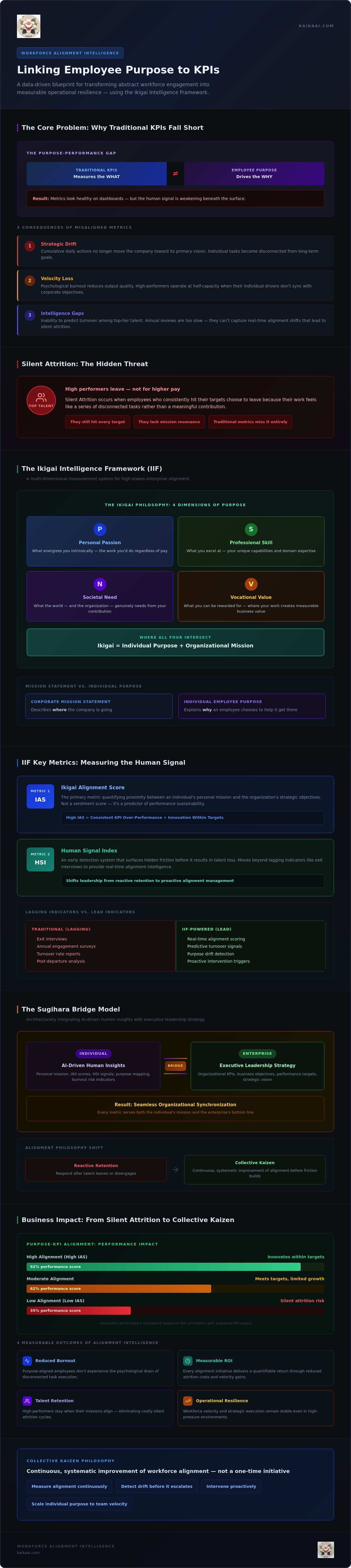
Traditional management frameworks often treat Key Performance Indicators (KPIs) as the absolute arbiter of organizational health. This perspective is incomplete. When leadership prioritizes quantitative output over qualitative resonance, they create a Purpose-Performance Gap. This is a state where team members meet every numerical milestone while the structural integrity of the organization's culture erodes. Metrics might appear positive on a dashboard, but beneath the surface, the "human signal" is weakening.
The most devastating consequence of this gap is Silent Attrition. This phenomenon occurs when high-performing employees, those who consistently hit their targets, choose to leave because they no longer feel a sense of mission resonance. They aren't leaving for higher pay; they're leaving because their work feels like a series of disconnected tasks rather than a meaningful contribution. Standard top-down KPI cascading often ignores the individual drivers of the workforce, treating employees as modular components rather than dynamic contributors with their own aspirations. Workforce Alignment Intelligence is the necessary evolution of HR analytics, providing the tools to measure this hidden friction before it results in talent loss.
The High Cost of Misaligned Metrics
The financial impact of disengaged high-performers is a heavy burden on enterprise growth. When KPIs focus only on the "what" and ignore the "why," organizations experience strategic drift. This happens when the cumulative actions of the workforce no longer move the company toward its primary vision. In high-velocity environments, annual reviews are an obsolete tool. They're too slow to capture the real-time shifts in alignment that lead to burnout. Misaligned metrics create organizational friction, which slows down execution and reduces the overall ROI of every engagement initiative.
- Strategic Drift: Misalignment between daily tasks and long-term goals.
- Velocity Loss: Reduced output quality due to psychological burnout.
- Intelligence Gaps: Inability to predict turnover among top-tier talent.
Defining Purpose in the Enterprise Context
It's vital to distinguish between a corporate mission statement and individual purpose. A mission statement describes where the company is going, while individual purpose explains why an employee chooses to help it get there. The Ikigai philosophy provides a framework for this, identifying the intersection of personal passion, professional skill, and societal need. Workforce alignment is the synchronization of personal mission and organizational architecture. The strategic process of linking employee purpose to KPIs ensures that high-velocity execution doesn't come at the cost of human potential. By aligning these two forces, leadership can transform performance metrics from a source of stress into a roadmap for collective success.
The Ikigai Intelligence Framework: Quantifying the Human Signal
Precision is the antidote to attrition. While traditional HR tools rely on lagging indicators like exit interviews, the Ikigai Intelligence Framework (IIF) operates as a multi-dimensional measurement system designed for the high-stakes enterprise. It doesn't just track activity; it surfaces the human truths beneath the data. By linking employee purpose to KPIs, this framework provides executive leadership with a high-fidelity map of organizational harmony and operational risk. It moves beyond superficial engagement scores to analyze the structural integrity of the workforce.
Measuring the Ikigai Alignment Score (IAS)
The IAS serves as the primary metric for quantifying the proximity between an individual's personal mission and the organization's strategic objectives. It isn't a simple sentiment score; it's a predictor of performance sustainability. There's a documented correlation between high IAS results and consistent KPI over-performance. When an employee's work aligns with their internal drivers, they don't just meet targets; they innovate within them. To understand how these metrics integrate with your existing technology stack, consult The Definitive Guide to Workforce Alignment Software. This synchronization ensures that individual growth and corporate velocity move in the same direction.
Early Detection via the Human Signal Index
The Human Signal Index (HSI) functions as a leading indicator, identifying subtle behavioral shifts before they manifest in declining productivity. Traditional metrics often miss the "silence" that precedes a resignation. AI plays a critical role here, surfacing these signals with surgical precision to alert leadership of potential friction. To ensure the integrity of this data, the system utilizes the Employee Human Signal Index (EHSI). This index is built on clinical foundations to detect early markers of burnout, allowing for proactive intervention rather than reactive damage control. Organizations seeking to stabilize their workforce velocity often begin with a Workforce Alignment Intelligence Platform to bridge the gap between intent and execution.
Trust is the currency of alignment. In pilot programs, the IIF achieved an 87% employee honesty rate. This high level of transparency proves that when individuals feel their purpose is a recognized component of the organizational architecture, they provide more accurate and actionable data. By utilizing these indices, CHROs can identify the "signal before the silence," protecting the enterprise from the hidden costs of disengagement and ensuring long-term operational resilience.
Strategic Mapping: Translating Individual Purpose into Operational KPIs
Precision in translation is the cornerstone of organizational harmony. Mapping individual drivers to organizational output requires more than a simple shift in perspective; it requires a structural reconfiguration of performance management. While traditional frameworks focus solely on quantitative volume, linking employee purpose to KPIs introduces a qualitative multiplier that accelerates execution. This process involves a methodical translation of "soft" personal missions into "hard" operational metrics. By establishing a direct line between an employee's Ikigai and their daily targets, leadership ensures that every unit of effort contributes to both personal fulfillment and corporate velocity.
The Purpose-KPI Integration Matrix
Traditional output KPIs measure the final result, yet they often ignore the underlying energy required to achieve them. A purpose-aligned KPI framework utilizes "Alignment Weights" to adjust standard performance goals based on their resonance with an individual's drivers. This approach treats purpose as the primary velocity factor in KPI achievement. When alignment is high, the psychological friction of high-volume tasks decreases, leading to more resilient performance. Consider the shift in focus between these two metric styles:
- Traditional KPI: "Reduce customer churn by 5%." This focuses on a defensive, revenue-protection metric.
- Purpose-Aligned KPI: "Increase successful client outcomes by 5% through proactive mission-driven support." This focuses on the employee's desire to provide value and solve problems.
This mapping process must occur within a secure, enterprise-grade architecture. Handling sensitive human data requires strict adherence to privacy-compliant protocols, ensuring that personal insights are used for alignment rather than surveillance. Transparency in data usage fosters the trust necessary for the system to function effectively at a global scale.
Monitoring Burnout Risk in High-Performance Teams
Strategic mapping is only sustainable if it accounts for the physiological and psychological limits of the workforce. By utilizing the Employee Human Signal Index (EHSI), leaders can monitor resilience metrics alongside traditional output metrics. This ensures that aggressive KPI targets do not compromise the long-term health of the team. The EHSI is built on clinical psychology foundations, using responsible AI to detect early indicators of strain. For a deeper analysis of these lead indicators, see Leading Indicators of Employee Burnout. This clinical grounding prevents the "performance at any cost" mentality that leads to catastrophic turnover, replacing it with a model of sustainable, high-velocity growth.
Executing Alignment: The Sugihara Bridge Model in Action
Software alone cannot solve structural misalignment. Execution in a complex enterprise demands a culturally nuanced integration method that respects the human element. The Sugihara Bridge Model serves as the architectural connection between raw AI data and strategic human leadership. This phase-based methodology ensures that linking employee purpose to KPIs isn't a static event but a dynamic, evolving process. It transforms the abstraction of alignment into a concrete operational workflow that balances executive vision with individual mission resonance.
The process begins with the Measurement Phase, where the Ikigai Intelligence Framework (IIF) is deployed across the enterprise to capture high-fidelity alignment signals. This is followed by the Interpretation Phase, where AI-driven insights are paired with human consultants to contextualize behavioral patterns. Finally, the Action Phase utilizes these refined insights to implement data-driven Kaizen. This structured approach allows leadership to close alignment gaps with surgical precision, ensuring that workforce velocity remains high without compromising structural integrity.
The Hybrid Intelligence Advantage
AI alone is insufficient for the delicate nature of workforce transformation. While algorithms excel at high-volume pattern recognition, they lack the emotional nuance required for sensitive leadership interventions. The role of human judgment is critical in interpreting HSI and EHSI signals, providing the necessary context that a machine might overlook. By maintaining this hybrid model, organizations build trust through transparency and ethical AI use. This ensures that data serves as a tool for empowerment rather than a mechanism for surveillance, fostering a culture of psychological safety and institutional reliability.
Implementing Collective Kaizen
Real-time alignment scores provide the necessary data to drive continuous improvement workshops. Moving away from the stagnation of annual reviews, this framework fosters a "continuous performance" mindset where organizational health is monitored and optimized daily. To institutionalize this philosophy, leadership can utilize Collective Kaizen Workshops to bridge the gap between individual purpose and team output. For a technical analysis of how these systems operate at scale, consult The Executive Guide to Data-Driven Kaizen Platforms. This systematic approach ensures that every team member remains synchronized with the enterprise's evolving strategic architecture.
From Silent Attrition to Collective Kaizen: The Business Impact
The transition from reactive attrition management to a proactive philosophy of Collective Kaizen represents a fundamental shift in enterprise architecture. By linking employee purpose to KPIs, organizations don't just improve morale; they stabilize their operational foundation. The measurable impact of this alignment extends beyond simple engagement scores, manifesting in the structural integrity of the workforce and the velocity of strategic execution. This isn't merely about higher profitability; it's about building an organization capable of enduring high-stakes market volatility through deep-seated human resonance.
Operational Resilience is the ultimate byproduct of this synchronization. When individual drivers are architecturally linked to corporate milestones, the organization develops a self-correcting mechanism. Instead of waiting for quarterly results to identify failures, leadership can utilize real-time alignment data to pivot with precision. This creates a state of perpetual readiness, where the workforce isn't just responding to strategy but actively accelerating it through a shared sense of mission and purpose.
The ROI of Alignment Intelligence
The financial justification for alignment intelligence is rooted in the dramatic reduction of turnover costs. Silent attrition is an expensive drain on resources, often costing an enterprise significant amounts in lost productivity and recruitment fees. By utilizing early detection signals, leadership can intervene before the "silence" sets in. This proactive stance increases workforce velocity, ensuring that strategic initiatives move from conception to execution with minimal friction. Organizations that prioritize these metrics develop a superior form of Operational Resilience for Leadership, transforming their workforce into a high-fidelity intelligence asset.
The Future of Corporate Governance
Looking toward 2032, the landscape of corporate reporting will undergo a significant evolution. Institutional investors and regulatory bodies increasingly demand transparency regarding the social components of ESG metrics. Alignment Intelligence will move from a niche advantage to a standard requirement for corporate governance. Kaika AI is positioned to lead this category, providing the high-fidelity data necessary for sophisticated institutional reporting. As we approach the target date for TSE/ASX dual listing in 2032, our focus remains on shaping the next generation of global enterprises through the intersection of technology and human behavior.
Executive leadership must decide whether to remain reliant on lagging indicators or to adopt a framework that surfaces truth in real-time. The opportunity to request early access to the Kaika AI platform is now available for visionaries ready to evolve their organizational structure. It's time to hear the signal before the silence and secure your organization's future through architectural alignment.
Architecting the Future of Workforce Velocity
The transition from fragmented performance management to a unified alignment strategy is no longer optional for the global enterprise. We've established that the structural integrity of your organization depends on the synchronization of individual mission and corporate milestones. By linking employee purpose to KPIs, you transform abstract potential into a measurable lead indicator of success. This methodology moves your leadership beyond reactive retention toward a sustainable culture of Collective Kaizen.
Kaika AI provides the precision tools required for this evolution. Our framework is supported by an academic partnership with Waseda University and features clinically-validated burnout detection to protect your most valuable assets. With a pilot NPS of 72, our platform demonstrates the power of surfacing human truths beneath the data. You're invited to request early access to the Kaika AI Workforce Alignment Platform and secure the signal before the silence. Let's build a more harmonious and resilient future together.
Frequently Asked Questions
How do you measure something as subjective as employee purpose?
The Ikigai Intelligence Framework (IIF) quantifies existential resonance through specific, data-driven indices. It converts qualitative drivers into the Ikigai Alignment Score (IAS) by analyzing the proximity between individual missions and strategic goals. This creates a rigorous baseline for what was previously considered unmeasurable sentiment. The system surfaces human truths beneath the data, allowing for precise structural adjustments that traditional analytics cannot provide.
Can linking purpose to KPIs actually prevent burnout?
Yes, by utilizing the Employee Human Signal Index (EHSI), the system identifies early psychological strain markers with clinical precision. Linking employee purpose to KPIs ensures that workload is perceived as meaningful rather than purely transactional. This grounding allows leadership to adjust targets before they lead to catastrophic exhaustion. It transforms performance management into a tool for sustainable growth and long-term operational resilience.
How does the Ikigai Alignment Score (IAS) differ from a standard engagement survey?
Standard surveys are lagging indicators that capture surface-level sentiment at a single point in time. The IAS is a predictive, real-time metric that measures structural alignment. It doesn't just ask if an employee is happy; it evaluates the synchronization between their personal drivers and the organization's strategic architecture. This provides a more accurate map of organizational health and performance sustainability across the entire enterprise.
Is the data used for purpose-mapping private and secure?
All data is handled within a privacy-compliant, enterprise-grade architecture that prioritizes ethical use and transparency. The platform uses anonymized signals to surface organizational trends while protecting individual identities. This ensures that the framework remains a tool for alignment rather than a mechanism for invasive surveillance. Trust is maintained through rigorous data governance standards that meet the requirements of global scale organizations.
What is the Sugihara Bridge Model and why is it necessary?
The Sugihara Bridge Model is a phase-based methodology that integrates AI-driven data with human leadership judgment. It's necessary because raw data lacks the cultural nuance and emotional intelligence required for sensitive interventions. This model provides the architectural framework to translate digital signals into meaningful organizational change. It ensures that data-driven insights are applied with the strategic wisdom necessary for complex workforce transformations.
How long does it take to see results from a workforce alignment platform?
Initial alignment signals are typically visible within the first 30 to 90 days of deployment. While structural cultural shifts take longer, early indicators like the Human Signal Index (HSI) provide immediate insights into workforce velocity. Organizations often see measurable improvements in employee honesty and strategic execution speed within the first two quarters. This allows for rapid iteration and the early closing of alignment gaps.
Does this framework work for global divisions outside of Japan?
The framework is designed for global scale and functions effectively across diverse cultural contexts. While rooted in the Japanese philosophy of Ikigai, the underlying principles of human potential and organizational harmony are universal. The system adapts to various leadership mindsets while maintaining a consistent standard for measuring structural alignment. This makes it an ideal tool for multinational corporations seeking to synchronize disparate divisions under a unified vision.
What role does AI play in purpose-based performance management?
AI acts as the signal before the silence, identifying behavioral patterns that human observation often misses. It processes high-volume data to surface lead indicators of disengagement and burnout. By linking employee purpose to KPIs through intelligent algorithms, the platform provides the precision necessary for high-velocity enterprise management. This allows CHROs to move from reactive troubleshooting to proactive organizational optimization with surgical accuracy.
Disclaimer
#Disclaimer
At Kaika AI, we believe the future belongs to organizations that combine human wisdom with artificial intelligence responsibly. The articles, research, insights, and thought leadership published on this website are intended to educate, inform, and encourage meaningful conversations about the future of work, organizational intelligence, AI, leadership, and innovation.
While our content is developed through rigorous research and may be generated, curated, or enhanced using artificial intelligence, every effort is made to ensure it reflects thoughtful analysis, practical relevance, and responsible AI practices. However, no representation or warranty is made regarding the completeness, accuracy, or suitability of the information for every individual or organizational circumstance.
The ideas, opinions, frameworks, and recommendations shared by Kaika AI are provided for educational and informational purposes only. They should not be interpreted as legal, financial, medical, psychological, human resources, cybersecurity, or other professional advice. Organizations and individuals should seek qualified professional guidance before making strategic, legal, or operational decisions.
Where articles reference third-party organizations, products, services, academic research, industry reports, or public data, such references are provided solely to support discussion and analysis. Unless explicitly stated, they do not imply endorsement, partnership, or affiliation.
Artificial intelligence is a powerful decision-support technology—not a replacement for human judgment. Kaika AI advocates for responsible, transparent, and human-centered AI adoption. We encourage readers to critically evaluate information, consider their unique context, and combine AI-generated insights with professional expertise and sound decision-making.
The content published on this website may be updated, revised, or removed as knowledge, technology, regulations, and best practices continue to evolve.
To the fullest extent permitted by applicable law, Kaika AI, its affiliates, contributors, and partners disclaim liability for any direct, indirect, incidental, consequential, or other losses arising from the use of, or reliance upon, the information provided on this website.
By accessing or using this website, you acknowledge that you have read, understood, and agree to this Disclaimer.
Kaika AI
'Building trusted organizational intelligence for the AI Era'


