
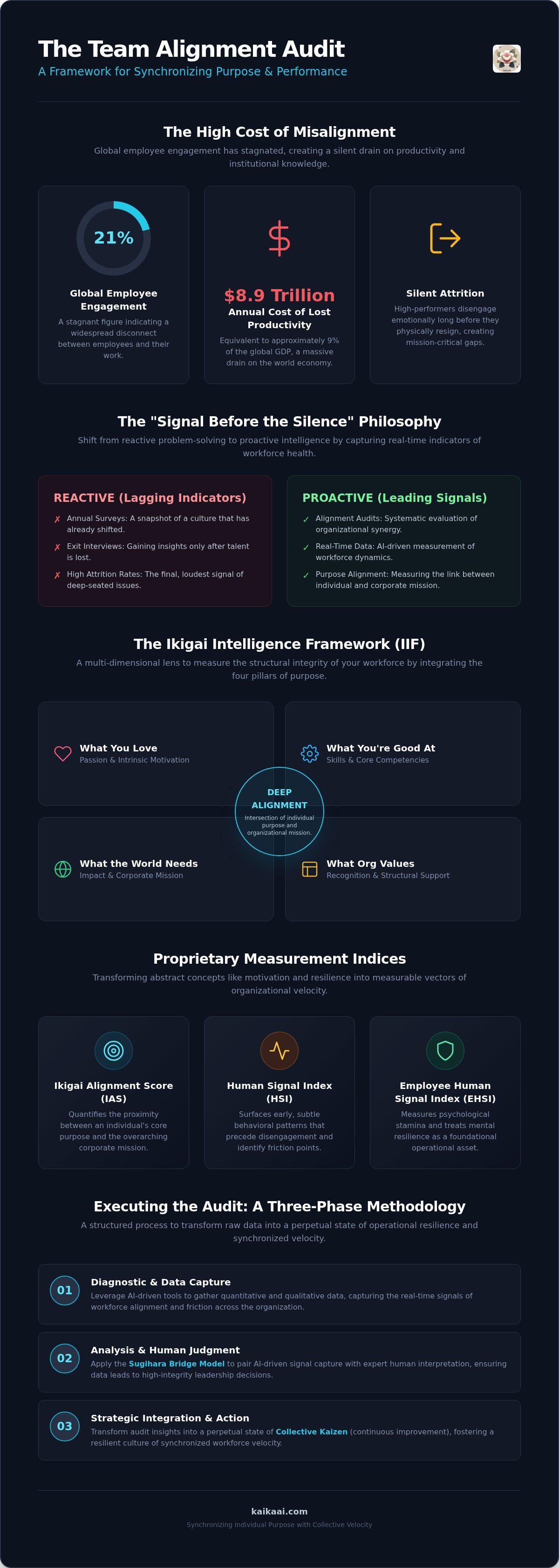
Global employee engagement has stagnated at 21%, costing the world economy an estimated $8.9 trillion in lost productivity annually. For executive leadership, the most dangerous threat isn't a visible crisis but the silent attrition of high-performers who meet their KPIs while drifting away from the corporate mission. You likely recognize the friction of fragmented silos and the high burnout risk that persists despite your best technological investments. Learning how to conduct a team alignment audit is the first step toward restoring structural integrity to your workforce.
This article provides a sophisticated roadmap for organizational synergy, moving beyond superficial surveys to a data-driven methodology that surfaces the human truth beneath your workforce data. We'll examine a strategic intelligence framework designed to synchronize individual purpose with collective velocity. By the end, you'll master a methodology that pairs AI-driven measurement with human judgment to ensure your strategic vision translates into operational reality. This approach allows you to identify the signal before the silence, foster collective Kaizen, and synchronize individual purpose with mission.
Key Takeaways
- Identify hidden organizational friction before it scales into silent attrition by adopting a "signal before the silence" diagnostic approach.
- Master a rigorous three-phase methodology on how to conduct a team alignment audit to synchronize executive architectural vision with daily operational execution.
- Utilize the Ikigai Intelligence Framework (IIF) and proprietary indices like the Ikigai Alignment Score (IAS) to measure the precise proximity between individual purpose and corporate mission.
- Leverage the Sugihara Bridge Model to pair AI-driven signal capture with expert human judgment, ensuring sensitive workforce data leads to high-integrity leadership decisions.
- Transform static audit insights into a perpetual state of collective Kaizen, fostering a culture of operational resilience and synchronized workforce velocity.
Understanding the Team Alignment Audit: Signal Before the Silence
An alignment audit is not a mere administrative checklist. It's a systematic evaluation of organizational synergy that measures the precise synchronization between individual purpose and the overarching corporate mission. For executive leadership, understanding strategic alignment is the difference between a high-velocity workforce and a stagnant one. Most leaders wait for an exit interview to ask what went wrong. By then, the talent has already left. Our "Signal Before the Silence" philosophy shifts this timeline. It identifies structural friction before it manifests as attrition or stalled strategy. It finds the quiet indicators of disconnect before they become loud failures.
CHROs must move beyond reactive problem-solving. Traditional annual surveys fail here because they provide a lagging indicator of a culture that has already shifted. They lack the granularity needed to navigate modern enterprise workforce shifts. Learning how to conduct a team alignment audit allows leaders to capture real-time signals. It transforms workforce management into a proactive intelligence operation. It moves the needle from guessing to knowing.
The High Cost of Misalignment
Misalignment is a structural failure that drains institutional knowledge. When departments operate in silos, they impede workforce resilience metrics and stall strategic growth. Silent attrition occurs when top performers disengage emotionally long before they resign physically. This disconnect creates mission-critical gaps that reduce overall workforce velocity. A lack of synchronization means energy is wasted on conflicting priorities rather than collective progress. The financial impact is measurable. Low engagement costs the global economy $8.9 trillion annually, roughly 9% of global GDP, according to 2025 Gallup data.
The Ikigai Philosophy in Enterprise Alignment
True alignment requires a deeper framework than standard management tactics. We integrate the four pillars of Ikigai: what people love, what they are good at, what the world needs, and what the organization values. Most companies aim for simple engagement. We aim for deep-seated purpose alignment. It's about finding the intersection where an individual’s passion meets the company’s structural requirements. This isn't just philosophical; it's measurable. Advanced ai in employee engagement provides the data layer for this approach. It allows you to see the human truth beneath the numbers. When you understand how to conduct a team alignment audit through this lens, you build a resilient, purpose-driven architecture that thrives at scale.
The Ikigai Intelligence Framework: Measuring Structural Synergy
The Ikigai Intelligence Framework (IIF) serves as the definitive diagnostic instrument for large-scale enterprise health. It moves beyond the limitations of traditional performance metrics by evaluating the structural integrity of the human element. When executives evaluate how to conduct a team alignment audit, they require a multi-dimensional lens that captures both strategic intent and psychological reality. This framework provides that lens through three proprietary indices designed to measure the invisible architecture of your workforce. It creates a systematic bridge between the cold data of performance and the warm reality of human potential.
The Three Measurement Indices
The Ikigai Alignment Score (IAS) quantifies the qualitative sense of belonging by calculating the proximity between an individual's core purpose and the corporate mission. It transforms abstract motivation into a measurable vector of organizational velocity. Complementing this is the Human Signal Index (HSI), which surfaces early behavioral patterns that precede disengagement. This index identifies the subtle friction points where a team's collective efforts begin to deviate from the established model for linking behaviors to strategy. Finally, the Employee Human Signal Index (EHSI) measures psychological stamina. It treats mental resilience as the foundation of long-term alignment, ensuring that high performance doesn't come at the cost of systemic burnout. Without this psychological baseline, alignment remains a fragile, short-term achievement rather than a sustainable competitive advantage.
Clinical Validity in Workforce Data
Data integrity is paramount when handling sensitive workforce signals. We co-developed the EHSI with clinical psychologists to ensure that detection remains both ethical and accurate. This scientific rigor is why pilot programs utilizing our Workforce Alignment Intelligence Platform achieved an 87% employee honesty rate. By prioritizing transparency and psychological safety, we move beyond the "surveillance" stigma often associated with workforce analytics. Our methodology balances enterprise-grade security with stringent Japanese privacy standards, providing a secure environment for tracking sensitive signals. This partnership with clinical experts and academic institutions like Waseda University ensures that every data point serves the dual purpose of organizational excellence and human flourishing. Understanding how to conduct a team alignment audit requires this level of clinical depth to ensure that your strategic insights are grounded in the human truth of your workforce. This rigorous approach transforms raw data into a strategic asset that protects both the mission and the people who execute it.
Diagnostic Layers: Identifying Gaps Between Purpose and Performance
The architectural vision established during executive consultations often encounters significant friction when translated into daily operational execution. This disconnect creates mission-critical gaps where the strategic intent of the boardroom fails to manifest in the localized workflows of the organization. When analyzing how to conduct a team alignment audit, leadership must look beyond "surface alignment." Traditional metrics often celebrate teams for meeting KPIs, yet these same teams may be drifting away from the core mission. This is the fundamental difference between simple performance and structural alignment. We utilize AI for organizational health to identify these gaps in real-time, moving from static snapshots to dynamic, predictive intelligence. The Sugihara Bridge Model facilitates this by pairing sophisticated AI signal capture with expert human judgment, ensuring that complex workforce data translates into precise leadership strategy.
Detecting the Burnout-Productivity Correlation
High performance frequently masks a looming burnout crisis within mission-critical divisions. Teams that appear most productive on paper are often those closest to total systemic failure; their output is fueled by unsustainable effort rather than structural efficiency. By monitoring leading indicators of employee burnout, leaders can protect their most valuable talent before disengagement occurs. The Employee Human Signal Index (EHSI) serves as a predictive sensor, flagging psychological strain and declining stamina before these signals translate into attrition. This layer of the audit ensures that short-term velocity doesn't compromise long-term operational resilience. It allows for the detection of the "signal before the silence" that characterizes the departure of top-tier talent.
Cross-Departmental Synergy Analysis
Fragmented silos represent a primary obstacle to collective velocity. In many large-scale enterprises, departmental goals inadvertently contradict the overarching corporate mission, creating "silo friction" that wastes significant operational energy. A core component of how to conduct a team alignment audit involves measuring the internal synergy between cross-functional units. We analyze the characteristics of high-performance teams to ensure that every division pulls in the same strategic direction. Our data-driven Kaizen methodology improves cross-departmental velocity by optimizing these internal connections. This structural synchronization transforms fragmented units into a unified, high-integrity force capable of executing complex strategies with precision. By identifying where departmental objectives diverge, leadership can re-establish the balance required for sustained growth.
Executing the Audit: A Three-Phase Methodology
Operationalizing a strategy requires a disciplined, architectural approach that moves beyond the limitations of manual data collection. Knowing how to conduct a team alignment audit involves more than just distributing a questionnaire; it requires a structured intelligence operation. We utilize a three-phase methodology designed to synchronize executive vision with the daily reality of the global workforce. This process ensures that every data point serves as a catalyst for structural evolution rather than a static record of the past. By maintaining a low-friction interface, we target a weekly completion rate of 74% or higher, ensuring that the intelligence gathered remains current and actionable.
The following table delineates the architectural progression of the audit framework, moving from foundational intent to integrated strategic outcomes.
| Phase | Strategic Focus | Key Operational Outcome |
|---|---|---|
| Phase 1: Foundation | Structural Discovery | Executive "True North" and IAS baseline established. |
| Phase 2: Intelligence | Signal Capture | Real-time HSI and EHSI data processing via the IIF. |
| Phase 3: Synthesis | Strategic Integration | Sugihara Bridge Model application and bespoke action plans. |
Phase 1: Setting the Architectural Foundation
The process begins with executive-level architectural consultations to define the organization's "True North." Before cascading the audit to the broader workforce, we establish a baseline Ikigai Alignment Score (IAS) for the leadership team itself. This phase ensures that the strategic intent is clear and that the executive mindset is synchronized. We prioritize transparent communication regarding the "why" of the audit, which has led to an 87% honesty rate in our pilot programs. Establishing this foundation is critical for maintaining high participation rates and ensuring the integrity of the subsequent data capture.
Phase 2: Deploying the Intelligence Platform
Once the foundation is set, we deploy our proprietary intelligence platform to begin continuous measurement. Unlike traditional snapshot audits that provide outdated information, our system offers real-time performance dashboards. We capture the Human Signal Index (HSI) across diverse divisions and global locations, identifying subtle behavioral shifts before they impact the bottom line. Utilizing advanced workforce alignment software allows us to automate complex data processing while maintaining granular visibility. This phase transforms raw workforce signals into a dynamic map of organizational health and mission-critical gaps.
Phase 3: The Sugihara Bridge Model in Action
The final phase involves the Sugihara Bridge Model, where we pair AI-driven data with the expertise of trained human consultants. This hybrid approach avoids "data coldness" by interpreting sensitive signals with essential cultural nuance. This is particularly vital for Japanese corporate structures where harmony and perseverance may mask underlying disengagement. We develop bespoke integration plans for specialized divisions based on these nuanced audit findings. This ensures that the results of the audit lead to measurable structural impact and long-term operational resilience. To begin your own transformation, you can request an Alignment Audit from our strategic consultants today.
Strategic Integration: Transforming Audit Data into Collective Kaizen
The conclusion of a primary diagnostic phase marks the commencement of a deeper structural evolution. Once an executive team masters how to conduct a team alignment audit, the focus shifts from discovery to the maintenance of perpetual synchronization. This requires a transition from isolated insights to a state of data-driven Kaizen where alignment is treated as a living, breathing process. We build operational resilience through a three-phase structural framework that prioritizes the identification of friction before it manifests as attrition. By integrating continuous performance management software, leadership ensures that the human truth beneath the data remains a visible strategic priority. Our long-term vision targets institutional resilience and a high Net Promoter Score (NPS), which our proprietary frameworks have measured at 72 in large-scale enterprise environments.
Implementing Collective Kaizen Workshops
Implementing Collective Kaizen Workshops allows specific divisions to transform audit data into ground-up improvement initiatives. This phase demands a sophisticated leadership mindset shift, moving from the enforcement of top-down compliance to the active interpretation of workforce signals. We foster a culture where individual purpose and organizational goals remain in constant, transparent dialogue. This architectural harmony ensures that the workforce doesn't just meet KPIs but operates with a shared sense of mission and psychological stamina. By empowering teams to address the specific friction points identified in the audit, you create a self-correcting system that thrives on precision and collective purpose. This method replaces the "alignment illusion" with a documented reality of synchronized effort and shared value.
Measuring the ROI of Alignment Intelligence
Measuring the ROI of alignment intelligence provides the empirical justification for sustained investment in human potential and organizational harmony. We track the measurable reduction in attrition rates and the corresponding surge in workforce velocity following the audit process. High Ikigai Alignment Scores (IAS) correlate directly with increased enterprise valuation and long-term stability. For organizations navigating the complexities of global scale, such as dual-listing or international expansion, this alignment serves as the definitive foundation for sustainable growth. It provides the structural integrity required to maintain excellence across diverse cultural landscapes, ensuring that the organizational mission remains uncompromised by distance or scale. This strategic integration transforms a one-time audit into a permanent competitive advantage, fostering a resilient culture that adapts to market shifts with unmatched speed and integrity.
Synchronizing Strategy with Human Potential
Mastery of organizational synergy requires shifting from reactive management to a predictive intelligence framework. By understanding how to conduct a team alignment audit, executive leaders can identify the "signal before the silence" that precedes attrition and strategic stagnation. This methodology utilizes the Ikigai Intelligence Framework to bridge the gap between architectural vision and daily execution. Our development of the EHSI, co-led by clinical psychologists, ensures that psychological stamina remains the bedrock of your performance metrics.
Enterprise pilots have demonstrated the power of this approach, achieving an 87% employee honesty rate and a 72 Net Promoter Score (NPS). These results confirm that high-integrity data leads to superior strategic outcomes and institutional resilience. You now possess the framework to move beyond superficial engagement toward deep-seated purpose alignment. Request Early Access to the Kaika AI Alignment Platform to begin your journey toward collective Kaizen. Your workforce is a living architecture capable of unmatched velocity when properly aligned. Build the future of your organization on a foundation of synchronized purpose and operational excellence.
Frequently Asked Questions
What is the primary difference between a team alignment audit and an engagement survey?
A team alignment audit focuses on structural synchronization between individual purpose and organizational mission. Standard engagement surveys often serve as lagging indicators; they measure how people feel rather than where they're going. Our audit utilizes the Ikigai Alignment Score (IAS) to quantify the qualitative sense of belonging. This methodology ensures that high performance is supported by shared vision rather than just temporary enthusiasm. It's the difference between measuring current speed and ensuring the destination is correct.
How long does a comprehensive team alignment audit typically take for a large enterprise?
The timeline for how to conduct a team alignment audit depends on the enterprise's architectural complexity. We implement a three-phase methodology starting with executive consultations and moving into continuous signal capture. While initial diagnostic baselines are established quickly, the platform targets a 74% weekly completion rate to maintain visibility. This approach transforms the audit into a perpetual intelligence operation, allowing for immediate strategic adjustments as workforce signals evolve across global divisions.
Can an alignment audit actually predict employee attrition before it happens?
Yes, the audit is specifically designed to identify the "signal before the silence" that precedes a resignation. By monitoring the Human Signal Index (HSI), leadership can detect subtle behavioral shifts that indicate disengagement or silent attrition. Most organizations only realize a problem exists once a top performer leaves. Our framework surfaces these mission-critical gaps early, providing the data needed to intervene while there's still time to act. This proactive detection is vital for maintaining institutional resilience.
What role does clinical psychology play in the Kaika AI audit process?
Clinical psychology provides the ethical and scientific foundation for the Employee Human Signal Index (EHSI). Co-developed with clinical psychologist Michelle Kwamboka, the EHSI flags psychological strain and burnout risk with high precision. This involvement ensures that our data collection remains responsible and grounded in human well-being. By prioritizing clinical validity, we achieved an 87% employee honesty rate in our pilot programs. It allows leaders to protect their most valuable talent without compromising individual privacy or trust.
How does the Ikigai philosophy apply to Western corporate environments?
The Ikigai philosophy provides a universal framework for purpose that resonates deeply within Western corporate structures. It focuses on the intersection of what employees love, what they excel at, what the world needs, and what the organization values. This alignment isn't just a cultural preference; it's a driver of organizational velocity. By integrating this philosophy into the audit, leaders can move beyond superficial metrics and foster a culture where individual success and corporate mission are inextricably linked.
Is the data collected during an alignment audit compliant with international privacy standards?
We prioritize data integrity and transparency by utilizing enterprise-grade security protocols. Our platform is strictly compliant with Japanese privacy standards, which are among the most comprehensive in the world. This ensures that sensitive workforce signals are tracked ethically and securely. We believe that responsible AI use is the foundation of employee trust. This commitment to privacy is why our methodology maintains such high honesty and completion rates among participants in large-scale enterprise environments.
How often should a large organization conduct a team alignment audit?
Large organizations should move away from annual snapshots in favor of continuous alignment intelligence. Understanding how to conduct a team alignment audit as a living process allows leadership to respond to shifts in real-time. Markets and workforce sentiments move too quickly for traditional yearly reviews to be effective. By maintaining a constant pulse on the Ikigai Alignment Score (IAS), you ensure that your strategic vision remains synchronized with operational reality. This constant dialogue fosters a culture of collective Kaizen.
What is the Sugihara Bridge Model, and why is it necessary for the audit?
The Sugihara Bridge Model is our hybrid architecture that pairs AI-driven measurement with trained human consultants. It's necessary because workforce data requires human judgment to interpret sensitive signals with cultural nuance. AI provides the speed and scale to capture signals, but the "bridge" ensures that leadership decisions remain empathetic and strategically sound. This model prevents "data coldness" and ensures that the human truth beneath the data leads to high-integrity outcomes for the entire organization.
Disclaimer
#Disclaimer
At Kaika AI, we believe the future belongs to organizations that combine human wisdom with artificial intelligence responsibly. The articles, research, insights, and thought leadership published on this website are intended to educate, inform, and encourage meaningful conversations about the future of work, organizational intelligence, AI, leadership, and innovation.
While our content is developed through rigorous research and may be generated, curated, or enhanced using artificial intelligence, every effort is made to ensure it reflects thoughtful analysis, practical relevance, and responsible AI practices. However, no representation or warranty is made regarding the completeness, accuracy, or suitability of the information for every individual or organizational circumstance.
The ideas, opinions, frameworks, and recommendations shared by Kaika AI are provided for educational and informational purposes only. They should not be interpreted as legal, financial, medical, psychological, human resources, cybersecurity, or other professional advice. Organizations and individuals should seek qualified professional guidance before making strategic, legal, or operational decisions.
Where articles reference third-party organizations, products, services, academic research, industry reports, or public data, such references are provided solely to support discussion and analysis. Unless explicitly stated, they do not imply endorsement, partnership, or affiliation.
Artificial intelligence is a powerful decision-support technology—not a replacement for human judgment. Kaika AI advocates for responsible, transparent, and human-centered AI adoption. We encourage readers to critically evaluate information, consider their unique context, and combine AI-generated insights with professional expertise and sound decision-making.
The content published on this website may be updated, revised, or removed as knowledge, technology, regulations, and best practices continue to evolve.
To the fullest extent permitted by applicable law, Kaika AI, its affiliates, contributors, and partners disclaim liability for any direct, indirect, incidental, consequential, or other losses arising from the use of, or reliance upon, the information provided on this website.
By accessing or using this website, you acknowledge that you have read, understood, and agree to this Disclaimer.
Kaika AI
'Building trusted organizational intelligence for the AI Era'


