
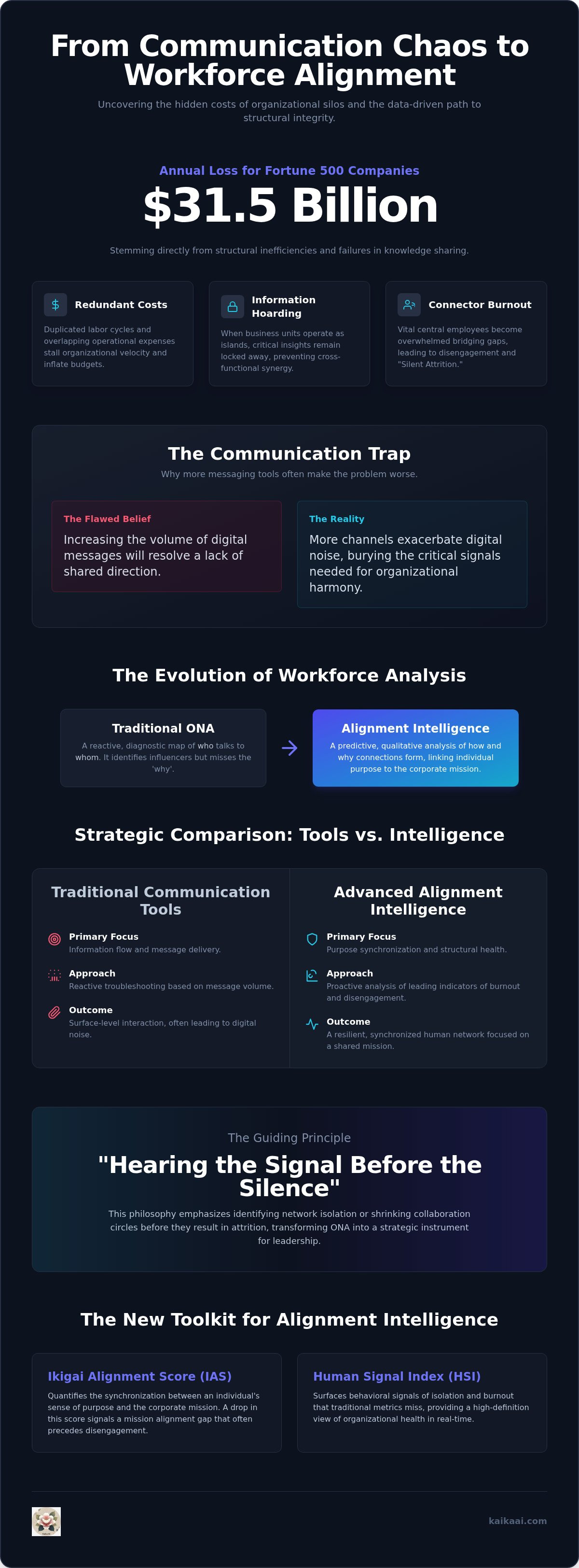
Fortune 500 companies lose an estimated $31.5 billion annually as a direct consequence of structural inefficiencies and knowledge-sharing failures. You likely recognize the symptoms within your own architecture: redundant operational costs, information hoarding between business units, and the quiet burnout of your most vital central connectors. While many leaders attempt to bridge these gaps with standard software, true structural integrity requires organizational network analysis for collaboration to identify the invisible barriers hindering your collective velocity.
This guide introduces a sophisticated framework for workforce alignment that transcends basic communication. Executive leadership can gain real-time visibility into hidden friction points and systemic bottlenecks through data-driven insight. You'll discover how to transition from reactive troubleshooting to advanced alignment intelligence. We'll explore a methodical approach to synchronizing individual employee Ikigai with your corporate mission, ensuring that every human component of your organization moves with precision and shared purpose.
Key Takeaways
- Identify why traditional chat platforms often fail to dismantle silos and how they can inadvertently create more operational noise.
- Discover how organizational network analysis for collaboration reveals invisible bottlenecks and identifies your most critical human connectors.
- Compare synchronous communication apps against advanced alignment intelligence to determine which tools actually drive measurable workforce velocity.
- Apply the Sugihara Bridge Model to integrate predictive AI measurements with expert human judgment for a balanced approach to structural health.
- Learn to utilize the "signal before the silence" to detect departmental disengagement before it impacts your bottom line or employee retention.
The Anatomy of the Silo: Why Traditional Communication Tools Fail
Silos are not merely functional divisions; they represent a systemic misalignment of human purpose. When business units operate with conflicting objectives, the resulting friction erodes strategic execution at scale. This is the "Communication Trap": the flawed belief that increasing the volume of digital messages will somehow resolve a structural lack of shared direction. In reality, more Slack channels often exacerbate the noise, burying the critical signals required for organizational harmony. Silos are symptoms of a purpose-alignment gap rather than a simple technical data deficiency.
The Hidden Cost of Organizational Fragmentation
Operational fragmentation costs Fortune 500 companies an estimated $31.5 billion annually. This loss stems from knowledge-sharing failures and redundant labor cycles that stall organizational velocity. Such duplication of effort signals a failure of workforce alignment software to unify the enterprise architecture. Fragmented teams also suffer from "Human Signal" interference. This phenomenon occurs when the frantic pace of digital communication obscures the underlying psychological state of the workforce. It prevents leadership from seeing the "central connectors" who are buckling under the weight of bridging disconnected silos. When isolation becomes the norm, "Silent Attrition" follows. High-value talent departs not because of compensation, but because of a purposeful disconnect from the collective mission.
Why Slack and Microsoft Teams Aren’t Enough
Traditional tools like Microsoft Teams facilitate information flow, yet they rarely achieve purpose synchronization. Digital noise often disguises a profound lack of cross-departmental synergy. To move beyond surface-level interaction, executives must leverage Organizational Network Analysis (ONA). Implementing organizational network analysis for collaboration provides the visibility needed to detect structural friction points before they manifest as attrition. It shifts the focus from reactive messaging to proactive Alignment Intelligence. By utilizing organizational network analysis for collaboration, leaders can transform their approach to structural health. This transition bridges the gap between daily messaging and the overarching corporate mission, ensuring the human network remains resilient, synchronized, and uncompromisingly focused on excellence.
Beyond Mapping: Evolving Organizational Network Analysis for Collaboration
Traditional Organizational Network Analysis (ONA) serves as a diagnostic tool to visualize the complex web of interactions within an enterprise. While an expert on ONA can identify influencers and bottlenecks, mapping who speaks to whom is merely the first step. The Ikigai Intelligence Framework (IIF) represents the predictive evolution of this methodology. It moves beyond static interaction maps to analyze the qualitative nature of those connections. By utilizing organizational network analysis for collaboration, the IIF detects structural misalignment at its source: the individual level.
Central to this framework is the Ikigai Alignment Score (IAS). This metric quantifies the synchronization between an individual's personal sense of purpose and the overarching corporate mission. When this score drops, it indicates a mission alignment gap that often precedes disengagement. Complementing this is the Human Signal Index (HSI). The HSI surfaces behavioral signals of isolation that traditional metrics miss, providing a high-definition view of organizational health. Together, these tools transform organizational network analysis for collaboration into a strategic instrument for executive leadership.
Moving from Reactive Mapping to Predictive Alignment
Annual engagement surveys provide a rear-view mirror perspective on workforce sentiment. These reactive snapshots often arrive too late to prevent attrition or cultural decay. In contrast, real-time ONA and alignment metrics offer the "Signal Before the Silence." This philosophy emphasizes identifying leading indicators of employee burnout, such as network isolation or shrinking collaboration circles, before they result in turnover. Organizations that monitor these signals can intervene with surgical precision, maintaining operational resilience during periods of high-stakes transition. Executing an Alignment Audit establishes a necessary baseline for this structural evolution.
The Role of AI in Surfacing Human Truth
AI-driven analytics identify mission alignment gaps that manual observation simply cannot perceive. These systems process vast quantities of metadata to find patterns of purposeful disconnect across departments. Responsible AI application requires uncompromising transparency and ethical data use to maintain the 87% employee honesty rate observed in IIF pilot studies. AI-driven Kaizen improves cross-departmental synergy through continuous data loops that refine organizational structures in real time. This systematic approach ensures that the intersection of technology and human behavior remains a source of competitive advantage rather than a point of friction.
Categorizing the Silo-Busting Toolkit: A Strategic Comparison
Executive leadership requires a precise understanding of the difference between tools that record activity and those that synchronize purpose. They record activity. But they don't always align teams. While many platforms capture the tactical "what" and "how" of daily operations, they frequently ignore the strategic "why." This distinction defines the "Human Truth" factor. It separates basic activity logs from deep, actionable sentiment analysis. Achieving measurable synergy requires continuous performance management software that prioritizes structural integrity over mere task completion.
Tier 1 & 2: Communication and Task Visibility
By prioritizing immediate info, platforms like Slack and Jira provide task-level visibility. They are excellent for managing short-term tactical output. Yet, these tools possess inherent limitations in solving deep-rooted structural misalignment. Task management often fails to bridge the "us vs. them" departmental mentality. It lacks context. These tools show that a project is delayed but don't explain if the delay stems from a siloed information flow. Without applying Organizational Network Analysis, leadership remains blind to the invisible friction points that stall progress.
Tier 3: Workforce Alignment Intelligence Platforms
Tier 3 platforms represent the pinnacle of the silo-busting toolkit. They connect individual human purpose to high-level organizational performance. Unlike traditional HR analytics dashboards that focus on superficial attendance or turnover rates, the Ikigai approach utilizes organizational network analysis for collaboration to measure the qualitative depth of internal connections. This methodology tracks "Workforce Velocity." This metric represents the speed at which aligned teams move toward strategic milestones. These platforms often utilize passive data collection to map collaboration patterns automatically, reducing the burden on the workforce while increasing data accuracy.
By monitoring specific workforce resilience metrics, executives can maintain institutional health over long-term cycles. These platforms move beyond simple interaction counts. They reveal how effectively the collective mission resonates across every department. Effective organizational network analysis for collaboration allows executives to see past the noise of daily chat logs to find the true drivers of synergy. It transforms raw data into a strategic roadmap for organizational evolution.
Implementing the Sugihara Bridge: A 3-Phase Integration Strategy
Structural transformation requires more than just data; it demands a hybrid architecture that bridges artificial intelligence with expert human judgment. The Sugihara Bridge Model offers a rigorous, phase-based methodology for dismantling silos and restoring organizational harmony. This model ensures that workforce data translates into specific operational outcomes rather than remaining abstract. By maintaining a "Human in the Loop" approach, leadership can interpret complex behavioral signals with clinical accuracy and ethical transparency.
Phase 1: Diagnostic Discovery and Signal Mapping
The integration begins with a comprehensive Alignment Audit to identify mission-critical gaps between departments. This diagnostic process establishes baseline Human Signal Index (HSI) and Employee Human Signal Index (EHSI) scores across different organizational divisions. These metrics reveal where friction exists and where purpose has become diluted. A central component of this phase is the Employee Honesty Rate. This metric serves as a core indicator of organizational health by measuring the transparency of internal feedback loops. Utilizing organizational network analysis for collaboration during this phase allows executives to map the "signal before the silence." This identifies teams at risk of isolation before structural decay occurs.
Operationalizing Continuous Improvement and Resilience
Phase 2 involves Architectural Consultation to develop the leadership mindset required to bridge deep-seated divisions. This moves into Phase 3: Collective Kaizen. Scaling Kaizen workshops fosters genuine cross-departmental collaboration by aligning individual Ikigai with group performance. Real-time dashboards provide the visibility needed to maintain workforce velocity and strategic synchronization. These tools allow for immediate adjustments when alignment scores fluctuate, preventing the re-emergence of silos. Long-term operational resilience requires this blend of data-driven feedback and clinical oversight.
By applying organizational network analysis for collaboration consistently, organizations build a resilient framework capable of withstanding global scale and market volatility. This methodical progression ensures that excellence becomes a repeatable, measurable outcome across the entire enterprise. Leaders ready to initiate this structural evolution can begin by scheduling Collective Kaizen Workshops to synchronize departmental goals with the overarching corporate mission. This systematic approach ensures that collaboration becomes a permanent structural feature rather than a temporary initiative.
Kaika AI: Hearing the Signal Before the Silence
Kaika AI provides the definitive solution to departmental fragmentation through its Workforce Alignment Intelligence Platform. By utilizing organizational network analysis for collaboration, the platform detects structural friction before it manifests as attrition or systemic failure. This architecture allows leadership to hear the "signal before the silence," identifying the subtle behavioral shifts that precede disengagement. The platform achieves an 87% employee honesty rate, ensuring that the insights reflecting your organization's health are both accurate and actionable. With a Net Promoter Score of 72, Kaika AI demonstrates a level of trust and efficacy that traditional HR tools fail to reach. The design philosophy is rooted in a Japan-first architecture, backed by a strategic partnership with Waseda University to ensure uncompromising scientific rigor.
The Ikigai Advantage for Global Enterprise Alignment
The Ikigai philosophy offers a globally relevant framework for human potential that transcends cultural boundaries and functional divisions. It connects individual employee purpose with large-scale organizational goals, a necessity for firms targeting dual listings on the TSE and ASX by 2032. This framework ensures that as an enterprise scales, its human core remains synchronized and resilient. Kaika AI offers bespoke integration services for specialized corporate divisions, allowing for a tailored application of the Ikigai Intelligence Framework. This precision ensures that every business unit moves with the same velocity toward the corporate mission, eliminating the duplication of effort that characterizes siloed organizations.
Strategic Integration and Executive Partnership
Successful structural transformation requires a blend of visionary leadership and clinical precision. Under the guidance of King Tabia and the clinical expertise of Michelle Kwamboka, Kaika AI addresses the psychological dimensions of network isolation that competitors often overlook. This clinical oversight ensures that burnout detection is grounded in psychological truth rather than just metadata patterns. It positions Kaika AI as the essential partner for organizations seeking long-term operational resilience and total structural harmony. CHROs and executive leaders are invited to request early access to implement this framework, ensuring their teams remain aligned during periods of high-stakes transition. To begin your journey toward total structural harmony, Request an Alignment Audit from Kaika AI.
Architecting a Unified Enterprise Future
Dismantling departmental silos requires a strategic shift from reactive messaging to proactive alignment intelligence. This framework demonstrates that structural friction is not a failure of technology; it is a misalignment of human purpose. By implementing organizational network analysis for collaboration, leadership can finally visualize the invisible human architecture that either drives or delays strategic progress. This data-driven approach ensures that central connectors remain resilient while business units move with collective velocity toward a shared mission.
Kaika AI provides the clinical precision needed for this institutional evolution. Our platform delivers a clinically-informed EHSI for burnout prevention and maintains an 87% employee honesty rate, supported by our academic partnership with Waseda University. With a Net Promoter Score of 72, our framework offers the institutional reliability necessary for firms targeting dual listings on the TSE and ASX. You can now request early access to the Kaika AI Workforce Alignment Platform to begin your structural transformation. The path to total organizational harmony is within reach for visionary leaders who prioritize human potential and strategic integrity. Your organization's most resilient chapter starts with a single, aligned step.
Frequently Asked Questions
What is organizational network analysis for collaboration?
It is a methodology that maps and analyzes the informal communication patterns and relationship dynamics within an organization. Unlike traditional charts, it reveals how information actually flows through teams. Using organizational network analysis for collaboration helps identify central connectors and isolated departments. It provides the visibility needed to dismantle silos and ensure that collective efforts align with the overarching corporate mission.
How does ONA differ from traditional organizational charts?
Traditional organizational charts represent formal hierarchy and reporting lines. They show who is supposed to talk to whom. ONA identifies the hidden network of actual interactions and influence. It surfaces the informal leaders and bottlenecks that formal structures often obscure. This distinction is critical for leaders who need to understand the true operational architecture of their enterprise to drive meaningful structural transformation.
Can AI identify departmental silos before they impact revenue?
Yes, advanced alignment intelligence detects behavioral shifts and communication friction at their earliest stages. By monitoring the signal before the silence, AI identifies teams drifting away from the core mission before disengagement leads to attrition. This predictive capability allows executives to intervene strategically. It prevents the $31.5 billion in annual losses that Fortune 500 companies typically experience due to knowledge-sharing failures and operational fragmentation.
What is the Ikigai Intelligence Framework (IIF)?
The IIF is Kaika AI's proprietary system consisting of three measurement indices: the Ikigai Alignment Score, the Human Signal Index, and the Employee Human Signal Index. It quantifies how closely an individual’s sense of purpose synchronizes with the organization's mission. Developed in partnership with Waseda University, this framework provides the data necessary to detect disengagement and silos before they manifest as attrition or stalled strategy.
How do you ensure employee privacy while using network analysis tools?
Kaika AI utilizes enterprise-grade security compliant with Japanese privacy standards to protect sensitive workforce data. The platform focuses on metadata and behavioral signals rather than the content of private communications. Transparency is foundational to our approach. This ethical commitment resulted in an 87% employee honesty rate during pilot studies. We ensure that AI data is used responsibly to enhance organizational harmony without compromising individual privacy.
What is the Sugihara Bridge Model in workforce alignment?
The Sugihara Bridge Model is a hybrid architecture that pairs AI-driven measurement with expert human consultation. It ensures that sensitive workforce signals receive interpretation through the lens of human judgment. This model prevents the cold, purely algorithmic assessment of employee behavior. By combining technical intelligence with architectural consultation, it helps CHROs develop the leadership mindset required to bridge divisions and foster long-term operational resilience.
How does Kaika AI measure the ROI of breaking down silos?
We measure ROI through improvements in workforce velocity and the reduction of redundant operational costs. The platform utilizes organizational network analysis for collaboration to quantify synergy across departments. With a Net Promoter Score of 72, our pilot results demonstrate that alignment leads to higher engagement and lower attrition. These measurable outcomes translate directly into preserved revenue and enhanced strategic execution for global enterprises.
What role does a clinical psychologist play in workforce intelligence software?
Clinical psychologist Michelle Kwamboka co-developed our Employee Human Signal Index to identify psychological strain and burnout risk. This clinically informed approach ensures that the platform detects burnout at the individual level with high precision. It provides a deeper layer of human truth than standard HR analytics. This expertise allows leaders to act with compassion and accuracy, maintaining the structural integrity of the workforce during high-stakes transitions.
Disclaimer
#Disclaimer
At Kaika AI, we believe the future belongs to organizations that combine human wisdom with artificial intelligence responsibly. The articles, research, insights, and thought leadership published on this website are intended to educate, inform, and encourage meaningful conversations about the future of work, organizational intelligence, AI, leadership, and innovation.
While our content is developed through rigorous research and may be generated, curated, or enhanced using artificial intelligence, every effort is made to ensure it reflects thoughtful analysis, practical relevance, and responsible AI practices. However, no representation or warranty is made regarding the completeness, accuracy, or suitability of the information for every individual or organizational circumstance.
The ideas, opinions, frameworks, and recommendations shared by Kaika AI are provided for educational and informational purposes only. They should not be interpreted as legal, financial, medical, psychological, human resources, cybersecurity, or other professional advice. Organizations and individuals should seek qualified professional guidance before making strategic, legal, or operational decisions.
Where articles reference third-party organizations, products, services, academic research, industry reports, or public data, such references are provided solely to support discussion and analysis. Unless explicitly stated, they do not imply endorsement, partnership, or affiliation.
Artificial intelligence is a powerful decision-support technology—not a replacement for human judgment. Kaika AI advocates for responsible, transparent, and human-centered AI adoption. We encourage readers to critically evaluate information, consider their unique context, and combine AI-generated insights with professional expertise and sound decision-making.
The content published on this website may be updated, revised, or removed as knowledge, technology, regulations, and best practices continue to evolve.
To the fullest extent permitted by applicable law, Kaika AI, its affiliates, contributors, and partners disclaim liability for any direct, indirect, incidental, consequential, or other losses arising from the use of, or reliance upon, the information provided on this website.
By accessing or using this website, you acknowledge that you have read, understood, and agree to this Disclaimer.
Kaika AI
'Building trusted organizational intelligence for the AI Era'


