
The most dangerous threat to your organization isn't a competitor's strategy, but the silent attrition of your top talent. While your current workforce goal tracking software might report green lights across every department, global engagement has plummeted to a decade-low of 21 percent, costing the global economy nearly 9 trillion dollars in lost productivity. You likely feel the friction between high-level executive vision and daily ground-level execution. It's a common frustration to see performance scores remain high while cultural cohesion and long-term resilience erode behind the scenes.
This guide provides the blueprint to transition from reactive task-monitoring to a sophisticated workforce alignment intelligence model. You'll learn how to synchronize individual purpose with organizational velocity, creating a framework that identifies burnout risks before they compromise your structural integrity. We'll explore how to leverage the Ikigai Intelligence Framework and the Sugihara Bridge Model to move beyond superficial metrics. By the end of this article, you'll understand how to build a resilient, intrinsically motivated workforce where every action serves a unified strategic mission.
Key Takeaways
- Transform your approach from monitoring administrative outputs to synchronizing human purpose with organizational architecture.
- Utilize the Ikigai Intelligence Framework to generate a quantifiable Alignment Score that measures the depth of mission-purpose synchronization.
- Evaluate the next generation of workforce goal tracking software by its ability to detect behavioral signals and burnout risks before they impact attrition.
- Transition from basic productivity metrics to workforce velocity, focusing on the structural integrity and speed of your executive strategy.
- Implement a systematic three-phase roadmap for alignment, beginning with a comprehensive Audit to surface and resolve mission-critical gaps.
Why Traditional Workforce Goal Tracking Software Fails in the AI Era
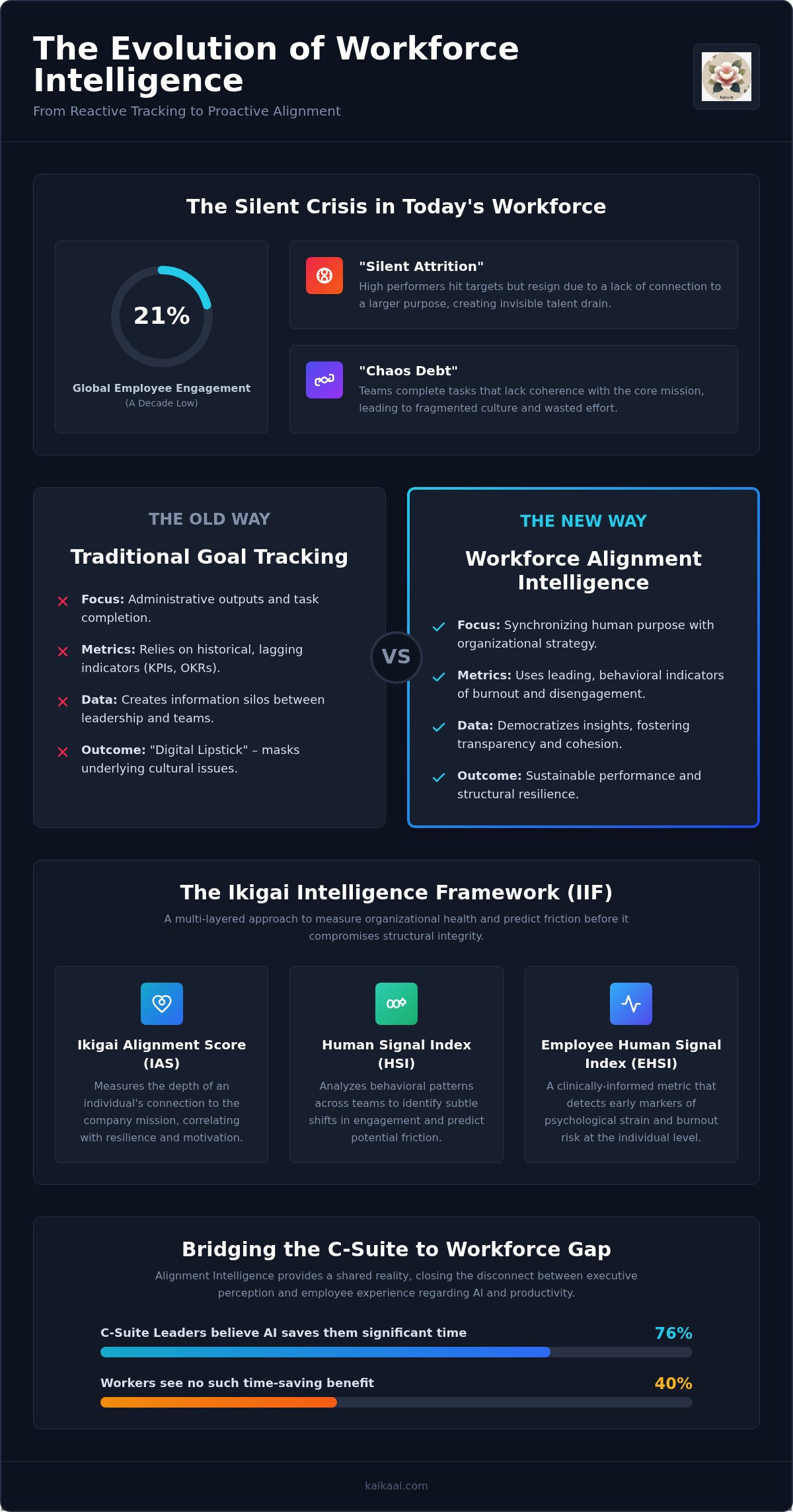
Traditional workforce goal tracking software often functions as a digital ledger for administrative compliance rather than a driver of organizational velocity. When leadership views goals through the narrow lens of output alone, they inadvertently accumulate "Chaos Debt." This occurs when teams complete tasks that lack a coherent connection to the core mission, leading to a fragmented culture. This structural failure underpins the "Silent Attrition" phenomenon. High performers frequently hit every target on their dashboard yet choose to resign because their work feels disconnected from a larger purpose. Effective Business performance management requires more than just checking boxes; it demands a synchronization of individual intent with executive strategy.
Many organizations find that traditional OKRs die after a single cycle. Without human-centric data to provide context, these frameworks become burdensome chores rather than strategic catalysts. They fail to capture the behavioral signals that precede disengagement, leaving leaders blind until the exit interview. In a landscape where global employee engagement is at a decade-low of 21 percent, relying on static tracking methods is no longer a viable strategy for resilience.
The Limitations of Legacy KPI and OKR Tools
Legacy systems prioritize historical reporting over real-time behavioral insights. These platforms often operate on restrictive per-user fee models that discourage total organizational transparency, creating data silos between leadership and the workforce. When an organization has a fundamental misalignment in its culture, simply adding a new tracking tool is "Digital Lipstick." It masks the symptoms without addressing the underlying structural rot. True resilience requires a platform that democratizes data, ensuring that every contributor understands their role in the architectural whole.
Moving Toward Alignment Intelligence
We are witnessing a shift toward Workforce Alignment Intelligence. This new category of enterprise technology focuses on the intersection of organizational psychology and systems engineering. It moves leadership away from monitoring what employees do and toward understanding why they do it. By identifying leading indicators of burnout and disengagement, executives can intervene with precision before the silence of attrition begins. A 2026 survey highlights a growing disconnect, where 76 percent of C-Suite leaders believe AI saves them significant time, while 40 percent of workers see no such benefit. Alignment intelligence bridges this gap by ensuring that productivity isn't just a measure of volume, but a reflection of deep-seated mission alignment. It transforms goal tracking from a static administrative log into a dynamic engine of human potential.
The Architecture of Alignment: The Ikigai Intelligence Framework
The Ikigai Intelligence Framework (IIF) serves as the structural foundation for modern workforce goal tracking software, moving beyond the binary of "met" or "missed" targets. It operates on the principle that organizational velocity is a direct byproduct of mission-purpose synchronization. By quantifying the abstract intersection of human potential and corporate objective, the IIF provides a rigorous methodology for maintaining structural integrity during rapid scale or market volatility.
The Three Measurement Indices for Executive Clarity
To provide leaders with a holistic view of organizational health, the IIF utilizes three distinct indices that move from high-level strategic alignment to individual well-being:
- Ikigai Alignment Score (IAS): It doesn't merely track task completion; it measures the depth of an individual's connection to the company mission, where high scores correlate with increased resilience and intrinsic motivation.
- Human Signal Index (HSI): Analyzes behavioral patterns to identify subtle shifts in engagement across large-scale teams, serving as a leading indicator of potential friction.
- Employee Human Signal Index (EHSI): A clinically informed metric developed with psychologists to detect early markers of psychological strain and burnout risk.
This multi-layered approach ensures that performance remains sustainable, preventing the high-stakes cost of sudden turnover in mission-critical roles. For executives managing global divisions, these scores offer a transparent view into the cultural health of their architecture.
Responsible AI and Ethical Data Use
Data integrity is the bedrock of the IIF. Pilot studies recorded an 87 percent employee honesty rate. It's a significant departure from the low-reliability figures often associated with traditional engagement surveys, reflecting the high trust generated by our academic partnership with Waseda University. This trust is maintained through strict adherence to the 2026 APPI amendments and global enterprise security protocols. We prioritize transparency in how AI interprets sentiment, ensuring that every data point serves the dual goal of organizational harmony and individual well-being. By utilizing the Sugihara Bridge Model, we combine technical intelligence with human consultation to interpret these signals accurately. This ethical framework ensures that your workforce goal tracking software remains a tool for empowerment rather than a mechanism for surveillance. Implementing a Workforce Alignment Intelligence Platform provides the systematic framework needed to maintain this human-centric clarity as you scale.
Evaluating Workforce Alignment Platforms vs. Traditional HR Tools
CHROs must distinguish between tools that merely catalog activity and those that architect alignment. Traditional task managers record history; alignment platforms predict future velocity. While simple productivity metrics measure the volume of work, workforce velocity measures the speed of mission-critical progress. This distinction is vital for organizations undergoing complex transformations. A Japan-first design philosophy ensures compliance with local standards like the 2026 APPI amendments while addressing the unique cultural nuances of the regional workforce. Our academic partnership with Waseda University provides the empirical validation required for such high-stakes tool selection. It ensures the underlying logic is grounded in rigorous organizational science rather than transient corporate trends.
Selecting the right workforce goal tracking software requires moving beyond a simple feature-checklist. You need a system that functions as a strategic partner, capable of surfacing the human truth behind the data points.
Key Selection Criteria for Enterprise Leadership
Enterprise leaders should prioritize continuous insight capabilities over periodic pulse surveys. Pulse surveys are reactive. They often capture temporary sentiment rather than deep-seated alignment. Modern platforms must integrate seamlessly with existing organizational architecture and leadership mindsets to avoid creating "Digital Lipstick" on broken processes. Scalability is equally critical. The platform must reduce cross-departmental synergy gaps, ensuring that a strategy defined in the boardroom maintains its integrity as it moves through every division.
The Sugihara Bridge Model: Why Human Judgment Still Matters
The Sugihara Bridge Model represents a hybrid architecture where AI-driven measurement meets human consultation. While AI can process vast behavioral signals, sensitive workforce data requires interpretation by trained experts. This approach resolves the "Coaching and Surveillance" conflict often found in enterprise tools. Purely automated systems can breed distrust among employees who fear algorithmic bias. By pairing technical intelligence with clinical psychologist-led consultation, organizations can interpret signals with nuance and empathy. This model ensures that the platform remains a tool for collective Kaizen rather than a mechanism for intrusive monitoring. It preserves the human element in an increasingly data-driven environment, fostering a culture of transparency and mutual growth. This balanced methodology is essential for maintaining an 87 percent honesty rate in workforce data, as it proves to the contributor that their input leads to meaningful, human-led structural improvement.
How to Implement Workforce Goal Tracking: A Strategic Roadmap
Implementing workforce goal tracking software isn't a mere software deployment; it's a structural evolution. To move from legacy task-tracking to a state of high-velocity alignment, organizations must follow a methodical, three-phase roadmap. This progression ensures that the technical intelligence of the platform integrates seamlessly with the human potential of the workforce, creating a culture of resilience rather than one of surveillance.
Phase 1: The Alignment Audit. This diagnostic stage identifies mission-critical gaps across divisions. It surfaces the human truth hidden beneath surface-level performance metrics. Phase 2: Structural Framework Implementation. This involves deploying the Ikigai Intelligence Framework (IIF) and the Sugihara Bridge Model. Here, the organization installs the architectural foundations for synchronization. Phase 3: Collective Kaizen. The final stage establishes a data-driven culture of continuous improvement, where every contributor is an active participant in organizational evolution.
Phase 1: Surfacing the Human Truth
The journey begins by conducting a comprehensive Alignment Audit to find hidden attrition risks. This process moves beyond static data to reveal why high performers might be disengaging. Executive leadership must engage in architectural consultations to define the specific parameters of workforce velocity. By setting these baseline metrics early, you create a quantifiable standard for success that transcends simple task completion. It's about understanding the current structural integrity of your teams before attempting to scale.
Phase 2 & 3: Driving Operational Resilience
Once the audit is complete, the focus shifts to operationalizing these insights. Training leadership on interpreting the Human Signal Index (HSI) is paramount. Leaders must learn to hear the signal before the silence of attrition occurs. Launching Collective Kaizen Workshops allows teams to synchronize their individual purpose with the broader organizational mission. This synchronization is the engine of collective growth.
Data integrity is maintained by monitoring the 74 percent weekly completion rate across all alignment modules. This consistency ensures that the intelligence platform has the high-fidelity data needed to provide accurate behavioral signals. This systematic approach transforms workforce goal tracking software from an administrative burden into a strategic asset. To begin your organizational evolution, you can schedule an Alignment Audit with our executive consultants today.
The Future of Workforce Intelligence: Toward Global Resilience
The trajectory of organizational intelligence is moving toward a state of global resilience where alignment serves as the primary metric of corporate value. We envision a future where the synchronization of human potential is institutionalized within the global financial architecture. By 2032, Kaika AI targets a dual listing on the Tokyo Stock Exchange (TSE) and the Australian Securities Exchange (ASX). This strategic milestone will provide the institutional credibility required to lead a worldwide transformation in how enterprises manage their human capital. For executive leadership, this journey is about achieving operational resilience for leadership through a predictive framework that anticipates structural friction before it manifests as operational failure.
Building Sustainable High-Performance Cultures
True systemic evolution requires moving beyond the superficial "Digital Lipstick" of legacy administrative tools. Sustainable high-performance cultures are built on the structural synchronization of individual purpose and corporate mission. When an employee's personal Ikigai aligns with the organization's strategic trajectory, longevity becomes an organic outcome rather than a forced metric. Utilizing advanced workforce alignment software allows executives to maintain this delicate balance across diverse global divisions. It ensures that strategic growth is not just a measure of headcount or revenue expansion, but a reflection of deep-seated cultural integrity and collective velocity. This approach transforms workforce goal tracking software into a vital instrument for preserving the human element within a high-tech enterprise.
Next Steps for CHROs
The path to organizational transformation begins with a fundamental commitment to human-centric data and ethical intelligence. CHROs should prepare their organizations for a data-driven Kaizen evolution by requesting early access to the Ikigai Intelligence Framework. This framework provides the empirical tools needed to measure the abstract intersections of purpose and performance. Aligning with institutional partners like Waseda University ensures your growth strategy remains grounded in rigorous, research-backed methodologies. Adopting a sophisticated workforce goal tracking software is the necessary first step in building a resilient architecture that protects your mission-critical talent.
The mission of modern leadership is to hear the signal before the silence. By acting on the subtle behavioral cues surfaced by alignment intelligence, you protect your top performers and ensure the long-term vitality of your organization. Alignment is not a static destination; it's the continuous, rhythmic process of synchronizing human potential with strategic excellence.
Synchronizing Purpose for Organizational Velocity
The transition from administrative monitoring to alignment intelligence represents a fundamental evolution in modern leadership. You've discovered how legacy tools often accumulate chaos debt and why a human-centric architecture is essential for maintaining long-term resilience. By adopting a sophisticated workforce goal tracking software, you move beyond superficial metrics to hear the signal before the silence of attrition begins. Our methodology, validated through a rigorous academic partnership with Waseda University, has achieved an 87 percent employee honesty rate and a net promoter score of 72. These results confirm that trust and transparency are the primary engines of high-velocity performance.
The roadmap to alignment requires strategic discipline, beginning with a diagnostic audit and culminating in a culture of collective Kaizen. This systematic approach ensures your executive strategy maintains its integrity throughout every division of your organization. You don't have to wait for the next cycle of turnover to secure your mission-critical talent. Take the first step toward a synchronized, resilient future today. Request early access to the Kaika AI Workforce Alignment Platform and begin your journey toward global excellence.
Frequently Asked Questions
What is the difference between goal tracking and workforce alignment intelligence?
Workforce alignment intelligence moves beyond traditional record-keeping to synchronize individual purpose with organizational mission. While standard workforce goal tracking software catalogs historical task completion, alignment intelligence uses the Ikigai Intelligence Framework to predict future organizational velocity. It identifies structural friction points by measuring the depth of mission-purpose synchronization. This proactive approach allows leaders to address disengagement before it impacts productivity or results in silent attrition across mission-critical divisions.
How does the Ikigai Intelligence Framework (IIF) protect employee privacy?
The Ikigai Intelligence Framework (IIF) utilizes a privacy by design architecture that strictly adheres to the 2026 APPI amendments. We prioritize ethical data use through our Sugihara Bridge Model, which ensures that technical intelligence is always interpreted by human consultants. This commitment to transparency resulted in an 87 percent employee honesty rate during pilot studies. Our academic partnership with Waseda University further validates our rigorous data protection and ethical interpretation protocols.
Can this software predict burnout before it leads to resignation?
Yes, the platform is specifically engineered to identify burnout through the Employee Human Signal Index (EHSI). This clinically informed index was co-developed with clinical psychologists to detect early markers of psychological strain and behavioral shifts. By analyzing these leading indicators, executives can intervene with precision before burnout leads to resignation. It allows leadership to hear the signal before the silence, protecting high performers who may otherwise be suffering from invisible exhaustion.
What is the Sugihara Bridge Model and why is it necessary?
The Sugihara Bridge Model is a hybrid architecture that pairs AI-driven measurement with trained human consultants. It's necessary because sensitive workforce signals often require nuanced interpretation that pure algorithms cannot provide. This model reduces the conflict between coaching and surveillance, ensuring that employees view the platform as a tool for collective Kaizen. By blending data-driven precision with human judgment, organizations can maintain cultural harmony while driving high-stakes performance outcomes.
How long does it take to see results from a Workforce Alignment Audit?
A Workforce Alignment Audit provides immediate baseline metrics for workforce velocity and engagement within the first phase of our strategic roadmap. While the full implementation of the Ikigai Intelligence Framework is a three-phase process, the initial audit surfaces hidden attrition risks and mission-critical gaps almost instantly. This diagnostic clarity allows CHROs to set accurate benchmarks and begin the process of structural synchronization without the delays common in traditional administrative overhauls.
Is Kaika AI compliant with Japanese data privacy standards?
Kaika AI is fully compliant with the Act on the Protection of Personal Information (APPI), including the 2026 overhaul regarding cross-border data transfers and employee disclosure. Our Japan-first design philosophy ensures that we meet the highest standards of enterprise-grade security and transparency. We prioritize responsible AI use, providing clear documentation on how sentiment data is processed to ensure that organizational goals never compromise individual privacy rights or institutional integrity.
What industries benefit most from workforce goal tracking software?
Large enterprises undergoing workforce transformation across all sectors benefit most from this technology. Industries with complex organizational architectures or high-stakes attrition risks find workforce goal tracking software indispensable for maintaining operational resilience. Whether in technology, manufacturing, or financial services, any organization that relies on the synchronization of top talent to drive global velocity requires a framework that connects human purpose with strategic excellence.
How do you measure the "Human Signal" in a remote or hybrid workforce?
Measuring the Human Signal Index (HSI) in remote or hybrid environments relies on continuous sentiment analysis and behavioral pattern recognition. Unlike periodic pulse surveys that capture static moments, the IIF provides real-time insights into how distributed teams interact with the organizational mission. By identifying shifts in engagement signals across digital communication channels, leaders can maintain a transparent view of cultural health regardless of physical location, ensuring that remote contributors remain synchronized.
Disclaimer
#Disclaimer
At Kaika AI, we believe the future belongs to organizations that combine human wisdom with artificial intelligence responsibly. The articles, research, insights, and thought leadership published on this website are intended to educate, inform, and encourage meaningful conversations about the future of work, organizational intelligence, AI, leadership, and innovation.
While our content is developed through rigorous research and may be generated, curated, or enhanced using artificial intelligence, every effort is made to ensure it reflects thoughtful analysis, practical relevance, and responsible AI practices. However, no representation or warranty is made regarding the completeness, accuracy, or suitability of the information for every individual or organizational circumstance.
The ideas, opinions, frameworks, and recommendations shared by Kaika AI are provided for educational and informational purposes only. They should not be interpreted as legal, financial, medical, psychological, human resources, cybersecurity, or other professional advice. Organizations and individuals should seek qualified professional guidance before making strategic, legal, or operational decisions.
Where articles reference third-party organizations, products, services, academic research, industry reports, or public data, such references are provided solely to support discussion and analysis. Unless explicitly stated, they do not imply endorsement, partnership, or affiliation.
Artificial intelligence is a powerful decision-support technology—not a replacement for human judgment. Kaika AI advocates for responsible, transparent, and human-centered AI adoption. We encourage readers to critically evaluate information, consider their unique context, and combine AI-generated insights with professional expertise and sound decision-making.
The content published on this website may be updated, revised, or removed as knowledge, technology, regulations, and best practices continue to evolve.
To the fullest extent permitted by applicable law, Kaika AI, its affiliates, contributors, and partners disclaim liability for any direct, indirect, incidental, consequential, or other losses arising from the use of, or reliance upon, the information provided on this website.
By accessing or using this website, you acknowledge that you have read, understood, and agree to this Disclaimer.
Kaika AI
'Building trusted organizational intelligence for the AI Era'


