
In 2026, mentions of "misalignment" in employee feedback surged by 149%, signaling a systemic breakdown in how modern organizations translate strategy into collective action. Most leaders assume their vision permeates every level of the enterprise, yet the reality is often a fragmented landscape of departmental silos and silent talent attrition. Achieving true corporate mission synchronization requires more than a polished statement; it demands a structural evolution where data-driven enterprise intelligence meets the nuanced depths of human psychology. You understand the corrosive friction caused when frontline reality drifts away from executive intent, leading to stalled execution and preventable burnout.
This article reveals how AI-driven workforce alignment intelligence transforms static mission statements into dynamic, synchronized organizational velocity. We'll explore the integration of the Ikigai Intelligence Framework and the Sugihara Bridge Model to bridge the gap between individual purpose and institutional resilience. You'll discover a methodical approach to gaining real-time visibility into organizational health while fostering a unified workforce where personal meaning drives corporate excellence. This isn't about superficial engagement; it's about the precision orchestration of purpose and performance in a high-stakes global market.
Key Takeaways
- Transition from rigid, top-down goal cascading to a bi-directional model that ensures individual actions contribute to strategic objectives in real-time.
- Achieve corporate mission synchronization by leveraging AI-driven intelligence to surface the human truth beneath workforce data and align personal purpose with organizational architecture.
- Utilize the Ikigai Intelligence Framework to gain a multi-dimensional understanding of how employees perceive their value, skill, and impact within the corporate ecosystem.
- Implement the Sugihara Bridge Model to move through three distinct phases of synchronization: precise AI measurement, expert human interpretation, and targeted strategic intervention.
- Reduce silent attrition and burnout by establishing a clear, data-driven roadmap that connects executive vision to frontline reality across global operations.
The Architecture of Corporate Mission Synchronization
Corporate mission synchronization represents the structural integration of an organization's high-level vision with the granular, daily actions of its workforce. Unlike traditional Strategic Alignment, which often relies on static annual planning, synchronization functions as a living system of bi-directional feedback. It's the continuous calibration of individual effort against evolving strategic objectives. When this alignment is achieved, the organization transitions from a collection of disparate departments into a cohesive, high-performance engine capable of maintaining focus despite market volatility.
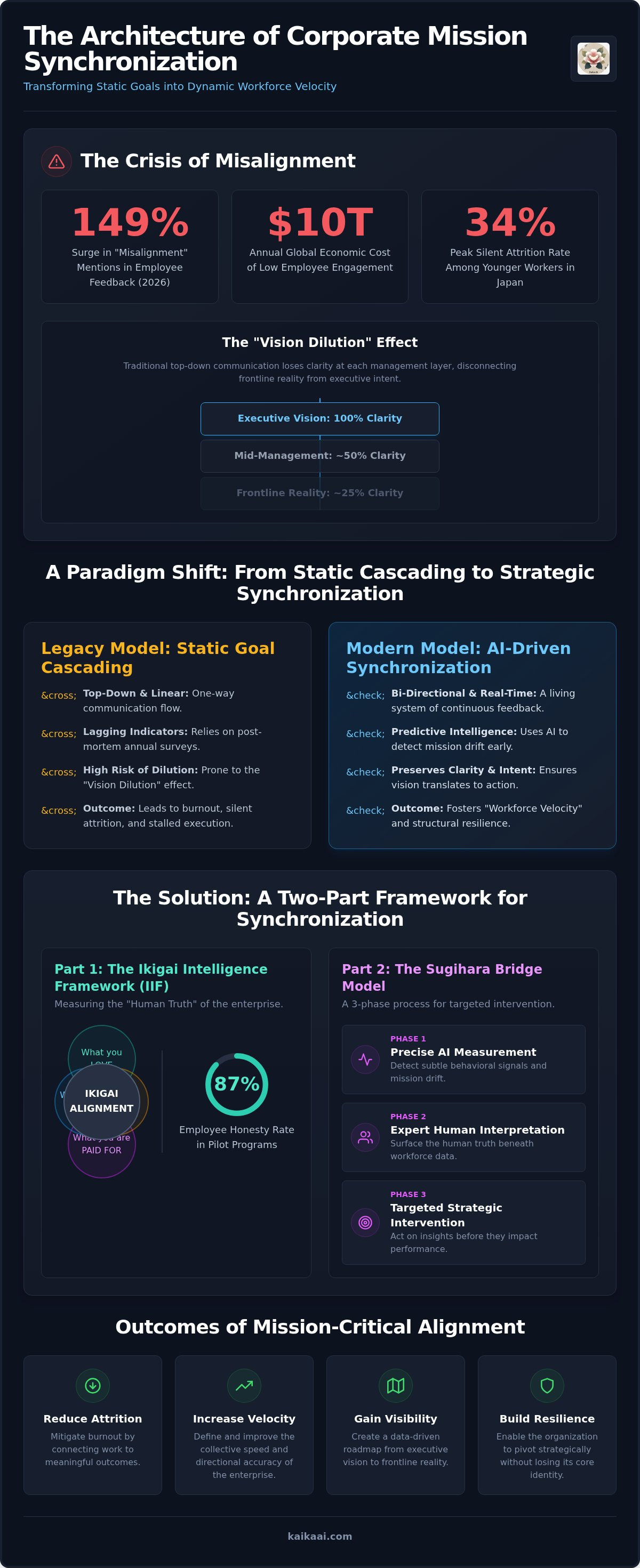
Traditional "cascading" models fail because they rely on linear communication in an increasingly non-linear global economy. As executive vision travels through management layers, it often loses 50% of its clarity at each level, resulting in a frontline reality that bears little resemblance to the boardroom's intent. This dilution creates the "misalignment" mentions that surged 149% in 2026. Global productivity suffers as a result; Gallup reports that low engagement costs the global economy approximately $10 trillion annually. The stakes involve more than just lost revenue; they involve the erosion of organizational integrity.
Successful synchronization produces Workforce Velocity, a metric defining the collective speed and directional accuracy of an enterprise. It's the structural resilience that allows a company to pivot without losing its core identity. Without it, companies face stalled strategy execution where top talent departs not because of salary, but because their work feels disconnected from a meaningful outcome. This is the high-stakes environment where corporate mission synchronization becomes a survival imperative rather than a management luxury.
The Limitations of Legacy Alignment Models
Annual engagement surveys act as post-mortem reports rather than predictive navigators. They capture lagging indicators of dissatisfaction long after the critical signals have passed. In Japan, where engagement sits at a mere 8%, the gap between executive vision and employee reality is particularly stark. Silent attrition now affects 28% to 34% of Japanese workers in their 20s and 30s, manifesting as a motivational detachment that traditional HR tools fail to measure or mitigate. These legacy systems lack the sophistication to bridge the widening "Communication Gap" inherent in decentralized, global enterprises.
Synchronization as a Real-Time Intelligence Metric
Modern leadership requires a shift from qualitative "buy-in" to quantitative alignment scores. By utilizing AI to detect subtle behavioral signals, organizations can identify mission drift before it manifests as turnover or project failure. This technological layer provides real-time visibility into the health of the organizational architecture, allowing the CHRO to act as a strategic architect. Mission synchronization is the intersection of operational efficiency and human purpose. It transforms the workforce from a static resource into a dynamic, synchronized force for innovation.
The Ikigai Intelligence Framework: Measuring the Human Truth
The engine of corporate mission synchronization is the Ikigai Intelligence Framework (IIF). While legacy systems focus on output, the IIF captures the "human truth" of the enterprise. It applies the traditional philosophy of Ikigai, the intersection of what people love, what they are good at, what the world needs, and what they are paid for, to the complex architecture of a global workforce. This approach moves beyond superficial engagement scores to measure the fundamental resonance between an employee's personal purpose and the corporate mission.
Measuring human truth differs fundamentally from standard productivity tracking. Traditional metrics observe what employees do; the IIF understands why they do it. This distinction is vital for maintaining organizational velocity without inducing burnout. Organizations utilizing this framework see a significant shift in data quality. Pilot programs have demonstrated an 87% employee honesty rate, ensuring that the insights generated reflect actual workforce sentiment rather than performative compliance.
Decoding the Ikigai Alignment Score (IAS)
The Ikigai Alignment Score (IAS) serves as the primary metric for synchronization. It synthesizes anonymized data points to provide a clear, numerical representation of mission resonance across different departments. This score allows executive leadership to pinpoint exactly where synchronization is highest and where it is fracturing. Implementing this level of precision requires sophisticated workforce alignment software to process complex behavioral signals at scale. By focusing on the IAS, leaders can move from guessing about culture to managing alignment with engineering-grade accuracy.
The Human Signal Index (HSI) and Behavioral Synergy
To anticipate mission drift before it impacts performance, the framework utilizes the Human Signal Index (HSI). This early warning system detects "silent" signals of disengagement that precede physical turnover or strategy failure. Developed in partnership with Waseda University, these behavioral metrics provide a scientifically validated view of organizational health. The HSI surfaces the subtle friction points within teams, allowing for strategic intervention before silos harden. Leaders who prioritize these signals can achieve a Net Promoter Score as high as 72, as seen in our Tokyo-based participant groups. To see how these metrics transform your leadership strategy, consider an Alignment Audit to establish your baseline.
Strategic Synchronization vs. Static Goal Cascading
Static goal cascading operates on a premise of linear command; it assumes that strategy formulated at the summit retains its integrity as it trickles down. This top-down architectural flaw creates a "Mindset Gap" where leadership views alignment as a one-time communication event rather than a continuous operational state. True corporate mission synchronization functions as a bi-directional exchange. It doesn't just push objectives down; it pulls behavioral data up, allowing the organization to pivot with surgical precision when market conditions shift. This real-time intelligence transforms strategy from a rigid document into a living, breathing capability.
Why OKRs Alone Are Insufficient for Global Scale
Objectives and Key Results (OKRs) frequently fall into the "compliance trap." In this state, employees meet specific KPIs but lose sight of the overarching mission, leading to performative excellence that masks underlying disengagement. AI-driven intelligence identifies the "why" behind performance data, distinguishing between rote task completion and mission-aligned innovation. To maintain this momentum, leaders must integrate continuous performance management software that surfaces intent. This technology moves beyond the "set and forget" nature of traditional OKRs, ensuring that every individual action resonates with the corporate core.
The Velocity Advantage of Synchronized Missions
Organizational Velocity is the speed of mission-aligned execution. It's the byproduct of a workforce that moves in unison without the need for constant, manual redirection. When missions are synchronized, the "friction costs" of cross-departmental silos vanish. Misalignment is expensive; the global economy loses $10 trillion annually due to low engagement and wasted effort. Measuring the ROI of synchronization involves tracking the reduction in strategy execution time and the increase in talent retention. By fostering high-performance cultures through data-driven alignment, enterprises build a structural resilience that competitors cannot replicate. This synchronization ensures that collective energy is never diluted by conflicting priorities or bureaucratic inertia.
Implementing the Sugihara Bridge Model for Global Synchronization
The Sugihara Bridge Model provides the hybrid architecture necessary for global corporate mission synchronization. It functions as a disciplined synthesis between computational intelligence and human interpretation, ensuring that data never exists in a vacuum. This model specifically respects the cultural nuances of large Japanese and global enterprises, where expressive feedback is often replaced by subtle behavioral shifts. By integrating Clinical Psychologists into the framework, the model identifies the precise correlation between mission drift and psychological strain. It ensures that the drive for performance does not sacrifice the human foundation of the enterprise.
Success in decentralized environments requires a move away from purely human-led consulting, which lacks the scalability to monitor global operations in real-time. The Sugihara Bridge Model addresses this by creating a continuous loop of measurement and intervention. It recognizes that while AI can detect the presence of friction, it requires human wisdom to navigate the complexities of leadership mindset and organizational history. This hybrid approach allows for a composed, strategic response to high-stakes performance challenges.
Phase 1: Surfacing the Signal via AI Intelligence
Phase 1 focuses on surfacing the signal through the Employee Human Signal Index (EHSI). This metric flags psychological strain by detecting behavioral patterns that precede burnout, allowing leaders to intervene before attrition becomes inevitable. AI-driven intelligence surfaces these "silent" signals, providing a level of predictive clarity that traditional surveys miss. Incorporating workforce resilience metrics into this phase allows the CHRO to monitor the structural integrity of the workforce in real-time. It's about moving from reactive management to proactive orchestration, identifying burnout patterns before they manifest as a loss of organizational velocity.
Phase 2 & 3: Human Judgment and Strategic Kaizen
The transition from technical measurement to strategic execution occurs in Phases 2 and 3. Expert consultants apply the Sugihara Bridge Model to interpret complex data streams, providing the human context necessary for executive decision-making. This phase relies on the Collective Kaizen approach, where alignment gaps are addressed through collaborative problem-solving rather than rigid directives. It's the final stage of corporate mission synchronization, moving from data-driven awareness to measurable structural change. Leaders can re-synchronize teams after major strategic pivots by following a disciplined methodology: first, they calibrate the new vision against existing EHSI data; second, they deploy targeted interventions to address specific friction points; and finally, they utilize workshops to embed the new mission into daily operations. To begin this transformation within your own leadership team, explore our Collective Kaizen Workshops.
The Executive Roadmap to Mission-Critical Alignment
The evolution from silent attrition to synchronized performance demands a fundamental re-engineering of the organizational core. It's no longer sufficient to treat employee engagement as a peripheral HR metric. Leadership must view corporate mission synchronization as a primary driver of enterprise value and operational resilience. Kaika AI occupies the vanguard of Workforce Alignment Intelligence, providing the structural framework necessary to maintain velocity in a volatile global market. Our vision for global category leadership, including our trajectory toward a 2032 listing on the TSE and ASX, reflects a commitment to establishing a new international standard for human-centric enterprise performance.
The CHRO as the Chief Alignment Architect
The modern CHRO must transcend traditional administrative functions to become the primary steward of organizational mission-purpose synchronization. This role requires a transition from reactive problem-solving to proactive organizational architecture. By utilizing predictive attrition intelligence, leaders identify the precise moments when individual purpose drifts from corporate goals. This intelligence allows the CHRO to function as a strategic partner to the CEO, ensuring that the human engine of the company remains calibrated for long-term growth. To begin this transition, executives should audit their current state using the following criteria:
- Do you possess real-time, quantitative visibility into mission resonance across all global departments?
- Can you identify behavioral signals of psychological strain before they manifest as physical turnover?
- Is there a documented, bi-directional feedback loop between frontline reality and executive strategy?
- Are your current alignment tools providing predictive signals or merely lagging engagement indicators?
Securing the Future: Ethical AI and Privacy Standards
Trust serves as the foundational cornerstone of any enterprise intelligence system. Kaika AI adheres to the most stringent Japanese and global privacy standards, ensuring that data-driven insights never compromise individual integrity or psychological safety. This uncompromising commitment to transparency is precisely why our pilot programs achieved an 87% employee honesty rate. When employees feel secure in the ethical use of their data, they provide the genuine human truth necessary for authentic synchronization. The result is a resilient enterprise where performance remains high and burnout remains low, sustained by a transparent and ethical AI architecture. Request early access to the Kaika AI Workforce Alignment Platform to secure your organization's future.
Orchestrating the Future of Enterprise Velocity
The transition from static goal cascading to dynamic corporate mission synchronization marks a pivotal shift in executive leadership. By integrating the Ikigai Intelligence Framework with the Sugihara Bridge Model, organizations move beyond superficial engagement metrics to achieve a state of structural harmony. You've seen how real-time behavioral signals, validated by Waseda University research, provide a predictive early warning system against silent attrition and strategic drift. This architectural approach ensures that individual purpose doesn't just coexist with corporate goals; it accelerates them.
Our enterprise pilots have demonstrated the power of this framework, achieving an NPS of 72 and an 87% employee honesty rate. This data-driven confidence allows for a composed, strategic response to the complexities of global scale. It's time to move from reactive management to proactive orchestration. Request Early Access to the Kaika AI Workforce Alignment Platform and begin your journey toward mission-critical alignment. The path to resilient, synchronized performance starts with a single, strategic step forward.
Frequently Asked Questions
What is the primary difference between goal cascading and mission synchronization?
Goal cascading is a top-down, linear process where objectives are pushed from leadership to the frontline, often losing 50% clarity at each level. Mission synchronization is a bi-directional, real-time intelligence loop that aligns individual purpose with organizational strategy. It ensures that every action resonates with the core vision, creating organizational velocity rather than just task compliance. This model transforms strategy from a static document into a living operational capability.
How does AI measure 'human truth' without violating employee privacy?
Kaika AI utilizes anonymized behavioral signals and aggregate data to surface workforce sentiment without identifying specific individuals. By adhering to strict Japanese and global privacy standards, the platform creates a secure environment where employees feel safe providing honest feedback. This psychological safety resulted in an 87% employee honesty rate during pilot programs. The focus remains on identifying structural friction points and organizational trends rather than monitoring individual performance.
What is the Ikigai Alignment Score (IAS) and how is it calculated?
The Ikigai Alignment Score is a proprietary metric that quantifies the resonance between an individual's personal sense of purpose and the corporate mission. It's calculated by analyzing data inputs across four philosophical pillars: what employees love, what they excel at, what the world needs, and what they are paid for. This multi-dimensional index provides a clear numerical value that allows CHROs to identify departments where corporate mission synchronization is highest or where it's beginning to fracture.
Can mission synchronization software help reduce employee burnout?
Yes, the platform identifies early psychological strain via the Employee Human Signal Index (EHSI). This index was co-developed with clinical psychologists to flag burnout risk before it manifests as physical turnover or "quiet quitting." By surfacing these silent signals, leaders can implement strategic interventions to restore balance. Reducing the friction caused by misalignment directly lowers the cognitive load on employees, which is essential for maintaining long-term operational resilience and workforce health.
How does the Sugihara Bridge Model combine AI with human consulting?
The Sugihara Bridge Model is a hybrid architecture that pairs AI-driven measurement with trained human consultants. While AI identifies the presence of friction through indices like the HSI, human experts interpret these signals within the context of organizational culture and leadership mindset. This ensures that sensitive workforce data is translated into actionable executive guidance. This three-phase approach moves from precise measurement to human interpretation and, finally, to strategic intervention through Collective Kaizen Workshops.
What are the leading indicators of mission drift in a large enterprise?
Leading indicators include a decline in the Ikigai Alignment Score, increased mentions of misalignment in feedback, and subtle shifts in behavioral synergy captured by the Human Signal Index. Unlike lagging indicators like voluntary turnover, these signals surface months before disengagement becomes critical. In large enterprises, mission drift often accelerates at specific growth thresholds, such as 150 or 500 employees. Detecting these patterns early allows for the re-synchronization of teams before productivity stalls.
How do Japanese privacy standards influence Kaika AI’s workforce intelligence?
Kaika AI prioritizes transparency and ethical data use by strictly following Japanese privacy regulations and global benchmarks. The platform's design respects the cultural nuances of the Japanese workforce, where values like harmony and perseverance are paramount. By ensuring that data is used for structural improvement rather than punitive monitoring, the system maintains high levels of trust. This focus on ethical architecture is a core differentiator that supports our long-term vision of global category leadership.
What is the expected ROI of implementing a workforce alignment platform?
ROI is measured through the reduction in strategy execution time, lower turnover costs, and a measurable increase in organizational velocity. Misalignment currently costs the global economy $10 trillion in lost productivity, making corporate mission synchronization a high-yield investment. Organizations using the platform see a significant reduction in the friction costs associated with departmental silos and silent attrition. These measurable business outcomes provide a clear financial justification for shifting from reactive HR to proactive organizational architecture.
Disclaimer
#Disclaimer
At Kaika AI, we believe the future belongs to organizations that combine human wisdom with artificial intelligence responsibly. The articles, research, insights, and thought leadership published on this website are intended to educate, inform, and encourage meaningful conversations about the future of work, organizational intelligence, AI, leadership, and innovation.
While our content is developed through rigorous research and may be generated, curated, or enhanced using artificial intelligence, every effort is made to ensure it reflects thoughtful analysis, practical relevance, and responsible AI practices. However, no representation or warranty is made regarding the completeness, accuracy, or suitability of the information for every individual or organizational circumstance.
The ideas, opinions, frameworks, and recommendations shared by Kaika AI are provided for educational and informational purposes only. They should not be interpreted as legal, financial, medical, psychological, human resources, cybersecurity, or other professional advice. Organizations and individuals should seek qualified professional guidance before making strategic, legal, or operational decisions.
Where articles reference third-party organizations, products, services, academic research, industry reports, or public data, such references are provided solely to support discussion and analysis. Unless explicitly stated, they do not imply endorsement, partnership, or affiliation.
Artificial intelligence is a powerful decision-support technology—not a replacement for human judgment. Kaika AI advocates for responsible, transparent, and human-centered AI adoption. We encourage readers to critically evaluate information, consider their unique context, and combine AI-generated insights with professional expertise and sound decision-making.
The content published on this website may be updated, revised, or removed as knowledge, technology, regulations, and best practices continue to evolve.
To the fullest extent permitted by applicable law, Kaika AI, its affiliates, contributors, and partners disclaim liability for any direct, indirect, incidental, consequential, or other losses arising from the use of, or reliance upon, the information provided on this website.
By accessing or using this website, you acknowledge that you have read, understood, and agree to this Disclaimer.
Kaika AI
'Building trusted organizational intelligence for the AI Era'


