
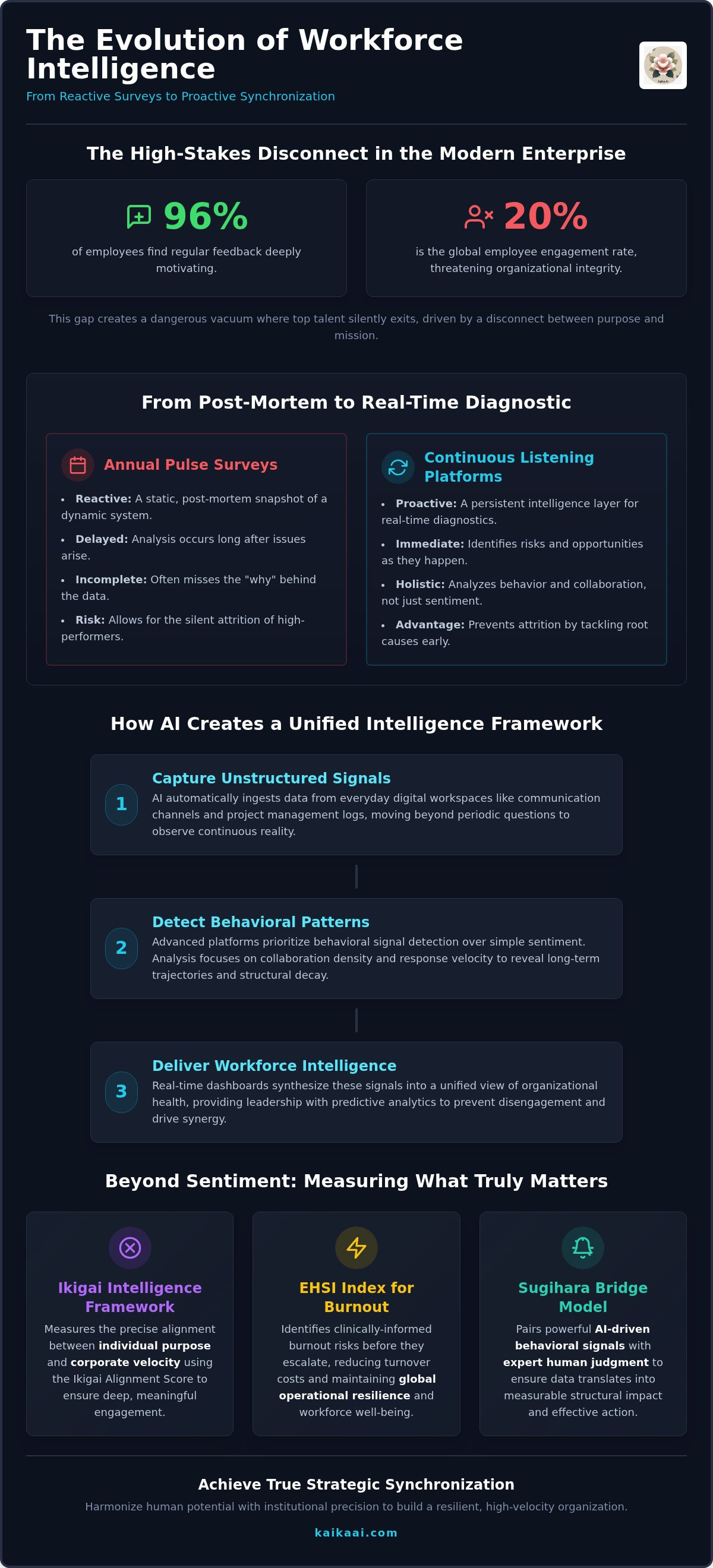
While 96% of employees find regular feedback deeply motivating, the global reality remains a stark 20% engagement rate that threatens the structural integrity of the modern enterprise. You likely feel the mounting pressure as employee purpose decouples from the organizational mission, creating a dangerous vacuum where top talent silently exits. It's a high-stakes performance crisis that fragmented HR tools often exacerbate through data fatigue rather than resolving through strategic clarity.
This executive guide demonstrates how AI-driven continuous employee listening platforms transform these disjointed signals into a sophisticated intelligence framework for total organizational synchronization. By moving beyond static measurement toward workforce alignment intelligence, leadership can secure real-time visibility into burnout risks and spiraling turnover costs. We will analyze the transition from reactive feedback loops to a proactive delivery architecture, ensuring your global divisions maintain the velocity and resilience required for sustained excellence. Discover how to harmonize human potential with institutional precision to achieve true strategic synchronization across your entire workforce.
Key Takeaways
- Transition from reactive annual pulse surveys to a proactive intelligence model that identifies silent attrition before top talent exits the organization.
- Leverage continuous employee listening platforms to transform fragmented digital signals into a structured framework for real-time organizational synchronization.
- Utilize the Ikigai Intelligence Framework to measure the precise alignment between individual purpose and corporate velocity using the Ikigai Alignment Score.
- Deploy the Sugihara Bridge Model to pair AI-driven behavioral signals with expert human judgment, ensuring data translates into measurable structural impact.
- Identify clinically-informed burnout risks through the EHSI index to reduce turnover costs and maintain global operational resilience.
The Evolution of Employee Listening: From Passive Surveys to Continuous Intelligence
The traditional annual pulse survey has become an institutional liability. It offers a static snapshot of a dynamic system, effectively providing a post-mortem when leadership requires a real-time diagnostic. By the time survey results are analyzed and shared, the silent attrition of high-performing talent has often already begun. Modern continuous employee listening platforms replace these reactive cycles with a persistent intelligence layer. This shift allows executives to identify mission-critical gaps in Organizational Culture and operational flow before they manifest as bottom-line deficits.
Effective leadership requires hearing the signal before the silence. In high-stakes environments, the absence of noise often masks a decoupling of employee purpose from corporate mission. Continuous listening creates a strategic framework for synchronization; it ensures every division moves with the same intent and velocity. It's about transforming fragmented feedback into a structured intelligence framework that supports decisive action.
The Cost of Workforce Misalignment
Workforce misalignment acts as a silent tax on organizational performance. When individual efforts aren't synchronized with the overarching strategy, the resulting friction creates a significant financial drain. Fragmented data from legacy HR tools often blinds leadership to these inefficiencies, leading to a state of institutional paralysis. Maintaining workforce velocity is no longer a luxury; it's a prerequisite for competitive resilience in a landscape where only 20% of global employees report true engagement. Without real-time visibility, executives can't distinguish between productive energy and the frantic activity that precedes burnout.
Continuous Listening as a Governance Tool
Strategic leaders are repositioning sentiment analysis as a core component of their risk management frameworks. Moving beyond superficial HR metrics, continuous employee listening platforms provide high-fidelity indicators of organizational health. These tools allow for the integration of behavioral signals into broader governance structures, transforming human potential into a measurable asset. Workforce alignment intelligence is the synchronization of human purpose with organizational architecture. This systematic approach ensures the collective energy of the workforce remains focused on the primary mission, protecting the organization against internal fragmentation and external volatility.
The Architectural Mechanics of Continuous Listening Platforms
Sophisticated architecture is the foundation of organizational synchronization. Continuous employee listening platforms function by capturing unstructured signals across digital workspaces, ranging from communication channels to project management logs. This automated data ingestion provides the raw material for a Strategic Framework for Systemic Workforce Alignment. It's a fundamental shift from asking periodic questions to observing the continuous reality of the work environment. By integrating these disparate data points, leadership can move beyond fragmented snapshots toward a unified view of institutional health.
While standard Natural Language Processing (NLP) parses surface-level sentiment, advanced platforms prioritize behavioral signal detection. Sentiment reflects a fleeting moment; behavior reveals a long-term trajectory. By identifying patterns in collaboration density and response velocity, leadership can distinguish between temporary stress and structural decay. Real-time dashboards then synthesize these signals to facilitate cross-departmental synergy, ensuring that every division operates with technical precision and shared purpose.
Real-Time Metrics and Predictive Analytics
The evolution from descriptive to predictive analytics is what creates a sustainable competitive advantage in talent. AI doesn't just report on attrition after the fact; it identifies the subtle precursors to disengagement. By leveraging specific workforce resilience metrics, executives gain visibility into burnout patterns weeks before they manifest as formal resignations. This foresight allows for targeted intervention, preserving institutional knowledge and reducing the high costs associated with top-talent turnover.
Enterprise-Grade Security and Privacy Standards
Trust is the primary currency of alignment. To achieve the 87% employee honesty rate observed in high-performance pilot programs, platforms must adhere to rigorous privacy standards. This includes strict compliance with Japan's Act on the Protection of Personal Information (APPI), which necessitates transparent data handling and precise purpose specification. Secure connectors and anonymized reporting ensure that while leadership sees the collective signal, individual privacy remains absolute. Ethical AI isn't a secondary feature; it's a structural requirement for any serious enterprise tool. You can begin establishing this foundation of trust by conducting a comprehensive Alignment Audit of your current digital workspace architecture.
Beyond Sentiment: Measuring Ikigai Alignment and Burnout Risk
The enterprise landscape demands a deeper diagnostic than simple sentiment analysis. While traditional continuous employee listening platforms often stop at measuring job satisfaction, the Ikigai Intelligence Framework (IIF) penetrates the layer of human truth to assess structural synchronization. This methodology utilizes the Ikigai Alignment Score (IAS) to measure the precise overlap between individual purpose and the corporate mission. By quantifying this connection, leadership moves from superficial engagement metrics to a rigorous assessment of workforce velocity and resilience.
The framework also incorporates the Human Signal Index (HSI), which identifies disengagement patterns long before they manifest as formal resignations. For more critical risks, the Employee Human Signal Index (EHSI) provides a clinically-informed diagnostic developed in collaboration with psychologists. This index focuses on detecting the early indicators of psychological strain, allowing executives to intervene with precision rather than reacting to a crisis. It's about maintaining a high-performance culture without sacrificing the human potential that drives it.
The Science of Purpose-Performance Correlation
Aligning individual and organizational goals represents the next frontier of corporate ROI. When human purpose is synchronized with organizational architecture, performance becomes an organic outcome rather than a forced metric. In the corporate context, Ikigai is the intersection of skill, professional passion, and organizational necessity. The EHSI serves as an essential warning system within this structure, identifying when the pressure of high-performance environments begins to compromise individual health. This clinical rigor ensures the pursuit of excellence doesn't lead to structural fragility or talent depletion.
Detecting the Signal Before the Silence
Behavioral signals typically precede visible disengagement by several weeks. By monitoring these subtle shifts in collaboration and output patterns, leadership addresses alignment gaps in real-time. This proactive approach directly combats the action gap that leaves only 51% of global employees feeling their feedback leads to tangible improvements. Understanding the leading indicators of employee burnout shifts the leadership mindset from crisis management to strategic preservation. Addressing these signals early preserves the integrity of global divisions and significantly reduces the turnover costs associated with silent attrition.
Strategic Implementation: Bridging the Gap Between Signal and Action
Implementation of continuous employee listening platforms requires more than technical deployment; it demands a structural bridge between data and human agency. Raw AI signals, while precise, lack the contextual nuance required for sensitive workforce interventions. Without a human layer, data-driven insights risk being perceived as surveillance, eroding the very trust necessary for organizational harmony. Successful execution transforms these signals into a strategic intelligence framework that supports decisive, empathetic leadership.
AI alone is insufficient for nuanced workforce transformation. The Sugihara Bridge Model serves as the definitive delivery architecture for workforce alignment. It pairs AI-driven behavioral signals with expert human judgment, ensuring that every data point undergoes rigorous validation before executive action. This hybridity addresses the "Big Brother" objection by positioning technology as an assistant to leadership rather than a replacement for it. Human consultants interpret sensitive signals, filtering out statistical noise to provide leadership with actionable, high-stakes intelligence. This collaborative process secures executive-level buy-in by grounding technological capabilities in established management principles.
The Sugihara Bridge Model Architecture
The role of human judgment is critical in validating AI-detected behavioral shifts. While the platform identifies the "what" of workforce behavior, the human consultant explores the "why," ensuring that interventions remain targeted and culturally appropriate. This phase-based integration moves from initial architectural consultation to total operational resilience, allowing the organization to scale its listening capabilities without compromising individual privacy. By maintaining this balance, leadership ensures that data remains a tool for empowerment rather than a mechanism for control.
Executing Data-Driven Kaizen
Strategic integration fosters a culture of continuous performance management, where iterative improvements become the standard rather than the exception. Collective Kaizen Workshops facilitate team alignment by translating global divisional data into specific, local improvements. These sessions ensure that the action gap is bridged, proving to employees that their honesty leads to measurable structural change. Measuring the ROI of this integration involves tracking the reduction in turnover costs and the stabilization of workforce velocity. To begin this transformation within your own organization, you can engage with our team for an Executive Consultation to map your current alignment gaps and deployment readiness.
Reimagining Workforce Resilience with Kaika AI’s Intelligence Framework
Kaika AI serves as the definitive category leader in workforce alignment intelligence, providing a framework that transcends the limitations of legacy HR tools. The platform's Japan-first design integrates the Ikigai philosophy into a high-tech enterprise environment, ensuring that individual purpose remains the core driver of organizational velocity. By anchoring technical capabilities in human-centric values, the system achieves a level of synchronization that standard continuous employee listening platforms cannot replicate. It's a strategic evolution designed for leaders who demand measurable structural impact over superficial engagement metrics.
Pilot results demonstrate the efficacy of this architectural approach. High-performance programs have yielded an 87% employee honesty rate and a Net Promoter Score (NPS) of 72 among Tokyo-based participants. These figures confirm that the Sugihara Bridge Model successfully fosters the trust required for genuine intelligence gathering. This proven traction supports a strategic trajectory toward a 2032 dual-listing target on both the Tokyo Stock Exchange and the Australian Securities Exchange, reflecting a long-term commitment to global transparency and scale.
A Global Vision for Organizational Harmony
Scaling these capabilities across global divisions requires rigorous academic and operational validation. Collaborative efforts with Waseda University and the Tokyo Innovation Base ensure that the Ikigai Intelligence Framework remains at the cutting edge of systems engineering and organizational psychology. These partnerships refine the AI models to maintain resilience across diverse cultural architectures, allowing the platform to detect disengagement signals with clinical precision. Leadership teams seeking to evolve their operational resilience can now request early access to the Kaika AI platform to begin their own alignment journey.
Conclusion: The Executive Path to Alignment
The transition from reactive listening to strategic synchronization marks a fundamental evolution in leadership mindset. Modern CHROs must adopt predictive attrition intelligence to protect their most valuable talent from the risks of silent attrition. By moving beyond standard continuous employee listening platforms, executives secure real-time visibility into the health of their global workforce and the stability of their mission-critical operations. The path to organizational harmony is architectural; it requires the courage to hear the signal before the silence and the discipline to act on that intelligence with precision. Secure the future of your organization by requesting early access to the Kaika AI platform today.
Architecting the High-Performance Enterprise
The transition from passive survey cycles to a persistent intelligence layer is a prerequisite for modern organizational resilience. By deploying continuous employee listening platforms, leadership moves beyond descriptive data toward predictive clarity. This shift allows for the precise measurement of individual purpose through the Ikigai Intelligence Framework, ensuring that every division operates with technical precision and shared intent. Pilot studies have already validated this architectural approach, yielding an 87% employee honesty rate and an NPS of 72 among high-performance teams.
Maintaining this level of synchronization requires the clinical rigor of the EHSI index to identify burnout risks before they compromise your structural integrity. It's a strategic evolution that transforms fragmented signals into a coherent framework for action. You can secure your organization's competitive velocity by taking the next step in this journey. Request early access to the Kaika AI Workforce Alignment Intelligence Platform to begin your evolution. The future of your enterprise depends on your ability to hear the signal before the silence; start building your bridge to total alignment today.
Frequently Asked Questions
What is a continuous employee listening platform?
A continuous employee listening platform is an integrated technology layer that captures real-time feedback and behavioral signals across digital workspaces. Unlike traditional methods, continuous employee listening platforms provide a persistent stream of intelligence rather than static snapshots. This allows leadership to monitor organizational health dynamically. By aggregating unstructured data from communication channels, these systems transform fragmented sentiment into a structured framework for strategic synchronization and operational resilience.
How does continuous listening differ from traditional employee surveys?
Traditional surveys rely on infrequent, retrospective self-reporting that often misses the silent attrition window before top talent exits. Continuous listening utilizes automated data ingestion to provide real-time diagnostics of the work environment. This proactive approach identifies mission-critical gaps as they emerge rather than months after they occur. It shifts the focus from reactive measurement to workforce alignment intelligence, ensuring that executive decisions are based on current behavioral signals.
Can AI really predict employee burnout and attrition risk?
AI identifies burnout and attrition by detecting subtle shifts in collaboration density and response velocity that precede formal resignations. By analyzing these behavioral signals, the system recognizes patterns of psychological strain that the human eye might overlook. This predictive capability allows leadership to intervene weeks before a crisis manifests. When paired with clinically-informed indices like the EHSI, AI becomes a high-fidelity diagnostic tool for maintaining long-term workforce stability and resilience.
What is the Ikigai Alignment Score (IAS)?
The Ikigai Alignment Score is a proprietary metric within the Ikigai Intelligence Framework that quantifies the synchronization between individual purpose and organizational mission. It measures the intersection of employee skill, professional passion, and institutional necessity. A high IAS indicates that a workforce is moving with maximum velocity and shared intent. This score provides executives with a precise baseline for assessing whether their human capital is truly aligned with the corporate strategy.
Is continuous listening compliant with Japanese privacy standards?
Implementation must strictly adhere to the Act on the Protection of Personal Information (APPI), which requires precise purpose specification and transparent data handling. Responsible continuous employee listening platforms utilize secure connectors and anonymized reporting to protect individual identities while surfacing collective signals. This compliance is non-negotiable for maintaining the trust required for high honesty rates. Organizations must verify that their vendors meet these rigorous protection standards to ensure ethical and transparent data usage.
How do you ensure employee honesty in a continuous listening system?
Honesty is secured through a combination of absolute anonymity and a proven action gap resolution. In high-performance pilot programs, Kaika AI achieved an 87% honesty rate by demonstrating that feedback leads to tangible structural improvements. When employees see that their input results in measurable Kaizen rather than surveillance, trust increases. This psychological safety is reinforced by the Sugihara Bridge Model, which ensures that data is used for human empowerment rather than institutional control.
What is the Sugihara Bridge Model in workforce alignment?
The Sugihara Bridge Model is the definitive delivery architecture that pairs AI-driven measurement with expert human judgment. It recognizes that while AI is superior at detecting signals, human consultants are essential for interpreting the nuanced reasons behind behavioral shifts. This hybrid approach ensures that interventions are both data-driven and culturally sensitive. It acts as a structural safeguard that validates technical insights before they are translated into executive-level strategic actions for global divisions.
Why is clinical psychologist involvement important for employee listening software?
Clinical rigor is essential for distinguishing between temporary workplace stress and structural burnout risk. Psychologists help develop indices like the EHSI, ensuring the platform identifies genuine psychological strain with medical-grade precision. This involvement prevents the trivialization of employee well-being into mere HR metrics. By grounding AI development in established psychological principles, the software provides leadership with a reliable diagnostic tool that prioritizes the long-term health, safety, and potential of the entire workforce.
Disclaimer
#Disclaimer
At Kaika AI, we believe the future belongs to organizations that combine human wisdom with artificial intelligence responsibly. The articles, research, insights, and thought leadership published on this website are intended to educate, inform, and encourage meaningful conversations about the future of work, organizational intelligence, AI, leadership, and innovation.
While our content is developed through rigorous research and may be generated, curated, or enhanced using artificial intelligence, every effort is made to ensure it reflects thoughtful analysis, practical relevance, and responsible AI practices. However, no representation or warranty is made regarding the completeness, accuracy, or suitability of the information for every individual or organizational circumstance.
The ideas, opinions, frameworks, and recommendations shared by Kaika AI are provided for educational and informational purposes only. They should not be interpreted as legal, financial, medical, psychological, human resources, cybersecurity, or other professional advice. Organizations and individuals should seek qualified professional guidance before making strategic, legal, or operational decisions.
Where articles reference third-party organizations, products, services, academic research, industry reports, or public data, such references are provided solely to support discussion and analysis. Unless explicitly stated, they do not imply endorsement, partnership, or affiliation.
Artificial intelligence is a powerful decision-support technology—not a replacement for human judgment. Kaika AI advocates for responsible, transparent, and human-centered AI adoption. We encourage readers to critically evaluate information, consider their unique context, and combine AI-generated insights with professional expertise and sound decision-making.
The content published on this website may be updated, revised, or removed as knowledge, technology, regulations, and best practices continue to evolve.
To the fullest extent permitted by applicable law, Kaika AI, its affiliates, contributors, and partners disclaim liability for any direct, indirect, incidental, consequential, or other losses arising from the use of, or reliance upon, the information provided on this website.
By accessing or using this website, you acknowledge that you have read, understood, and agree to this Disclaimer.
Kaika AI
'Building trusted organizational intelligence for the AI Era'


