
What if the most profound threat to your organizational resilience isn't a volatile market, but the quiet, accelerating drift of your workforce away from your core mission? You've likely experienced the frustration of stalled strategy execution despite having impeccably documented roadmaps. It's a common enterprise paradox where top talent retreats into silent disengagement because their individual purpose no longer anchors to the corporate vision. To bridge this divide, a mission critical alignment audit provides the high-fidelity intelligence needed to synchronize individual ikigai with organizational architecture and restore structural integrity.
You'll discover how to identify structural gaps using advanced alignment intelligence, moving beyond superficial metrics to achieve genuine operational harmony. This article explores a systematic framework for gaining real-time visibility into workforce synchronization, reducing burnout-related attrition, and transforming your human capital into a precise engine of strategic velocity. We'll examine how to capture the signal before the silence, ensuring your leadership remains composed and strategic in the face of complex global pressures.
Key Takeaways
- Identify hidden structural gaps between documented strategy and real-time execution by conducting a comprehensive mission critical alignment audit.
- Leverage the Ikigai Intelligence Framework to synchronize individual purpose with organizational architecture, fostering deep-seated employee commitment and operational harmony.
- Transition from subjective leadership assessments to objective diagnostic intelligence that provides measurable visibility into workforce velocity and attrition risk scores.
- Apply the three-phase Sugihara Bridge Model to convert diagnostic insights into a permanent, data-driven system for continuous enterprise resilience.
- Reduce burnout-related attrition by aligning high-stakes performance requirements with the philosophical focus on human potential and organizational synchronization.
Defining the Mission Critical Alignment Audit in the AI Era
A mission critical alignment audit is not a mere compliance exercise or a static scorecard of strategic intent. It is a rigorous, systematic evaluation of how effectively an organization's workforce synchronization mirrors its core objectives. While traditional financial audits scrutinize historical fiscal health, this audit functions as a forward-looking diagnostic of organizational metabolic rate. It identifies the precise degree to which individual purpose and daily operations serve the overarching mission. In an era of decentralized scale, "mission-critical" refers to more than just operational uptime; it defines the very survival and strategic velocity of the enterprise.
To understand the foundation of these connections, one might ask What is Strategic Alignment? and find it involves the tight coupling of organizational culture and strategic intent. Within this framework, corporate governance must evolve to hear the signal before the silence. This philosophy prioritizes the detection of subtle behavioral shifts and purpose-drift before they manifest as systemic failure. It transforms leadership from a reactive posture into a proactive, strategic force capable of maintaining structural integrity under high-stakes pressure.
The Cost of Strategic Misalignment
Strategic misalignment creates a corrosive environment where silent attrition thrives. Top talent rarely leaves because of a single event; they exit due to a slow, cumulative detachment from the organization's "why." This fragmentation results in significant organizational friction, where departments operate as isolated silos despite clearly documented roadmaps. Stalled execution is the inevitable byproduct of this friction. Leaders must deploy advanced workforce alignment software to quantify these hidden losses and synchronize performance with purpose. Without this technical intelligence, the financial impact of missed milestones and talent replacement costs remains an unmanaged liability.
Why Traditional Engagement Surveys Fail
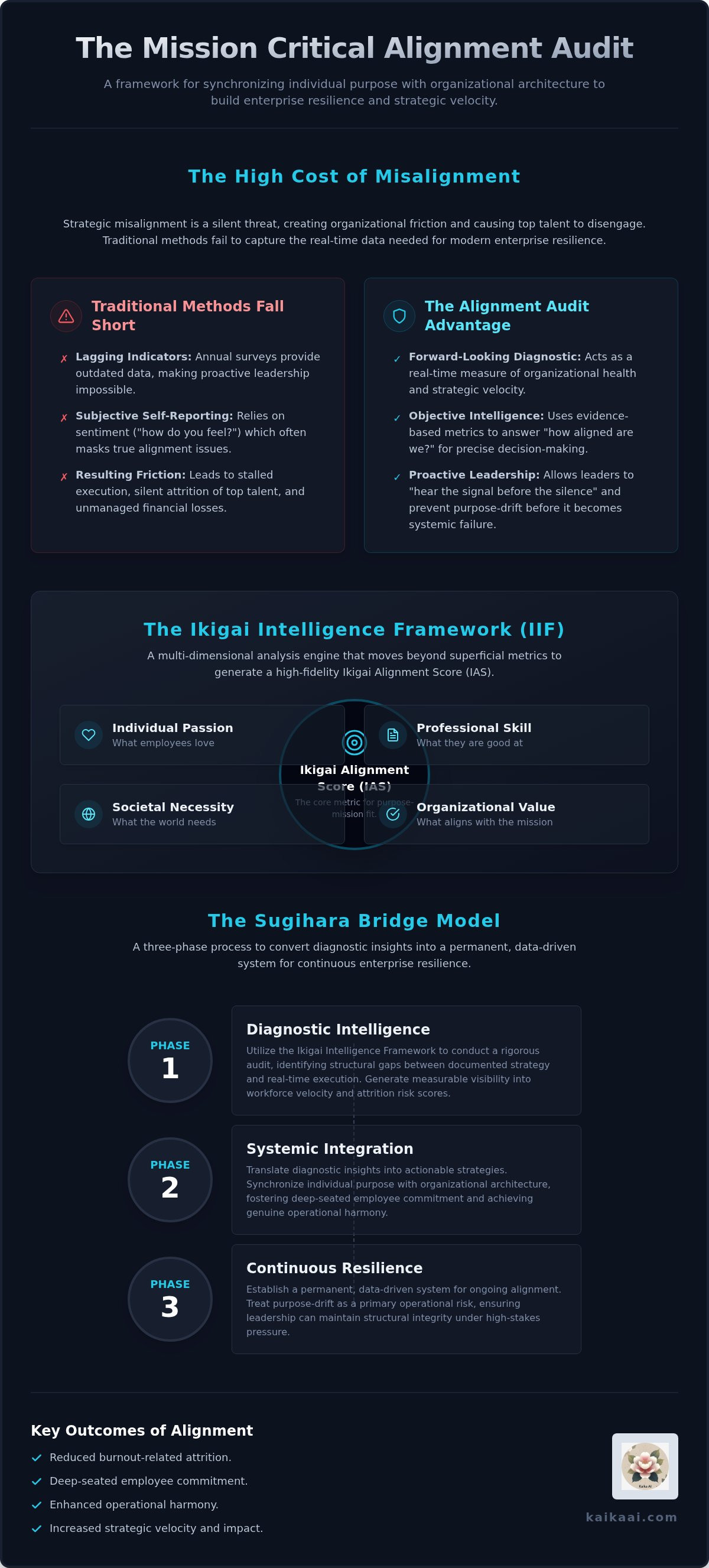
Annual employee surveys are relics of a slower industrial age. Their inherent lag time means that by the time leadership analyzes the data, the cultural context has already shifted. These tools rely on subjective self-reporting, which often masks the true state of workforce sentiment. Modern enterprise resilience requires real-time, behavioral workforce data that bypasses the filters of social desirability. An effective mission critical alignment audit demands evidence-based metrics over anecdotal feedback. It replaces the "how do you feel" approach with "how aligned are we," providing the objective clarity necessary for executive decision-making. This transition from sentiment to synchronization is the hallmark of a disciplined, results-driven leadership mindset.
The Ikigai Intelligence Framework: A New Audit Standard
The Ikigai Intelligence Framework (IIF) provides the sophisticated engine required for a contemporary mission critical alignment audit. It replaces the superficiality of traditional audits with a multidimensional analysis of the intersection between individual passion, professional skill, societal necessity, and organizational value. By measuring these four quadrants, the framework generates an Ikigai Alignment Score (IAS) that serves as a high-fidelity metric for purpose-mission fit. This score allows executive leadership to see exactly where individual trajectories diverge from corporate objectives. Clinical oversight remains a non-negotiable component of this framework; it ensures that the data-driven confidence of the enterprise is balanced with a deep, philosophical understanding of human potential.
Integrating this framework into broader Enterprise Risk Management protocols allows leaders to treat purpose-drift as a primary operational risk. Organizations that fail to quantify this drift often find themselves reacting to crises rather than preventing them. By utilizing the IIF, leadership can move from a state of endurance to one of synchronized velocity. This methodical approach ensures that every structural component of the organization is pulling in the same direction, maximizing both impact and resilience.
Decoding the Human Signal Index (HSI)
The Human Signal Index (HSI) functions as the diagnostic sensor for the audit. It surfaces subtle behavioral signals across the enterprise before disengagement or silent attrition becomes a reality. In large-scale organizations, the predictive power of sentiment analysis identifies patterns of friction that remain invisible to standard management layers. HSI is a lead indicator for organizational health that allows for strategic intervention before performance stalls.
Psychological Resilience and the EHSI
Resilience requires more than just technical skill; it demands psychological structural integrity. The Employee Human Signal Index (EHSI) was co-developed with clinical psychologists to bridge the gap between technical intelligence and human-centric outcomes. This index enables the mission critical alignment audit to flag leading indicators of employee burnout with surgical precision. These insights are delivered under strict Japanese privacy standards, ensuring that data transparency never compromises ethical boundaries. By identifying these signals early, executives can maintain a composed, strategic response to workforce stressors. Leaders seeking to implement these systematic changes can explore the Workforce Alignment Intelligence Platform to begin their evolution.
Diagnostic Intelligence vs. Traditional Strategy Audits
Traditional strategy audits often rely on subjective leadership interviews and anecdotal evidence. While these qualitative conversations provide a high-level view of intent, they are frequently compromised by cognitive bias and social desirability. In contrast, a mission critical alignment audit utilizes objective, AI-driven data to map the actual behavioral landscape of the organization. This diagnostic intelligence allows for a precise distinction between "strategy clarity," which is the mere existence of a documented plan, and "operational synchronization," which measures the workforce's actual capacity to execute that plan in real-time. This distinction is vital for leaders who demand measurable structural impact over optimistic projections.
The transition from reactive problem-solving to proactive signal detection marks a fundamental shift in executive governance. Instead of waiting for quarterly reports to reveal missed targets, leaders can now identify purpose-drift as it occurs. Kaika AI serves as the category leader in this transition, providing the technological infrastructure necessary to detect subtle shifts in workforce velocity. By prioritizing data over narrative, the enterprise remains resilient and agile, capable of maintaining high-stakes performance without the frantic energy of crisis management.
Data-Driven Kaizen vs. Static Reporting
Static audit reports offer a frozen snapshot of the past. They lack the dynamic capability required for rapid course correction in volatile markets. By integrating continuous performance management software, organizations maintain a state of perpetual refinement. Real-time metrics provide the velocity needed to adjust strategy before minor misalignments become systemic failures. This data-driven approach is validated by the 87% employee honesty rate achieved in Kaika AI pilot programs, demonstrating that transparency and trust are measurable structural assets rather than abstract ideals.
The Executive Architectural Consultation
While AI provides the data, human judgment remains the final arbiter of strategic meaning. The mission critical alignment audit does not replace leadership; it enhances it. Executive-level consultations are essential for interpreting AI signals within the specific cultural context of the firm. This hybrid approach is formalized in the Sugihara Bridge Model, which creates a seamless architecture between technical intelligence and human-centric decision-making. It ensures that phase-based integration remains grounded in the realities of global leadership while leveraging the precision of workforce analytics. This methodical flow allows executives to move from high-level visionary statements to structured, operational outcomes with uncompromising focus.
The Executive Checklist for Mission-Critical Alignment
An effective mission critical alignment audit requires a disciplined, architectural approach to assessment. CHROs and executive leaders must move beyond superficial sentiment analysis to evaluate the structural integrity of the organization. This checklist serves as a high-level diagnostic tool to determine if your enterprise possesses the synchronization necessary to withstand market volatility. It prioritizes measurable outcomes over vague cultural aspirations, focusing on the precision of your strategic execution. Before advancing to technical implementation, ensure your current framework addresses these primary pillars of enterprise resilience.
- Cross-Departmental Synergy: Do your internal structures facilitate or hinder workforce velocity? Identify silos that create friction and slow the transmission of strategic directives.
- Ethical AI Compliance: Ensure your workforce intelligence adheres to Japan's Act on the Protection of Personal Information (APPI) 2026 amendments. Transparency regarding biometric data and AI processing is now a non-negotiable legal and reputational requirement.
- Attrition Risk Intelligence: Monitor for signals of disengagement before they manifest as proxy resignations. In large Japanese enterprises, 15.7% of resignations now arrive via third-party agencies; your audit must detect these shifts before the exit occurs.
Pillar 1: Purpose Synchronization
The core of organizational harmony lies in the synchronization of individual purpose with the corporate mission. Leaders must ask if individual employees see their personal ikigai reflected in the daily operations of the firm. The audit measures the delta between executive vision and frontline reality, identifying where purpose-drift begins to erode performance. By utilizing automated IAS tracking, you can pinpoint specific departments where alignment is failing. This allows for surgical intervention rather than broad, ineffective corporate mandates. It transforms the "engagement paradox" into a measurable roadmap for synchronization.
Pillar 2: Operational Resilience Metrics
Resilience is the ability to maintain strategic velocity under high-stakes pressure. Your audit must evaluate the workforce resilience metrics currently in place to ensure they provide predictive rather than reactive data. Check for early warning systems that flag burnout and disengagement before they impact the bottom line. A robust audit assesses the organization's capacity to absorb stress without sacrificing its core mission. It replaces hope with data-driven confidence, providing a clear view of your operational structural integrity. To begin your transition toward this high-fidelity intelligence, schedule an Alignment Audit to identify your hidden structural gaps.
Implementing the Sugihara Bridge Model: From Audit to Action
The transition from diagnostic realization to operational synchronization requires a disciplined, architectural methodology. A mission critical alignment audit is not a terminal event; it is the foundational catalyst for the Sugihara Bridge Model. This three-phase strategic integration methodology ensures that the insights gathered during the audit phase translate into measurable structural impact. By bridging the gap between raw data and executive action, organizations move toward a state of perpetual resilience. This path leads directly to the implementation of the Workforce Alignment Intelligence Platform, where AI-driven measurement converges with trained human executive consultation to sustain organizational harmony.
Phase 1: Structural Framework Implementation
The initial phase focuses on establishing baseline alignment scores across all enterprise divisions using the results from the mission critical alignment audit. This configuration phase involves deploying the AI infrastructure necessary for real-time signal detection, ensuring that the IAS, HSI, and EHSI metrics are calibrated to the organization's specific strategic context. Security remains paramount. All technical deployments must adhere to enterprise-grade standards and comply with the Japanese APPI 2026 amendments regarding processor obligations and data transparency. By securing this technical foundation, leadership creates a reliable environment for continuous intelligence gathering and strategic calibration.
Phase 2: Leadership Mindset Development
Data alone cannot drive evolution; it requires a shift in leadership philosophy. During this phase, audit insights inform Collective Kaizen Workshops designed to refine the executive architectural mindset. Leaders learn to act on behavioral signals before they manifest as the silent attrition discussed in previous sections. This training fosters cross-departmental synergy by replacing siloed intuition with data-driven transparency. It empowers managers to maintain high-stakes performance while remaining composed and strategic, transforming the organization's culture from reactive endurance to proactive synchronization.
The ultimate objective is the achievement of systemic AI for organizational health. This final stage of the Sugihara Bridge Model scales the intelligence platform across the entire global scale of the enterprise. It ensures that the synchronization of individual purpose and corporate mission becomes an automated, self-correcting system. Through this methodical progression, the organization achieves a state of visionary excellence, where technology and human behavior intersect to drive uncompromising results.
Architecting the Future of Enterprise Synchronization
Mastering organizational resilience requires a fundamental shift from static reporting to high-fidelity diagnostic intelligence. By implementing a mission critical alignment audit, your leadership gains the structural visibility needed to synchronize individual purpose with global strategic goals. This framework, supported by our strategic partnership with Waseda University, replaces subjective guesswork with a verified 87% employee honesty rate and a proven NPS of 72 among enterprise participants. It ensures your corporate architecture remains robust against the quiet drift of silent attrition and strategic fragmentation.
The Sugihara Bridge Model provides the methodical roadmap to transition these audit insights into a permanent state of operational harmony. You've seen how the Ikigai Intelligence Framework bridges the gap between workforce potential and executive execution. Now is the time to secure your organization's metabolic rate and strategic velocity. We invite you to request early access to the Kaika AI Alignment Intelligence Platform and begin your evolution. Your journey toward a synchronized, resilient future starts with a single, data-driven step toward uncompromising excellence.
Frequently Asked Questions
What is a mission critical alignment audit?
A mission critical alignment audit is a systematic diagnostic process that evaluates the synchronization between an organization's strategic mission and the individual purpose of its workforce. It moves beyond traditional HR metrics to identify structural gaps that lead to stalled execution or silent attrition. By surfacing these misalignments, the audit provides leadership with the high-fidelity intelligence needed to restore operational harmony and ensure long-term enterprise resilience.
How does AI improve the accuracy of a workforce alignment audit?
Artificial intelligence enhances accuracy by replacing subjective leadership intuition with real-time, behavioral workforce data. These systems detect subtle patterns in sentiment and performance that human observers often overlook, capturing the signal before the silence. By utilizing advanced analytics, the audit provides objective visibility into organizational health, allowing for proactive strategic interventions rather than reactive crisis management. This data-driven approach achieved an 87% employee honesty rate in pilot programs.
What is the Ikigai Intelligence Framework (IIF)?
The Ikigai Intelligence Framework (IIF) is the proprietary engine of the audit, rooted in the Japanese philosophy of purpose. It measures the intersection of individual passion, skill, societal necessity, and organizational value through three distinct indices. These include the Ikigai Alignment Score (IAS) for purpose fit, the Human Signal Index (HSI) for behavioral signals, and the Employee Human Signal Index (EHSI) for psychological strain. Together, they provide a comprehensive map of workforce synchronization.
How can an audit identify burnout risk before attrition occurs?
The audit identifies burnout risk by monitoring the Employee Human Signal Index (EHSI), which was co-developed with clinical psychologists to detect early indicators of psychological strain. Unlike annual surveys that capture data too late, this index surfaces behavioral shifts and disengagement signals in real-time. By flagging these risks early, executives can implement supportive measures before disengagement translates into the costly reality of silent attrition or the use of resignation agencies.
Is employee data privacy protected during an alignment audit?
Data privacy is a non-negotiable pillar of the audit process. Our platform adheres to the rigorous standards of Japan's Act on the Protection of Personal Information (APPI) 2026 amendments, ensuring total transparency regarding data processing and biometric handling. We prioritize ethical AI use by maintaining strict processor obligations and anonymizing sensitive workforce signals. This commitment to security fosters the high levels of trust reflected in our participants' 87% honesty rate.
What makes the Sugihara Bridge Model different from traditional consulting?
Traditional consulting often relies on static reports and one-time interviews, whereas the Sugihara Bridge Model utilizes a hybrid architecture of AI-driven measurement and trained human consultants. This model ensures that complex workforce signals are interpreted with human nuance and strategic judgment. It provides a continuous, phase-based methodology for integration, moving from baseline structural frameworks to leadership mindset development, rather than offering a temporary, outside-in solution that fails to scale.
How long does a comprehensive mission critical alignment audit take?
A mission critical alignment audit functions as the initial phase of a long-term strategic evolution rather than a one-off event. While the baseline structural framework implementation occurs rapidly, the transition into a state of continuous intelligence is a methodical, phase-based process. This approach ensures that the organization establishes a reliable AI infrastructure for real-time signal detection, allowing leadership to maintain strategic velocity and resilience across the entire global scale of the enterprise.
What specific metrics are included in an alignment audit report?
The audit report delivers a multidimensional view of organizational health through the Ikigai Alignment Score (IAS), Human Signal Index (HSI), and Employee Human Signal Index (EHSI). It includes specific metrics on workforce velocity, attrition risk scores, and cross-departmental synergy gaps. These reports provide the diagnostic clarity necessary for executive decision-making, supported by proof points such as the high honesty rates and Net Promoter Scores of 72 achieved in enterprise pilot programs.
Disclaimer
#Disclaimer
At Kaika AI, we believe the future belongs to organizations that combine human wisdom with artificial intelligence responsibly. The articles, research, insights, and thought leadership published on this website are intended to educate, inform, and encourage meaningful conversations about the future of work, organizational intelligence, AI, leadership, and innovation.
While our content is developed through rigorous research and may be generated, curated, or enhanced using artificial intelligence, every effort is made to ensure it reflects thoughtful analysis, practical relevance, and responsible AI practices. However, no representation or warranty is made regarding the completeness, accuracy, or suitability of the information for every individual or organizational circumstance.
The ideas, opinions, frameworks, and recommendations shared by Kaika AI are provided for educational and informational purposes only. They should not be interpreted as legal, financial, medical, psychological, human resources, cybersecurity, or other professional advice. Organizations and individuals should seek qualified professional guidance before making strategic, legal, or operational decisions.
Where articles reference third-party organizations, products, services, academic research, industry reports, or public data, such references are provided solely to support discussion and analysis. Unless explicitly stated, they do not imply endorsement, partnership, or affiliation.
Artificial intelligence is a powerful decision-support technology—not a replacement for human judgment. Kaika AI advocates for responsible, transparent, and human-centered AI adoption. We encourage readers to critically evaluate information, consider their unique context, and combine AI-generated insights with professional expertise and sound decision-making.
The content published on this website may be updated, revised, or removed as knowledge, technology, regulations, and best practices continue to evolve.
To the fullest extent permitted by applicable law, Kaika AI, its affiliates, contributors, and partners disclaim liability for any direct, indirect, incidental, consequential, or other losses arising from the use of, or reliance upon, the information provided on this website.
By accessing or using this website, you acknowledge that you have read, understood, and agree to this Disclaimer.
Kaika AI
'Building trusted organizational intelligence for the AI Era'


