
What if the metrics you rely on to measure success are actually masking the structural decay of your organization? Most executive leaders recognize that traditional workforce productivity benchmarks often fail to capture the human truth of their operations. You've likely seen teams hitting their output targets while simultaneously trending toward silent attrition. It's a frustrating paradox. Data suggests peak performance; however, the underlying organizational harmony is fracturing. This disconnect between corporate strategy and individual employee effort creates a fragile foundation that cannot sustain long-term growth.
This guide moves you beyond static, volume-based KPIs toward a sophisticated model of high-velocity alignment. You'll discover how to leverage next-generation workforce productivity benchmarks to bridge the gap between high-level purpose and operational execution. We'll explore a data-driven framework for organizational synergy that acts as an early warning system for disengagement and burnout. By the end of this analysis, you'll understand how to measure the precise synchronization of effort and mission. You'll gain the strategic tools to ensure your enterprise remains resilient, agile, and uncompromisingly focused on excellence.
Key Takeaways
- Transition from static output metrics to Alignment Velocity to measure the speed at which your workforce executes on a shared strategic mission.
- Utilize the Ikigai Alignment Score (IAS) and Human Signal Index (HSI) to identify high-velocity synergy and detect disengagement before it leads to attrition.
- Replace legacy workforce productivity benchmarks with a data-driven framework that prioritizes human potential and organizational harmony over mere volume.
- Execute a phase-based transition starting with an Alignment Audit to uncover the human truth within your data and bridge the strategy-execution gap.
- Leverage the Sugihara Bridge Model to combine AI-powered intelligence with human-centric consultation for scalable, secure, and resilient performance alignment.
Beyond Output: Redefining Workforce Productivity Benchmarks for 2026
The era of measuring enterprise health through the narrow lens of volume is ending. For decades, leadership teams relied on hours logged and ticket closures as the primary indicators of success. These metrics are retrospective. They describe what happened yesterday without accounting for the structural integrity of the workforce today. In 2026, sophisticated workforce productivity benchmarks must evolve to measure synchronicity rather than just activity. We're witnessing a transition toward predictive intelligence that prioritizes the human truth beneath the data points.
Alignment Velocity represents the new frontier of performance measurement. It's the speed at which a collective workforce executes on a shared strategic mission. While traditional output measures focus on the quantity of work, Alignment Velocity focuses on the directional accuracy of that effort. High activity without alignment is merely friction. True enterprise growth requires a workforce that doesn't just work harder, but moves with a unified, high-velocity purpose toward organizational goals.
The Failure of Traditional Productivity KPIs
Standard optimization strategies often inadvertently create a mask for institutional decay. When executives push for higher efficiency using legacy benchmarks, they frequently trigger silent attrition. This phenomenon occurs when employees remain technically productive but have emotionally detached from the corporate mission. To understand the baseline, one must ask: What is Workforce Productivity? Traditionally, it's the ratio of total output to total input. However, this definition fails to account for the psychological cost of "work about work" or the long-term impact of burnout.
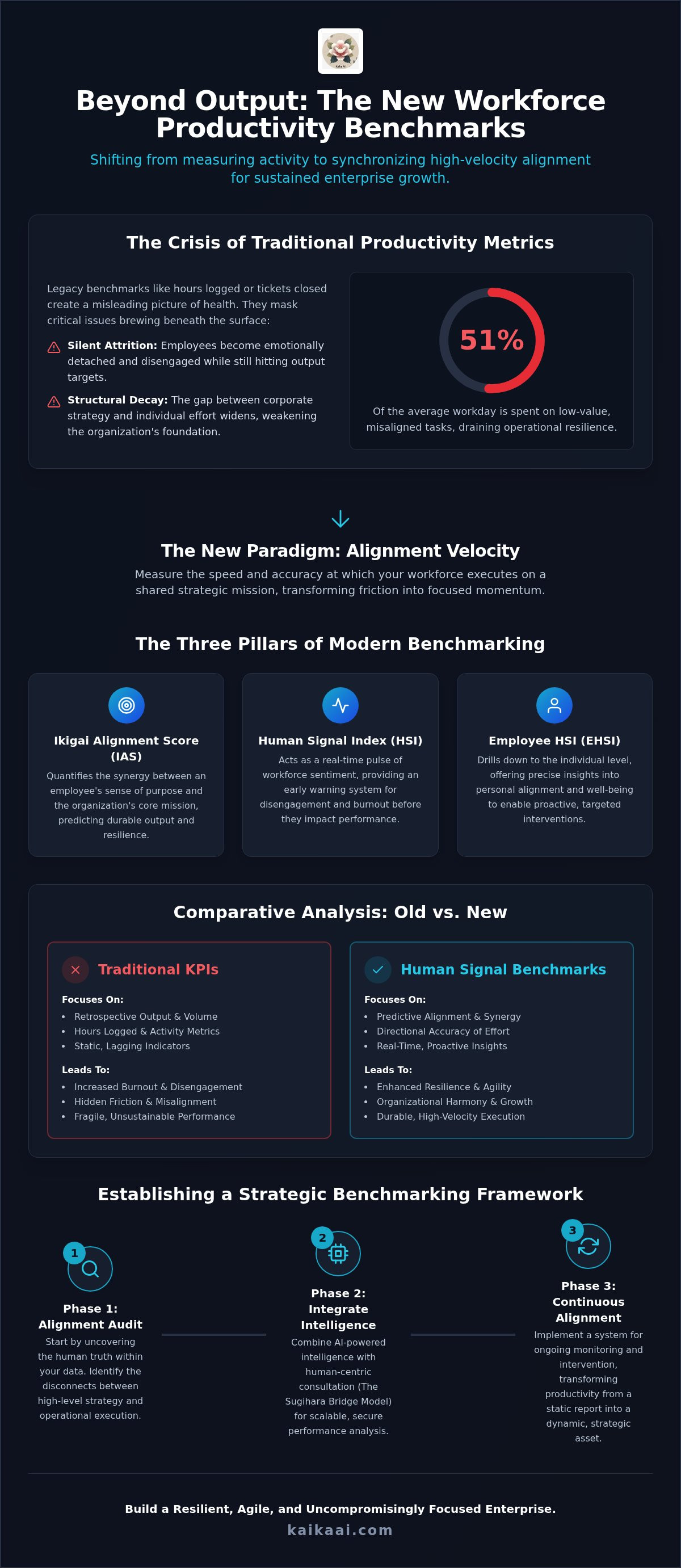
The "Signal before the Silence" philosophy serves as the modern management standard for identifying structural instability before it manifests as operational failure. High activity levels often hide the fact that 51% of the workday is spent on low-value tasks. By automating routine interactions with tools like Hello Voice AI, companies can free up their staff for mission-critical alignment. Without a more nuanced approach to workforce productivity benchmarks, leaders remain blind to the growing disconnect between corporate strategy and individual effort. This misalignment isn't just a cultural issue; it's a measurable drain on operational resilience.
The Rise of Workforce Alignment Intelligence
The solution lies in integrating systems engineering with organizational psychology. By adopting an Ikigai-based framework, companies can quantify the synergy between individual purpose and organizational mission. This isn't a "soft" metric. It's a hard indicator of resilience. When an employee's personal sense of "reason for being" aligns with the company's objective, the result is a measurable boost in durable output and a significant decrease in burnout risk.
Deploying a Workforce Alignment Intelligence Platform allows leadership to move from reactive reporting to proactive intervention. Instead of analyzing why a team missed a quarterly target, executives can monitor the Human Signal Index in real-time. This shift toward predictive intelligence ensures that performance is built on a foundation of genuine harmony rather than unsustainable pressure. It transforms productivity from a static number into a dynamic, architectural asset that scales with the enterprise.
The Three Pillars of Modern Benchmarking: IAS, HSI, and EHSI
The architecture of 2026 organizational performance rests on three proprietary indices: the Ikigai Alignment Score (IAS), the Human Signal Index (HSI), and the Employee Human Signal Index (EHSI). These aren't mere data points. They represent a fundamental shift in how executive leadership audits the structural integrity of their human capital. While legacy modern productivity benchmarks often fixate on the visible surface of output, these pillars reveal the psychological currents driving that output. The HSI, in particular, serves as a real-time pulse of workforce sentiment. It provides early detection of disengagement before it impacts the bottom line or disrupts operational velocity.
Quantifying Purpose: The Ikigai Alignment Score
The Ikigai Alignment Score (IAS) provides a mathematical framework for the intersection of individual skill, passion, and organizational mission. It quantifies the degree of mission-critical synergy across the enterprise. By mapping these variables, leaders can identify the specific gap between executive vision and frontline execution. This isn't abstract philosophy. It's a precise diagnostic tool. High IAS clusters often reveal your next generation of high-potential leaders. Conversely, departments with low IAS scores serve as early indicators of structural friction that will eventually stall growth. Performance becomes a function of synchronization rather than just exertion.
Predictive Health: The EHSI as a Burnout Benchmark
Traditional engagement surveys fail because they're retrospective and prone to social desirability bias. The Employee Human Signal Index (EHSI) utilizes a clinically-informed approach to detect psychological strain. It achieves an 87% employee honesty rate by focusing on human truths rather than corporate platitudes. By monitoring leading indicators of employee burnout, EHSI allows for intervention weeks before a high-performer reaches the point of resignation. This index moves beyond generic "wellness" metrics to provide a rigorous, data-driven benchmark for psychological resilience.
This level of granular intelligence is essential for modern corporate governance. It moves the conversation from "Are people working?" to "Is the work sustainable and aligned?". Using these workforce productivity benchmarks, boards can ensure that operational velocity doesn't come at the expense of institutional health. For leaders ready to move beyond surface-level metrics, conducting an Alignment Audit is the first step toward building a truly synchronized enterprise. It ensures that every unit of effort contributes directly to the collective mission without compromising the human foundation of the business.
Comparative Analysis: Traditional KPIs vs. Human Signal Benchmarks
Modern enterprise leadership requires a fundamental shift from monitoring volume to auditing velocity. Traditional workforce productivity benchmarks have long relied on "Time on Task" as the ultimate arbiter of value. This approach is flawed. It treats the employee as a mechanical component rather than a strategic asset. In contrast, Alignment Velocity measures the precision and speed of mission execution. While a team might show 100% utilization in a legacy report, they could be moving rapidly in the wrong direction. High utilization without alignment isn't productivity; it's high-speed friction that inevitably leads to institutional burnout.
Operational Efficiency vs. Strategic Alignment
The following table illustrates the divergence between legacy metrics and the sophisticated indices required for 2026 corporate governance.
| Metric Category | Traditional KPI (Reactive) | Alignment Intelligence (Proactive) |
|---|---|---|
| Execution | Utilization Rate / Hours Logged | Alignment Velocity |
| Sentiment | eNPS / Annual Surveys | Human Signal Index (HSI) |
| Risk Management | Attrition Rate / Exit Interviews | EHSI (Burnout & Strain Detection) |
| Synergy | Manager Subjective Reviews | Ikigai Alignment Score (IAS) |
High utilization often precedes a total collapse in workforce resilience. When systems are pushed to 100% capacity without regard for the Human Signal Index, the "Signal before the Silence" is ignored. This oversight results in silent attrition, where top talent disengages long before they formally resign. For these reasons, continuous performance management software must be philosophically grounded in the synchronization of individual purpose and organizational mission to be effective.
From Surveys to Real-Time Signals
The "Survey Fatigue" problem is a significant barrier to accurate data. Annual reviews are retrospective artifacts that capture static sentiment rather than dynamic operational reality. Employees often provide "safe" answers rather than the human truth. To counter this, AI-driven anonymity and Ikigai-based frameworks have achieved an 87% employee honesty rate in pilot environments. This transparency is essential for building a data-driven framework for organizational synergy.
Benchmarking the weekly completion rate serves as a vital indicator of organizational trust. In high-performing cultures, we see consistent 74% completion rates for alignment check-ins. These real-time dashboards enable faster executive pivot-cycles. Instead of waiting for quarterly reports to identify a disconnect, leadership can see the friction as it develops. This proactive stance transforms workforce productivity benchmarks from simple accounting tools into strategic early warning systems. It allows for a Collective Kaizen approach where performance is continuously tuned for both output and harmony.
Establishing a Strategic Benchmarking Framework: A Phase-Based Approach
Deploying sophisticated workforce productivity benchmarks requires more than technical integration; it demands a phased architectural transformation. Most organizations fail because they attempt to layer modern metrics over fractured foundations. To build an enterprise that scales with precision, leadership must move through a methodical progression from discovery to synchronization. This structured approach ensures that data intelligence translates into measurable structural impact across all global divisions.
Phase 1 initiates the process with a rigorous Alignment Audit to uncover structural friction and mission-critical gaps. Phase 2 transitions into Architectural Consultation, where we design bespoke integration strategies for specialized divisions. This ensures that a global engineering team and a regional sales force aren't forced into a one-size-fits-all metric box. Finally, Phase 3 implements Collective Kaizen. These workshops facilitate team-level mission synchronization, turning abstract corporate goals into daily operational realities for every contributor. This phase-based evolution establishes a durable baseline for operational resilience through predictive metrics.
The Alignment Audit: Surfacing the Human Truth
The audit serves as the diagnostic baseline for operational resilience. It allows executives to see the "Signal before the Silence" by quantifying the disconnect between stated purpose and actual effort. High-performance teams often mask significant attrition risks behind consistent output. By utilizing a strategic framework for systemic workforce alignment, you can detect when the psychological cost of productivity begins to outweigh the strategic gain. This phase establishes the truth as a management standard, ensuring that growth is built on a foundation of genuine harmony rather than unsustainable pressure.
Mindset Development and Leadership Alignment
The most advanced AI-driven signals are useless without a leadership mindset capable of interpreting them. Executives must evolve from task-masters into Strategic Sages who understand the intersection of technology and human behavior. This evolution requires developing psychological stamina through rigorous Operational Resilience Training. You aren't just managing schedules; you're managing the collective energy and purpose of a global workforce. Bridging the gap between data intelligence and human-centric leadership ensures that your organization remains composed under high-stakes pressure. It transforms your leadership team into a force for structural integrity and visionary excellence.
To begin your organizational transformation, schedule an Alignment Audit to identify the structural gaps in your current performance framework.
Scaling Excellence: Integrating Kaika AI for Continuous Performance Alignment
Scaling a global enterprise requires more than administrative software. It requires a system that synchronizes human purpose with operational velocity. While legacy platforms focus on the mechanics of payroll and scheduling, true category leaders leverage workforce productivity benchmarks to foster cultural and mission-based alignment. Kaika AI represents this evolution. It provides a framework where data intelligence doesn't replace leadership but empowers it to act with surgical precision. This transition ensures that as your organization grows, its structural integrity remains uncompromisingly focused on excellence.
The Sugihara Bridge Model: Responsible AI in Action
Data alone is a blunt instrument. The Sugihara Bridge Model pairs AI-driven measurement with human consultation to ensure that sensitive workforce signals are interpreted with clinical oversight. This approach recognizes that an EHSI score isn't just a number; it's a reflection of human strain. By involving clinical psychologists in the benchmarking process, we maintain an 87% employee honesty rate. This transparency is the cornerstone of ethical data use. It ensures that workforce resilience metrics become a standard pillar of corporate governance rather than a surveillance tool.
Security remains paramount in this architectural design. Our platform utilizes enterprise-grade encryption and privacy compliance protocols to protect the human truth within your data. This commitment to transparency and ethics allows for a 74% weekly completion rate, as employees trust the system to advocate for their well-being while driving performance. It creates a feedback loop where data-driven insights lead to tangible improvements in organizational harmony and resilience.
Architecting the Future of Work
Kaika AI isn't just a tool; it's a vision for the intersection of technology and human potential. Our academic partnership with Waseda University validates our methodology, ensuring that our indices are grounded in rigorous organizational psychology. From our roots in Tokyo, we're expanding toward a global presence, with a strategic roadmap targeting a dual TSE/ASX listing by 2032. This trajectory reflects our commitment to institutional reliability and long-term partnership with global leaders who understand the nuances of a leadership mindset.
The future belongs to organizations that can hear the signal before the silence. By integrating these advanced workforce productivity benchmarks, you ensure your enterprise remains resilient in the face of global complexity. Secure your organization's future by aligning purpose with performance today. To request early access to the Kaika AI workforce alignment platform, contact our executive consultation team to begin your journey toward high-velocity alignment.
Architecting the Future of High-Velocity Alignment
The transition from legacy metrics to a purpose-driven framework is no longer optional for the resilient enterprise. By integrating sophisticated workforce productivity benchmarks, leaders can bridge the gap between strategic vision and frontline execution. You've seen how the three pillars of IAS, HSI, and EHSI provide a clinically-informed early warning system for disengagement. This structural intelligence ensures that your organization doesn't just hit targets; it maintains the psychological stamina required for long-term excellence.
Scaling this excellence requires a commitment to transparency and ethical data use. With an 87% employee honesty rate, our framework surfaces the human truth beneath the noise. It reduces attrition through early-signal detection and utilizes clinically-informed burnout prediction to protect your most valuable assets. Secure your organization's future by hearing the signal before the silence. Request early access to the Kaika AI Workforce Alignment Intelligence Platform to begin your transformation today. Your journey toward organizational harmony starts with a single, data-driven step.
Frequently Asked Questions
What are the most important workforce productivity benchmarks for 2026?
The most critical workforce productivity benchmarks for 2026 don't focus on raw output but on Alignment Velocity and mission-critical synergy. Leadership teams must prioritize metrics that quantify the synchronization between individual effort and organizational strategy. Key indices include the Human Signal Index (HSI) for sentiment and the Ikigai Alignment Score (IAS) for purpose. These benchmarks provide a predictive view of enterprise health, allowing for proactive adjustments before operational friction manifests.
How does the Ikigai Alignment Score (IAS) differ from traditional engagement surveys?
The Ikigai Alignment Score (IAS) measures the deep synchronization of individual purpose with corporate mission, whereas traditional surveys often only capture surface-level satisfaction. While surveys are retrospective and prone to bias, the IAS provides a mathematical framework for mapping skill, passion, and strategic need. This allows executives to identify high-potential leaders and alignment-critical departments. It transforms abstract cultural concepts into measurable, actionable diagnostic data for structural integrity.
Can AI-driven benchmarks accurately predict employee burnout?
Yes, AI-driven benchmarks like the Employee Human Signal Index (EHSI) can accurately predict burnout by identifying leading indicators of psychological strain weeks before resignation occurs. These indices use clinically-informed algorithms to detect subtle shifts in engagement and effort. By monitoring these workforce productivity benchmarks, organizations can intervene with targeted support. This transition from reactive reporting to predictive health management is essential for maintaining a resilient and high-performing global workforce.
What is the 'Human Signal Index' and why is it a leading indicator of turnover?
The Human Signal Index (HSI) is a real-time pulse of workforce sentiment that serves as a leading indicator of turnover by surfacing the signal before the silence. It detects the early stages of disengagement that traditional metrics often miss. When HSI scores drop, it's a sign of fracturing organizational harmony. Monitoring this index allows leadership to address structural friction and silent attrition risks before they impact the bottom line or disrupt operational velocity.
How do large enterprises implement workforce alignment intelligence without compromising privacy?
Large enterprises implement workforce alignment intelligence by utilizing responsible AI frameworks that prioritize ethical data use and high-grade encryption. Systems like Kaika AI don't compromise privacy because they ensure employee anonymity to foster trust while providing leadership with aggregated, actionable insights. By maintaining transparency about how data is used, organizations can bridge the gap between technical intelligence and human-centric outcomes. This approach ensures privacy compliance while surfacing the human truth.
What is a healthy benchmark for employee honesty in digital feedback systems?
A healthy benchmark for employee honesty in digital feedback systems is approximately 87%, a rate achieved through AI-driven anonymity and purpose-aligned frameworks. Most legacy systems suffer from social desirability bias, leading to skewed data. Achieving high honesty rates requires a platform that employees trust to advocate for their well-being. High completion rates, such as the 74% weekly average seen in pilot tests, further validate the integrity and reliability of the workforce data.
How does the Sugihara Bridge Model integrate AI data with executive decision-making?
The Sugihara Bridge Model integrates AI-driven workforce signals with human judgment and clinical oversight to ensure data-driven decisions remain contextually grounded. While AI surfaces patterns and risks, human consultants provide the nuanced interpretation necessary for complex organizational changes. This model prevents leadership from over-relying on blunt metrics. It ensures that executive interventions are both strategically sound and philosophically aligned with the human potential and resilience of the collective workforce.
What role does mission synchronization play in organizational resilience?
Mission synchronization is the cornerstone of organizational resilience, as it ensures every unit of effort contributes directly to the collective goal. When a workforce is aligned, it possesses the structural integrity to withstand market volatility and internal shifts. Through Collective Kaizen workshops, teams achieve high-velocity alignment that transforms abstract strategy into daily operational reality. This synchronization creates a durable foundation, allowing the enterprise to scale with precision and uncompromising visionary excellence.
Disclaimer
#Disclaimer
At Kaika AI, we believe the future belongs to organizations that combine human wisdom with artificial intelligence responsibly. The articles, research, insights, and thought leadership published on this website are intended to educate, inform, and encourage meaningful conversations about the future of work, organizational intelligence, AI, leadership, and innovation.
While our content is developed through rigorous research and may be generated, curated, or enhanced using artificial intelligence, every effort is made to ensure it reflects thoughtful analysis, practical relevance, and responsible AI practices. However, no representation or warranty is made regarding the completeness, accuracy, or suitability of the information for every individual or organizational circumstance.
The ideas, opinions, frameworks, and recommendations shared by Kaika AI are provided for educational and informational purposes only. They should not be interpreted as legal, financial, medical, psychological, human resources, cybersecurity, or other professional advice. Organizations and individuals should seek qualified professional guidance before making strategic, legal, or operational decisions.
Where articles reference third-party organizations, products, services, academic research, industry reports, or public data, such references are provided solely to support discussion and analysis. Unless explicitly stated, they do not imply endorsement, partnership, or affiliation.
Artificial intelligence is a powerful decision-support technology—not a replacement for human judgment. Kaika AI advocates for responsible, transparent, and human-centered AI adoption. We encourage readers to critically evaluate information, consider their unique context, and combine AI-generated insights with professional expertise and sound decision-making.
The content published on this website may be updated, revised, or removed as knowledge, technology, regulations, and best practices continue to evolve.
To the fullest extent permitted by applicable law, Kaika AI, its affiliates, contributors, and partners disclaim liability for any direct, indirect, incidental, consequential, or other losses arising from the use of, or reliance upon, the information provided on this website.
By accessing or using this website, you acknowledge that you have read, understood, and agree to this Disclaimer.
Kaika AI
'Building trusted organizational intelligence for the AI Era'


