
What if the silence in your organization isn't a sign of stability, but a precursor to systemic collapse? Most leaders recognize that traditional methods of implementing kaizen for continuous improvement often fail because they rely on manual, lagging indicators. You've likely felt the frustration of strategy documents gathering dust while front-line execution drifts further from the core mission. This disconnect creates a vacuum where silent attrition and disengagement thrive, hidden from the view of outdated performance reviews. It's a high-stakes environment where the speed of change demands more than just incremental tweaks.
We'll show you how to modernize this classic philosophy using workforce alignment intelligence to synchronize individual purpose with organizational performance. Precision is no longer optional. By shifting from reactive management to predictive synchronization, you can hear the signal before the silence. This article explores the Sugihara Bridge Model and the deployment of the Ikigai Alignment Score (IAS) to provide real-time visibility into your workforce. You'll learn a systematic approach to reducing burnout while securing a measurable ROI on your structural evolution. We're moving beyond trendy buzzwords to build a disciplined, AI-driven framework for 2026.
Key Takeaways
- Transition from archaic suggestion boxes to an intelligence-led architecture that enables continuous performance in real-time.
- Quantify organizational synergy by applying the Ikigai Intelligence Framework (IIF) to synchronize individual purpose with executive strategy.
- Master the 3-phase Sugihara Bridge Model for implementing kaizen for continuous improvement, ensuring a seamless integration of AI-driven data and human-centric leadership.
- Utilize predictive metrics like the Ikigai Alignment Score (IAS) and Human Signal Index (HSI) to detect behavioral shifts and burnout risks before they impact the bottom line.
- Leverage a workforce alignment intelligence platform to achieve measurable operational resilience and a significant return on your continuous improvement initiatives.
Beyond the Suggestion Box: The Evolution of Continuous Improvement
Kaizen, once the bedrock of manufacturing efficiency, has undergone a radical metamorphosis. In the 2026 intelligence era, we define it as continuous performance reimagined through the lens of structural alignment. Implementing kaizen for continuous improvement no longer means waiting for a monthly feedback session or checking a physical suggestion box. It requires a high-velocity intelligence layer that captures the subtle shifts in organizational energy. This evolution demands a transition from reactive process tweaks to the architectural synchronization of human intent with organizational output.
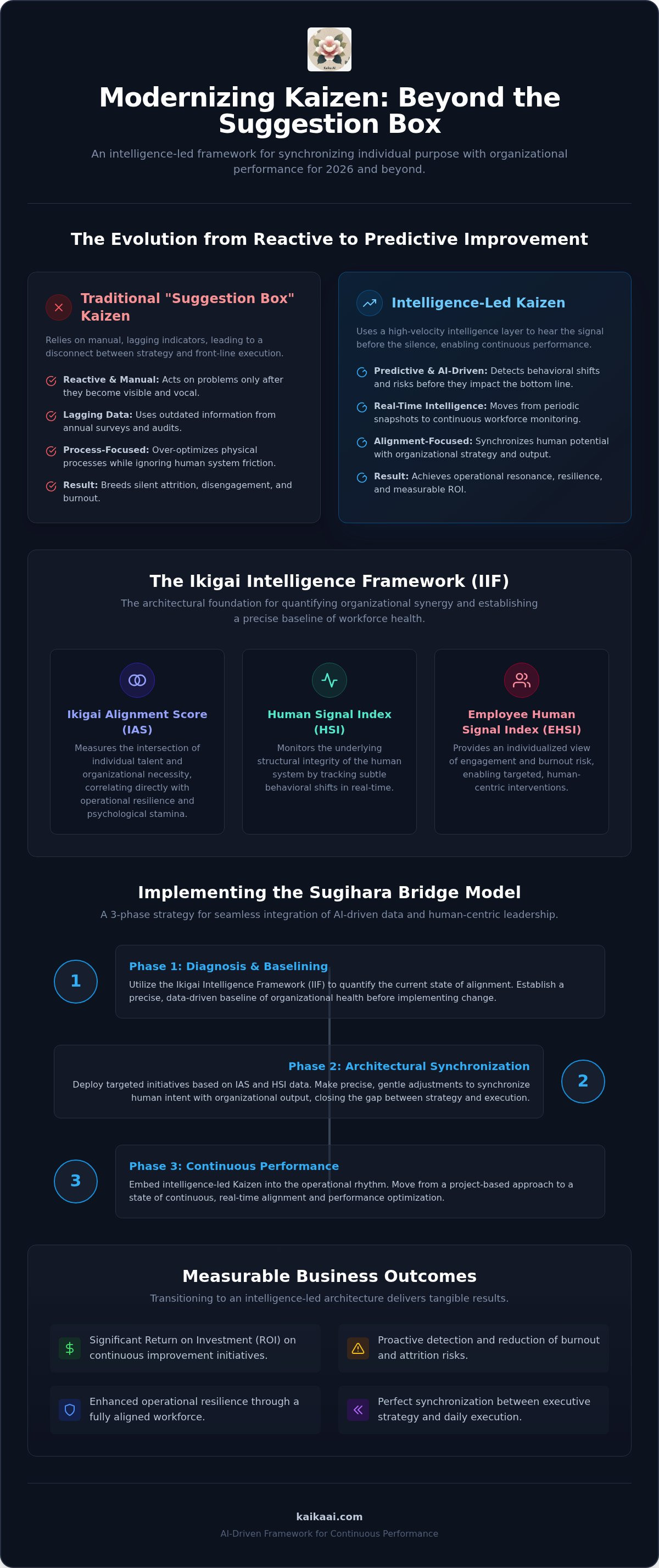
Traditional "Suggestion Box Kaizen" is fundamentally reactive. It relies on the visible, the vocal, and the already broken. In contrast, Intelligence-Led Kaizen operates on the principle of hearing the signal before the silence. It provides executive leadership with the precision needed to synchronize individual purpose with collective performance. This shift elevates the CHRO from a position of reactive firefighting to a strategic architect of alignment. When workforce velocity is prioritized, the organization achieves a state of operational resonance where strategy and execution move in perfect unison.
The Failure of Static Continuous Improvement Models
Annual engagement surveys and manual audits are historical artifacts. They offer a static snapshot of an organization that is constantly in motion. By the time leadership reviews these reports, the insights are often obsolete, rendering any subsequent action ineffective. This lag creates a breeding ground for silent attrition, where high-potential talent disengages and loses momentum long before they formally resign. Traditional Lean environments often focus so heavily on physical process optimization that they ignore the psychological friction slowing down the human system. Implementing kaizen for continuous improvement in 2026 requires moving from periodic snapshots to continuous workforce intelligence to maintain structural integrity.
Kaizen in the Knowledge Economy
In an era where intangible assets drive enterprise value, Lean principles must evolve to optimize psychological stamina and intellectual engagement. We are shifting from the mechanical optimization of assembly lines to the meticulous alignment of human potential. This evolution treats cognitive capacity and emotional resonance as critical operational components that require constant, gentle adjustment. The goal is no longer just "doing more with less" but achieving a state of harmony where individual growth accelerates organizational velocity. In the modern enterprise, 2026 Kaizen is the intersection of AI-driven listening and human-centric action.
The Ikigai Intelligence Framework: Quantifying Organizational Synergy
The Ikigai Intelligence Framework (IIF) serves as the architectural foundation for modern workforce alignment. Unlike traditional management models that view employees as interchangeable units of production, the IIF recognizes that sustainable velocity requires a deep synchronization of individual purpose and corporate mission. This framework provides the empirical data needed to move beyond abstract cultural goals. By quantifying the intangible, leaders can establish a precise baseline of organizational health before initiating any structural changes. It's the difference between guessing at culture and measuring it with engineering precision.
The framework relies on a rigorous three-pillar measurement approach: the Ikigai Alignment Score (IAS), the Human Signal Index (HSI), and the Employee Human Signal Index (EHSI). These metrics don't just track output; they monitor the underlying structural integrity of the human system. This data-driven clarity is essential when implementing kaizen for continuous improvement, as it ensures that every incremental change is grounded in the reality of human behavior rather than executive assumptions. Without this baseline, improvement initiatives often result in superficial changes that fail to address core misalignments.
Measuring Purpose with the Ikigai Alignment Score (IAS)
The IAS tracks the intersection where individual talent meets organizational necessity. It's a high-stakes metric because a high score directly correlates with operational resilience and psychological stamina. When teams operate with a unified IAS, they naturally dissolve departmental silos that typically stall strategic execution. Leaders can use these insights to bridge synergy gaps, ensuring that talent is positioned where it generates the most significant impact. Organizations seeking this level of precision often begin with a comprehensive alignment audit to map their current state and identify hidden friction points.
Detecting the Signal Before the Silence with HSI
The Human Signal Index (HSI) functions as a leading indicator of disengagement, identifying the subtle behavioral shifts that precede a drop in productivity. It embodies our core philosophy: hearing the signal before the silence. By leveraging AI to surface these patterns, leadership can intervene before friction becomes failure. This isn't about surveillance; it's about the ethical use of technology to uncover human truth beneath workforce data. The HSI provides the predictive intelligence required to maintain momentum in a high-stakes global market. Combined with the EHSI, which specifically monitors burnout risk, the IIF ensures that continuous improvement is both high-performing and human-centric.
Data-Driven Kaizen vs. Traditional Lean: A Strategic Comparison
Traditional Lean focuses on the visible: cycle times, inventory levels, and physical defects. While effective in stable environments, this manual approach often overlooks the invisible friction inherent in the knowledge economy. Implementing kaizen for continuous improvement in 2026 requires a shift from optimizing for mere efficiency to optimizing for alignment. When a system is efficient but misaligned, it merely accelerates the wrong outcomes. Data-driven Kaizen uses predictive analytics to ensure that every improvement cycle strengthens the bond between the individual and the enterprise mission, reducing the catastrophic waste of executive-frontline drift.
Critics often argue that AI-driven frameworks are too "cold" for human-centric cultures. This perspective misinterprets the role of intelligence. Far from being a clinical surveillance tool, workforce alignment intelligence acts as a digital stethoscope. It listens to the heartbeat of the organization, surfacing the "human truth" that often remains buried in hierarchy. Traditional Lean relies on subjective observations that are prone to bias; data-driven Kaizen provides an objective mirror. It empowers leaders to make decisions that are both strategically sound and emotionally resonant, proving that precision and empathy aren't mutually exclusive.
From Reactive PDCA to Predictive Intelligence
The Plan-Do-Check-Act (PDCA) cycle remains a valid logic, yet its manual execution is too slow for high-velocity markets. Waiting weeks to "Check" the results of a change often means reacting to data that's already stale. Modern architectures replace these periodic reviews with "micro-Kaizen" adjustments made daily. By integrating continuous performance management software into daily workflows, leaders gain real-time feedback loops. This intelligence layer transforms Kaizen from a series of discrete events into a persistent, self-correcting state of operational excellence.
Addressing Burnout Risk in the Improvement Cycle
A common failure of traditional Lean is the phenomenon of "Lean burnout," where the relentless pursuit of efficiency compromises psychological stamina. AI-augmented frameworks solve this by acting as a biological safety valve. Using the Employee Human Signal Index (EHSI), the platform monitors the structural health of the workforce during the improvement process. These leading indicators of employee burnout allow executives to pause or pivot before performance degrades. Implementing kaizen for continuous improvement without these human-centric safeguards is a strategic risk that leads to silent attrition. By hearing the signal before the silence, organizations protect their most valuable asset while maintaining peak velocity.
Implementing the Sugihara Bridge Model: A 3-Phase Strategy
The Sugihara Bridge Model represents a sophisticated hybrid architecture, blending algorithmic precision with nuanced human judgment. Implementing kaizen for continuous improvement requires more than raw data; it necessitates a culturally sensitive interpretation that only expert consultants can provide. This model ensures that high-tech signals are translated into high-touch leadership actions. Every step of the implementation adheres to enterprise-grade security and privacy protocols, ensuring that sensitive behavioral data remains protected within a rigorous ethical framework. It's a disciplined approach to evolution that respects the complexity of the modern global enterprise.
Phase 1: The Alignment Audit and Baseline Establishment
The journey begins with a mission critical alignment audit designed to detect the "silence" within your organizational structure. This phase focuses on identifying deep-seated mission-alignment gaps that often span across global divisions. By establishing a baseline using the Ikigai Intelligence Framework (IIF) indices, leadership can set precise KPIs that reflect true organizational health. This architectural consultation ensures the foundation is secure before any technical integration occurs, allowing for a structured and phase-based methodology that minimizes operational friction.
Phase 2: Strategic Integration and Leadership Mindset
Once the baseline is established, we deploy the SaaS platform to begin real-time data collection. This phase is not merely technical; it involves intensive workshops where leaders learn to interpret HSI and IAS signals with strategic clarity. Through Collective Kaizen Workshops, we synchronize individual purpose with the broader corporate mission, transforming the workforce into a unified, high-velocity system. This integration fosters a leadership mindset that values proactive synchronization over reactive management, ensuring that executive strategy and front-line execution move in perfect harmony.
Phase 3: Continuous Optimization and Operational Resilience
The final phase involves scaling the framework across specialized divisions to ensure systemic integrity. We utilize workforce resilience metrics to measure the long-term sustainability of these initiatives. By standardizing the "listening" process, the organization creates a permanent safety valve against silent attrition and disengagement. This phase solidifies the transition to a predictive state of excellence, where continuous improvement is a constant, automated reality. To begin your journey toward structural harmony, schedule an executive consultation today.
Scaling Operational Excellence with Kaika AI
The impact of a workforce alignment intelligence platform on enterprise profitability is profound and measurable. It moves beyond superficial engagement scores to provide a structural map of the organization's human capital. By hearing the signal before the silence, leaders gain a decisive competitive advantage, allowing them to preemptively resolve operational friction that would otherwise erode the bottom line. This level of precision is essential for organizations aiming for dual listing-caliber governance by 2032. Implementing kaizen for continuous improvement through the Kaika AI framework ensures that every strategic move is backed by empirical data and architectural integrity. By partnering with applied AI experts like Cogniva, enterprises can successfully navigate this fundamental shift from hopeful management to engineered synchronization.
The Strategic Advantage of Japanese Privacy Standards
Enterprise-grade security is a non-negotiable requirement for workforce data. Kaika AI is built on rigorous Japanese data ethics, prioritizing transparency and trust as the primary drivers of data accuracy. This commitment to ethical intelligence resulted in an 87% employee honesty rate during pilot studies, a figure that far exceeds industry norms for internal surveys. Our platform achieved an NPS of 72 among 340 Tokyo-based participants, demonstrating that employees value a system that respects their human potential while optimizing their performance. By ensuring that behavioral signals are collected with institutional reliability, we provide a foundation of trust that is necessary for any systemic evolution.
Your Journey Toward Continuous Performance
The first step for a CHRO is a fundamental audit of the current state of alignment. It's impossible to fix what you cannot see. By identifying where individual purpose and executive strategy have drifted apart, you can begin the process of structural repair. Building a high-performance culture requires a deep respect for the human truth beneath the data. This journey toward continuous performance is an architectural undertaking that rewards precision, discipline, and a visionary mindset. We invite you to move beyond traditional limitations and embrace a framework designed for the complexities of 2026. Request early access to the Kaika AI platform and begin your organization's evolution today.
Building the Resilient Architecture of 2026
The evolution of continuous performance requires a transition from manual, lagging audits to the real-time precision of workforce alignment intelligence. By integrating the Ikigai Intelligence Framework, leaders can finally bridge the gap between executive strategy and front-line execution. This architectural approach ensures that implementing kaizen for continuous improvement is no longer a series of discrete events but a persistent state of operational resonance. It's about engineering a system where purpose and performance move in unison.
Our methodology, co-developed with clinical psychologists, prioritizes responsible AI use to protect the human system while driving enterprise velocity. Pilot results demonstrate the efficacy of this framework, yielding a 74% weekly completion rate and an NPS of 72. These metrics confirm that both employees and executives find value in a system that synchronizes individual intent with organizational output. Take the first step toward structural harmony and measurable resilience. Request early access to the Kaika AI Workforce Alignment Intelligence Platform to secure your organization's position in the 2026 intelligence era. Your evolution starts here.
Frequently Asked Questions
What is the main difference between traditional Kaizen and AI-driven Kaizen?
Traditional Kaizen is reactive and manual, relying on visible physical defects and periodic reviews. AI-driven Kaizen is predictive and persistent, utilizing real-time data to identify subtle behavioral signals before they manifest as operational failures. This shift allows for micro-Kaizen adjustments daily rather than waiting for monthly audits. It's a method that ensures strategy and execution remain synchronized in high-velocity markets, transforming a discrete event into a persistent state of excellence.
How does the Ikigai Intelligence Framework measure employee purpose?
The Ikigai Intelligence Framework (IIF) utilizes the Ikigai Alignment Score (IAS) to quantify the intersection of individual talent and organizational mission. By analyzing behavioral signals and engagement metrics, the platform identifies how deeply a contributor's skills resonate with corporate objectives. This data-driven approach removes the subjectivity from cultural alignment, providing a precise metric for organizational synergy. It's an architectural tool for leaders who prioritize measurable structural impact over vague corporate buzzwords.
Can Kaizen be implemented in a remote or hybrid workforce?
Yes, implementing kaizen for continuous improvement is essential for remote and hybrid environments where physical oversight is absent. Digital workforce alignment intelligence acts as a virtual stethoscope, monitoring the human truth of distributed teams through the Human Signal Index. This provides leadership with the same visibility into operational friction as they'd have on a physical factory floor. It prevents disengagement and silent attrition across global divisions by maintaining a constant, high-velocity feedback loop.
What are the Human Signal Index (HSI) and Employee Human Signal Index (EHSI)?
The Human Signal Index (HSI) is a leading indicator that identifies behavioral patterns preceding disengagement or stalled strategy. The Employee Human Signal Index (EHSI) specifically monitors burnout risk and psychological stamina, co-developed with clinical psychologists to ensure ethical data use. Together, these indices provide the predictive intelligence required to hear the signal before the silence. They'll allow for proactive interventions that protect both performance and human potential, ensuring the organization remains resilient under pressure.
How does the Sugihara Bridge Model balance AI data with human judgment?
The Sugihara Bridge Model uses a hybrid AI-human architecture where algorithmic precision is filtered through culturally nuanced executive consultation. While the platform provides the raw signals, human experts interpret these findings to ensure that interventions are emotionally resonant and strategically sound. This balance prevents the cold application of data, ensuring that continuous improvement initiatives remain human-centric while maintaining high technical velocity. It's a disciplined approach that respects the complexity of global leadership mindsets.
Is employee data privacy protected in a continuous improvement platform?
Privacy is a foundational pillar of our platform, which adheres to rigorous Japanese data ethics and enterprise-grade security standards. We prioritize transparency to ensure contributors feel safe sharing the human truth necessary for structural evolution. The framework is designed to uncover systemic friction rather than individual surveillance, focusing on collective alignment. This architecture fosters a culture of trust by ensuring that behavioral data is used exclusively to enhance organizational harmony and operational resilience.
How long does it take to see results from implementing Kaizen for continuous improvement?
Initial visibility into alignment gaps typically emerges within the first 30 days of the Phase 1 Alignment Audit. However, full operational resilience and measurable ROI on implementing kaizen for continuous improvement usually materialize during Phase 2 as leadership begins integrating real-time HSI and IAS signals. By Phase 3, the organization achieves a self-correcting state of excellence. This methodical progression ensures that the listening process is standardized across all specialized divisions for sustainable performance.
Does this framework work for non-manufacturing industries like tech or finance?
This framework is specifically designed for the knowledge economy, including high-stakes sectors like tech and finance where intangible assets drive value. In these industries, the primary waste isn't defective parts but misaligned human potential and cognitive burnout. By optimizing for alignment rather than just mechanical efficiency, organizations in these fields can achieve the structural integrity needed to manage intellectual capital at scale. It provides the precision required to synchronize high-velocity teams with executive strategy.
Disclaimer
#Disclaimer
At Kaika AI, we believe the future belongs to organizations that combine human wisdom with artificial intelligence responsibly. The articles, research, insights, and thought leadership published on this website are intended to educate, inform, and encourage meaningful conversations about the future of work, organizational intelligence, AI, leadership, and innovation.
While our content is developed through rigorous research and may be generated, curated, or enhanced using artificial intelligence, every effort is made to ensure it reflects thoughtful analysis, practical relevance, and responsible AI practices. However, no representation or warranty is made regarding the completeness, accuracy, or suitability of the information for every individual or organizational circumstance.
The ideas, opinions, frameworks, and recommendations shared by Kaika AI are provided for educational and informational purposes only. They should not be interpreted as legal, financial, medical, psychological, human resources, cybersecurity, or other professional advice. Organizations and individuals should seek qualified professional guidance before making strategic, legal, or operational decisions.
Where articles reference third-party organizations, products, services, academic research, industry reports, or public data, such references are provided solely to support discussion and analysis. Unless explicitly stated, they do not imply endorsement, partnership, or affiliation.
Artificial intelligence is a powerful decision-support technology—not a replacement for human judgment. Kaika AI advocates for responsible, transparent, and human-centered AI adoption. We encourage readers to critically evaluate information, consider their unique context, and combine AI-generated insights with professional expertise and sound decision-making.
The content published on this website may be updated, revised, or removed as knowledge, technology, regulations, and best practices continue to evolve.
To the fullest extent permitted by applicable law, Kaika AI, its affiliates, contributors, and partners disclaim liability for any direct, indirect, incidental, consequential, or other losses arising from the use of, or reliance upon, the information provided on this website.
By accessing or using this website, you acknowledge that you have read, understood, and agree to this Disclaimer.
Kaika AI
'Building trusted organizational intelligence for the AI Era'


