
What if the attrition spike your organization is facing isn't a talent problem, but a structural failure to identify the signal before the silence? Most enterprise leaders recognize that high-performance cultures demand intensity. However, many struggle to distinguish between sustainable velocity and the invisible erosion of silent burnout, which research suggests currently affects 30% of the workforce. Analyzing the productivity and burnout correlation is no longer a soft human resources concern; it's a strategic financial imperative for maintaining operational resilience.
You've likely felt the frustration of watching top talent depart or seeing presenteeism drain your bottom line through lagging, reactive data. This article reveals the scientific link between systemic exhaustion and organizational productivity debt, teaching you to identify the leading indicators of employee burnout before they impact your margins. We'll provide a reliable framework to measure burnout risk and offer an evidence-based justification for workforce alignment investments, moving your leadership from reactive crisis management to a proactive state of organizational health.
Key Takeaways
- Quantify the inverse productivity and burnout correlation to identify hidden financial risks within your workforce before they manifest as attrition.
- Distinguish between the visible costs of absenteeism and the silent, more damaging impact of presenteeism on organizational velocity and output quality.
- Transition from lagging, reactive surveys to proactive intelligence by utilizing leading indicators that detect disengagement signals months before a formal resignation.
- Shift the organizational focus from workload reduction to purpose alignment by integrating the Ikigai framework into your structural leadership design.
- Implement a phase-based methodology to synchronize technological precision with human judgment, ensuring long-term operational resilience and workforce harmony.
The Science of Productivity and Burnout Correlation
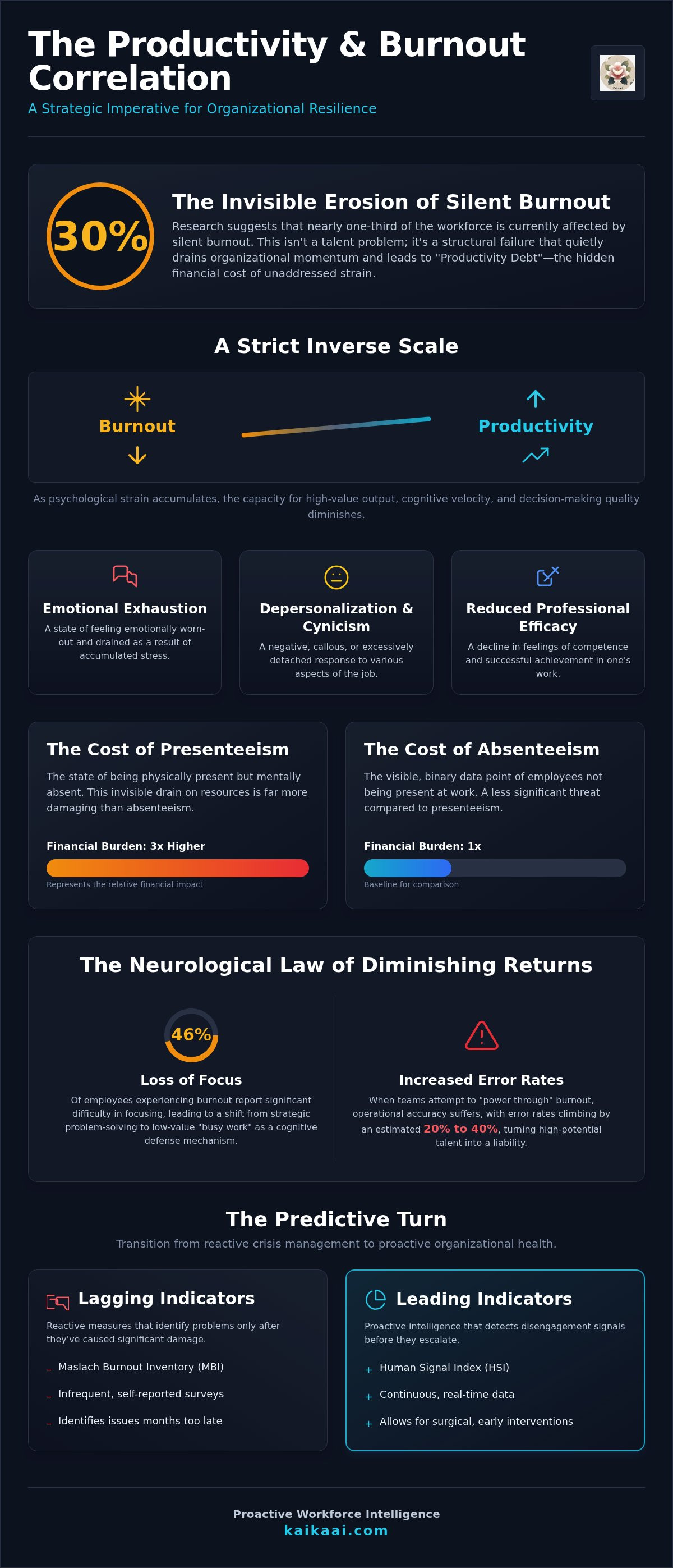
High-performance cultures often mistake persistent exhaustion for a badge of commitment. However, the productivity and burnout correlation functions as a strict inverse scale; as psychological strain accumulates, the capacity for high-value output diminishes. This isn't merely a decline in hours worked. It's a fundamental erosion of cognitive velocity and decision-making quality. When leaders ignore these early signals, they allow "Productivity Debt" to accrue, which is the hidden financial cost of unaddressed strain that eventually bankrupts organizational momentum.
The Science of Productivity and Burnout Correlation identifies three primary dimensions of this phenomenon: emotional exhaustion, depersonalization or cynicism, and a sense of reduced professional efficacy. These factors don't appear overnight. They are preceded by leading indicators of employee burnout that often go unnoticed by traditional management. Recognizing these signals requires a shift from viewing employees as static resources to seeing them as dynamic systems that require synchronization and balance.
To better understand how individuals can begin addressing these symptoms, watch this helpful video:
The Maslach Burnout Inventory vs. Real-Time Metrics
Traditional assessments typically rely on the Maslach Burnout Inventory (MBI). While this framework is scientifically robust for academic research, its reliance on infrequent, self-reported surveys makes it a lagging indicator in a fast-paced enterprise. By the time an MBI survey reveals a problem, the talent may already be halfway out the door. Modern leadership requires a transition to a continuous Human Signal Index (HSI). This approach captures daily fluctuations in engagement and sentiment, allowing for surgical interventions rather than reactive, company-wide mandates that often miss the mark.
Cognitive Load and the Law of Diminishing Returns
Chronic stress fundamentally alters the brain's executive function. Research from Spring Health in April 2026 indicates that 46% of employees experiencing burnout find it significantly harder to focus and stay productive. This creates a neurological Law of Diminishing Returns. Instead of solving complex strategic problems, burned-out talent shifts toward low-value "busy work" as a survival mechanism. This shift isn't a lack of discipline; it's a cognitive defense against overload. Industry estimates suggest that error rates can climb by 20% to 40% when teams attempt to "power through" burnout, transforming high-potential talent into a liability for operational accuracy.
Quantifying the Impact: Presenteeism and Invisible Attrition
Traditional management often focuses on absenteeism as the primary metric for workforce health. It's a visible, binary data point. However, the most significant threat to enterprise stability is presenteeism, the state of being physically present but mentally absent. Industry data suggests the financial burden of presenteeism is often three times higher than that of absenteeism. This invisible drain on resources occurs when employees operate at a fraction of their capacity, creating a persistent drag on organizational momentum. By understanding the productivity and burnout correlation, leaders can begin to quantify the "productivity debt" that accumulates when teams are present in body but not in purpose.
This phenomenon leads to what we define as silent attrition. These employees haven't left the company, but they've mentally resigned. They stop innovating, they avoid collaborative friction, and they settle for the path of least resistance. Quantifying the Impact of this mental withdrawal reveals a staggering loss in strategic execution. When 30% of your workforce experiences this "silent burnout," the collective output doesn't just slow down; it stagnates. The risk is even higher when it affects leadership. A single exhausted executive can inadvertently stifle the creativity of an entire division, creating a cascade of disengagement that mirrors their own cynicism.
The Financial Architecture of Disengagement
Executive leadership must view linking employee engagement to financial performance as a core fiduciary responsibility. The replacement cost for a high-performing leader often reaches 1.5 to 2 times their annual salary. This doesn't include the "velocity tax" paid during the months of vacancy and onboarding. Prevention is consistently more cost-effective than replacement. Organizations that proactively address structural misalignments protect their strategic execution speed and preserve their most valuable intellectual capital. A comprehensive Alignment Audit can provide the necessary data to justify these critical investments in human potential.
Behavioral Signals of Declining Workforce Velocity
Traditional HR analytics frequently fail to capture the nuanced behavioral shifts that precede a total breakdown. You won't find the early signs of burnout in a quarterly performance review. Instead, they appear in communication patterns. Look for a sudden drop in spontaneous collaboration or a shift from proactive strategy to reactive task management. When internal synergy declines, workforce velocity follows. These "silent signals" are the leading indicators of a growing purpose deficit. Identifying these patterns early allows for structural adjustments before the disengagement becomes permanent.
The Predictive Turn: From Lagging to Leading Indicators
Modern corporate governance requires a fundamental shift in perception. We must move from post-mortem analysis to real-time predictive intelligence. Waiting for an exit interview to understand why a top performer left is a failure of leadership. By the time someone resigns, the productivity and burnout correlation has already extracted its toll on your division's velocity. True resilience lies in hearing the signal before the silence, identifying the subtle shifts in engagement that precede a total breakdown.
AI-driven workforce alignment platforms now allow leaders to detect attrition risk months before a resignation letter hits the desk. This isn't about tracking keystrokes; it's about monitoring the Employee Human Signal Index (EHSI). This proprietary metric, co-developed with clinical psychologists and supported by our academic partnership with Waseda University, identifies the specific psychological strain that leads to disengagement. A 2022 study on burnout and productivity loss confirms that emotional exhaustion is the strongest predictor of both absenteeism and presenteeism. By preventing employee burnout with AI, organizations can protect their strategic execution from these invisible drains.
Establishing an Early Warning System
Implementing a predictive framework begins with baselining the Ikigai Alignment Score (IAS) to measure the fit between individual purpose and organizational mission. Once established, leadership can deploy continuous, low-friction human signal monitoring (HSI) to detect deviations from the baseline. We then integrate clinical psychology insights to validate these data-driven flags, ensuring that every intervention is grounded in human-centric reality rather than cold algorithms. This multi-layered approach transforms raw data into actionable leadership intelligence.
Ethical Data Use and Employee Honesty
The transition from surveillance to alignment intelligence requires a privacy-first design. Transparency is the only way to maintain the high employee honesty rates necessary for accurate data. In our pilot programs, we've achieved an 87% honesty rate by ensuring that employees understand how their data serves their own well-being and professional growth. When people feel seen rather than watched, they provide the authentic signals needed for true organizational harmony. It's about building a symbiotic relationship where technology serves the human potential, not the other way around.
The Ikigai Factor: Structural Alignment as a Burnout Antidote
Traditional management literature often characterizes burnout as a simple consequence of workload surplus. While volume is a factor, our research suggests that systemic exhaustion is more frequently a symptom of a purpose deficit. When individual effort is disconnected from organizational mission, the resulting friction creates the productivity and burnout correlation that erodes enterprise value. We address this through the Ikigai philosophy, which seeks the precise intersection of passion, mission, vocation, and profession.
The Ikigai Alignment Score (IAS) serves as our primary diagnostic tool for measuring the gap between employee values and corporate objectives. A low IAS indicates that talent is expending significant cognitive energy simply to remain engaged with their roles. Conversely, high alignment scores correlate with enhanced operational resilience. When an organization achieves structural harmony, the workforce doesn't just endure high-velocity periods; they navigate them with a sense of collective efficacy that surface-level wellness programs cannot replicate.
Synchronizing Individual Purpose with Corporate Mission
Maintaining this synchronization across global divisions requires more than visionary rhetoric. It demands robust workforce alignment software that provides real-time visibility into mission-cascading failures. These failures occur when high-level strategy isn't translated into meaningful, localized objectives, leading to localized burnout clusters within specific departments. To counter this, we implement Collective Kaizen Workshops, fostering a culture of continuous alignment where every team member participates in the refinement of their professional purpose. This collaborative approach ensures that the organizational mission remains a living, breathing driver of performance.
Building Operational Resilience through Alignment
Operational resilience is the capacity of a system to recover its velocity following a high-stress strategic pivot. Aligned teams possess a unique form of workforce sustainability because their commitment is grounded in shared purpose rather than mere compliance. They don't view a change in direction as a disruption, but as a necessary evolution of the mission. Moving beyond the superficiality of "wellness days" toward permanent structural harmony creates a foundation where high performance and human well-being coexist. To begin identifying the specific friction points within your leadership structure, an Alignment Audit provides the data-driven clarity needed for meaningful change.
Strategic Implementation: The Sugihara Bridge Model
The Sugihara Bridge Model represents the architectural culmination of our alignment philosophy. It's a hybrid methodology that synchronizes AI-driven precision with the nuanced judgment of executive leadership. While the productivity and burnout correlation provides the underlying data foundation, this model offers the strategic pathway to structural health. Execution occurs through three distinct, cumulative phases designed to move an organization from reactive volatility to proactive alignment.
| Phase | Strategic Objective | Operational Outcome |
|---|---|---|
| 1. Diagnostic | Execute Alignment Audit to map systemic hotspots. | Identification of localized "Productivity Debt" clusters. |
| 2. Integration | Deploy Ikigai Intelligence Framework (IIF). | Recalibration of roles to bridge the purpose-mission gap. |
| 3. Optimization | Continuous Human Signal monitoring and coaching. | Sustained operational resilience and velocity. |
Phase 1 begins with a Diagnostic Alignment Audit to identify where individual purpose and corporate mission have decoupled. This isn't a general sentiment survey; it's a deep-tissue scan of organizational friction points. Phase 2 involves the strategic integration of the Ikigai Intelligence Framework (IIF), where we recalibrate roles to ensure talent is utilized at its highest potential. Phase 3 focuses on continuous monitoring and executive coaching to ensure the organization remains resilient against external market shifts.
The Role of the Strategic Sage in Organizational Health
AI provides the signal, but the Strategic Sage provides the solution. Technological intelligence alone cannot resolve the complex emotional and structural nuances of burnout. It requires human-led interpretation to transform raw data into culture-shifting decisions. We train leadership to act on signals before they become crises, ensuring interventions are both timely and empathetic. By leveraging clinical psychology insights to inform enterprise-level HR decisions, we prioritize long-term workforce sustainability over short-term spikes in output.
- Training executives to interpret EHSI data with emotional intelligence.
- Developing intervention protocols that respect individual privacy.
- Synchronizing technical intelligence with established management principles.
Measuring the ROI of Alignment Intelligence
Investing in alignment intelligence yields measurable business outcomes that directly impact the bottom line. We track the reduction in turnover and the corresponding increase in workforce velocity as primary success metrics. In a 340-person pilot program, our methodology achieved an NPS of 72, demonstrating the high level of employee trust that structural harmony produces. Our long-term vision is to define category leadership in workforce alignment by 2032, providing an uncompromising blueprint for the future of global enterprise governance. By moving beyond temporary perks and focusing on structural integrity, organizations can secure their competitive advantage in an increasingly volatile talent market.
Advancing Toward Structural Harmony and Operational Excellence
Leadership in the modern enterprise requires a fundamental departure from reactive crisis management. By addressing the productivity and burnout correlation through structural alignment rather than superficial perks, organizations can reclaim lost velocity and protect their most valuable talent. This transition depends on moving toward leading indicators and purpose-driven frameworks that synchronize individual aspirations with collective goals. As we've explored, the path to resilience lies in the architectural precision of models like the Sugihara Bridge.
Achieving this level of precision demands a platform built on scientific integrity and human trust. Our EHSI clinically informed index and academic partnership with Waseda University provide the rigorous foundation necessary for enterprise-scale transformation. By maintaining an 87% employee honesty rate, we provide the authentic data required to move from outdated surveillance to true alignment intelligence. This ensures that every strategic pivot is supported by a workforce that's mentally present and mission-aligned.
It's time to shift from monitoring output to mastering organizational harmony. Request early access to the Kaika AI Workforce Alignment Platform to begin your journey toward operational resilience. Secure your organization's future by hearing the signal before the silence. We look forward to partnering with you on this evolution.
Summary of Insights
The productivity and burnout correlation is a fundamental structural metric that determines the long-term velocity of an enterprise. Burnout should not be viewed as an individual health crisis, but as a systemic "productivity debt" resulting from a disconnect between individual purpose and organizational mission. By shifting from lagging indicators like attrition to leading behavioral signals like the Employee Human Signal Index (EHSI), leadership can proactively secure operational resilience. True workforce sustainability is achieved not through temporary wellness perks, but through the architectural alignment of the Ikigai framework and the Sugihara Bridge Model.
Frequently Asked Questions
What is the direct link between productivity and burnout?
The relationship functions as an inverse scale where increasing levels of psychological strain result in a non-linear decline in cognitive velocity. As burnout markers rise, the capacity for strategic decision-making and high-value innovation diminishes, replaced by reactive task management. This correlation ensures that an organization’s output quality is directly capped by the mental and emotional resilience of its workforce.
How can AI accurately predict burnout risk without being intrusive?
Predictive intelligence focuses on behavioral signals and communication patterns rather than individual surveillance. By analyzing the frequency of collaboration and shifts in engagement velocity, AI identifies structural friction points before they manifest as attrition. This privacy-first approach ensures high honesty rates by focusing on alignment intelligence that benefits both the executive leadership and the individual contributor.
Why is presenteeism more damaging to an enterprise than absenteeism?
Presenteeism represents an invisible drain on resources where employees remain on the payroll but operate at a fraction of their potential. Unlike absenteeism, which is a visible vacancy, presenteeism masks a decline in organizational velocity and strategic execution. This "silent burnout" creates a persistent drag on margins that often remains undetected by traditional HR metrics until it reaches a critical failure point.
What is the Ikigai Alignment Score and how does it prevent burnout?
The Ikigai Alignment Score (IAS) measures the fit between an employee’s professional vocation and the organization’s mission. It identifies "purpose deficits" that serve as the primary drivers of chronic exhaustion. By ensuring that talent is positioned where their passion and skills intersect with organizational needs, the IAS reduces the cognitive friction that leads to systemic burnout.
Can burnout be reversed through organizational structural changes?
Burnout is fundamentally a structural failure, meaning its reversal requires a recalibration of the organizational architecture. By improving mission-cascading pathways and role clarity, leadership can remove the chronic stressors that drain workforce energy. Shifting the focus from workload reduction to mission alignment allows for a permanent restoration of human potential and operational harmony.
How does the Sugihara Bridge Model differ from traditional HR consulting?
The Sugihara Bridge Model integrates real-time AI precision with human-led executive coaching, offering a scalable solution that traditional consulting lacks. While conventional interventions are often reactive and infrequent, this model provides a continuous diagnostic loop. It allows leadership to act on signals in real time, ensuring that the organization remains synchronized even during high-velocity strategic pivots.
What are the first signs of declining workforce velocity in large enterprises?
Early indicators include a noticeable drop in spontaneous internal collaboration and a retreat from proactive strategy toward defensive, low-value work. These behavioral shifts suggest that teams are entering a survival mode to conserve mental energy. Identifying these "silent signals" early allows leadership to intervene before the disengagement impacts the bottom line or results in the loss of top-tier talent.
Is burnout a result of workload or a lack of mission alignment?
While workload volume is a contributing factor, a lack of mission alignment is the most significant predictor of systemic exhaustion. High-performing teams can sustain intense workloads when their efforts are synchronized with a clear, meaningful purpose. Burnout occurs when the expenditure of effort feels disconnected from the mission, turning professional activity into a drain rather than a source of efficacy.
Ready to transform your organizational health? Request early access to the Kaika AI Workforce Alignment Platform and begin hearing the signal before the silence.
LinkedIn Summary
Enterprise productivity is under threat from an invisible source: silent burnout. Our latest strategic reference explores the productivity and burnout correlation, revealing why "presenteeism" is a more significant financial drain than absenteeism. Learn how to move from reactive surveys to predictive alignment intelligence using the Ikigai framework and the Sugihara Bridge Model. It is time to stop managing workload and start mastering organizational harmony. Read the full analysis to discover how to secure your operational resilience for 2026 and beyond.
Disclaimer
#Disclaimer
At Kaika AI, we believe the future belongs to organizations that combine human wisdom with artificial intelligence responsibly. The articles, research, insights, and thought leadership published on this website are intended to educate, inform, and encourage meaningful conversations about the future of work, organizational intelligence, AI, leadership, and innovation.
While our content is developed through rigorous research and may be generated, curated, or enhanced using artificial intelligence, every effort is made to ensure it reflects thoughtful analysis, practical relevance, and responsible AI practices. However, no representation or warranty is made regarding the completeness, accuracy, or suitability of the information for every individual or organizational circumstance.
The ideas, opinions, frameworks, and recommendations shared by Kaika AI are provided for educational and informational purposes only. They should not be interpreted as legal, financial, medical, psychological, human resources, cybersecurity, or other professional advice. Organizations and individuals should seek qualified professional guidance before making strategic, legal, or operational decisions.
Where articles reference third-party organizations, products, services, academic research, industry reports, or public data, such references are provided solely to support discussion and analysis. Unless explicitly stated, they do not imply endorsement, partnership, or affiliation.
Artificial intelligence is a powerful decision-support technology—not a replacement for human judgment. Kaika AI advocates for responsible, transparent, and human-centered AI adoption. We encourage readers to critically evaluate information, consider their unique context, and combine AI-generated insights with professional expertise and sound decision-making.
The content published on this website may be updated, revised, or removed as knowledge, technology, regulations, and best practices continue to evolve.
To the fullest extent permitted by applicable law, Kaika AI, its affiliates, contributors, and partners disclaim liability for any direct, indirect, incidental, consequential, or other losses arising from the use of, or reliance upon, the information provided on this website.
By accessing or using this website, you acknowledge that you have read, understood, and agree to this Disclaimer.
Kaika AI
'Building trusted organizational intelligence for the AI Era'


