Burnout isn't a failure of individual resilience; it's a structural misalignment between organizational velocity and human purpose. When leadership fails to bridge this gap, the result is the invisible attrition of high-performers who simply run out of road. Successfully preventing employee burnout with AI requires moving beyond reactive, surface-level engagement surveys that fail to predict real risk. You need a system that functions as a central nervous system for your enterprise, identifying friction before it becomes a fracture.
You've likely watched talented contributors drift away despite positive quarterly reviews, their departure signaled only by a resignation letter that arrived months after the initial disconnect. We'll show you how to architect a data-driven burnout prevention framework that synchronizes individual purpose with corporate strategy. By the end of this guide, you'll understand how to implement an Alignment Audit and a three-phase strategic methodology to gain real-time visibility into your workforce's velocity. We're moving toward a high-performance culture where structural integrity and human potential exist in perfect, measurable harmony.
Key Takeaways
- Reframe burnout from a symptom of excessive workload to a structural friction that emerges when organizational velocity outpaces individual purpose alignment.
- Learn how to architect a data-driven early warning system for preventing employee burnout with AI by integrating real-time productivity and engagement metrics into a central intelligence hub.
- Move beyond reactive wellness perks toward a model of predictive resilience that applies the philosophy of continuous Kaizen to systemic workforce health.
- Identify the operational steps of a three-phase strategic framework, beginning with a comprehensive Alignment Audit to synchronize individual goals with corporate architecture.
- Discover how a Workforce Alignment Intelligence Platform serves as the central nervous system for maintaining long-term operational harmony and high-velocity performance.
Beyond Workload Creep: Reconceptualizing Burnout as Purpose Misalignment
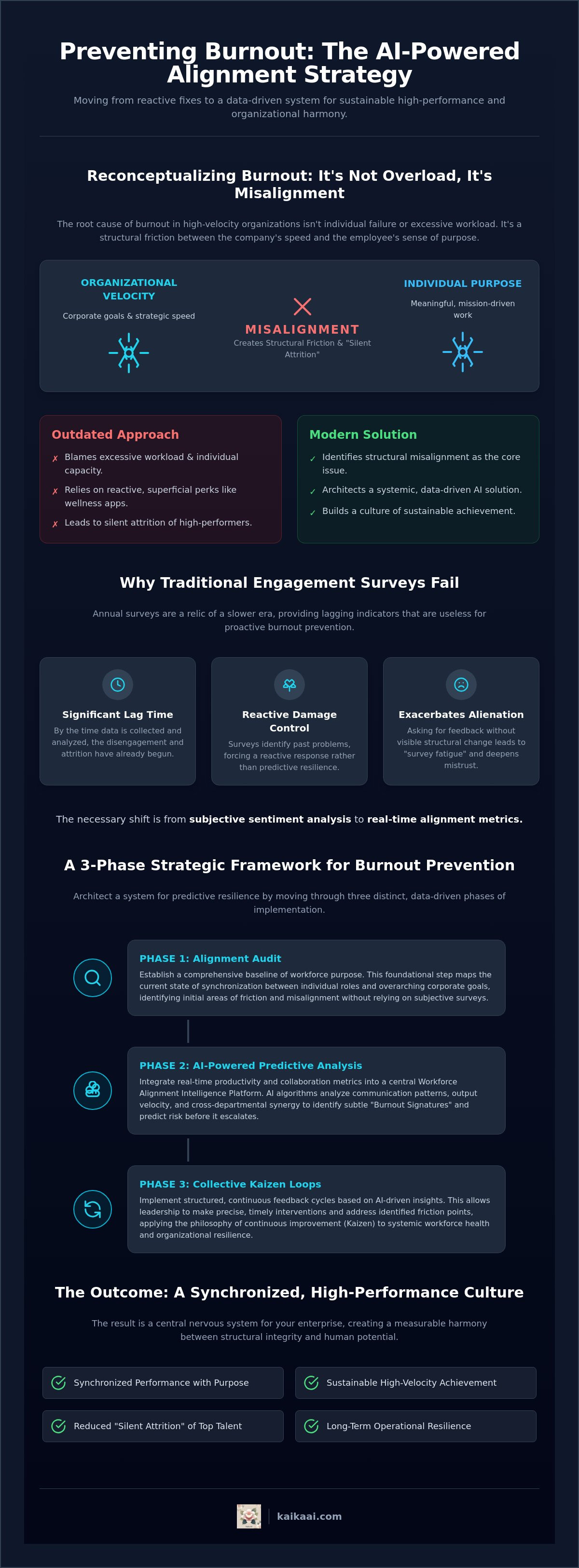
The enterprise landscape of 2026 has exposed a critical flaw in traditional management theory. We've long treated occupational burnout as a failure of individual capacity or a simple consequence of excessive volume. This is a strategic error. In high-velocity organizations, burnout is actually a structural friction occurring when organizational velocity outpaces individual purpose alignment. It's the heat generated by a machine whose parts are moving at different speeds in conflicting directions. When we focus on preventing employee burnout with AI, we aren't just looking for ways to reduce tasks; we're seeking to architect a system where every unit of effort contributes to a shared, visible mission.
Superficial palliatives like wellness apps or flexible Friday afternoons fail because they don't address this core systemic exhaustion. High-performers don't quit because they're working hard. They quit because their hard work feels decoupled from a meaningful outcome. This mission disconnect triggers a "silent attrition" where your most valuable assets disengage long before they actually depart. AI provides the architectural solution necessary to synchronize performance with human potential, transforming the workplace from a site of extraction into a landscape of sustainable achievement.
The Friction of Misalignment
Structural misalignment occurs when the cascade of corporate goals fails to reach the individual contributor with clarity. This creates a state of cognitive dissonance where the employee's daily output feels irrelevant to the broader organizational strategy. Burnout is a symptom of structural misalignment rather than mere workload. It's the psychological tax paid for navigating ambiguity. To maintain high Workforce Velocity, leadership must ensure that individual purpose and corporate trajectory are locked in a symbiotic rhythm. Without this synchronization, even the most talented teams will eventually succumb to the inertia of purposeless effort.
Why Traditional Engagement Surveys Fail
The annual engagement survey is a relic of a slower era. Its inherent lag time makes it useless for preventing employee burnout with AI because by the time the data is analyzed, the attrition has already begun. This "Survey Fatigue" cycle often exacerbates the problem; employees feel further alienated when they're asked to provide feedback that leads to no measurable structural change. We're currently witnessing a mandatory transition from subjective sentiment analysis to real-time alignment metrics. We don't need to know how employees "feel" once a year. We need to know how they're performing in relation to their purpose in real-time. This shift allows for predictive resilience rather than reactive damage control.
Architecting an Employee Burnout Early Warning System
Architecting a system for preventing employee burnout with AI requires a shift from anecdotal observation to structural intelligence. We approach this as a systems engineering challenge. The first step involves an Alignment Audit to establish a baseline of workforce purpose synchronization. Without this foundation, any subsequent data is devoid of context. Once established, we integrate real-time productivity and engagement metrics into a central Workforce Alignment Intelligence Platform. This creates a living map of organizational health that evolves alongside your strategy.
Predictive algorithms then analyze shifts in communication patterns and output velocity to identify emerging friction. Finally, we implement Collective Kaizen loops. These structured feedback cycles allow leadership to address identified risks before they manifest as attrition. Managers who proactively prevent employee burnout understand that performance is a function of sustained alignment, not temporary exertion. It's about maintaining the integrity of the human machine.
The Intelligence Layer: How AI Predicts Risk
AI identifies "Burnout Signatures," which are subtle, non-linear changes in digital collaboration and task completion rates that human managers often miss. It tracks cross-departmental synergy to pinpoint where silos are creating localized stress points. The system distinguishes between "healthy intensity," which characterizes high-performance flow, and "toxic burnout," which signals structural decay. This pattern recognition allows for surgical intervention rather than broad, ineffective policy changes. It transforms noise into actionable strategic foresight.
Privacy and Security in the Intelligence Era
Trust is the bedrock of any intelligence system. We adhere to enterprise-grade Japanese privacy standards, ensuring that data remains a tool for empowerment rather than surveillance. By utilizing anonymized data sets, we protect individual identity while providing the deep organizational insights necessary for resilience. Transparency is a prerequisite for success. When employees understand how their data protects their own well-being, the system gains the collective buy-in required for long-term impact. Initiating an Alignment Audit can be the first step in building this transparent, data-driven culture.
Data-Driven Kaizen: Moving from Reactive Fixes to Predictive Resilience
The philosophy of Kaizen, rooted in the pursuit of incremental, continuous improvement, finds its most critical modern application in the preservation of human capital. When we discuss preventing employee burnout with AI, we're describing a transition from episodic crisis management to a state of perpetual operational resilience. Reactive fixes are inherently late. They address the damage after the structural integrity of the team has already been compromised. A data-driven Kaizen approach treats workforce health as a dynamic system that requires constant, minute adjustments to maintain peak synchronization. It's the difference between repairing a bridge after a collapse and monitoring its structural vibrations to prevent a single crack from forming.
This Strategic Integration approach ensures that as organizational goals shift, the workforce doesn't experience the whiplash of sudden redirection. AI functions as the sensory apparatus that detects these subtle shifts in velocity. By fostering a culture of proactive synchronization, global leadership can ensure that individual effort remains tightly coupled with corporate mission. This isn't about working less; it's about working with a precision that eliminates the friction of wasted energy. It's a methodical evolution that transforms the Workforce Alignment Intelligence Platform into a predictive tool for long-term stability.
Continuous Improvement of the Employee Experience
Real-time feedback loops allow leadership to implement micro-adjustments in workload and mission alignment before stress reaches a critical threshold. This requires a fundamental development in leadership mindset, where managers act as strategic stewards of their team's cognitive load. Kaizen serves as the foundation for sustainable organizational growth by ensuring that human capacity and strategic demand remain in equilibrium. When the employee experience is continuously calibrated, performance becomes a byproduct of health rather than a sacrifice for it. This continuous refinement prevents the accumulation of alignment debt that typically leads to high-performer attrition.
Building Institutional Resilience
We must distinguish between individual grit and institutional stamina. While grit relies on the temporary psychological reserves of a person, stamina is built into the enterprise's architecture. AI identifies mission-critical gaps where misalignment threatens long-term stability, allowing for structural reinforcements. In a volatile global market, this level of operational resilience is a primary competitive advantage. It ensures the organization can maintain high velocity without the catastrophic failure of its most vital components. Utilizing Collective Kaizen Workshops can further solidify this resilience, turning individual insights into shared structural strengths that protect the entire organization.
A 3-Phase Strategic Framework for Burnout Prevention
Successfully preventing employee burnout with AI requires a methodical, phase-based approach rather than a fragmented tool rollout. We've observed that high-velocity organizations often struggle because they attempt to fix culture before they've fixed their structure. This framework is designed to move your enterprise from a state of reactive fragmentation to one of architectural alignment. It begins with the cold clarity of data and concludes with the warm synchronization of human purpose. Throughout this process, executive-level architectural consultations are vital to ensure the intelligence platform reflects the organization's actual strategic intent.
The transition through these phases isn't merely a software implementation; it's a fundamental evolution of your operational DNA. By following a structured methodology, leadership can avoid the common pitfall of "tool fatigue" where new technology becomes just another source of cognitive load. Instead, the AI becomes a silent, supportive infrastructure that maintains the integrity of the workforce. It creates a landscape where performance and well-being are no longer in competition but are, in fact, the same metric.
The Audit: Finding the Gaps
The journey starts with a Structural Audit. During this initial phase, we conduct a deep-dive into existing workforce goal tracking and alignment metrics to identify where the cascade of corporate mission has stalled. By ingesting historical performance data, the system identifies "High-Risk Divisions" where the friction of misalignment is already generating heat. We establish specific KPIs for the early warning system, ensuring that every subsequent tactical move is grounded in measurable baseline reality. This phase provides the roadmap for the entire integration process.
Scaling Alignment Across Global Divisions
Phase two involves the tactical integration of the Workforce Alignment Intelligence Platform, followed by a third phase of Cultural Evolution. Scaling alignment across diverse geographic and functional teams requires a consistent deployment of Operational Resilience Training. This ensures that a developer in Tokyo and a strategist in New York are operating from the same purpose-driven blueprint. We measure the ROI of this alignment through the lens of reduced attrition rates and increased workforce velocity. When the mission is clear, the work becomes lighter. To begin this process for your organization, you can schedule an Executive Consultation to define your structural starting point.
Kaika AI: Synchronizing Performance with Operational Resilience
The Kaika AI Workforce Alignment Intelligence Platform serves as the central nervous system for the modern enterprise. It provides the structural visibility necessary for preventing employee burnout with AI by identifying purpose-friction before it translates into attrition. This is not a mere monitoring tool. It is a comprehensive framework for evolution. Our approach is rooted in the belief that high-performance cultures are built on the foundation of synchronization. The Alignment Audit serves as your diagnostic roadmap. It exposes the hidden frictions within your enterprise architecture. By mapping individual purpose against organizational velocity, we provide the clarity required for long-term sustainability.
True resilience requires more than just software; it demands a strategic integration methodology that evolves with the organization. We combine sophisticated intelligence capabilities with a human-centric philosophy to ensure that performance is a byproduct of harmony rather than a sacrifice for it. This dual focus allows global leadership to move beyond the limitations of legacy management systems. We invite visionary leaders to request early access to our platform to begin the process of data-driven Kaizen and workforce optimization. The future of the enterprise depends on the precision of its alignment.
The Kaika Methodology
Our three-phase strategic integration methodology is the gold standard for global enterprise alignment. It begins with the Structural Audit, moves through Tactical Integration, and culminates in Cultural Evolution. This process is supported by high-level Executive Consultation to refine the leadership mindset for a new era of management. The Workforce Alignment Intelligence Platform acts as the core engine of synchronization, ensuring that every strategic pivot is mirrored in the workforce's daily output. We don't just offer a service. We propose a total architectural transformation that bridges the gap between corporate mission and individual experience.
Securing the Future of Your Workforce
We prioritize institutional reliability through rigorous Japanese privacy standards and enterprise-grade security. This ensures that your data-driven efforts are built on a foundation of absolute trust and structural integrity. By joining the vanguard of organizations prioritizing human-centric intelligence, you secure the future of your most vital asset. For a deeper understanding of this process, explore our methodology for Aligning Individual and Organizational Goals with AI. The era of reactive management is over. Through Collective Kaizen Workshops and predictive intelligence, you can maintain a high-velocity culture that remains resilient under the pressures of global scale. Request early access today to architect a more synchronized future.
Architecting the Resilient Enterprise
The preservation of high-performance talent requires a transition from reactive crisis management to proactive structural synchronization. We've established that burnout isn't a failure of individual grit but a symptom of organizational misalignment. By implementing a sophisticated intelligence layer, leadership gains the real-time visibility necessary for maintaining workforce velocity. Successfully preventing employee burnout with AI depends on this architectural clarity. It's about moving from subjective sentiment to systematic synchronization.
Our strategic three-phase integration methodology ensures that your enterprise evolves with precision while adhering to rigorous Japanese privacy standards. This framework transforms workforce alignment intelligence from a conceptual goal into a measurable operational reality. It's time to bridge the gap between individual purpose and corporate mission to secure the long-term integrity of your global organization. Request early access to the Kaika AI Workforce Alignment Platform to begin your journey toward predictive resilience and structural harmony. Your most valuable assets deserve a system designed for their sustained excellence and collective growth.
Frequently Asked Questions
How can AI identify burnout patterns before they become critical?
AI identifies burnout by detecting non-linear deviations in digital collaboration rhythms and task completion velocity. These burnout signatures manifest as subtle shifts in communication frequency or a decoupling of effort from intended strategic outcomes. By analyzing these architectural friction points in real-time, the system surfaces risk long before it reaches the threshold of clinical exhaustion or resignation. It's the precision of this pattern recognition that allows leadership to maintain the integrity of the organizational machine.
Is an AI-powered early warning system invasive to employee privacy?
A sophisticated framework prioritizes structural health over individual surveillance. By utilizing anonymized data sets and adhering to rigorous Japanese privacy standards, the system focuses on organizational alignment rather than personal monitoring. Transparency is the cornerstone of this approach; it ensures employees understand that data serves as a protective infrastructure for their own sustainable performance and well-being. This builds the institutional trust necessary for long-term strategic success and workforce resilience.
Can AI-driven burnout prevention work for remote and global teams?
AI-driven systems are specifically engineered to bridge the geographic and functional silos inherent in global operations. These platforms synchronize disparate teams by providing a unified visibility layer that tracks mission alignment across time zones. For remote contributors, this technology replaces the lost physical cues of the office with data-driven insights that maintain their connection to the corporate mission. This ensures that even specialized workforce segments, such as those searching for praca zdalna dla niepełnosprawnych, remain integrated and supported within the enterprise architecture. It's the central nervous system required for a truly distributed, high-performance enterprise.
What is the difference between AI engagement analytics and traditional surveys?
The primary distinction lies in the transition from reactive sentiment to predictive intelligence. Traditional surveys suffer from inherent lag time and subjective bias, often capturing data months after the misalignment has occurred. AI-powered analytics provide real-time visibility into workforce velocity, allowing for preventing employee burnout with AI through continuous micro-adjustments rather than infrequent, high-stakes interventions. This shift transforms the leadership role from damage control to strategic stewardship of human potential.
How does purpose alignment reduce employee attrition?
Purpose alignment functions as the structural glue that binds individual effort to organizational trajectory. When employees perceive a direct correlation between their daily output and a broader mission, the cognitive dissonance that drives burnout is effectively neutralized. This synchronization creates a sense of institutional belonging and psychological safety; these are the primary drivers of long-term retention among high-performing talent. It ensures that velocity remains sustainable without sacrificing human potential.
What are the first steps to implementing an AI burnout prevention framework?
The initial phase requires a comprehensive Alignment Audit to establish a baseline for workforce synchronization. This diagnostic process identifies existing structural gaps and high-risk divisions within the enterprise. Following this audit, leadership should engage in Executive Consultation to ensure the intelligence platform is calibrated to the organization's specific strategic goals. This structured approach is essential for preventing employee burnout with AI while maintaining high organizational velocity.
Can AI predict which employees are at the highest risk of turnover?
AI identifies turnover risk by surfacing the specific patterns of disengagement that precede a resignation. While the system focuses on structural friction, it can pinpoint localized clusters of misalignment where attrition is statistically probable. This allows leadership to deploy Collective Kaizen Workshops or tactical interventions to restore alignment and preserve critical human capital before the talent loss occurs. It's a shift from exit interviews to proactive retention architecture.
How do Japanese privacy standards protect my organization's data?
Japanese privacy standards represent some of the most rigorous data protection protocols in the global enterprise landscape. These standards mandate strict data minimization, purpose limitation, and robust encryption frameworks that exceed many international requirements. Adhering to these principles ensures that your organization's intelligence remains a secure asset, protected against unauthorized access while maintaining the integrity of the workforce's digital footprint. It provides the institutional reliability required for high-stakes leadership decisions.
Disclaimer
#Disclaimer
At Kaika AI, we believe the future belongs to organizations that combine human wisdom with artificial intelligence responsibly. The articles, research, insights, and thought leadership published on this website are intended to educate, inform, and encourage meaningful conversations about the future of work, organizational intelligence, AI, leadership, and innovation.
While our content is developed through rigorous research and may be generated, curated, or enhanced using artificial intelligence, every effort is made to ensure it reflects thoughtful analysis, practical relevance, and responsible AI practices. However, no representation or warranty is made regarding the completeness, accuracy, or suitability of the information for every individual or organizational circumstance.
The ideas, opinions, frameworks, and recommendations shared by Kaika AI are provided for educational and informational purposes only. They should not be interpreted as legal, financial, medical, psychological, human resources, cybersecurity, or other professional advice. Organizations and individuals should seek qualified professional guidance before making strategic, legal, or operational decisions.
Where articles reference third-party organizations, products, services, academic research, industry reports, or public data, such references are provided solely to support discussion and analysis. Unless explicitly stated, they do not imply endorsement, partnership, or affiliation.
Artificial intelligence is a powerful decision-support technology—not a replacement for human judgment. Kaika AI advocates for responsible, transparent, and human-centered AI adoption. We encourage readers to critically evaluate information, consider their unique context, and combine AI-generated insights with professional expertise and sound decision-making.
The content published on this website may be updated, revised, or removed as knowledge, technology, regulations, and best practices continue to evolve.
To the fullest extent permitted by applicable law, Kaika AI, its affiliates, contributors, and partners disclaim liability for any direct, indirect, incidental, consequential, or other losses arising from the use of, or reliance upon, the information provided on this website.
By accessing or using this website, you acknowledge that you have read, understood, and agree to this Disclaimer.
Kaika AI
'Building trusted organizational intelligence for the AI Era'


