
What if the most dangerous threat to your organization isn't the talent leaving today, but the talent that's already checked out while remaining on the payroll? You've likely felt the frustration of silent attrition, where employees are physically present but psychologically detached from the mission. Traditional turnover data is a lagging indicator that only records what went wrong yesterday. It fails to predict the burnout occurring right now or the growing disconnect between your corporate vision and daily operational reality.
This article shows you how to move beyond static HR reporting to a dynamic, intelligence-driven measurement of workforce health and alignment. By implementing sophisticated workforce sustainability metrics, you'll gain the ability to detect human signals before they turn into systemic failures. We'll explore a strategic framework designed to synchronize individual purpose with organizational architecture. This approach ensures your company doesn't just survive current market pressures but builds the structural integrity required for long-term resilience. You'll discover how to align human potential with measurable business outcomes through a disciplined, data-driven lens that prioritizes precision and velocity.
Key Takeaways
- Define workforce sustainability as the strategic capacity of a human collective to deliver consistent value through periods of volatility.
- Categorize workforce sustainability metrics into three distinct pillars of Alignment, Behavioral Signals, and Psychological Strain to move beyond superficial HR reporting.
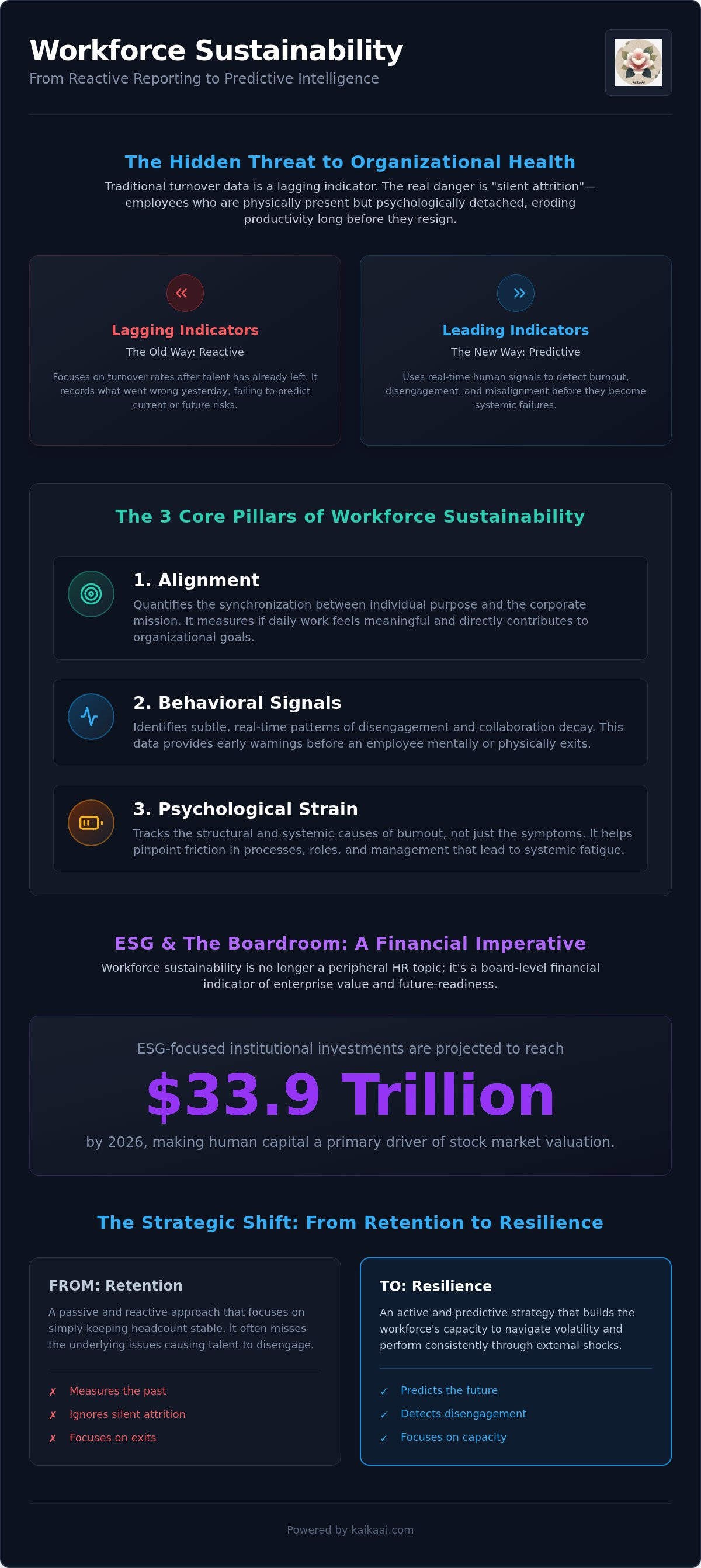
- Transition from reactive, lagging turnover data to predictive intelligence that captures real-time human signals before burnout occurs.
- Follow a structured implementation path, starting with an Alignment Audit, to synchronize employee daily reality with the corporate mission.
- Leverage the Ikigai Intelligence Framework to establish a single source of truth for leadership regarding workforce health and structural integrity.
Defining Workforce Sustainability in the Era of Intelligence
Workforce sustainability isn't a collection of employee benefits or cultural niceties. It's the measurable capacity of a human collective to generate consistent value while navigating systemic volatility. In 2026, where market pressures and regulatory shifts like the CSRD demand higher transparency, organizations must distinguish between short-term perks and long-term structural integrity. Implementing workforce sustainability metrics allows leadership to move beyond superficial reporting and into the realm of architectural optimization. It's a shift from maintaining a headcount to ensuring a high-velocity, synchronized workforce that can withstand external shocks without internal fracturing. Sustainability is a performance metric, not a compliance burden.
To better understand the technical foundation of these measurements, watch this overview of calculating workforce health and safety within established reporting frameworks:
The Shift from Retention to Resilience
Traditional HR departments often prioritize retention rates, yet turnover is a lagging indicator that fails to capture the toxicity of silent attrition. When employees disengage while remaining in their roles, productivity erodes long before a resignation letter arrives. This is why forward-thinking executives are pivoting toward workforce resilience metrics. These tools measure organizational synergy and the sustainable employability of the talent pool. This approach focuses on the long-term capacity of individuals to function effectively within the labor market and the specific organizational structure. It replaces passive retention with active resilience, ensuring the workforce remains an asset rather than a liability during rapid pivots.
ESG and the Boardroom: Why Sustainability is a Financial Metric
The boardroom no longer relegates the 'Social' dimension of ESG to the periphery of corporate strategy. With ESG-focused institutional investments projected to reach $33.9 trillion by 2026, human capital has become a primary driver of stock market valuation. New regulations, such as California Senate Bill 253 and SB 261, underscore this transition by demanding rigorous reporting from large-scale enterprises. We're seeing a fundamental evolution from narrative-based reporting to Human Capital Intelligence. This data-driven approach treats workforce sustainability metrics as leading indicators of financial resilience and operational stability. Workforce sustainability is a board-level financial indicator that signals an organization's true enterprise value and future-readiness.
The Core Pillars of Workforce Sustainability Metrics
Building a resilient organization requires more than a casual observation of employee satisfaction. It demands a rigorous, tri-tiered framework that transforms abstract human behavior into actionable intelligence. To achieve this, we categorize workforce sustainability metrics into three fundamental pillars: Alignment, Behavioral Signals, and Psychological Strain. This structure allows executives to visualize the structural integrity of their human capital with the same precision applied to financial auditing. By monitoring these categories, leadership can identify where the organizational architecture supports performance and where it creates friction.
- The Alignment Pillar: Quantifies the synchronization between individual purpose and the corporate mission.
- The Behavioral Pillar: Identifies subtle patterns of disengagement before they result in attrition.
- The Psychological Pillar: Tracks the structural causes of burnout to prevent systemic fatigue.
Purpose Alignment: The Ikigai Factor
Purpose isn't a secondary consideration; it's the primary engine of organizational velocity. When an individual's sense of mission mirrors the company's trajectory, the result is a self-sustaining cycle of high performance. Quantifying aligning individual and organizational goals requires sophisticated intelligence that measures "Purpose Velocity." This metric tracks how quickly and effectively personal ambition translates into strategic execution. Without this alignment, even the most talented teams eventually succumb to the weight of disconnected labor. A comprehensive Alignment Audit can reveal the hidden gaps where mission and reality diverge.
Quantifying Human Signals and Sentiment
Annual engagement surveys are relics of a slower era. They provide a static snapshot of the past rather than a predictive roadmap for the future. Modern workforce sustainability metrics rely on continuous sentiment analysis to capture the "signal before the silence." This proactive approach identifies the moment an employee begins to drift away from their role, long before they enter the resignation phase. Data integrity is crucial here. In pilot studies, we've observed an 87% employee honesty rate when using non-punitive, intelligence-driven feedback loops. This transparency allows leaders to address structural disconnects with surgical precision, ensuring that the human signal index remains high and that behavioral signals lead to constructive intervention rather than reactive damage control.
Beyond Reporting: Real-Time Human Signal Tracking
Static HR reporting is a post-mortem. It documents failure after the talent has already exited. To build true organizational resilience, leadership must pivot to real-time human signal tracking. This shift transforms workforce sustainability metrics from a historical record into a predictive radar. While traditional analytics focus on lagging indicators like turnover rates, AI-driven intelligence identifies the "signal before the silence." It detects the subtle erosion of engagement that precedes physical attrition, allowing for intervention while the talent is still in the building.
The danger of high-performance cultures is the invisible cost of exhaustion. Metrics often show peak productivity right before a systemic collapse. Understanding the productivity and burnout correlation is vital for executive leadership. Without this insight, you risk optimizing for short-term output at the expense of long-term structural integrity. By monitoring leading indicators of employee burnout, organizations can intervene before psychological strain becomes irreversible. This isn't surveillance; it's a preventative framework designed to protect the organization's most valuable asset. It's about using data as a shield rather than a spotlight.
Predicting Attrition with Behavioral AI
Behavioral AI analyzes collaboration patterns and communication velocity to surface risks that human managers often miss. It identifies shifts in synchronization or a sudden drop in peer-to-peer engagement. Responsible AI use ensures these insights remain focused on structural health rather than individual policing. In practice, identifying these signals 90 days in advance allows for strategic realignment, reducing turnover by addressing the root causes of friction before they escalate. This proactive approach turns workforce sustainability metrics into a tool for operational continuity and talent preservation.
The Sugihara Bridge: Balancing AI with Human Judgment
Data provides the foundation, but human judgment provides the nuance. The Sugihara Bridge Model emphasizes that AI is a diagnostic tool, not a decision-maker. Complex psychological signals require the expertise of human consultants to interpret the "why" behind the "what." This balance maintains strict privacy standards while surfacing the organizational truths necessary for evolution. It ensures that workforce sustainability remains a human-centric endeavor powered by technical precision. High-stakes workforce decisions require the fusion of machine velocity and strategic wisdom to maintain organizational harmony.
Implementing a Sustainability Framework for Global Scale
Deploying a global framework for workforce sustainability metrics requires more than a simple software installation. It demands a methodical, architectural approach to organizational evolution. This process ensures that the intelligence surfaced at the divisional level translates into strategic resilience at the enterprise core. We execute this through a three-phase methodology designed for precision and scalability.
- Phase 1: The Alignment Audit. We begin by mapping the current purpose-performance gap. This initial diagnostic identifies where individual intent and corporate trajectory have diverged.
- Phase 2: Architectural Integration. Leadership deploys the intelligence framework across global divisions. This phase synchronizes data streams to create a unified view of workforce health.
- Phase 3: Collective Kaizen. Organizations use real-time data to drive continuous improvement at scale. This phase transforms static reporting into a living system of operational refinement.
Navigating global privacy standards is a critical component of this deployment. As of 2026, organizations must balance the rigorous transparency of the European Union's CSRD with the specific ESG reporting standards emerging in Japan. Compliance isn't just about avoiding penalties. It's about building a foundation of trust that enables high-integrity data collection across diverse legal landscapes. Successful implementation respects regional nuances while maintaining a centralized standard for human signal intelligence.
Synchronizing Purpose Across Global Divisions
Managing the "Cascading Effect" of a corporate mission requires cultural nuance and technical precision. In global enterprises, a mission statement often loses its velocity as it travels from headquarters to regional offices. Maintaining the integrity of this signal requires specialized workforce alignment software. These tools ensure that every division, regardless of geography, remains synchronized with the central strategic intent. Leadership must cultivate a mindset that views data as a catalyst for harmony rather than a tool for control. It's about creating a unified behavioral language that transcends borders.
Measuring ROI on Workforce Sustainability
Executive leadership requires clear evidence of financial impact. By linking employee engagement to financial performance, organizations can quantify the direct relationship between workforce health and the bottom line. This includes calculating the cost-avoidance of prevented attrition and the productivity gains from reduced burnout. The Sustainability Dividend is the measurable financial surplus generated when an organization eliminates the friction of misalignment and silent attrition. It's the ultimate proof of a resilient enterprise. Analyzing these figures allows boards to treat human capital with the same fiscal discipline as physical assets.
Ready to evaluate your organization's structural integrity? Schedule an Alignment Audit to begin your transition to a resilient workforce model.
The Kaika AI Approach: Precision Alignment as Sustainability
Kaika AI redefines the standard for workforce sustainability metrics through the Ikigai Intelligence Framework (IIF). This system doesn't just collect data; it synthesizes purpose, capability, and organizational need into a single operational reality. The core of this framework is the Ikigai Alignment Score (IAS). It provides leadership with a definitive source of truth regarding the synchronization of their talent pool. By quantifying how closely individual aspirations mirror the corporate trajectory, the IAS allows for a level of strategic precision previously reserved for financial or supply chain management. This alignment is the bedrock of long-term resilience.
Preventive intervention requires more than just sentiment analysis. The Employee Human Signal Index (EHSI) serves as a clinically informed early warning system for psychological strain. It identifies the precursors to burnout by monitoring shifts in behavioral patterns and engagement velocity. Our mission is to help executives "hear the signal before the silence," ensuring that high-performance environments remain sustainable rather than self-destructive. This intelligence enables a proactive response to the structural stressors that lead to silent attrition. It transforms the way leadership perceives human risk.
Clinical Credibility in Workforce Intelligence
The development of the EHSI involved deep collaboration with clinical psychologists to ensure that data collection respects the nuances of human behavior. This approach prioritizes psychological safety, creating an environment where employees feel secure in their transparency. Academic partnerships, notably with institutions like Waseda University, provide the rigorous validation necessary for global enterprise deployment. These collaborations ensure that our metrics aren't just technically sound but are grounded in established psychological and organizational principles. The result is a framework that maintains high-stakes performance without compromising human potential.
Future-Proofing the Enterprise for 2032 and Beyond
Leadership in 2032 will be defined by the ability to manage human potential with the same technical discipline as digital infrastructure. Kaika AI is positioning itself as the global leader in the workforce alignment category, providing the tools necessary for this evolution. Organizations that adopt these frameworks early gain a significant competitive advantage in talent resilience and operational velocity. They move beyond reactive crisis management into a state of continuous, data-driven synchronization.
You can now request early access to the Workforce Alignment Intelligence Platform to begin this transformation. Shift your perspective from viewing the workforce as a fixed cost center to treating it as a dynamic, sustainable asset. Secure your organization's future by building the structural integrity required for long-term resilience. The transition from a traditional reporting model to an intelligence-driven framework is the definitive step toward lasting organizational harmony.
Transitioning to a Resilience-First Enterprise
The transition from reactive HR reporting to a predictive intelligence framework is no longer a strategic luxury. It's a foundational imperative for global enterprises navigating the structural complexities of the 2026 market. By integrating sophisticated workforce sustainability metrics, leadership can finally synchronize individual purpose with organizational architecture. This shift allows you to detect the signal before the silence, preventing the erosion of talent through silent attrition and systemic burnout. Our methodology replaces guesswork with precision, ensuring your human capital remains a synchronized engine of growth.
The results from our Tokyo pilot demonstrate this structural integrity, yielding an NPS of 72 and an 87% employee honesty rate. With the clinically-informed EHSI index, you gain a diagnostic tool that prioritizes both high-stakes performance and psychological safety. You have the opportunity to transform your workforce from a volatile cost center into a resilient, mission-aligned asset. Take the definitive step toward organizational harmony and operational velocity.
Request early access to the Kaika AI Workforce Alignment Intelligence Platform to begin your evolution. The future of leadership belongs to those who prioritize alignment as a core financial and operational standard. We look forward to building this resilient future with you.
Frequently Asked Questions
What are the most important workforce sustainability metrics for CHROs in 2026?
CHROs must prioritize leading indicators that measure structural health rather than historical turnover. The most critical metrics include the Ikigai Alignment Score (IAS) for purpose synchronization and the Employee Human Signal Index (EHSI) for burnout risk. These data points allow leadership to assess the long-term viability of their talent strategy against emerging ESG standards and global market volatility. Focusing on these metrics ensures the organization remains resilient under pressure.
How do workforce sustainability metrics differ from traditional employee engagement scores?
Traditional engagement scores are static snapshots of past sentiment that often function as lagging indicators. In contrast, workforce sustainability metrics provide a dynamic, predictive view of organizational synchronization. They measure the structural alignment between individual purpose and corporate mission in real-time. This approach allows executives to identify systemic friction and architectural disconnects before they manifest as attrition or productivity loss, offering a more rigorous standard for enterprise health.
Can AI really predict employee burnout without violating privacy?
AI can effectively predict burnout by analyzing anonymized behavioral signals and collaboration velocity rather than individual surveillance. By focusing on aggregate patterns of psychological strain and engagement drift, responsible AI frameworks surface systemic risks while maintaining strict data ethics. This method identifies the "signal before the silence" at a divisional level. It allows leadership to address the root causes of exhaustion without compromising the privacy or trust of the individual contributor.
How do you measure the alignment between individual employee purpose and corporate mission?
Measurement occurs through the Ikigai Intelligence Framework (IIF), which quantifies the synchronization between personal aspirations and strategic objectives. We track "Purpose Velocity" to see how effectively individual intent translates into organizational execution. This process involves mapping behavioral data against the corporate roadmap to identify where personal growth and company goals diverge. High alignment scores indicate a self-sustaining workforce where individual motivation naturally drives enterprise-level performance.
What is the 'Human Signal Index' and why does it matter for attrition?
The Human Signal Index (HSI) is a predictive metric that captures subtle shifts in engagement and collaboration patterns. It matters because it provides an early warning system, often identifying attrition risks up to 90 days before a resignation occurs. By surfacing these signals early, leadership can implement strategic realignments to retain key talent. This proactive approach transforms the talent management function from a reactive cost center into a driver of operational continuity.
What role does the Ikigai philosophy play in measuring workforce sustainability?
Ikigai provides the philosophical foundation for our workforce sustainability metrics, balancing individual fulfillment with organizational necessity. It moves the conversation beyond superficial perks to focus on the intersection of passion, mission, and professional capability. By using this framework, organizations can build a human-centric architecture that is both productive and psychologically sustainable. It creates a systematic way to ensure that work remains meaningful for the employee and valuable for the enterprise.
How do you calculate the financial ROI of workforce sustainability initiatives?
ROI is measured through the "Sustainability Dividend," which quantifies the financial gains from reduced turnover and improved productivity. We calculate the cost-avoidance of prevented attrition and the impact of minimized burnout on operational velocity. Linking these human capital signals directly to financial performance allows boards to see the measurable impact of alignment. This data-driven approach proves that a synchronized workforce is a primary driver of long-term stock market valuation and resilience.
What is the first step in implementing a workforce sustainability framework?
The definitive first step is conducting a comprehensive Alignment Audit to map the current purpose-performance gap. This diagnostic phase establishes a baseline for organizational health by identifying where mission and daily reality are disconnected. Once these gaps are visible, leadership can begin the architectural integration of intelligence tools across global divisions. Starting with an audit ensures that subsequent interventions are precise, scalable, and grounded in the actual state of the workforce.
Disclaimer
#Disclaimer
At Kaika AI, we believe the future belongs to organizations that combine human wisdom with artificial intelligence responsibly. The articles, research, insights, and thought leadership published on this website are intended to educate, inform, and encourage meaningful conversations about the future of work, organizational intelligence, AI, leadership, and innovation.
While our content is developed through rigorous research and may be generated, curated, or enhanced using artificial intelligence, every effort is made to ensure it reflects thoughtful analysis, practical relevance, and responsible AI practices. However, no representation or warranty is made regarding the completeness, accuracy, or suitability of the information for every individual or organizational circumstance.
The ideas, opinions, frameworks, and recommendations shared by Kaika AI are provided for educational and informational purposes only. They should not be interpreted as legal, financial, medical, psychological, human resources, cybersecurity, or other professional advice. Organizations and individuals should seek qualified professional guidance before making strategic, legal, or operational decisions.
Where articles reference third-party organizations, products, services, academic research, industry reports, or public data, such references are provided solely to support discussion and analysis. Unless explicitly stated, they do not imply endorsement, partnership, or affiliation.
Artificial intelligence is a powerful decision-support technology—not a replacement for human judgment. Kaika AI advocates for responsible, transparent, and human-centered AI adoption. We encourage readers to critically evaluate information, consider their unique context, and combine AI-generated insights with professional expertise and sound decision-making.
The content published on this website may be updated, revised, or removed as knowledge, technology, regulations, and best practices continue to evolve.
To the fullest extent permitted by applicable law, Kaika AI, its affiliates, contributors, and partners disclaim liability for any direct, indirect, incidental, consequential, or other losses arising from the use of, or reliance upon, the information provided on this website.
By accessing or using this website, you acknowledge that you have read, understood, and agree to this Disclaimer.
Kaika AI
'Building trusted organizational intelligence for the AI Era'


