

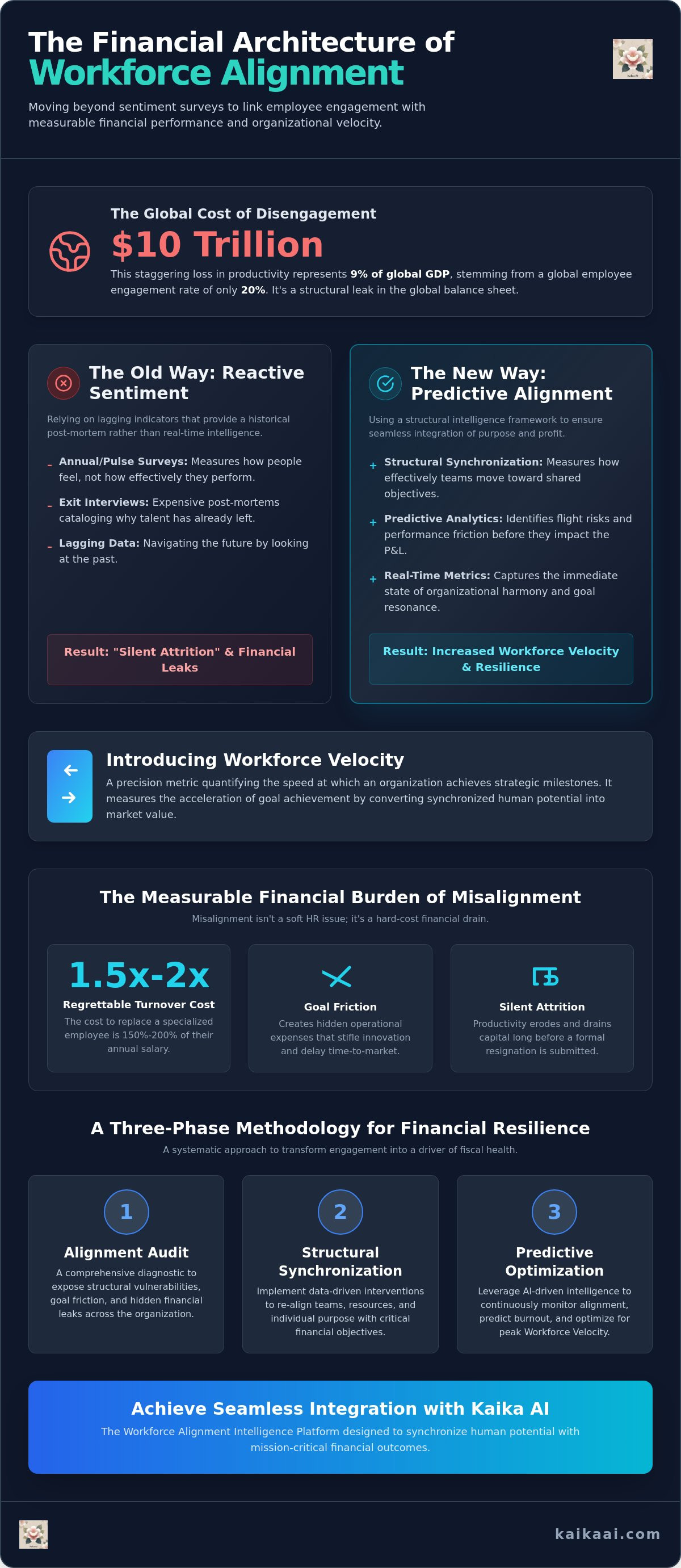
Low employee engagement costs the world economy approximately $10 trillion in lost productivity, a staggering 9% of global GDP. For the modern executive, this isn't just a human resources concern; it's a structural leak in the balance sheet. You've likely seen the data showing global engagement at a mere 20%, yet the traditional tools used to fix this remain stagnant. The challenge isn't a lack of data, but a lack of synthesis. By linking employee engagement to financial performance through a rigorous intelligence framework, leadership can finally move beyond superficial sentiment. It's time to stop viewing culture as a soft asset and start treating it as the primary engine of organizational velocity.
We recognize the frustration of fragmented data that fails to explain financial leaks or the high cost of regrettable attrition. You require a clear ROI for every initiative, not just another pulse survey with no predictive value. This article details how to transform abstract employee engagement into measurable financial results through AI-driven structural alignment. We will explore the 2026 Executive Intelligence Framework, a methodology designed to provide predictive intelligence on burnout while ensuring the systematic synchronization of purpose and profit.
Key Takeaways
- Discover the architectural necessity of linking employee engagement to financial performance by replacing static sentiment data with structural synchronization.
- Quantify organizational momentum using Workforce Velocity, a precision metric that measures the acceleration of goal achievement through synchronized individual purpose.
- Differentiate between reactive engagement and active alignment to identify high-potential flight risks hidden within traditionally "happy" teams.
- Implement a three-phase methodology for financial resilience, starting with a comprehensive Alignment Audit to expose structural vulnerabilities.
- Leverage the Kaika AI Workforce Alignment Intelligence Platform to achieve seamless integration between human potential and mission-critical financial outcomes.
Beyond the Survey: Why Traditional Engagement Fails the P&L
For decades, the executive suite has viewed sentiment through the distorted lens of the annual survey. This "Survey Trap" creates a strategic liability; it offers a historical post-mortem of organizational health while the market demands real-time agility. High-velocity markets don't wait for quarterly reports to signal a loss in momentum. When leadership relies on lagging data, they're essentially navigating a supersonic jet by looking at the wake behind them. The fundamental error lies in failing to see that linking employee engagement to financial performance requires a structural synchronization rather than a periodic temperature check.
True organizational health is defined by the seamless integration of individual purpose and enterprise-scale goals. We must redefine employee engagement as a measure of structural integrity. Without this alignment, capital drains through "Silent Attrition," a phenomenon where productivity erodes long before a formal resignation is ever tendered. This transition from reactive HR to predictive workforce intelligence is the only path to sustainable fiscal resilience. It's about moving from a culture of observation to a culture of architectural precision.
The Failure of Lagging Indicators
Exit interviews are expensive post-mortems of financial defeat. They catalog why talent has already left, providing zero utility for retention or performance optimization of the remaining workforce. Similarly, traditional "pulse" surveys often fail to identify systemic performance friction; they measure how people feel, not how effectively they're moving toward a shared objective. To maintain institutional reliability, executives must pivot toward real-time metrics that capture the immediate state of organizational harmony and goal resonance.
The True Cost of Workforce Misalignment
Misalignment isn't just a cultural friction; it's a measurable financial burden. Research indicates that the impact of regrettable turnover in specialized divisions can reach 1.5x to 2x an employee's annual salary. Beyond direct replacement costs, goal friction between departments creates hidden operational expenses that stifle innovation and delay time-to-market. As engagement declines, we observe a corresponding decay in "Workforce Velocity," the rate at which an organization converts human potential into market value. Linking employee engagement to financial performance allows leadership to quantify these leaks and repair the structural gaps that inhibit growth.
The Financial Architecture of Alignment and Workforce Velocity
Operational resilience is built at the intersection of human potential and data precision. When an organization’s architecture is aligned, it doesn't just survive volatility; it utilizes that volatility to pull ahead of less synchronized competitors. Achieving this state requires a move away from anecdotal management toward a system where performance is a predictable outcome of structural integrity. Organizations seeking to bridge this gap often start with a comprehensive Workforce Alignment Intelligence Platform to visualize and eliminate hidden friction points.
Synchronizing Individual Purpose and Corporate Mission
A Strategic Sage understands that the workforce is a synchronized architectural system rather than a collection of independent contractors. Purpose-aligned employees demonstrate a significantly higher level of psychological stamina, allowing them to maintain high performance during periods of intense market pressure. The performance delta is stark: satisfied employees do the work, but aligned employees innovate the process. This critical intersection of engagement, performance, and profitability dictates the long-term viability and compounding growth of the enterprise.
Predicting Financial Leaks Through Burnout Analytics
AI-driven analytics provide the visibility required to stop financial leaks before they manifest on the balance sheet. By identifying the "burnout curve" through behavioral metrics like task completion speed and communication patterns, platforms can predict turnover risks months in advance. This foresight is vital for corporate governance, as it protects Earnings Per Share (EPS) from the sudden volatility of talent loss. Burnout prediction is a structural necessity for operational resilience. By linking employee engagement to financial performance through predictive modeling, executives can transform a reactive cost center into a proactive engine of value creation.
Predictive Analytics vs. Reactive Sentiment: A Comparative Framework
The "black box" of employee turnover is no longer impenetrable. While traditional HR approaches rely on reactive sentiment, modern executive leadership demands a predictive comparative framework. The goal isn't just to measure how employees feel. It's about linking employee engagement to financial performance by identifying the structural alignment of the workforce. When we move from passive observation to active intelligence, we uncover the hidden patterns that dictate organizational velocity and long-term fiscal health.
A critical distinction must be made between engagement and alignment. An employee can be highly engaged, passionate about their craft and the company culture, yet remain fundamentally misaligned with the strategic direction of the enterprise. This misalignment creates a high flight risk. Without a clear sense of purpose synchronization, even the most enthusiastic talent becomes susceptible to external recruitment. Predictive analytics allow us to visualize this gap, transforming workforce stability from a variable into a constant.
The Limitations of Traditional Pulse Surveys
Sentiment analysis alone is a poor predictor of structural attrition. It captures a fleeting emotional state rather than the underlying systemic friction that erodes productivity over time. While research has long established a connection between employee engagement and 11 performance outcomes, including profitability and customer loyalty, traditional surveys lack the depth to identify cross-departmental friction points. Global scalability requires platform intelligence that can navigate multi-regional compliance while providing a unified view of the organizational architecture.
The Executive Advantage of Predictive Intelligence
Effective capital allocation depends on workforce predictability. By moving from HR-led initiatives to executive-led workforce intelligence, leadership gains a strategic advantage in managing human capital. This shift ensures that decisions are based on data-driven insights rather than anecdotal evidence. Maintaining this level of intelligence requires uncompromising data integrity. By adhering to rigorous Japanese privacy standards (APPI), organizations can build a foundation of data-driven trust. This commitment to security ensures that linking employee engagement to financial performance remains a sustainable, ethical, and highly effective strategic pillar.
Strategic Integration: The Three-Phase Methodology for Financial Resilience
Strategic resilience isn't found in a static document; it's forged through a methodical integration of human intent and operational structure. Moving beyond the theoretical requires a disciplined framework that translates high-level strategy into ground-level execution. This three-phase methodology provides the architectural blueprint for linking employee engagement to financial performance, ensuring that every layer of the organization vibrates with the same strategic frequency. It's a journey from diagnostic clarity to autonomous, high-velocity growth.
Phase 1 initiates with the Alignment Audit. This diagnostic stage identifies mission-critical gaps in the organizational architecture where individual purpose and enterprise goals diverge. It's a cold, data-driven assessment of structural integrity. Phase 2 moves into Strategic Consultation. Here, leadership redesigns goal cascading to synchronize with individual purpose, ensuring that the corporate mission is not a top-down mandate but a shared destination. Finally, Phase 3 establishes Collective Kaizen. This phase implements continuous, AI-driven improvement cycles that foster long-term growth and resilience through constant, incremental optimization.
Implementing Collective Kaizen Workshops
Collective Kaizen Workshops serve as the operational bridge between predictive data and human behavior. These sessions transform raw intelligence into team-level synchronization, utilizing purpose mapping to reduce attrition through transparent, data-backed career pathing. When employees see their personal growth mirrored in the company's success, linking employee engagement to financial performance becomes an organic reality rather than a forced metric. Systematic Kaizen cycles act as a continuous force multiplier that sustains Workforce Velocity by eliminating micro-frictions in real-time.
Architecting for Operational Resilience
Architecting for operational resilience requires a three-phase integration to ensure that software adoption matches strategic intent. This isn't a mere technical implementation; it's a cultural shift toward data-driven precision. The ROI of this framework is measured through the tangible reduction of regrettable attrition and the stabilization of institutional knowledge across the enterprise. Scaling this alignment across global divisions necessitates enterprise-grade security and a leadership mindset trained to interpret high-velocity predictive dashboards. Executives ready to fortify their organizational structure should begin with a comprehensive Alignment Audit to visualize their current performance delta and reclaim lost capital.
Kaika AI: Synchronizing Human Purpose with Organizational Capital
The Kaika AI Workforce Alignment Intelligence Platform represents the definitive culmination of systems engineering and deep-tier organizational psychology. It moves decisively beyond the limitations of traditional HR technology by providing a rigorous, AI-driven architecture for linking employee engagement to financial performance. By mapping the intricate, often invisible connection between individual aspiration and enterprise-scale mission goals, our proprietary intelligence identifies the structural resonance required for sustained market leadership. This is not a passive observation tool. It is a strategic engine designed to convert latent human potential into measurable organizational capital through continuous, real-time synchronization.
Our methodology transcends basic data visualization by merging the high-precision capabilities of our platform with sophisticated executive consultation. This ensures that every strategic insight leads directly to a specific, high-impact operational outcome. Institutional reliability is no longer a variable; it's a constant achieved through real-time alignment scores and predictive burnout modeling that protects your most valuable human assets from systemic erosion before it impacts the balance sheet. By establishing this level of structural integrity, leadership can finally quantify the direct impact of workforce harmony on organizational financial velocity.
Enterprise-Grade Security and Global Compliance
Global data processing in a high-stakes environment requires a foundation of uncompromising integrity and technical resilience. Kaika AI is architected to meet the rigorous Japanese privacy standards (APPI), ensuring that executive oversight is balanced with the highest levels of institutional data protection. Our real-time dashboards provide high-level architectural visibility for leadership, allowing for bespoke integration within mission-critical divisions where high-velocity performance and intellectual property security are non-negotiable. This level of compliance ensures that your workforce intelligence remains a secure, strategic asset across every regional division.
The Path to Systemic Workforce Synergy
True operational resilience is found in a state of permanent systemic synergy. By moving beyond the reactive cycle of attrition management, organizations can establish a stable foundation for long-term fiscal health and compounding innovation. The journey toward this synchronized future begins with a precise, data-driven evaluation of your current structural health. You can take the definitive first step toward reclaiming lost productivity and maximizing Workforce Velocity by requesting early access to our intelligence framework. Secure your organization’s future with the Kaika AI Alignment Audit today to transform your workforce into a precision-engineered engine of sustainable growth.
Architecting the Future of Organizational Velocity
The 2026 Executive Intelligence Framework demands a departure from the antiquated methods of the past. We've explored how transitioning from reactive sentiment to predictive intelligence creates a foundation for systemic resilience. By successfully linking employee engagement to financial performance, leadership can eliminate the capital leaks caused by structural misalignment and silent attrition. This evolution requires a disciplined three-phase strategic integration methodology. It ensures that every layer of the organizational architecture is synchronized with your core mission.
True operational excellence is now a matter of data-driven precision. Our platform utilizes an AI-powered burnout prediction engine and adheres to world-leading Japanese privacy standards to maintain institutional reliability. You don't have to navigate this strategic transition alone. It's time to transform your workforce into a high-velocity engine of financial growth and human potential. Request Early Access to the Kaika AI Workforce Alignment Platform and begin your journey toward architectural harmony. The opportunity to redefine your organization's trajectory is within reach. Let's build a future where purpose and profit exist in perfect synchronization.
Frequently Asked Questions
How does linking employee engagement to financial performance actually work in practice?
It works by quantifying the correlation between human effort and organizational velocity metrics through a Workforce Alignment Intelligence Platform. In practice, leadership tracks how individual purpose synchronization accelerates the achievement of strategic milestones. This structural alignment reduces operational friction, ensuring capital is directed toward high-yield outcomes rather than being lost to silent attrition or unproductive labor cycles.
What is the difference between employee engagement and workforce alignment?
Engagement measures emotional commitment, while alignment measures strategic synchronization. An employee can be highly engaged and passionate yet fundamentally misaligned with the enterprise mission. Alignment ensures that human energy is architecturally integrated with corporate goals, converting sentiment into a precise force for financial growth and institutional stability. It's the difference between feeling good and moving in the right direction.
How does predictive employee turnover analytics identify flight risks early?
It identifies risks by detecting subtle decays in behavioral metadata, such as task completion speed and task-switching frequency. These AI-driven lead indicators signal a breakdown in structural alignment long before a formal resignation occurs. By recognizing these patterns, leadership can intervene with Strategic Consultation to recalibrate the individual’s role within the organizational architecture, preserving mission-critical human capital.
Can AI predict burnout without compromising employee privacy?
Yes, it predicts burnout by analyzing anonymized behavioral patterns rather than private communication content. By focusing on systemic fluctuations in Workforce Velocity and digital activity, the system identifies stress markers without intruding on individual privacy. This methodology ensures institutional reliability while maintaining a foundation of data-driven trust. It's about protecting the collective health of the organizational system through ethical intelligence.
What are the financial costs of structural misalignment in an enterprise?
The costs manifest as regrettable turnover and stalled productivity, often reaching 1.5x to 2x an employee's annual salary for specialized roles. Beyond direct replacement expenses, misalignment creates hidden operational friction that delays mission-critical projects and market entry. These leaks erode Earnings Per Share and degrade the organization’s overall market resilience, representing a significant drain on enterprise-scale organizational capital.
How do Japanese privacy standards (APPI) impact HR data analytics?
APPI standards mandate rigorous data protection and transparency, necessitating a shift toward ethical, anonymized intelligence frameworks. These world-leading regulations ensure that workforce analytics are utilized to foster organizational harmony rather than surveillance. Adhering to these standards builds a culture of security, which is essential for linking employee engagement to financial performance across diverse, multi-regional global divisions.
What is an Alignment Audit and why is it the first step to retention?
An Alignment Audit is a comprehensive diagnostic evaluation of the gaps between individual purpose and corporate strategy. It's the first step because it exposes the structural vulnerabilities that lead to attrition. By identifying exactly where goal friction exists, leadership can initiate Collective Kaizen Workshops to repair the organizational architecture and secure long-term talent retention through purpose-driven synchronization.
How does Workforce Velocity impact a company’s Earnings Per Share (EPS)?
Workforce Velocity impacts EPS by accelerating the conversion of human potential into realized market value. Higher velocity means strategic objectives are met faster and with fewer capital leaks, directly improving margins. By linking employee engagement to financial performance, organizations optimize their operational efficiency, leading to superior investor returns and a more resilient, high-performance financial profile. For investors looking to identify companies achieving this level of growth, TickerAI offers AI-powered stock opportunity discovery.
Disclaimer
#Disclaimer
At Kaika AI, we believe the future belongs to organizations that combine human wisdom with artificial intelligence responsibly. The articles, research, insights, and thought leadership published on this website are intended to educate, inform, and encourage meaningful conversations about the future of work, organizational intelligence, AI, leadership, and innovation.
While our content is developed through rigorous research and may be generated, curated, or enhanced using artificial intelligence, every effort is made to ensure it reflects thoughtful analysis, practical relevance, and responsible AI practices. However, no representation or warranty is made regarding the completeness, accuracy, or suitability of the information for every individual or organizational circumstance.
The ideas, opinions, frameworks, and recommendations shared by Kaika AI are provided for educational and informational purposes only. They should not be interpreted as legal, financial, medical, psychological, human resources, cybersecurity, or other professional advice. Organizations and individuals should seek qualified professional guidance before making strategic, legal, or operational decisions.
Where articles reference third-party organizations, products, services, academic research, industry reports, or public data, such references are provided solely to support discussion and analysis. Unless explicitly stated, they do not imply endorsement, partnership, or affiliation.
Artificial intelligence is a powerful decision-support technology—not a replacement for human judgment. Kaika AI advocates for responsible, transparent, and human-centered AI adoption. We encourage readers to critically evaluate information, consider their unique context, and combine AI-generated insights with professional expertise and sound decision-making.
The content published on this website may be updated, revised, or removed as knowledge, technology, regulations, and best practices continue to evolve.
To the fullest extent permitted by applicable law, Kaika AI, its affiliates, contributors, and partners disclaim liability for any direct, indirect, incidental, consequential, or other losses arising from the use of, or reliance upon, the information provided on this website.
By accessing or using this website, you acknowledge that you have read, understood, and agree to this Disclaimer.
Kaika AI
'Building trusted organizational intelligence for the AI Era'


