
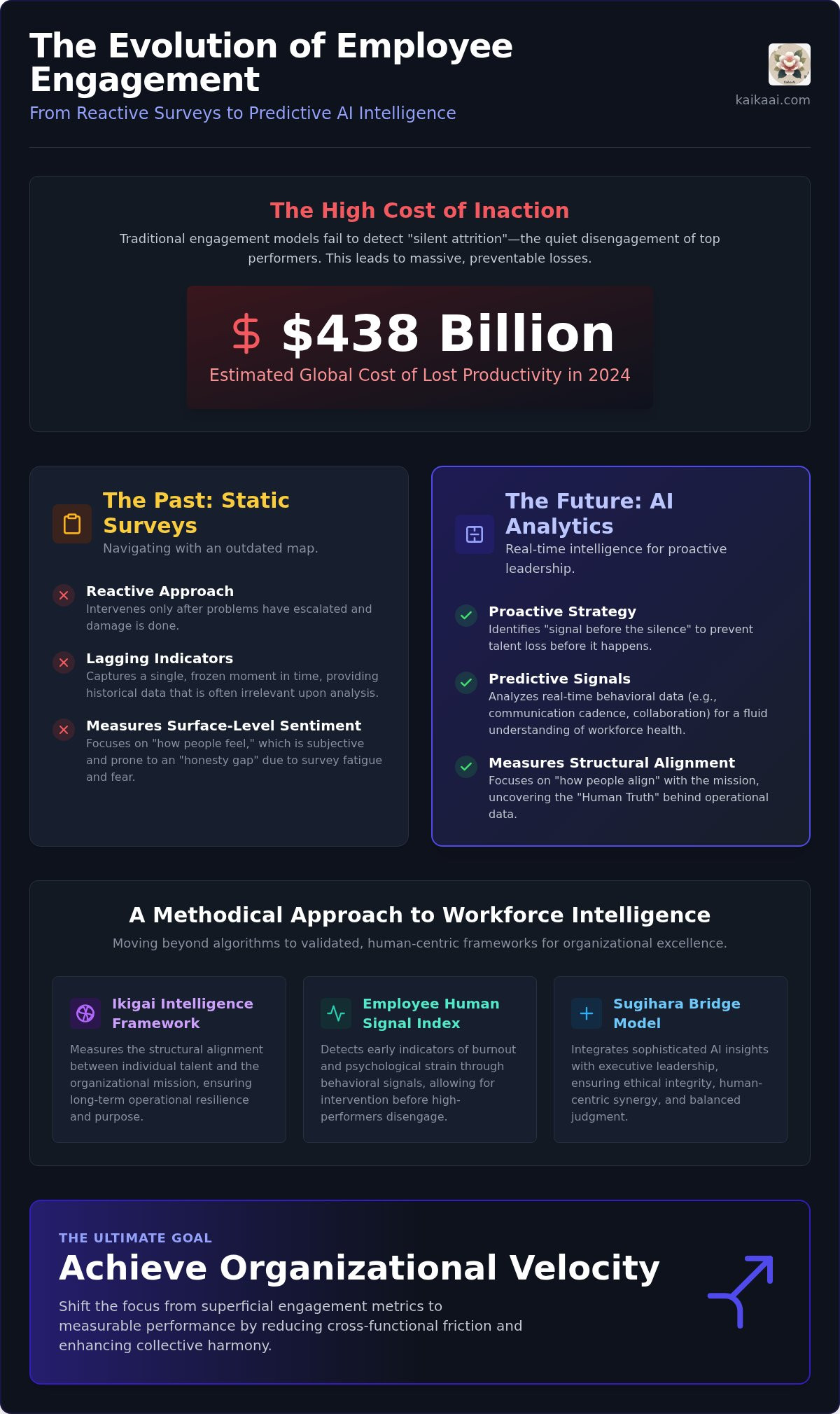
What if the most significant threat to your organizational velocity isn't a visible conflict, but the quiet withdrawal of your top performers? In 2026, relying on static annual surveys is akin to navigating a high-speed vessel using a map of the previous year's coastline. You likely understand that by the time traditional data highlights a problem, the opportunity for intervention has already vanished. The global cost of lost productivity due to disengagement reached an estimated $438 billion in 2024, proving that the price of reactive leadership is unsustainable.
This article explores how advanced AI employee engagement analytics move your strategy from historical observation to predictive precision. We'll examine how workforce alignment intelligence transforms lagging indicators into actionable signals for performance and retention. You'll learn to implement a framework that synchronizes individual purpose with organizational mission, allowing you to detect burnout risk before it manifests as attrition. We'll outline a methodical approach to building structural harmony, ensuring your leadership remains proactive, disciplined, and uncompromisingly focused on excellence.
Key Takeaways
- Transition from reactive, static feedback loops to proactive AI employee engagement analytics that identify silent attrition signals through real-time behavioral intelligence.
- Apply the Ikigai Intelligence Framework to measure the structural alignment between individual talent and organizational mission, ensuring long-term operational resilience.
- Utilize the Employee Human Signal Index to detect early indicators of burnout and psychological strain, allowing for intervention before high-performers disengage.
- Adopt the Sugihara Bridge Model to integrate sophisticated AI insights with executive leadership, maintaining ethical integrity and human-centric synergy.
- Shift the focus from superficial engagement metrics to "Organizational Velocity" by reducing cross-functional friction and enhancing collective harmony.
Beyond Surveys: The Evolution of AI Employee Engagement Analytics
The era of the "satisfaction survey" has reached its structural limit. In high-velocity enterprises, the time between a survey response and a management intervention is often too long to prevent talent loss. Traditional feedback loops fail because they capture a single, frozen moment in time. They don't account for the fluid nature of human motivation or the rapid shifts in market pressure. By the time a dashboard shows a dip in engagement, the cultural erosion has likely been underway for months. The survey is dead. Its replacement is intelligence.
Modern AI employee engagement analytics leverage behavioral signals to identify shifts in organizational velocity before they manifest as resignations. This evolution moves beyond simple sentiment analysis, which only measures how people feel, to behavioral intelligence, which measures how people align. We're witnessing a shift from asking employees how they're doing to observing the friction within the systems they inhabit. This transition is essential for leaders who demand a precise, data-driven understanding of their workforce's health.
To better understand this concept, watch this helpful video:
The Limitations of Static Sentiment Data
Traditional surveys suffer from an inherent "honesty gap." Employees often provide safe, curated answers because they fear repercussions or simply feel survey fatigue. This creates a data vacuum that obscures the true state of the organization. The cost of this silence is staggering. "Silent attrition," where high performers disengage mentally before they leave physically, contributes to a $1.9 trillion global productivity drain. Static pulse checks cannot capture the daily velocity of modern work. They're too slow, too shallow, and too easily manipulated. By incorporating organizational network analysis (ONA), leaders can map the actual flow of collaboration rather than relying on self-reported data that often masks underlying structural friction.
Shifting from Reactive Feedback to Predictive Alignment
The goal is to hear the "signal before the silence." This requires identifying subtle behavioral shifts, such as changes in communication cadence or a reduction in voluntary collaboration, before they become formal resignations. Predictive alignment focuses on the future capacity of the team rather than the past satisfaction of the individual. When organizations focus on linking employee purpose to business outcomes, they move beyond mere retention toward true organizational velocity. This creates a workforce that's resilient because it's synchronized. AI employee engagement analytics function as a real-time bridge between individual intent and corporate strategy.
The Mechanics of Workforce Alignment Intelligence
Operational excellence is not a static state. It's a dynamic synchronization of individual talent and institutional mission. To achieve this, the Ikigai Intelligence Framework (IIF) serves as a multidimensional measurement tool. It moves beyond superficial sentiment to quantify the structural integrity of the workforce. Developed through a strategic partnership with Waseda University, this framework ensures that AI employee engagement analytics are grounded in rigorous academic validation rather than mere algorithmic speculation. It's an architectural approach to understanding the human components of a high-velocity enterprise.
The core of this methodology lies in uncovering the "Human Truth" beneath standard operational data. While traditional systems focus on output, the IIF examines the underlying drivers of that output. It identifies the subtle alignment between an employee's internal purpose and their external professional contribution. This level of precision is essential for advancing workforce analytics from simple reporting to strategic intelligence. It allows executive leadership to see the organization not as a collection of roles, but as a synchronized system of potential.
Decoding the Ikigai Alignment Score (IAS)
The Ikigai Alignment Score (IAS) quantifies the intersection of passion, skill, and mission. It identifies the Purpose-Performance Correlation across global divisions, providing a clear view of where talent is truly thriving. This metric reveals high-potential individuals who are currently underutilized, allowing for strategic reallocation of human capital. In pilot studies, this purpose-driven approach achieved an 87% employee honesty rate. It bypasses the safety-seeking bias of traditional reporting. By measuring alignment instead of just satisfaction, the IAS offers a more resilient indicator of long-term retention and performance.
The Human Signal Index (HSI): Hearing the Silence
The Human Signal Index (HSI) provides an early warning system for operational friction. It monitors communication velocity and collaboration patterns to detect stalled strategy before it impacts the bottom line. By integrating real-time productivity metrics, the HSI identifies the signal before the silence of disengagement. It measures the subtle shifts in interaction that precede a drop in organizational velocity. This predictive capability allows leaders to address burnout risk and psychological strain with surgical precision. Organizations ready to move beyond reactive management should consider an Alignment Audit to identify hidden fractures in their current workforce structure.
Evaluating Enterprise Engagement Platforms: A Strategic Framework
Selection of a workforce intelligence platform is a high-stakes architectural decision. For the modern CHRO, the criteria must extend beyond simple interface aesthetics to include scalability, clinical validity, and deep cultural nuance. Many legacy tools fail because they lack a rigorous psychological foundation. They prioritize volume over value. A sophisticated approach to AI employee engagement analytics requires a system that can operate across global divisions while maintaining the precision of a localized intervention. It's about finding a partner that understands the intersection of technological velocity and human resilience.
Adopting 'Japan-first' design principles offers a unique advantage in this evaluation. Concepts like Ikigai and Kaizen provide a more sustainable global model because they focus on harmony and continuous, incremental improvement. These frameworks prevent the frantic, reactive management cycles common in Western corporate structures. By prioritizing structural alignment over superficial happiness scores, enterprise engagement platforms built on these principles ensure long-term operational integrity. They move the organization toward a state of collective synchronization that is both disciplined and visionary.
Differentiating Behavioral Analytics from Traditional Surveys
The distinction between reactive surveys and predictive signals is fundamental. Traditional methodologies rely on hindsight. They tell you why someone left last month, not why your current team is losing momentum today. High-velocity enterprises require real-time visibility. Pilot data shows that trust in these advanced systems is high, with a 74% weekly completion rate for signal-based check-ins. This level of participation suggests that employees value the relevance of the insights provided. When evaluating tools, leaders must distinguish between feature bloat and strategic intelligence. The goal is not more data, but more clarity.
| Feature | Survey-Based (Reactive) | AI-Signal (Predictive) |
|---|---|---|
| Data Frequency | Annual or Quarterly | Continuous / Real-Time |
| Primary Metric | Satisfaction Scores | Alignment & Velocity |
| Insight Type | Historical Analysis | Behavioral Forecasting |
| Actionability | Delayed Intervention | Proactive Correction |
Security and Privacy in AI Workforce Intelligence
Enterprise-grade security is non-negotiable. Platforms must adhere to rigorous global standards, including TSE and ASX data sovereignty requirements. Navigating Japanese privacy laws requires a sophisticated understanding of data ethics that many generic providers lack. To ensure psychological safety, the "Clinical Psychologist" safeguard is essential. This ensures that mental health risk prediction and burnout detection are handled with clinical integrity rather than just algorithmic efficiency. Kaika AI balances deep signal detection with individual privacy by utilizing anonymized behavioral patterns that prioritize organizational health over intrusive surveillance.
Implementing the Sugihara Bridge: Balancing AI with Human Judgment
The Sugihara Bridge Model establishes the ethical frontier of organizational evolution. It rejects the binary choice between automated efficiency and human intuition. Instead, it proposes a hybrid architecture where technology provides the high-fidelity signal and human experts provide the strategic interpretation. While AI employee engagement analytics can identify the precise location of structural friction, they cannot replace the nuanced judgment required to navigate complex corporate cultures. Leadership is an architectural endeavor. It requires a synthesized intelligence framework that respects the dignity of the individual while pursuing the velocity of the enterprise.
Relying solely on algorithms for workforce decisions creates a risk of clinical coldness that can alienate high-performing talent. The Sugihara Bridge acts as a corrective mechanism. It ensures that data serves as a foundation for dialogue rather than a final verdict. By integrating human expertise into the analytical loop, organizations can account for the unquantifiable variables of leadership: empathy, historical context, and visionary intent. This balanced approach creates a sense of psychological safety, confirming that while the system listens to the signal, the leaders hear the person.
The Hybrid Architecture of Modern Workforce Intelligence
Trained consultants play a critical role in interpreting AI employee engagement analytics to avoid the pitfalls of algorithmic bias. They provide the necessary context to ensure that cross-departmental synergy initiatives don't inadvertently suppress localized cultural strengths. This process involves more than just reading a dashboard. It requires an Executive Consultation to turn raw behavioral data into a structured plan for evolution. By combining technical intelligence with strategic sagecraft, enterprises can build a more resilient and synchronized workforce that remains grounded in human potential.
Phase-Based Integration for Large-Scale Transformation
Transforming a global enterprise requires a methodical, cumulative progression. This architectural shift occurs across three distinct phases, each designed to build upon the last to ensure long-term structural integrity.
- Phase 1: The Alignment Audit. This initial diagnostic surfaces the "human truth" beneath operational data. It identifies where individual purpose has become decoupled from the organizational mission, providing a clear map for intervention.
- Phase 2: Strategic Integration. During this phase, leaders synchronize the corporate mission across global divisions. It involves the deployment of workforce alignment intelligence to ensure every department moves at the same velocity.
- Phase 3: Operational Resilience. The final stage focuses on building long-term sustainability. It utilizes continuous feedback loops to maintain collective harmony and prevent the re-emergence of silent attrition.
Success in these phases depends on a fundamental shift in the leadership mindset. Organizations shouldn't just view data as a reporting tool but as a catalyst for continuous improvement. Through Collective Kaizen Workshops and Operational Resilience Training, leadership teams learn to utilize predictive signals to foster an environment of excellence. Organizations seeking to bridge the gap between data and strategy should engage in Executive Consultation to refine their workforce architecture.
Measurable Outcomes: Reducing Silent Attrition with Predictive Intelligence
The ultimate validation of any enterprise architecture lies in its measurable impact on organizational velocity. While traditional metrics often focus on historical turnover, AI employee engagement analytics enable a shift toward proactive retention. Silent attrition, the process where high performers mentally disengage long before their physical departure, represents a profound drain on institutional knowledge. By identifying the subtle behavioral shifts that precede a resignation, leadership can intervene with surgical precision. This predictive capability transforms engagement from a vague cultural sentiment into a rigorous, quantifiable driver of performance and resilience.
Reducing friction within cross-functional teams is the primary mechanism for accelerating delivery. When individual purpose is synchronized with the organizational mission, the resulting harmony eliminates the energy waste associated with misalignment. This synchronization isn't just a philosophical ideal; it's a structural necessity for global enterprises operating in high-stakes environments. The integration of AI employee engagement analytics ensures that every component of the workforce is moving toward the same strategic horizon, creating a state of collective momentum that is difficult for competitors to replicate.
Identifying Burnout Risk via Clinically-Informed Indices
The Employee Human Signal Index (EHSI) represents a sophisticated collaboration between AI systems engineers and clinical psychologists. Unlike generic sentiment tools, the EHSI focuses on detecting psychological strain through objective behavioral patterns such as communication lag and increasing social isolation. These signals often surface weeks before an employee acknowledges their own burnout. The EHSI serves as the definitive early warning system for executive mental health risk. By surfacing these indicators early, the platform allows for the implementation of Operational Resilience Training to protect the organization's most valuable human capital.
Driving Organizational Velocity Through Purpose Alignment
There is a direct, measurable correlation between Ikigai alignment and weekly productivity metrics. When employees find the intersection of their skills and the company's mission, their output becomes naturally more consistent and resilient. Pilot results from Tokyo-based initiatives demonstrate the power of this alignment, yielding a Net Promoter Score (NPS) of 72 and an 87% honesty rate in feedback. These benchmarks indicate a high level of trust and structural integrity within the workforce. To sustain this momentum, Collective Kaizen Workshops foster a culture of continuous improvement, ensuring that alignment is maintained even as the enterprise scales.
The future of AI in employee engagement positions these technologies as a core pillar of corporate governance. It moves workforce management away from intuitive guesswork and toward a disciplined, data-driven methodology. As regulatory environments evolve, the ethical use of predictive intelligence will become a hallmark of visionary leadership. Organizations that successfully bridge the gap between technical signal detection and human-centric outcomes will define the next era of global enterprise excellence.
Architecting the Future of Organizational Harmony
The transition from historical sentiment reporting to predictive workforce intelligence is a strategic imperative for the modern executive. By moving beyond the limitations of the "honesty gap," leaders can now leverage AI employee engagement analytics to detect silent attrition and burnout before they impact the bottom line. This shift requires a disciplined integration of clinical validity and academic rigor, as demonstrated by our strategic partnership with Waseda University and the implementation of the clinically-informed EHSI. When you prioritize structural alignment over superficial satisfaction, you transform your culture into a high-velocity engine of growth.
True resilience is found at the intersection of individual purpose and institutional mission. Pilot studies showing an 87% honesty rate confirm that when employees feel seen through the lens of alignment rather than surveillance, trust becomes the foundation of performance. It's time to replace reactive management with a framework that ensures every component of your organization moves with synchronized velocity. The signal is clear. It's time to listen.
Request Early Access to the Kaika AI Workforce Alignment Platform to begin your journey toward structural excellence today.
Frequently Asked Questions
What is the difference between sentiment analysis and workforce alignment intelligence?
Sentiment analysis typically measures emotional states through keyword detection in surveys. In contrast, workforce alignment intelligence evaluates the structural synchronization between individual talent and the corporate mission. While sentiment is a lagging indicator of past satisfaction, alignment provides a leading signal of future organizational velocity. This distinction allows leaders to identify where talent is underutilized or misdirected before it results in a drop in performance.
How does AI predict employee burnout without being intrusive?
AI predicts burnout by monitoring objective behavioral shifts rather than reading personal content. The Employee Human Signal Index (EHSI) identifies indicators like communication lag and increasing social isolation, which often precede mental exhaustion. Because this index was clinically co-developed with psychologists, it maintains a high standard of ethical integrity. This approach surfaces risk without violating individual privacy, functioning as a non-intrusive early warning system for executive leadership.
Can AI engagement analytics help reduce silent attrition in remote teams?
Yes, AI employee engagement analytics are particularly effective in remote environments where traditional face-to-face cues are absent. By analyzing digital collaboration patterns and communication velocity, the system detects the "silent attrition" that occurs when high performers mentally withdraw. These analytics provide real-time visibility into workforce alignment, allowing managers to re-engage distributed team members before their lack of connection leads to a formal resignation.
What is the Ikigai Alignment Score (IAS) and how is it calculated?
The Ikigai Alignment Score (IAS) is a quantitative metric that measures the intersection of an employee's passion, skill, and organizational mission. It's calculated using the Ikigai Intelligence Framework (IIF), which was developed through a strategic partnership with Waseda University. This score identifies the "Purpose-Performance Correlation," helping executives understand whether their human capital is structurally positioned to drive long-term operational resilience and excellence.
Is AI employee engagement data secure enough for large Japanese corporations?
Security is maintained through strict adherence to TSE and ASX data sovereignty standards. Our platform utilizes advanced encryption and anonymization protocols to ensure that behavioral signals don't expose sensitive individual identities. This architecture is specifically designed to meet the rigorous privacy requirements of large Japanese corporations. By balancing deep signal detection with clinical safeguards, we provide a secure environment for sensitive workforce interpretation.
How do the Sugihara Bridge Model and human consultants work together?
The Sugihara Bridge Model utilizes AI to generate high-fidelity signals while human consultants provide the strategic interpretation. AI identifies the location of structural friction, but human experts add the necessary cultural nuance and historical context during Executive Consultation. This hybrid architecture ensures that data-driven insights are translated into meaningful structural evolution. It prevents "algorithmic bias" by keeping human judgment at the center of critical leadership decisions.
What are the first steps to implementing an AI-driven engagement framework?
Implementation begins with a comprehensive Alignment Audit to surface the human truth beneath existing operational data. This initial diagnostic identifies hidden fractures in the workforce structure and establishes a baseline for measurement. Following the audit, organizations move through a phase-based integration that includes Operational Resilience Training and Collective Kaizen Workshops. This methodical progression ensures that the AI framework is seamlessly embedded into the existing corporate architecture.
How does purpose alignment correlate with measurable business performance?
Purpose alignment directly impacts measurable outcomes by reducing cross-functional friction and increasing delivery speed. When individual goals are synchronized with the organizational mission, the resulting "Organizational Velocity" eliminates the productivity drain associated with disengagement. Pilot results from Tokyo-based initiatives show a Net Promoter Score (NPS) of 72, demonstrating that high alignment leads to greater institutional loyalty. This correlation proves that a purpose-driven workforce is a more resilient and profitable enterprise.
Disclaimer
#Disclaimer
At Kaika AI, we believe the future belongs to organizations that combine human wisdom with artificial intelligence responsibly. The articles, research, insights, and thought leadership published on this website are intended to educate, inform, and encourage meaningful conversations about the future of work, organizational intelligence, AI, leadership, and innovation.
While our content is developed through rigorous research and may be generated, curated, or enhanced using artificial intelligence, every effort is made to ensure it reflects thoughtful analysis, practical relevance, and responsible AI practices. However, no representation or warranty is made regarding the completeness, accuracy, or suitability of the information for every individual or organizational circumstance.
The ideas, opinions, frameworks, and recommendations shared by Kaika AI are provided for educational and informational purposes only. They should not be interpreted as legal, financial, medical, psychological, human resources, cybersecurity, or other professional advice. Organizations and individuals should seek qualified professional guidance before making strategic, legal, or operational decisions.
Where articles reference third-party organizations, products, services, academic research, industry reports, or public data, such references are provided solely to support discussion and analysis. Unless explicitly stated, they do not imply endorsement, partnership, or affiliation.
Artificial intelligence is a powerful decision-support technology—not a replacement for human judgment. Kaika AI advocates for responsible, transparent, and human-centered AI adoption. We encourage readers to critically evaluate information, consider their unique context, and combine AI-generated insights with professional expertise and sound decision-making.
The content published on this website may be updated, revised, or removed as knowledge, technology, regulations, and best practices continue to evolve.
To the fullest extent permitted by applicable law, Kaika AI, its affiliates, contributors, and partners disclaim liability for any direct, indirect, incidental, consequential, or other losses arising from the use of, or reliance upon, the information provided on this website.
By accessing or using this website, you acknowledge that you have read, understood, and agree to this Disclaimer.
Kaika AI
'Building trusted organizational intelligence for the AI Era'


