
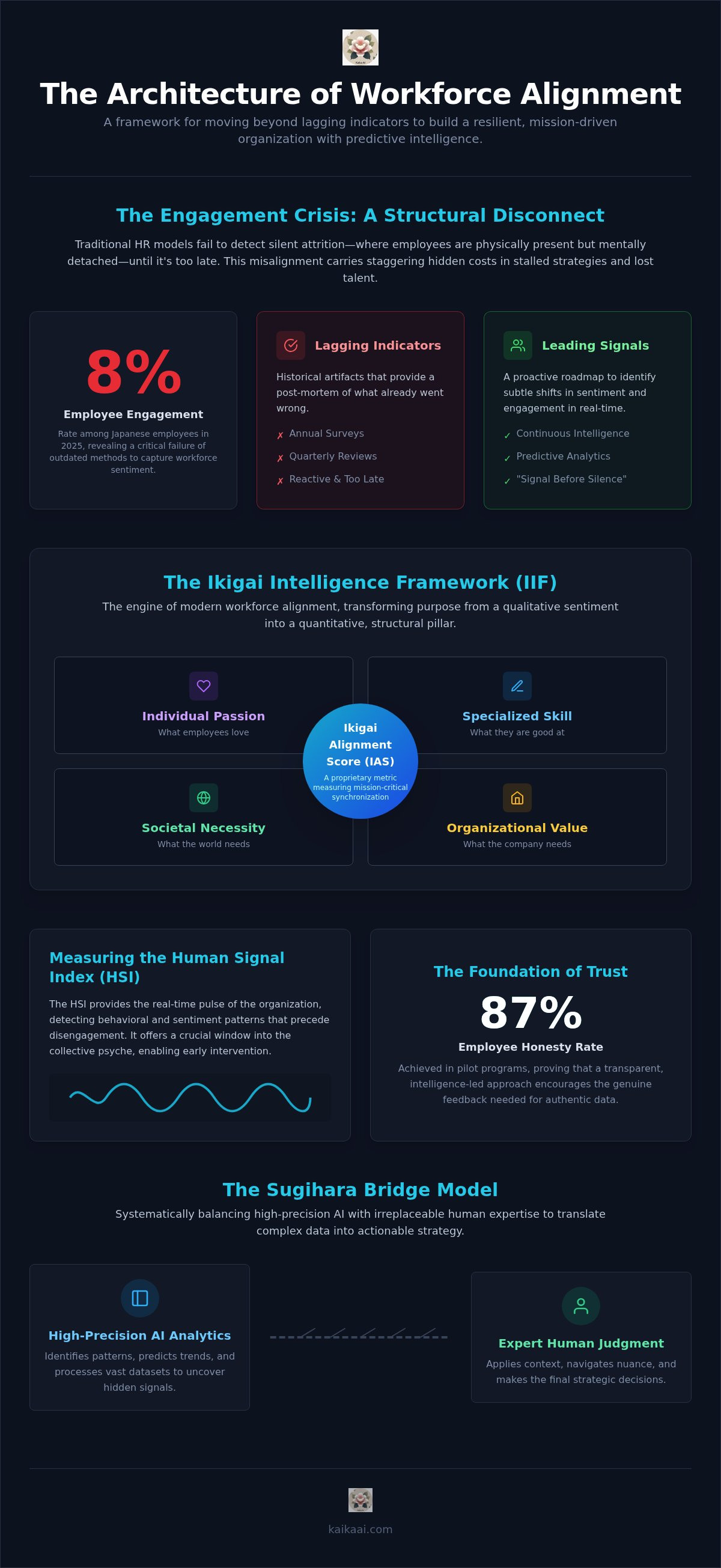
In 2025, only 8% of Japanese employees were classified as engaged at work, the lowest rate among developed nations. This statistic reveals a profound structural disconnect that traditional annual surveys fail to capture until it's too late. You likely feel the weight of this invisible withdrawal, where top talent remains physically present but mentally detached from the corporate mission. To bridge this gap, leaders must move beyond lagging indicators and adopt a dynamic workforce alignment strategy that transforms static HR data into real-time predictive intelligence.
You understand that organizational velocity depends on more than just efficient processes. It requires the precise synchronization of individual purpose with enterprise-scale execution. This article demonstrates how to move from reactive crisis management to a proactive framework that identifies disengagement before it leads to silent attrition. We'll explore how the Ikigai Intelligence Framework provides data-driven proof of purpose-alignment, ensuring your team moves with collective harmony and measurable resilience. By the end, you'll have a clear roadmap for building a resilient, mission-driven organization that thrives on structural integrity and human potential.
Key Takeaways
- Transition from static, top-down models to a bidirectional workforce alignment strategy that synchronizes individual purpose with enterprise mission in real-time.
- Utilize the Ikigai Intelligence Framework to systematically map the intersection of employee passion, skill, and organizational value for maximum structural impact.
- Replace lagging annual surveys with continuous predictive intelligence to identify "signal before the silence," preventing attrition through early detection of disengagement patterns.
- Integrate the Sugihara Bridge Model to balance high-precision AI analytics with the expert human judgment required to navigate complex organizational nuances.
- Drive measurable organizational velocity by transforming raw HR data into actionable insights that harmonize human potential with global performance standards.
What is a Workforce Alignment Strategy?
A workforce alignment strategy is the systematic synchronization of individual purpose, behavioral signals, and organizational mission. It represents a fundamental departure from traditional top-down cascading models that often fail to account for the nuances of human behavior. Modern intelligence-led alignment utilizes bidirectional feedback loops, ensuring that strategic directives from leadership are harmonized with the lived experience of every employee. This approach creates a cohesive environment where individual contributions directly fuel enterprise-scale goals through structural integrity and shared vision.
The role of the CHRO is fundamentally changing. It's moving from traditional people operations toward a model of workforce intelligence leadership. This evolution is necessary to address the growing threat of silent attrition. Silent attrition occurs when top talent disengages mentally while remaining physically present. Without a sophisticated strategy, these employees eventually leave, taking valuable institutional knowledge with them. A proactive framework identifies these disengagement signals early, allowing for strategic intervention before the professional bond is broken.
The Shift from Lagging Reports to Leading Signals
Quarterly surveys and annual reviews are historical artifacts. They fail to capture the high velocity of modern enterprise shifts. These lagging indicators provide a post-mortem of what went wrong rather than a roadmap for what to do next. A resilient workforce alignment strategy prioritizes leading signals over historical snapshots. It's about hearing the signal before the silence. Leaders must identify subtle shifts in sentiment and engagement in real-time to maintain momentum. Workforce alignment is the architectural bridge between strategic intent and human execution.
The Economic Impact of Misalignment
The hidden costs of misalignment are staggering. Stalled strategy execution, cross-departmental friction, and high turnover rates erode the bottom line and stifle innovation. When individual purpose is disconnected from the corporate mission, organizational synergy collapses. High-performing leaders use AI for organizational health to maintain a competitive advantage through systemic synchronization. This focus on human potential aligns with broader workforce development goals by prioritizing the structural integrity of the talent pool. Alignment drives operational resilience, ensuring the organization remains agile and unified during periods of rapid global change.
The Ikigai Intelligence Framework: A New Paradigm for Purpose
The Ikigai Intelligence Framework (IIF) serves as the fundamental engine of a modern workforce alignment strategy. It moves organizational purpose from a qualitative sentiment to a quantitative structural pillar. By mapping the precise intersection of individual passion, specialized skill, societal necessity, and organizational value, the IIF ensures that every contributor finds resonance within the enterprise mission. This synchronization isn't merely a cultural benefit; it's a requirement for long-term enterprise sustainability in a high-velocity global market.
Central to this framework is the Ikigai Alignment Score (IAS), a proprietary metric that measures the depth of mission-critical synchronization. This rigorous approach to human potential mirrors the strategic coordination mandated by the Workforce Innovation and Opportunity Act, which prioritizes the alignment of workforce systems to drive economic resilience. By establishing an IAS baseline, leadership gains a clear view of the structural integrity of their talent pool, allowing for precise adjustments that enhance organizational harmony and performance.
Measuring the Human Signal Index (HSI)
The Human Signal Index (HSI) provides the real-time pulse required to maintain operational momentum. It detects behavioral and sentiment patterns that precede disengagement, offering a window into the collective psyche of the organization. During pilot programs, Kaika AI achieved an 87% employee honesty rate, demonstrating that a transparent, intelligence-led approach encourages genuine feedback. This high level of trust allows leadership to act on authentic data rather than the filtered responses common in traditional corporate surveys.
Clinical Precision: The Employee Human Signal Index (EHSI)
True workforce alignment requires a sophisticated understanding of psychological health. The Employee Human Signal Index (EHSI) utilizes clinical precision to identify burnout risk, developed in collaboration with clinical psychologist Michelle Kwamboka. This index ethically monitors for signs of psychological strain while maintaining individual privacy, providing a proactive safeguard against systemic fatigue. By identifying the leading indicators of employee burnout, executives can deploy targeted support before attrition occurs. For leaders ready to evaluate their current structural health, a comprehensive Alignment Audit serves as the first step toward building a resilient, purpose-aligned organization.
Predictive Intelligence vs. Static HR Surveys
Static HR surveys are historical artifacts. They provide a post-mortem of a vanished reality, offering a "snapshot" of sentiment that is often weeks or months old by the time it reaches an executive dashboard. A robust workforce alignment strategy requires a departure from these lagging indicators. Instead, leadership must pivot toward "continuous stream" intelligence. This real-time data feed allows for data-driven Kaizen, where organizational health is refined through iterative, evidence-based adjustments rather than reactive crisis management.
Predictive intelligence identifies disengagement and burnout patterns with architectural precision. It surfaces subtle shifts in behavioral signals long before top talent submits a resignation. This proactive approach mirrors high-level strategic coordination seen in other sectors, such as WGU's Workforce Alignment Strategy, which utilizes data to ensure talent development remains synchronized with evolving market demands. By capturing the live velocity of the organization, executives can maintain momentum and protect their most valuable human assets.
Why Traditional Engagement Scores are Lagging Indicators
Traditional corporate surveys suffer from a persistent "honesty gap." Employees frequently provide the answers they believe leadership wants to hear, fearing that candor might lead to professional repercussions. This creates a distorted view of organizational health. AI-driven platforms bridge this gap by creating a more engaging, frictionless feedback loop. In Kaika AI pilot programs, these systems achieved a 74% completion rate, significantly outperforming industry averages for static surveys. Transitioning to continuous performance management software allows for the capture of authentic human signals that drive long-term synergy.
Ethical Data Use and Organizational Transparency
For Tokyo-based enterprises, maintaining real-time productivity metrics requires a strict adherence to Japanese privacy standards. Responsible AI isn't a secondary concern; it's a foundational requirement for organizational trust. Our "Human Truth" philosophy focuses on surfacing aggregate data patterns that allow leaders to act while there's still time to course-correct. This approach ensures enterprise-grade security and total anonymity for the individual. By prioritizing ethical data use, organizations create a transparent environment where predictive intelligence serves as a tool for empowerment rather than surveillance. It's about building a resilient structure that honors human potential through measurable, systemic integrity.
Implementing the Sugihara Bridge Model: From Data to Action
The Sugihara Bridge Model represents a sophisticated hybrid architecture that fuses high-precision AI with expert human consultancy. While predictive intelligence identifies patterns, sensitive workforce signals require the nuanced judgment of a strategic partner to interpret cultural context effectively. This is especially critical in the Japanese corporate environment, where harmony and subtle behavioral shifts often carry more weight than overt feedback. By combining the Workforce Alignment Intelligence Platform with human insight, organizations move from passive observation to decisive, purpose-driven action. This integrated approach builds workforce resilience metrics that strengthen over time.
Phase 1: The Alignment Audit and Baseline Measurement
The first phase focuses on establishing a rigorous baseline through a comprehensive Alignment Audit. Leadership utilizes the Ikigai Alignment Score (IAS) to quantify the current state of mission-critical synchronization across all divisions. This process exposes the architectural gaps in cross-departmental synergy that often remain hidden behind traditional reporting structures. By applying the Human Signal Index (HSI) during this phase, executives can pinpoint immediate attrition risks in key divisions, allowing for surgical interventions that stabilize the talent core before disengagement spreads.
Phase 2: Leadership Mindset and Strategic Integration
Successful workforce alignment strategy requires an evolution in leadership mindset. Executive consultation helps leaders interpret AI-driven signals, transforming raw data into a strategic roadmap for organizational harmony. This phase emphasizes the "listening to the signal" philosophy, where leaders learn to prioritize proactive resilience over reactive management. Through Collective Kaizen Workshops, teams engage in structured problem-solving that aligns individual purpose with operational excellence. Leaders who are ready to initiate this transformation should schedule an Executive Consultation to begin their integration journey.
Phase 3: Continuous Optimization and Global Scaling
The final phase involves scaling alignment across global divisions while respecting local cultural nuances. The platform provides a unified framework for organizational health that adapts to diverse geographic requirements without compromising structural integrity. This continuous optimization prepares the enterprise for significant institutional growth, including the targeted 2032 dual listing on the TSE and ASX. By maintaining a relentless focus on the EHSI and IAS, the organization ensures its workforce remains a resilient engine of global performance. This methodical progression ensures that the Tokyo headquarters remains the center of a synchronized, high-velocity global enterprise.
Scaling Synergy: The Future of Global Workforce Alignment
The transition from legacy HR management to Workforce Alignment Intelligence represents a tectonic shift in leadership philosophy. It is no longer sufficient to manage headcount; executives must now orchestrate the synchronization of individual Ikigai with enterprise-scale execution. This architectural approach to leadership transforms HR from a cost center into a strategic intelligence hub. This evolution ensures that every contributor is mentally and emotionally tethered to the corporate mission. By adopting a proactive workforce alignment strategy, organizations cultivate a high-velocity environment where human potential is the primary driver of structural integrity and global performance.
Proactive alignment serves as the definitive competitive edge for the next decade. As global markets fluctuate, the organizations that maintain structural harmony will outperform those burdened by invisible withdrawal. Kaika AI operates as the category leader in this emerging intelligence sector, providing the tools necessary for executive leadership to move with precision. Our focus on measurable structural impact ensures that your organization remains a serious, results-driven engine of human potential. Connecting individual purpose to the corporate mission is not a soft initiative; it's a strategic requirement for resilience.
The Road to 2032: Category Leadership and Global Expansion
Our mission is to become a globally recognized public entity that sets the standard for workforce intelligence. The partnership with Waseda University and the Tokyo Innovation Base (TiB) ensures our methodology remains grounded in both academic excellence and practical application. We are relentlessly committed to surfacing the human truth that traditional systems ignore. This dedication to transparency and ethical data use creates a foundation for institutional growth that will carry us toward our 2032 dual listing on the TSE and ASX. By maintaining our Tokyo headquarters as a center for innovation, we continue to fuel the global expansion of purpose-aligned enterprise leadership.
Next Steps for CHROs and Enterprise Leaders
Transitioning to a sophisticated workforce alignment strategy is the most significant investment a CHRO can make in 2026. Requesting early access to the Workforce Alignment Intelligence Platform provides your team with the leading signals required to stay ahead of attrition. By starting an Alignment Audit now, you establish a baseline for resilience that protects your talent core and accelerates organizational velocity. Don't wait for the silence of disengagement to become the roar of turnover. Leaders who act with speed and precision today will define the high-performance cultures of tomorrow.
Hear the signal before the silence with Kaika AI
Architecting the Synchronized Enterprise
The transition from reactive HR management to a proactive workforce alignment strategy represents the defining shift for modern global leadership. By integrating the Ikigai Intelligence Framework with real-time predictive analytics, organizations move beyond the limitations of lagging indicators to achieve genuine operational velocity. This architectural approach ensures that individual purpose and corporate mission remain in constant synchronization, even during periods of rapid institutional growth. The result is a resilient structure capable of navigating the complexities of the 2026 labor market with precision and harmony.
Our methodology, co-developed with clinical psychologists and supported by our research partnership with Waseda University, has demonstrated an 87% employee honesty rate and an NPS of 72 among participants. These metrics provide the data-driven proof that a transparent, intelligence-led framework fosters authentic engagement and structural integrity. Executives who prioritize this systemic evolution will secure a definitive competitive edge. Request Early Access to the Kaika AI Alignment Platform to begin identifying the signal before the silence. The future of your organization depends on the strength of its alignment today.
Frequently Asked Questions
What is the difference between employee engagement and workforce alignment?
Engagement measures how employees feel about their work, while a workforce alignment strategy focuses on the synchronization of individual purpose with organizational mission. Engagement is often a trailing indicator of satisfaction. In contrast, alignment is a structural metric that ensures every action directly supports enterprise-scale execution. While an engaged employee is happy, an aligned employee is moving in the exact direction required to drive organizational velocity and resilience.
How does the Ikigai Intelligence Framework measure individual purpose?
The Ikigai Intelligence Framework (IIF) utilizes the Ikigai Alignment Score (IAS) to quantify the intersection of passion, skill, societal need, and organizational value. It moves beyond qualitative sentiment by mapping these four dimensions against specific corporate objectives. This data-driven approach allows leaders to see exactly where individual purpose diverges from the mission. It provides a blueprint for systemic synchronization that honors human potential while maintaining rigorous performance standards.
Is AI-powered workforce monitoring compliant with Japanese privacy laws?
Kaika AI prioritizes enterprise-grade security and strict adherence to Japanese privacy norms. Our Human Truth philosophy focuses on surfacing aggregated behavioral signals rather than invasive individual surveillance. By maintaining total anonymity at the individual level, the platform provides leaders with actionable insights without compromising trust. This responsible approach to AI ensures compliance with local regulations while fostering a transparent environment where data serves as a tool for collective growth.
What is the "signal before the silence" philosophy?
The "signal before the silence" philosophy is a proactive leadership approach that identifies disengagement before it results in silent attrition. It focuses on detecting subtle behavioral shifts and sentiment patterns that precede a total withdrawal of effort. By capturing these leading indicators, executives can intervene while there's still time to course-correct. This philosophy transforms raw data into a predictive tool that protects the organization from the hidden costs of talent loss.
How does the Sugihara Bridge Model combine AI with human consultants?
The Sugihara Bridge Model is a hybrid architecture that pairs high-precision AI measurement with the nuanced judgment of trained human consultants. While the AI identifies complex data patterns, the consultant provides the cultural context and psychological depth required for effective intervention. This model is especially critical in Japan, where subtle communication styles require human interpretation. It ensures that sensitive workforce signals lead to empathetic, strategically sound actions rather than purely automated responses.
Can this strategy help reduce employee burnout?
This strategy reduces burnout by utilizing the Employee Human Signal Index (EHSI) to flag psychological strain in real-time. Co-developed with clinical psychologists, the EHSI identifies the leading indicators of exhaustion before they escalate into a crisis. By detecting these patterns early, leadership can adjust workloads or provide targeted support. This proactive care maintains organizational health and prevents the systemic fatigue that often stalls enterprise momentum and strategy execution.
What industries benefit most from workforce alignment intelligence?
Large enterprises facing complex workforce transformations benefit most from this intelligence, particularly those in high-stakes sectors like technology, finance, and manufacturing. These industries often struggle with silent attrition and the disconnect between global strategy and local execution. By implementing a workforce alignment strategy, these organizations can synchronize diverse teams across multiple divisions. This architectural clarity is essential for maintaining velocity in markets where human capital is the primary differentiator.
How long does it take to see results from a workforce alignment strategy?
Initial baseline measurements from an Alignment Audit are available almost immediately, providing an instant view of the Ikigai Alignment Score. However, systemic synchronization typically matures over several months as leadership integrates these signals into their decision-making processes. Most organizations observe measurable improvements in cross-departmental synergy and reduced attrition risk within the first two quarters. The long-term goal is continuous optimization that builds lasting operational resilience and organizational harmony.
Disclaimer
#Disclaimer
At Kaika AI, we believe the future belongs to organizations that combine human wisdom with artificial intelligence responsibly. The articles, research, insights, and thought leadership published on this website are intended to educate, inform, and encourage meaningful conversations about the future of work, organizational intelligence, AI, leadership, and innovation.
While our content is developed through rigorous research and may be generated, curated, or enhanced using artificial intelligence, every effort is made to ensure it reflects thoughtful analysis, practical relevance, and responsible AI practices. However, no representation or warranty is made regarding the completeness, accuracy, or suitability of the information for every individual or organizational circumstance.
The ideas, opinions, frameworks, and recommendations shared by Kaika AI are provided for educational and informational purposes only. They should not be interpreted as legal, financial, medical, psychological, human resources, cybersecurity, or other professional advice. Organizations and individuals should seek qualified professional guidance before making strategic, legal, or operational decisions.
Where articles reference third-party organizations, products, services, academic research, industry reports, or public data, such references are provided solely to support discussion and analysis. Unless explicitly stated, they do not imply endorsement, partnership, or affiliation.
Artificial intelligence is a powerful decision-support technology—not a replacement for human judgment. Kaika AI advocates for responsible, transparent, and human-centered AI adoption. We encourage readers to critically evaluate information, consider their unique context, and combine AI-generated insights with professional expertise and sound decision-making.
The content published on this website may be updated, revised, or removed as knowledge, technology, regulations, and best practices continue to evolve.
To the fullest extent permitted by applicable law, Kaika AI, its affiliates, contributors, and partners disclaim liability for any direct, indirect, incidental, consequential, or other losses arising from the use of, or reliance upon, the information provided on this website.
By accessing or using this website, you acknowledge that you have read, understood, and agree to this Disclaimer.
Kaika AI
'Building trusted organizational intelligence for the AI Era'


