
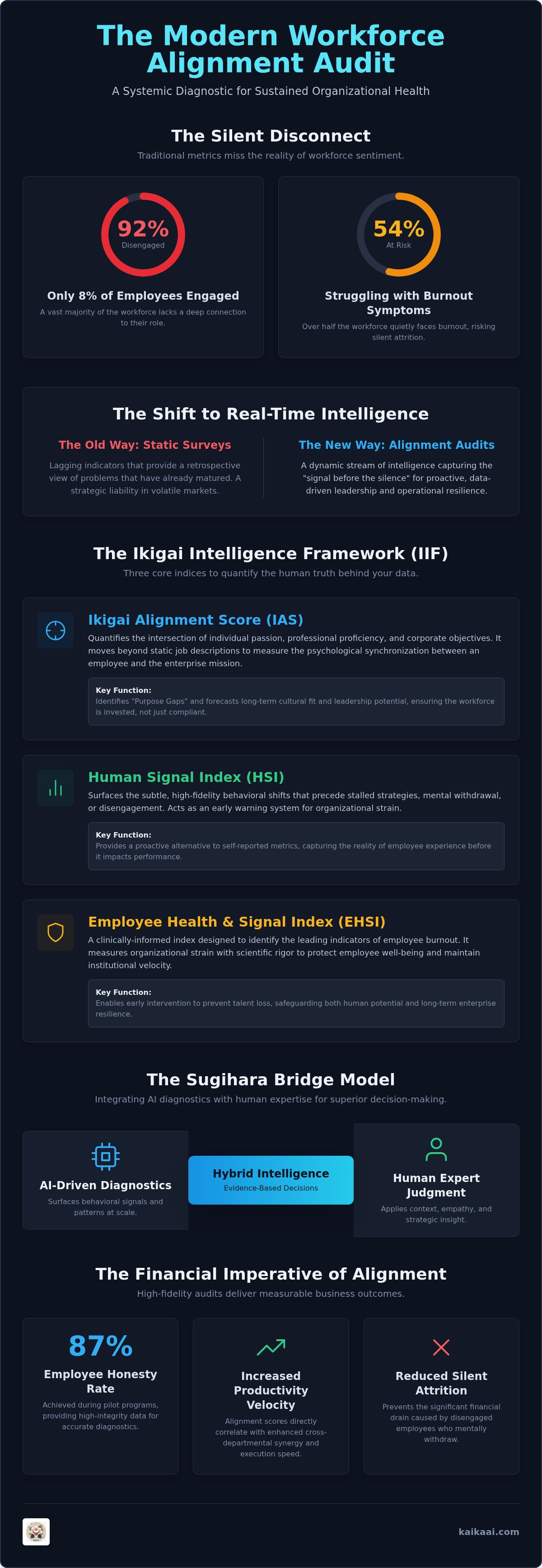
Only 8% of Japanese employees are engaged at work, while 54% struggle with burnout symptoms that they rarely disclose to leadership. You've likely felt the friction where strategic vision meets operational reality, sensing a disconnect that traditional surveys simply cannot quantify. It's frustrating to lead an organization where silent attrition erodes performance despite meeting every compliance standard.
A rigorous workforce alignment audit solves this by surfacing the human truth beneath your enterprise data. This diagnostic process moves beyond static metrics to identify mission-critical gaps using AI-driven behavioral signals. You'll learn how the Sugihara Bridge Model creates a hybrid architecture of technical intelligence and human psychology to prevent talent loss. We'll explore how this data-driven approach fosters organizational health, measurable cross-departmental synergy, and the early detection of disengagement. By synchronizing individual purpose with organizational velocity, you can build a resilient framework for sustained excellence.
Key Takeaways
- Bridge the strategic gap. Use a systemic workforce alignment audit to diagnose the disconnect between executive vision and daily operational execution.
- Quantify human potential. Leverage the Ikigai Intelligence Framework and its three core indices, IAS, HSI, and EHSI, to capture precise behavioral signals.
- Balance intelligence. Apply the Sugihara Bridge Model to integrate AI-driven diagnostics with human expert judgment for superior, evidence-based decision-making.
- Prevent silent attrition. Identify early indicators of burnout and disengagement to maintain organizational velocity and long-term enterprise resilience.
- Execute with precision. Follow a methodical three-phase integration plan to surface the human truth required for sustained institutional health.
Defining the Modern Workforce Alignment Audit
A workforce alignment audit isn't a routine HR checklist or a superficial cultural assessment. It's a systemic diagnostic of organizational health designed to map the structural integrity of your enterprise. Most executive teams operate under the assumption that their strategic vision is being executed exactly as intended. Yet, a profound discrepancy often exists between high-level strategy and ground-level execution. This audit identifies that gap with surgical precision. It shifts the leadership focus from the superficial question of "What are they doing?" to the deeper, more diagnostic inquiry of "Why are they doing it?"
The core of this process is the "signal before the silence" philosophy. Proactive leadership requires the ability to detect subtle behavioral shifts before they manifest as systemic failure. By the time an employee physically leaves the organization, the financial and operational damage is already done. The audit captures the quiet precursors to disengagement, allowing leaders to recalibrate the environment before silent attrition takes root and erodes institutional knowledge.
The Shift from Static Surveys to Real-Time Intelligence
Traditional annual engagement surveys are lagging indicators of failure. They provide a retrospective view of cultural fractures that have already matured. In volatile global markets, relying on year-old data is a strategic liability. Leaders need continuous sentiment analysis to maintain operational resilience and strategic velocity. Transitioning to a workforce alignment software model facilitates this evolution. It replaces the "snapshot" approach with a dynamic stream of intelligence. This ensures that executive decisions are based on the current human truth of the workforce rather than outdated metrics that no longer reflect reality.
The ROI of Organizational Synergy
Alignment is a financial imperative. High-fidelity audits correlate alignment scores with productivity velocity and measurable attrition reduction. When individual purpose is synchronized with the corporate mission, cross-departmental synergy increases naturally. This prevents the significant financial drain caused by silent attrition, where employees remain on the payroll but mentally withdraw their effort. During Kaika AI pilot programs, our methodology achieved an 87% employee honesty rate. This level of transparency is essential for an accurate workforce alignment audit. Without high-integrity data, your diagnostics are merely a reflection of what employees think leadership wants to hear, rather than the reality of their daily experience.
The Ikigai Intelligence Framework: Three Pillars of Audit Depth
The Ikigai Intelligence Framework (IIF) serves as the foundational architecture for a modern workforce alignment audit. While legacy systems focus on rigid competency modeling, the IIF recognizes that individual purpose is the primary driver of sustained organizational velocity. It moves beyond static job descriptions to analyze the psychological synchronization between a contributor and the enterprise mission; for those looking to explore their personal purpose through AI-driven mapping, AbipromAstro's projecteris.abipromastro.com offers a high-precision tool for self-discovery. By integrating clinical psychology into the diagnostic process, the framework measures organizational strain with scientific rigor. Behavioral signals provide a high-fidelity alternative to self-reported performance metrics. These metrics often mask underlying disengagement because employees naturally prioritize self-preservation over total transparency in traditional surveys.
Ikigai Alignment Score (IAS)
The IAS quantifies the intersection of individual passion, professional proficiency, and the corporate objective. It identifies "Purpose Gaps" where a lack of alignment creates friction in execution. These scores are predictive. They don't just reflect current performance; they forecast long-term cultural fit and future leadership potential. When a workforce alignment audit reveals high IAS scores, it indicates a team capable of navigating complex strategic shifts without losing momentum. This alignment ensures that the workforce isn't just compliant, but deeply invested in the collective outcome. Leaders seeking to implement these sophisticated diagnostics often start with an Alignment Audit to establish a baseline for organizational health.
Human Signal Index (HSI) and EHSI
The Human Signal Index (HSI) surfaces the subtle behavioral shifts that precede stalled strategies or mental withdrawal. Complementing this is the EHSI, a clinically informed index designed to identify leading indicators of employee burnout. This dual-layered approach uses responsible AI to predict mental health risks without compromising individual privacy. It ensures transparency while providing leaders with the intelligence needed to protect their most valuable assets. High-performing organizations use these indices to maintain a state of collective kaizen, ensuring every structural adjustment is grounded in human truth. This methodology provides a comprehensive framework for evolution that respects the nuance of human behavior.
The Sugihara Bridge Model: Hybrid Intelligence in Practice
The "Black Box" problem remains a significant barrier to the adoption of AI in Human Resources. Leadership teams often hesitate to trust algorithms that offer conclusions without context. The Sugihara Bridge Model addresses this directly. It functions as a hybrid AI-human architecture, ensuring that automated data never dictates strategy in isolation. Instead, it creates a structured synthesis where technical intelligence serves as the foundation for expert human judgment.
During a workforce alignment audit, this model facilitates a seamless transition from raw data to actionable leadership. While the Ikigai Intelligence Framework captures the underlying signals, trained human consultants interpret the nuance of those results. These experts provide the necessary bridge between a data-driven diagnostic and the reality of complex human behavior. This approach ensures operational resilience by focusing on architectural consultations that respect the intricacies of the enterprise environment.
Human Truth Beneath the Data
AI alone cannot solve the problem of organizational misalignment. It lacks the "Strategic Sage" persona required to understand the philosophical and emotional drivers of performance. The audit process includes a dedicated Mindset Development phase where leaders learn to engage with these deeper truths. By utilizing clinically backed EHSI data, executives can refine their management style to address specific burnout risks. This isn't about mere data collection; it's about developing the leadership maturity needed to act on human truth with precision and empathy.
Global Standards and Japanese Privacy Excellence
Enterprise security is non-negotiable when handling sensitive workforce signals. The Sugihara Bridge Model adheres to high-tier Japanese privacy standards, providing a level of protection that exceeds many global requirements. This commitment to ethical data use is reinforced through strategic academic partnerships, including collaboration with Waseda University. These partnerships validate our methodologies, ensuring they remain grounded in rigorous research. As organizations scale, this model provides a consistent framework for a workforce alignment audit across global divisions, maintaining institutional stability while respecting the nuances of local workplace cultures.
Executing the 3-Phase Alignment Integration
Execution is the vital bridge between strategic intent and enterprise impact. It requires a disciplined, three-phase methodology to ensure that workforce alignment isn't just a conceptual goal but a structural reality. This process moves the organization through a logical progression from deep diagnostic discovery to continuous, high-velocity optimization. By following a structured roadmap, leadership can transform fragmented departments into a synchronized, resilient ecosystem capable of navigating global market volatility.
Phase 1: Diagnostic and Structural Framework
The journey begins with a rigorous workforce alignment audit to surface the "silent" gaps that traditional management metrics often overlook. During this initial phase, we define the architectural scope of the intervention and identify the key stakeholders responsible for driving systemic change. Leadership establishes baseline metrics for productivity and burnout risk, providing a clear quantitative starting point for the transformation. By defining mission-critical alignment goals for the fiscal year, the organization creates a unified target that synchronizes individual effort with collective ambition. This phase ensures the foundation is secure before any technological deployment begins.
Phase 2 & 3: Implementation and Kaizen
Measurement follows the diagnostic phase, utilizing the Ikigai Intelligence Framework to capture real-time IAS and HSI data across the enterprise. This deployment transforms abstract sentiment into actionable intelligence, allowing for the early detection of disengagement signals. Integrating these insights into continuous performance management software ensures that the feedback loop remains active and relevant. It's no longer about waiting for quarterly reviews; it's about maintaining a constant pulse on the health of the organization.
Optimization is achieved through the strategic rollout of the SaaS platform to specialized divisions, followed by the initiation of Collective Kaizen workshops. These workshops aren't mere training sessions. They are architectural interventions designed to dismantle departmental silos that hinder operational velocity. By establishing the "signal before the silence" early warning system, leadership gains the ability to address friction points before they escalate into systemic failures. This creates a resilient feedback architecture where continuous improvement is a permanent feature of the organizational culture. This systematic approach ensures that every structural adjustment is grounded in real-time human truth.
Leaders seeking to implement this three-phase model can begin by securing a professional Alignment Audit to identify their most critical structural gaps.
The Kaika AI Alignment Audit: Your Path to 2032 Resilience
The workforce alignment audit represents more than a diagnostic tool; it's the initial architecture for category leadership. As enterprises navigate the complexities of the current global economy, the ability to synchronize human potential with strategic intent becomes the ultimate differentiator. Kaika AI is committed to this evolution, projecting a dual TSE/ASX listing by 2032 to provide institutional stability for our global partners. By securing early access to the Ikigai Intelligence Framework, leadership teams gain a decisive advantage in workforce velocity, ensuring their organizations remain agile in the face of shifting market demands.
Our commitment to ethical data use ensures that transparency never comes at the cost of individual privacy. We utilize workforce resilience metrics to provide a predictive framework for leadership. This approach allows executives to move beyond reactive management, building a culture that thrives on precision and structural integrity. It's about creating a state of permanent readiness where the enterprise can absorb shocks and maintain high performance without sacrificing the well-being of its contributors.
Institutional Credibility and Strategic Partnerships
Credibility is built through rigorous validation and strategic collaboration. Our partnerships with the Tokyo Innovation Base (TiB) and Waseda University ensure our methodologies remain at the forefront of organizational psychology and systems engineering. This academic and institutional backing is reflected in our performance data. In pilot programs, 340 participants gave the platform an NPS of 72, demonstrating the profound value of surfacing human truth. This success fuels our long-term roadmap for global workforce synchronization, providing a scalable model for multinational enterprises seeking a unified culture of excellence.
Taking Action: Requesting Early Access
Participation in the Kaika AI ecosystem is reserved for large-scale enterprises committed to deep structural transformation. We prioritize organizations that recognize the urgency of the "engagement gap" and are ready to move beyond compliance-based HR. During the first 90 days of a workforce alignment audit, CHROs can expect a comprehensive mapping of their organizational health, including the identification of critical disengagement signals. This period establishes the baseline for the Sugihara Bridge Model, pairing AI measurement with human expert judgment. Don't wait for the silence of attrition to signal a crisis. Hear the signal before the silence and secure the future of your enterprise today.
Synchronizing Human Potential for Global Scale
The path to institutional resilience requires moving beyond surface-level compliance to a deeper understanding of the human truth within your organization. By implementing a workforce alignment audit, you transition from retrospective data to real-time intelligence that captures the subtle behavioral signals of your team. Our strategic partnership with Waseda University and the development of the clinically backed EHSI burnout index ensure your diagnostics remain at the forefront of organizational psychology. It's this level of precision that allows leadership to move from reactive management to proactive stewardship.
This architectural approach has already demonstrated a 87% employee honesty rate in pilot programs, proving that trust and transparency are achievable at scale. You now have the framework to bridge the gap between executive strategy and ground-level execution. The time to detect disengagement is before it manifests as systemic attrition. By prioritizing this alignment, you build a foundation for sustained excellence and operational velocity. Request Early Access to the Workforce Alignment Intelligence Platform and begin your journey toward a more harmonious, high-velocity future. Your organization's potential is waiting to be fully realized.
Frequently Asked Questions
What is the primary difference between a workforce alignment audit and a standard HR audit?
A standard HR audit focuses on regulatory compliance and administrative accuracy. Conversely, a workforce alignment audit is a systemic diagnostic of organizational health. It identifies the discrepancy between executive strategy and ground-level execution. While standard audits look at what happened, this audit investigates why actions occur. It prioritizes the synchronization of individual purpose with corporate velocity to ensure long-term operational resilience and strategic integrity.
How does the Ikigai Intelligence Framework measure individual purpose?
The Ikigai Intelligence Framework (IIF) measures purpose through the Ikigai Alignment Score (IAS). This metric quantifies the intersection of an employee's passion, professional proficiency, and the enterprise mission. It identifies purpose gaps that lead to disengagement and silent attrition. By analyzing these behavioral signals, the framework provides a data-driven diagnostic of cultural fit. This ensures that every contributor is mentally and operationally aligned with the organization's high-level objectives.
Is the data collected during a workforce alignment audit secure and private?
Security and privacy are central to our architectural design. We adhere to high-tier Japanese privacy standards, which are among the most rigorous in the global enterprise market. Our commitment to ethical data use ensures that all behavioral signals remain protected and anonymized where necessary. This approach builds the trust required for an 87% employee honesty rate. We prioritize transparency and institutional reliability to protect both the individual and the enterprise.
How long does a comprehensive workforce alignment audit typically take?
A comprehensive workforce alignment audit typically follows a structured 90-day timeline for the initial diagnostic phase. This period allows for the preparation of the architectural scope, the deployment of the IIF platform, and the capture of real-time IAS and HSI data. The integration phase then moves into continuous performance management. This methodical progression ensures that leadership receives actionable intelligence without disrupting the daily velocity of the organization's global divisions.
Can an alignment audit predict when employees are at risk of burnout?
Yes, the audit utilizes the EHSI (Emotional Human Signal Index) to identify leading indicators of employee burnout. This clinically informed index was developed with input from clinical psychologists to detect mental withdrawal before it manifests as physical attrition. By surfacing these signals early, leadership can implement proactive measures to protect their talent. It's a predictive framework designed to maintain organizational harmony and prevent the financial drain associated with silent attrition.
What role do human consultants play in the Sugihara Bridge Model?
Human consultants act as the Strategic Sage within the Sugihara Bridge Model. While AI provides precise measurement, our experts interpret the nuance of sensitive workforce signals. They bridge the gap between raw data and architectural consultations. This hybrid architecture ensures that executive decisions are grounded in human judgment rather than isolated algorithms. Consultants help leaders refine their mindset and management style based on the human truth surfaced during the audit.
How does Kaika AI ensure the 87% honesty rate among employees?
We achieve an 87% employee honesty rate by utilizing a methodology backed by clinical psychology and strategic trust-building. Employees are more likely to provide transparent feedback when they understand the diagnostic is focused on alignment rather than punishment. Our partnership with Waseda University helps validate these trust-centric frameworks. By emphasizing the intersection of individual Ikigai and collective growth, we create an environment where contributors feel safe sharing their true operational experience.
What are the first steps for a CHRO to initiate an alignment audit?
The first step for a CHRO is to define the architectural scope and identify key stakeholders for the diagnostic. This involves establishing baseline metrics for productivity and burnout risk to find silent gaps in the organization. Initiating a workforce alignment audit requires a commitment to surfacing human truth beneath legacy enterprise data. Executives can then begin the structured transition toward the Sugihara Bridge Model to synchronize purpose and performance.
Disclaimer
#Disclaimer
At Kaika AI, we believe the future belongs to organizations that combine human wisdom with artificial intelligence responsibly. The articles, research, insights, and thought leadership published on this website are intended to educate, inform, and encourage meaningful conversations about the future of work, organizational intelligence, AI, leadership, and innovation.
While our content is developed through rigorous research and may be generated, curated, or enhanced using artificial intelligence, every effort is made to ensure it reflects thoughtful analysis, practical relevance, and responsible AI practices. However, no representation or warranty is made regarding the completeness, accuracy, or suitability of the information for every individual or organizational circumstance.
The ideas, opinions, frameworks, and recommendations shared by Kaika AI are provided for educational and informational purposes only. They should not be interpreted as legal, financial, medical, psychological, human resources, cybersecurity, or other professional advice. Organizations and individuals should seek qualified professional guidance before making strategic, legal, or operational decisions.
Where articles reference third-party organizations, products, services, academic research, industry reports, or public data, such references are provided solely to support discussion and analysis. Unless explicitly stated, they do not imply endorsement, partnership, or affiliation.
Artificial intelligence is a powerful decision-support technology—not a replacement for human judgment. Kaika AI advocates for responsible, transparent, and human-centered AI adoption. We encourage readers to critically evaluate information, consider their unique context, and combine AI-generated insights with professional expertise and sound decision-making.
The content published on this website may be updated, revised, or removed as knowledge, technology, regulations, and best practices continue to evolve.
To the fullest extent permitted by applicable law, Kaika AI, its affiliates, contributors, and partners disclaim liability for any direct, indirect, incidental, consequential, or other losses arising from the use of, or reliance upon, the information provided on this website.
By accessing or using this website, you acknowledge that you have read, understood, and agree to this Disclaimer.
Kaika AI
'Building trusted organizational intelligence for the AI Era'


