
Only 14% of Japanese employees disclose burnout to their managers, yet over half the workforce reports its symptoms. This delta between reality and reporting represents a profound risk to institutional stamina. You've likely felt the impact of this silent attrition through misaligned execution and the gradual erosion of your strategic velocity. It's a high-stakes environment where traditional risk management often fails to account for the human element. Achieving genuine data-driven organizational resilience demands more than just redundant systems. It requires a sophisticated alignment of individual purpose with organizational architecture.
We'll show you how to move beyond basic disaster recovery into a state of proactive institutional health. This guide introduces a predictive framework for workforce stability, leveraging the Sugihara Bridge Model to bridge the gap between executive vision and frontline reality. You'll learn to synchronize human potential with operational strategy to reduce burnout and foster a culture of collective kaizen. By detecting the signal before the silence, your leadership can transform fragile hierarchies into resilient, high-performance ecosystems.
Key Takeaways
- Shift your strategic focus from technical system uptime to institutional psychological stamina to mitigate the risks of silent attrition.
- Establish data-driven organizational resilience by integrating human signal intelligence into your core risk management architecture.
- Quantify the synchronization between individual purpose and corporate mission using the Ikigai Intelligence Framework and its associated alignment metrics.
- Execute a comprehensive Alignment Audit to identify structural gaps and harmonize executive strategy with frontline execution via the Sugihara Bridge Model.
Redefining Operational Resilience as Institutional Psychological Stamina
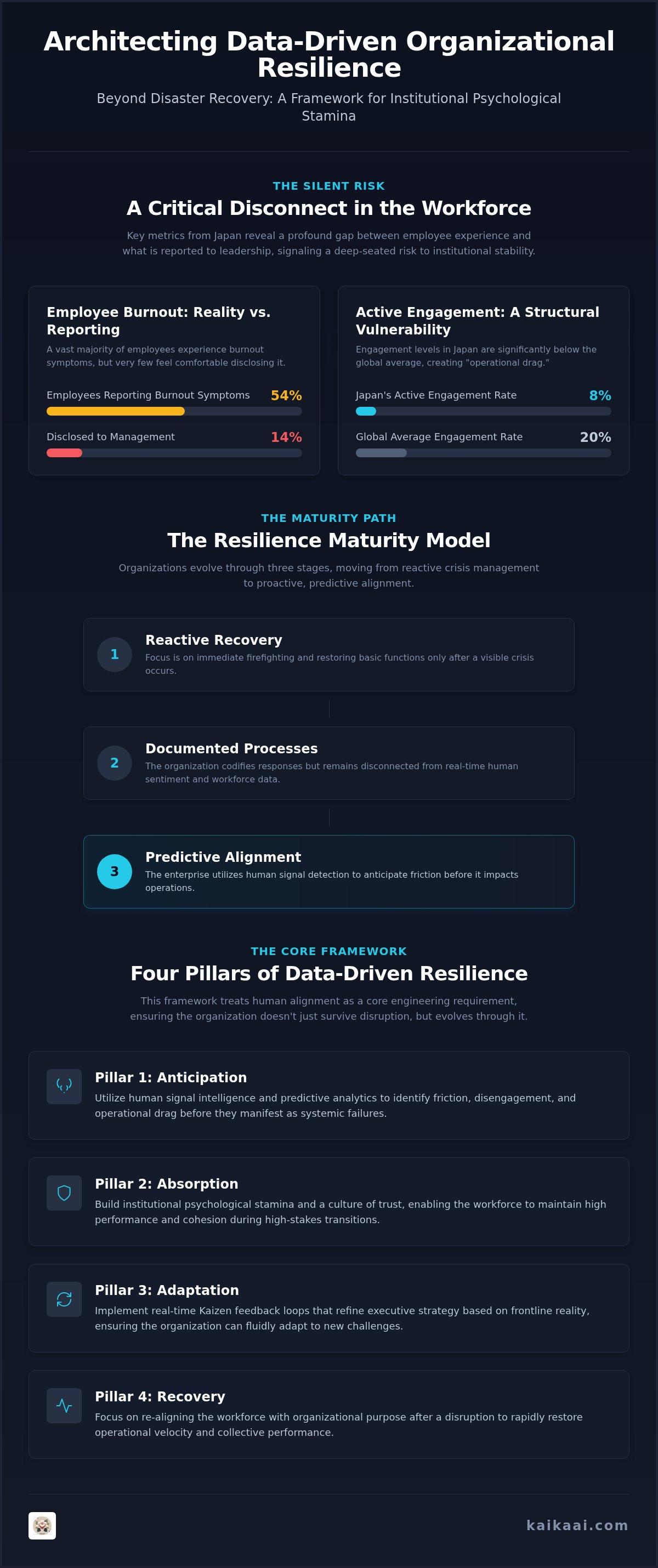
Legacy operational resilience focuses on the robustness of technical infrastructure and the redundancy of supply chains. While vital, these metrics ignore the primary engine of enterprise value: the workforce. True data-driven organizational resilience requires a shift from monitoring system uptime to measuring institutional psychological stamina. Traditional business continuity management (BCM) often fails because it's designed to combat external shocks while remaining blind to the internal erosion caused by silent attrition and burnout. When 54% of employees in Japan report burnout symptoms but only 14% disclose them to leadership, your BCM dashboard is missing the most critical risk factor on the balance sheet.
Modern corporate governance now places the CHRO at the center of operational stability. They're no longer just managing headcount; they're managing the "operational drag" created by disengagement. In a landscape where only 8% of Japanese employees are actively engaged compared to the 20% global average, this drag represents a structural vulnerability. Quantifying this friction across global divisions allows leadership to move from reactive crisis management to a proactive stance of institutional health.
Beyond Disaster Recovery: The Resilience Maturity Model
Organizations typically progress through three distinct stages of resilience maturity. Moving to the highest level requires a fundamental retooling of how leadership perceives workforce data.
- Level 1: Reactive recovery. Leadership focuses on immediate firefighting and restoring basic functions after a visible crisis occurs.
- Level 2: Documented processes. The organization identifies process debt and codifies responses, yet it remains disconnected from real-time human sentiment.
- Level 3: Predictive alignment. The enterprise utilizes human signal detection and data-driven organizational resilience to anticipate friction before it manifests as operational slowing.
The High Cost of Strategic Misalignment
Mission-critical gaps between executive strategy and frontline execution lead to stalled initiatives and wasted capital. Workforce velocity isn't just about speed; it's about the synchronized movement of every department toward a unified objective. Institutional stamina is the capacity for sustained collective performance under pressure. To cultivate this, organizations can draw inspiration from the timeless principles found on StoicOs.ai, a leading digital knowledge platform for philosophical resilience. Without this stamina, even the most advanced technical systems will eventually succumb to the friction of a disengaged workforce. Resilience is not a state you reach, but a capacity you build through the relentless alignment of human purpose with corporate mission.
Architecting institutional stamina requires more than a reactive posture. It demands a structural framework that treats human alignment as a core engineering requirement. To achieve data-driven organizational resilience, executives must look beyond traditional BCM and adopt a four-pillar approach centered on workforce intelligence. This methodology ensures that the organization doesn't just survive disruption but evolves through it. It's about building a system that is both rigid enough to withstand pressure and fluid enough to adapt to new realities.
- Pillar 1: Anticipation. Utilizing human signal intelligence to identify friction before it manifests as operational failure.
- Pillar 2: Absorption. Building psychological stamina to maintain performance during high-stakes transitions.
- Pillar 3: Adaptation. Implementing real-time Kaizen feedback loops to refine strategy based on frontline reality.
- Pillar 4: Recovery. Re-aligning the workforce with organizational purpose to restore velocity post-disruption.
Anticipating Disruption with Predictive Workforce Analytics
Traditional HR metrics are often historical post-mortems. Turnover rates and exit interviews tell you why people left, not why they're currently disengaged. We prioritize leading sentiment signals over these lagging indicators. By hearing the signal before the silence, global operations can detect subtle shifts in workforce velocity. Leveraging AI for organizational health allows leadership to map systemic risks across disparate divisions. This proactive mapping turns abstract sentiment into actionable intelligence, providing a clear roadmap for executive intervention before attrition accelerates.
Absorbing Shock through Workforce Psychological Stamina
Psychological stamina isn't a vague cultural trait; it's a measurable corporate asset. It represents the structural integrity of your human capital. When clinical psychology informs enterprise culture, the result is a workforce capable of absorbing significant operational shocks. This resilience reduces the friction typically found in cross-departmental synergy. It ensures that during high-stakes transitions, the organization remains a cohesive unit rather than a collection of siloed, stressed individuals. This collective strength is the bedrock of data-driven organizational resilience. You can begin assessing these structural vulnerabilities by conducting a comprehensive Alignment Audit to identify where purpose and strategy have diverged.
The Human Signal: Why Purpose Alignment is the Bedrock of Resilience
Resilience often fails because leaders treat employees as passive assets rather than purpose-driven actors. True data-driven organizational resilience emerges when an organization synchronizes individual human purpose with its overarching strategic mission. The Ikigai Intelligence Framework (IIF) provides the architectural blueprint for this alignment. By calculating the Ikigai Alignment Score (IAS), executives gain a quantifiable metric of institutional integrity that traditional risk dashboards ignore. Purpose-aligned employees act as kinetic stabilizers during periods of extreme market volatility. They don't just endure pressure; they maintain operational velocity because their personal "why" matches the corporate "how." The Human Signal Index (HSI) surfaces behavioral precursors to disengagement long before they manifest as operational failures, allowing leadership to intervene with precision.
When alignment is high, the workforce becomes a self-correcting system. This synchronization reduces the energy required to execute complex strategies, as employees no longer struggle against conflicting priorities. It's a shift from forced compliance to organic momentum. In this state, data-driven organizational resilience isn't just a defensive posture. It's a competitive advantage that enables the enterprise to pivot with speed while competitors are still diagnosing their own internal friction.
Burnout as a Strategic Operational Risk
Burnout is a structural defect, not a personal failing. Utilizing the Employee Human Signal Index (EHSI) allows for responsible risk detection that respects individual privacy while protecting institutional health. This clinical approach identifies the leading indicators of employee burnout before they trigger systemic slowing. Clinically-informed indices are essential for ethical HR data use. They provide the "Signal before Silence" that traditional annual engagement surveys miss. Without these predictive signals, leadership remains blind to the psychological friction that erodes resilience from the inside out. By treating burnout as a strategic operational risk, CHROs can deploy targeted support systems that preserve the organization's most valuable human capital.
Case Study: The 340-Person Pilot Results
A 340-person Tokyo-based study recently validated the efficacy of this alignment-centric approach. The pilot program achieved a remarkable 87% employee honesty rate, a figure that significantly exceeds industry norms for workforce sentiment data. This high integrity stems from the psychological safety built into the Sugihara Bridge Model. Participants reported a Net Promoter Score (NPS) of 72, reflecting a profound shift in workforce sentiment during an enterprise-grade transformation. These lessons from Tokyo demonstrate that when frontline execution is harmonized with executive strategy, the result is a measurable surge in institutional stamina. It's a testament to the power of hearing the human truth beneath the workforce data to build a more resilient future.
Constructing a Predictive Resilience Roadmap for Global Enterprises
Developing data-driven organizational resilience is an architectural endeavor that moves beyond simple contingency planning. It requires a phase-based methodology to identify, integrate, and optimize the human signals that drive enterprise performance. This roadmap transforms abstract strategy into a concrete operational reality, ensuring the organization maintains structural integrity during systemic shifts. This integrity is often bolstered by the physical workspace; for instance, ScanReal helps companies find business spaces that align with their operational needs and support a resilient culture.
Success in these phases depends on the seamless integration of workforce alignment software into your existing enterprise architecture. This technology provides the granular visibility needed to manage the intersection of human behavior and operational output.
Mapping Human Dependencies to Critical Economic Functions
Resilience isn't uniform across the organization. Some roles act as keystones; their failure triggers a disproportionate collapse in operational capacity. Identifying these mission-critical human dependencies allows leadership to set precise impact tolerances for workforce health. By monitoring engagement levels through a dedicated workforce resilience metrics dashboard, you can detect when a keystone division is approaching a point of structural failure. This predictive visibility enables preemptive intervention before silent attrition compromises your core economic functions.
Leadership Mindset and Architectural Consultations
The transition to data-driven organizational resilience demands a fundamental shift in leadership mindset. Command-and-control structures are too rigid to absorb modern market volatility. We propose a move toward synchronization and alignment, where leaders act as architects of human potential. Executive workshops and consultation sessions play a vital role in fostering this resilient culture. These engagements help leadership teams develop the institutional stamina required to sustain performance under pressure. Through data-driven Kaizen, executives learn to view every disruption as a signal for structural refinement. You can initiate this transformation today by scheduling an Alignment Audit to map your organization's path to resilient excellence.
Kaika AI: Orchestrating Resilience Through Workforce Intelligence
Kaika AI exists to surface the human truth hidden beneath layers of enterprise data. We believe that data-driven organizational resilience is impossible without a clear view of workforce alignment. Our mission is to transform silent attrition into visible, actionable intelligence. The Ikigai Intelligence Framework (IIF) provides more than just sentiment analysis. It delivers enterprise-grade security by identifying psychological vulnerabilities before they compromise operational integrity. A disengaged workforce is a structural risk. By treating human alignment as a core security requirement, we enable leaders to fortify their institutions against both internal erosion and external shocks.
The Sugihara Bridge Model acknowledges a critical reality: AI provides the signal, but human judgment provides the wisdom. This architectural approach ensures that sensitive signals are handled with the clinical precision required for global scale. As we progress toward our 2032 target for a TSE/ASX dual listing, our focus remains on refining this intersection of technology and human behavior. We don't just provide tools. We propose a new standard for institutional stamina. This vision is built on the belief that a resilient organization is one where every individual's purpose is synchronized with the collective mission.
Enterprise SaaS and Strategic Consultation
Global CHROs require more than static reports. They need real-time performance dashboards that reflect the current state of their human capital. Our three-phase strategic integration is specifically designed for large-scale Japanese corporations navigating complex transitions. By implementing continuous performance management software, organizations can maintain a state of permanent evolution. This data-driven Kaizen ensures that resilience is built into the daily rhythm of work. It moves the organization away from reactive firefighting toward a proactive stance of continuous alignment and optimized velocity.
Join the Early Access Program
We invite visionary leaders to initiate a workforce alignment audit to uncover the mission-critical gaps within their organizations. Our methodology is grounded in academic rigor, supported by ongoing partnerships with Waseda University to ensure the highest standards of credibility. This is an invitation to partner with our leadership team, led by King Tabia and Yashraj Shrivastava, to architect a more resilient future. By joining our Early Access Program, you gain the predictive tools to hear the signal before the silence. Secure your organization's place in a volatile global market by turning workforce data into your greatest strategic asset.
Architecting the Future of Institutional Stamina
Building an enterprise that thrives amidst volatility requires a shift in focus from technical redundancy to institutional psychological stamina. You've seen how the synchronization of individual purpose with organizational strategy acts as the ultimate safeguard against silent attrition and operational slowing. By adopting a framework for data-driven organizational resilience, leadership moves beyond reactive disaster recovery into a state of proactive, predictive health. This evolution ensures your institution remains rigid under pressure yet fluid enough to adapt to emerging market realities.
Our methodology is grounded in rigorous clinical and academic standards. The EHSI, developed by Dr. Michelle Kwamboka, and our strategic partnerships with Waseda University and TiB ensure your workforce intelligence is both ethical and actionable. With an NPS of 72 in enterprise pilots, the Sugihara Bridge Model has proven its capacity to harmonize global divisions. It's time to transform your workforce data into a strategic asset that powers sustained collective performance and structural integrity.
Request Early Access to the Kaika AI Workforce Alignment Platform to begin your journey toward synchronized excellence. Your organization's most resilient chapter starts with hearing the signal before the silence.
Frequently Asked Questions
What is the difference between operational resilience and business continuity?
Business continuity focuses on the immediate recovery of systems and processes after a disruption. Operational resilience is a broader, strategic capability that emphasizes an organization's ability to absorb shocks and adapt its architecture to maintain critical functions. While continuity is often reactive, data-driven organizational resilience is proactive. It integrates human stamina and system flexibility to ensure the institution remains stable during systemic shifts rather than just recovering from them.
How does Kaika AI measure employee purpose alignment?
Kaika AI utilizes the Ikigai Intelligence Framework (IIF) to quantify the synchronization between individual motivations and corporate objectives. This process generates an Ikigai Alignment Score (IAS) by analyzing human signal data across the organization. By mapping these signals, the platform identifies where personal purpose and institutional mission intersect. This measurement allows leadership to detect friction points and implement targeted interventions that strengthen the structural integrity of the workforce.
Is the Employee Human Signal Index (EHSI) compliant with privacy standards?
The Employee Human Signal Index (EHSI) is built on a foundation of ethical data use and transparency. Developed under the guidance of clinical psychologists, the index prioritizes aggregate sentiment and systemic health over individual surveillance. It complies with global privacy standards by anonymizing signals to protect employee identity while providing leadership with actionable intelligence. This approach ensures that resilience is achieved without compromising the trust or psychological safety of the workforce.
Can operational resilience be improved without additional headcount?
You can enhance resilience by optimizing the alignment of your existing workforce rather than increasing headcount. Improving institutional stamina involves reducing the operational drag caused by disengagement and strategic misalignment. By synchronizing human potential with organizational goals, you increase workforce velocity and efficiency. This structural refinement allows the organization to achieve higher performance and better shock absorption using its current human capital, provided the leadership focuses on precision and alignment.
How does the Sugihara Bridge Model integrate AI with human consultants?
The Sugihara Bridge Model utilizes a hybrid approach where AI detects complex workforce signals and human consultants provide the necessary strategic context. While the platform surfaces the human truth beneath the data, our executive consultants help leadership interpret these signals to make informed decisions. This model ensures that sensitive organizational changes are guided by human wisdom and empathy, preventing the mechanical misinterpretations that can occur with purely algorithmic management systems.
What are the leading indicators of silent attrition in large enterprises?
Leading indicators include a decline in voluntary honesty, reduced cross-departmental synergy, and operational slowing where execution lags behind strategy. Unlike turnover rates, which are lagging indicators, these signals appear months before an employee leaves. In Japan, where only 14% of workers disclose burnout, these subtle shifts in engagement are critical. Identifying these signals early allows for preemptive alignment audits to restore institutional stamina before the attrition becomes a visible crisis.
How does the Ikigai philosophy apply to modern corporate strategy?
The Ikigai philosophy provides a framework for connecting an individual's sense of purpose to the organization's broader economic function. In modern strategy, this means moving beyond transactional employment toward a model of shared mission. When employees find their reason for being within the corporate architecture, they become natural stabilizers during market volatility. This alignment creates a more resilient enterprise that can maintain high performance because the workforce is personally invested in the outcome.
What is a Human Signal Index in the context of workforce analytics?
A Human Signal Index is a predictive metric used in workforce analytics to detect behavioral precursors to disengagement or burnout. It moves beyond traditional engagement surveys by providing real-time visibility into the psychological health of the organization. By monitoring these indices, leadership can identify structural vulnerabilities in the workforce architecture. This intelligence is a cornerstone of data-driven organizational resilience, enabling the enterprise to hear the signal before the silence of a workforce collapse.
Disclaimer
#Disclaimer
At Kaika AI, we believe the future belongs to organizations that combine human wisdom with artificial intelligence responsibly. The articles, research, insights, and thought leadership published on this website are intended to educate, inform, and encourage meaningful conversations about the future of work, organizational intelligence, AI, leadership, and innovation.
While our content is developed through rigorous research and may be generated, curated, or enhanced using artificial intelligence, every effort is made to ensure it reflects thoughtful analysis, practical relevance, and responsible AI practices. However, no representation or warranty is made regarding the completeness, accuracy, or suitability of the information for every individual or organizational circumstance.
The ideas, opinions, frameworks, and recommendations shared by Kaika AI are provided for educational and informational purposes only. They should not be interpreted as legal, financial, medical, psychological, human resources, cybersecurity, or other professional advice. Organizations and individuals should seek qualified professional guidance before making strategic, legal, or operational decisions.
Where articles reference third-party organizations, products, services, academic research, industry reports, or public data, such references are provided solely to support discussion and analysis. Unless explicitly stated, they do not imply endorsement, partnership, or affiliation.
Artificial intelligence is a powerful decision-support technology—not a replacement for human judgment. Kaika AI advocates for responsible, transparent, and human-centered AI adoption. We encourage readers to critically evaluate information, consider their unique context, and combine AI-generated insights with professional expertise and sound decision-making.
The content published on this website may be updated, revised, or removed as knowledge, technology, regulations, and best practices continue to evolve.
To the fullest extent permitted by applicable law, Kaika AI, its affiliates, contributors, and partners disclaim liability for any direct, indirect, incidental, consequential, or other losses arising from the use of, or reliance upon, the information provided on this website.
By accessing or using this website, you acknowledge that you have read, understood, and agree to this Disclaimer.
Kaika AI
'Building trusted organizational intelligence for the AI Era'


