
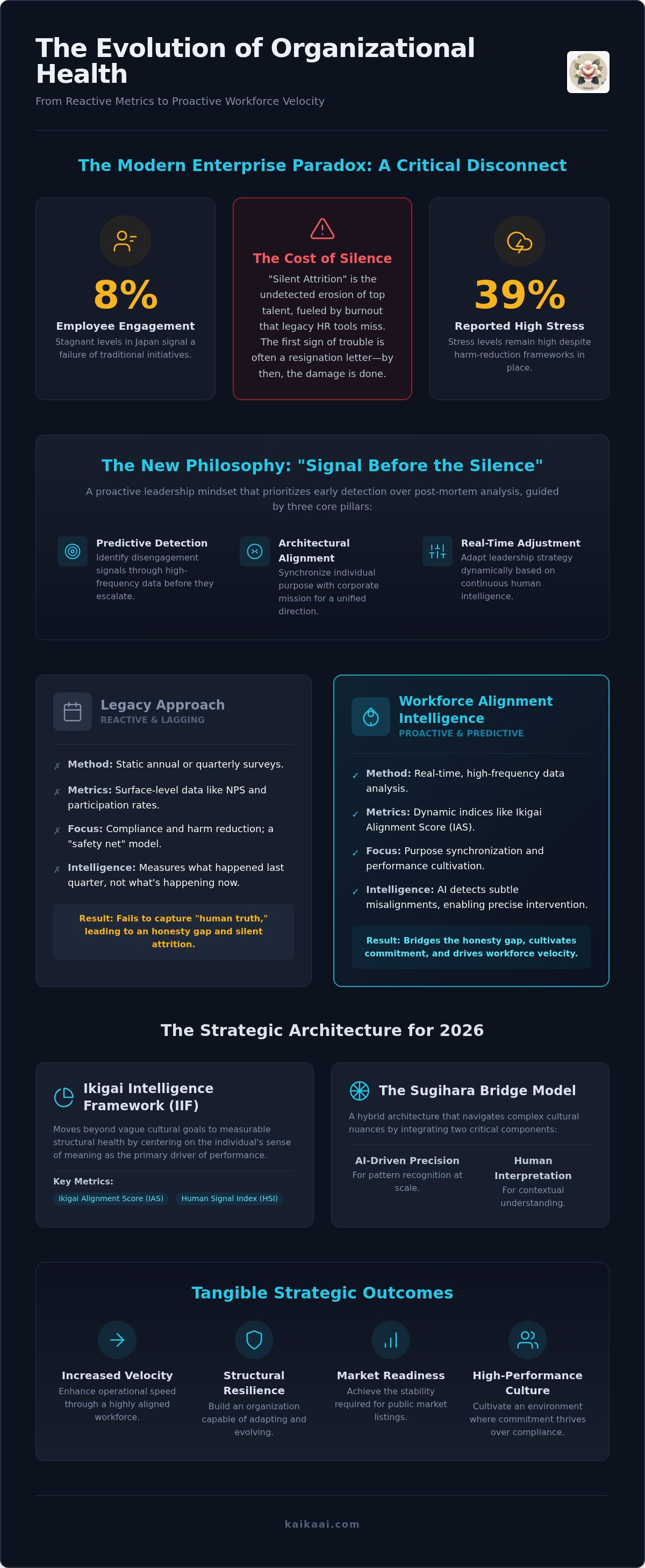
In 2026, the paradox of the modern enterprise has reached a critical breaking point. While corporate stress levels have finally begun to recede due to rigorous harm-reduction frameworks, employee engagement in Japan remains stagnant at a mere 8 percent. You've likely felt this friction within your own leadership team. You've implemented the wellness initiatives and the compliance-based safety nets, yet the silent attrition of your top talent continues unabated because the fundamental search for meaning remains unaddressed. Compliance is not commitment, and safety is not synchronization.
This guide demonstrates how to bridge that gap by deploying a sophisticated organizational health platform that transcends superficial pulse surveys. You'll discover how to transform raw workforce data into strategic intelligence by aligning individual purpose with your organizational mission through the Ikigai Intelligence Framework. We'll examine the architectural requirements for 2026 leadership, moving from reactive harm-prevention to the proactive cultivation of workforce velocity. By the end of this analysis, you'll possess a blueprint for building a high-performance culture where structural integrity and human potential exist in perfect harmony.
Key Takeaways
- Identify the early indicators of silent attrition and understand why traditional engagement metrics fail to capture the structural health of a modern enterprise.
- Learn how the Ikigai Intelligence Framework synchronizes individual purpose with corporate mission to create a measurable, high-performance culture.
- Discover the essential criteria for selecting an organizational health platform that utilizes real-time intelligence to bridge the honesty gap common in legacy surveys.
- Explore the Sugihara Bridge Model’s hybrid architecture, which integrates AI-driven precision with human interpretation to navigate complex cultural nuances.
- Connect workforce alignment to tangible strategic outcomes, including increased operational velocity and readiness for global public market listings.
Defining Organizational Health: Hearing the Signal Before the Silence
Organizational health represents the structural synchronization of purpose, performance, and resilience within an enterprise. It's the silent engine of velocity. While many leaders view health as a secondary cultural metric, it's actually the primary driver of sustainable growth. True health occurs when an individual's personal mission aligns perfectly with the corporate objective. In this state, the organization doesn't just survive; it evolves. A sophisticated organizational health platform makes this alignment visible, moving beyond the static snapshots of the past.
We call this philosophy "Signal Before the Silence." It's a proactive leadership mindset that prioritizes early detection over post-mortem analysis. In many organizations, the first sign of trouble is a resignation letter from a high-performer. That's the silence. By then, the damage to enterprise value is already done. Real-time intelligence allows you to hear the subtle shifts in sentiment and alignment before they solidify into turnover. This philosophy is built on three pillars:
- Predictive detection of disengagement signals through high-frequency data.
- Architectural alignment of individual and corporate goals.
- Real-time adjustment of leadership strategy based on human intelligence.
To better understand how these assessments function in a practical environment, watch this helpful overview:
The Cost of Organizational Silence
Silent attrition is the quiet erosion of your most valuable assets. It's often fueled by undetected burnout that goes unnoticed by traditional HR tools. These legacy systems rely on lagging indicators, measuring what happened last quarter rather than what's happening this morning. This disconnect explains why 39 percent of employees in Japan reported significant stress in 2025, despite decreased overall workplace harm. Understanding Occupational health psychology provides the foundational context for why these human signals matter. When you ignore these leading indicators of employee burnout, you aren't just losing people; you're losing the institutional knowledge required for resilience.
Workforce Alignment Intelligence vs. Traditional HR Analytics
Static data points like participation rates or Net Promoter Scores offer a flattened view of reality. They fail to capture the dynamic nature of human motivation. A modern organizational health platform utilizes workforce alignment intelligence to surface the "human truth" beneath surface-level data. This requires a strategic framework for systemic workforce alignment that goes beyond simple sentiment analysis. Artificial intelligence now plays a pivotal role in identifying these patterns at scale. It detects the subtle misalignment between corporate strategy and employee purpose, allowing CHROs to intervene with surgical precision. It's about moving from broad, ineffective interventions to targeted, high-impact synchronization.
The Ikigai Intelligence Framework: A New Standard for Alignment
The Ikigai Intelligence Framework (IIF) provides the architectural rigor necessary to move from vague cultural aspirations to measurable structural health. Unlike legacy tools that prioritize macro-execution metrics, this framework centers on the individual's sense of meaning as the primary driver of enterprise performance. It utilizes three primary indices: the Ikigai Alignment Score (IAS), the Human Signal Index (HSI), and the Employee Human Signal Index (EHSI). Together, these metrics allow an organizational health platform to map the precise intersection of human potential and corporate mission with mathematical precision.
Measuring the Ikigai Alignment Score (IAS)
The IAS redefines the traditional Japanese concept of Ikigai for the modern enterprise. It quantifies the degree to which an employee’s work intersects with four critical vectors: personal passion, specialized skill, organizational requirement, and economic value. When these vectors align, workforce velocity increases naturally. Employees aren't just completing tasks; they're fulfilling a personal mission that happens to be your corporate goal. This high-alignment state is the most potent defense against disengagement. Organizations that achieve this synchronization often see a measurable surge in operational resilience and long-term retention.
Predictive Burnout Detection via EHSI
The Employee Human Signal Index (EHSI) serves as a specialized diagnostic layer within the organizational health platform. Co-developed with clinical psychologist Michelle Kwamboka, the EHSI focuses on detecting the subtle behavioral shifts that precede clinical burnout. It moves beyond simple sentiment analysis to identify genuine psychological strain. By analyzing these high-frequency human signals, the platform flags risks before they manifest as attrition. This process relies on ethical AI protocols that prioritize transparency and data integrity. It's not about surveillance; it's about stewardship. With an 87 percent employee honesty rate and a 74 percent weekly completion rate, the EHSI provides a reliable stream of high-fidelity intelligence that protects your most valuable assets.
Executives looking to visualize these hidden dynamics often initiate an Alignment Audit to establish a baseline for institutional resilience and cultural clarity.
Comparing Organizational Health Models: AI vs. Traditional Surveys
Traditional organizational health assessments often fall into the trap of "macro-practice" analysis. While established models like McKinsey’s Organizational Health Index (OHI) provide extensive benchmarks based on management practices, they rely on infrequent, high-friction surveys that capture a sanitized version of reality. This creates a disconnect between corporate perception and employee truth. Leaders receive a filtered narrative that hides the very risks they seek to mitigate. You can't steer a global enterprise using data that's already three months old.
A modern organizational health platform shifts the focus toward a "human-signal" architecture. Instead of asking employees to evaluate management once every six months, these systems capture continuous, micro-level interactions that reflect the organization's true pulse. This transition is critical for driving measurable ROI, as detailed in our analysis of workforce alignment software. Unlike consulting-heavy models that require thousands of billable hours to generate a static report, AI-driven platforms scale effortlessly across global enterprises. They provide real-time strategic intelligence that evolves with your workforce, transforming human potential into a predictable asset.
The Honesty Advantage: Why Real-Time Data Wins
Traditional surveys suffer from a persistent "Honesty Gap." Employees often provide the answers they believe leadership wants to hear, fearing that transparency might lead to professional repercussions. Our validated results demonstrate that moving to a low-friction, high-frequency engagement model yields an 87 percent employee honesty rate. With a 74 percent weekly completion rate, the data stream remains consistent, high-fidelity, and actionable. This systematic approach reduces survey fatigue and fosters an environment of mutual trust. This is reflected in a Net Promoter Score (NPS) of 72, which significantly outperforms the median eNPS of -8 currently reported across many Japanese organizations. When employees feel heard without being interrogated, the quality of your intelligence improves exponentially.
Data Privacy and Ethical AI in Organizational Health
Maintaining this level of honesty requires an uncompromising commitment to data integrity and privacy. We adhere to stringent Japanese privacy standards and a "Responsible AI" mandate to ensure ethical data use. Ethical AI in workforce analytics means using anonymized signals to inform leadership strategy without compromising individual psychological safety. By focusing on collective patterns rather than individual surveillance, leadership can address systemic issues like burnout or misalignment while protecting the workforce. It's a balance of data-driven confidence and philosophical respect for human potential. This architectural integrity ensures that your organizational health platform remains a tool for empowerment rather than a mechanism for control.
The Sugihara Bridge Model: Integrating AI with Human Judgment
Purely algorithmic approaches to human capital often fail because they lack cultural context. Conversely, traditional human-led consulting is episodic and difficult to scale across global divisions. The Sugihara Bridge Model resolves this tension through a hybrid architecture. It uses an organizational health platform to gather high-fidelity data while relying on human experts to interpret sensitive workforce signals. This synergy ensures that strategic decisions are both data-driven and psychologically grounded. It's the difference between seeing a data point and understanding a human truth.
Implementation requires more than just software installation. It demands a systematic integration of technology into the leadership workflow. This process is supported by Operational Resilience Training, which equips managers with the skills to maintain structural integrity during periods of rapid growth or market volatility. By combining machine precision with human empathy, the enterprise creates a feedback loop that is both resilient and adaptive.
Phase 1: The Alignment Audit and Baseline
The implementation journey begins with a comprehensive Alignment Audit. This initial diagnostic phase uses the IIF to identify mission alignment gaps within the leadership layer and the broader workforce. During the Executive Consultation phase, we harmonize the platform's technical parameters with the unique architectural needs of the enterprise. This establishes a clear baseline for workforce velocity. It provides a measurable starting point, ensuring that every subsequent intervention is calibrated against actual performance data rather than anecdotal evidence.
Phase 2 & 3: Continuous Kaizen and Scaling
Once the baseline is established, the focus shifts to long-term synchronization. This involves deploying data-driven Kaizen platforms that facilitate real-time improvement across all levels of the organization. Scaling these efforts requires Collective Kaizen Workshops. In these sessions, cross-departmental teams collaborate to resolve systemic friction identified by the intelligence platform. These workshops turn abstract data into operational reality. The ultimate goal is to build an institutional resilience framework that allows the organization to adapt to market shifts without losing its core purpose or momentum.
Ready to bridge the gap between intelligence and action? Schedule an Alignment Audit to evaluate your current workforce synchronization and establish a baseline for growth.
Strategic Outcomes: Scaling Performance Through Intelligence
The implementation of an organizational health platform represents a fundamental shift in how modern enterprises quantify and cultivate their most critical asset: human alignment. Beyond the immediate mitigation of turnover, the strategic objective is the creation of a high-velocity workforce capable of navigating global complexities with structural integrity. When individual purpose synchronizes with corporate mission, the resulting operational resilience becomes a competitive moat. This intelligence-driven approach transforms workforce data from a passive archive into a predictive engine for strategic decision-making. It ensures that leadership can hear the signal before the silence of disengagement becomes permanent.
From Attrition Prevention to Performance Acceleration
Leadership must transition from a reactive problem-fixing mindset to a proactive velocity-optimization strategy. While detecting disengagement is essential, the ultimate value lies in accelerating the speed at which an organization can execute its vision. By utilizing real-time intelligence, CHROs can identify the specific cultural frictions that slow down decision-making and innovation. This level of transparency supports advanced leadership mindset development, allowing executives to lead with data-driven confidence rather than intuition alone. The systematic alignment of human capital directly influences global corporate governance standards and enhances long-term stakeholder returns by ensuring that every unit of effort is directed toward a unified strategic goal.
The Roadmap to 2032: TSE and ASX Listing Vision
Our commitment to institutional rigor is reflected in our strategic roadmap toward dual-listing on the Tokyo Stock Exchange (TSE) and the Australian Securities Exchange (ASX) by 2032. This vision underscores the enterprise-grade nature of our methodology and our dedication to transparent, measurable impact. Central to this evolution is our academic partnership with Waseda University, which provides the rigorous research foundation needed to refine the Ikigai Intelligence Framework for global scale. This collaboration ensures that our predictive models remain at the forefront of organizational psychology and systems engineering, providing the intellectual depth required for institutional reliability.
The transformation of organizational health from a qualitative concept into a quantitative strategic advantage is no longer a futuristic aspiration; it's a current operational requirement. CHROs who embrace this evolution position their organizations as category leaders in workforce alignment intelligence. Selecting a robust organizational health platform is the first step toward this structural evolution. We invite forward-thinking executive leadership teams to request early access to the workforce alignment platform and begin the process of structural synchronization. By establishing a baseline of health today, you secure the high-performance culture of tomorrow.
Architecting the Future of Workforce Synchronization
The evolution of the enterprise depends on the precision of its alignment. Moving beyond the limitations of static surveys, a modern organizational health platform provides the high-fidelity intelligence required to detect disengagement before it becomes silent attrition. By integrating the Ikigai Intelligence Framework with the Sugihara Bridge Model, leadership can finally synchronize individual potential with systemic mission. This transition from reactive harm-prevention to proactive velocity-optimization is the hallmark of 2026 leadership. It's a shift toward structural integrity that protects enterprise value at its source.
Our methodology is built on institutional rigor and academic validation through our partnership with Waseda University. With an 87 percent employee honesty rate and a Net Promoter Score of 72, we provide a level of structural insight that legacy tools simply cannot match. The path to a high-performance culture is architectural, not accidental. You're invited to take the first step toward this evolution by securing the intelligence needed for long-term resilience. We look forward to partnering with you in architecting a future where every individual finds meaning in the mission.
Request Early Access to the Kaika AI Workforce Alignment Platform and begin your journey toward measurable organizational harmony.
Frequently Asked Questions
What is an organizational health platform?
An organizational health platform is an enterprise-grade system that measures the structural synchronization of purpose, performance, and resilience. Unlike tools that only track sentiment, this platform uses predictive human signal intelligence to align individual missions with corporate objectives. It functions as a diagnostic engine for leadership, providing real-time visibility into workforce velocity. This allows executives to identify cultural frictions and misalignment before they manifest as silent attrition or operational failure within the modern global enterprise.
How does an organizational health platform differ from an engagement survey?
Traditional surveys provide static snapshots of past sentiment, whereas an organizational health platform offers a continuous stream of real-time intelligence. Surveys often suffer from the "Honesty Gap" and survey fatigue due to their length and infrequency. In contrast, this platform utilizes low-friction, high-frequency interactions that yield an 87 percent employee honesty rate. It moves beyond measuring satisfaction to analyzing the structural alignment and resilience of the entire organization.
Can AI accurately predict employee burnout?
Yes, AI can predict burnout by identifying subtle shifts in behavioral and sentiment patterns through indices like the Employee Human Signal Index (EHSI). Co-developed with clinical psychologist Michelle Kwamboka, the EHSI flags psychological strain weeks before it leads to "silent attrition." By analyzing high-frequency human signals, the AI detects disengagement patterns that are invisible to human managers. This allows for proactive intervention and architectural adjustments rather than reactive damage control after top talent leaves.
How do you ensure employee honesty in workforce alignment data?
Honesty is achieved through a combination of psychological safety and low-friction interface design. By ensuring that data is used for structural synchronization rather than individual surveillance, employees feel safe providing authentic feedback. Our validated results show an 87 percent honesty rate and a 74 percent weekly completion rate. This high fidelity is supported by an NPS of 72, indicating that employees find the process valuable. It's about building a partnership between the individual and the enterprise.
Is the Ikigai Intelligence Framework applicable outside of Japan?
The Ikigai Intelligence Framework is a universal methodology designed for global scale, even though it's rooted in Japanese philosophical principles. It addresses the fundamental human need for meaning and purpose in work, which is a global requirement for high performance. Through our academic partnership with Waseda University, we've refined the framework to ensure it maintains cultural nuance while delivering consistent, measurable outcomes. It's applicable to any organization seeking to synchronize its workforce with a clear, long-term mission.
What is the Sugihara Bridge Model in HR technology?
The Sugihara Bridge Model is a hybrid architecture that integrates machine precision with human judgment. It uses an organizational health platform to gather and process vast quantities of workforce data while relying on human experts for final interpretation and strategic application. This ensures that sensitive human signals are never handled by algorithms alone. It bridges the gap between cold data and the nuanced reality of human behavior, providing a balanced approach to enterprise-wide cultural evolution and leadership.
How does workforce alignment impact shareholder return?
Workforce alignment serves as a leading indicator of enterprise value and operational velocity. When individual purpose and corporate mission are synchronized, the organization experiences reduced attrition costs and higher execution speed. Research indicates that organizations with top-quartile health can deliver significantly higher shareholder returns. By creating a predictable, high-performance culture, alignment intelligence reduces the risk of institutional failure. It prepares the enterprise for global public market listings while ensuring long-term financial stability and stakeholder confidence.
What security standards does Kaika AI follow for employee data?
We adhere to stringent Japanese privacy laws and enterprise-grade security protocols to protect all workforce data. Our "Responsible AI" mandate ensures that data use is transparent, ethical, and focused on collective organizational patterns rather than individual monitoring. By utilizing anonymized signals, we protect employee identity while providing leadership with the intelligence needed for strategic evolution. This commitment to data integrity is fundamental to maintaining our high employee trust levels and ensuring compliance with global data protection standards.
Disclaimer
#Disclaimer
At Kaika AI, we believe the future belongs to organizations that combine human wisdom with artificial intelligence responsibly. The articles, research, insights, and thought leadership published on this website are intended to educate, inform, and encourage meaningful conversations about the future of work, organizational intelligence, AI, leadership, and innovation.
While our content is developed through rigorous research and may be generated, curated, or enhanced using artificial intelligence, every effort is made to ensure it reflects thoughtful analysis, practical relevance, and responsible AI practices. However, no representation or warranty is made regarding the completeness, accuracy, or suitability of the information for every individual or organizational circumstance.
The ideas, opinions, frameworks, and recommendations shared by Kaika AI are provided for educational and informational purposes only. They should not be interpreted as legal, financial, medical, psychological, human resources, cybersecurity, or other professional advice. Organizations and individuals should seek qualified professional guidance before making strategic, legal, or operational decisions.
Where articles reference third-party organizations, products, services, academic research, industry reports, or public data, such references are provided solely to support discussion and analysis. Unless explicitly stated, they do not imply endorsement, partnership, or affiliation.
Artificial intelligence is a powerful decision-support technology—not a replacement for human judgment. Kaika AI advocates for responsible, transparent, and human-centered AI adoption. We encourage readers to critically evaluate information, consider their unique context, and combine AI-generated insights with professional expertise and sound decision-making.
The content published on this website may be updated, revised, or removed as knowledge, technology, regulations, and best practices continue to evolve.
To the fullest extent permitted by applicable law, Kaika AI, its affiliates, contributors, and partners disclaim liability for any direct, indirect, incidental, consequential, or other losses arising from the use of, or reliance upon, the information provided on this website.
By accessing or using this website, you acknowledge that you have read, understood, and agree to this Disclaimer.
Kaika AI
'Building trusted organizational intelligence for the AI Era'


