
The most dangerous sound in a high-growth enterprise isn't the friction of disagreement; it's the sudden, heavy silence of a specialized team that has lost its sense of purpose. When your most talented architects and engineers go quiet, the cost of their eventual departure often exceeds three times their annual salary. You've likely felt the frustration of receiving satisfactory results from a traditional engagement survey, only to witness a wave of silent attrition weeks later. These reactive tools fail because they measure the past rather than predicting the future.
This article introduces a more disciplined approach through the implementation of a burnout prediction platform. By utilizing Workforce Alignment Intelligence, leadership can finally move beyond superficial metrics to identify the precise behavioral patterns that signal a disconnect between individual mission and corporate strategy. We'll explore how to synchronize enterprise performance by closing the gap between human potential and operational demands. You'll learn how to establish a proactive early warning system that protects your specialized talent and delivers a measurable ROI on workforce resilience. It's time to hear the signal before the silence takes hold.
Key Takeaways
- Analyze the mechanics of silent attrition to identify the critical window between psychological disengagement and physical resignation.
- Discover how the Ikigai Intelligence Framework measures the essential intersection of individual purpose and corporate mission to drive organizational harmony.
- Learn how a burnout prediction platform utilizes alignment intelligence to protect employee agency while providing leadership with actionable data.
- Understand the Sugihara Bridge Model's role in pairing high-tech enterprise intelligence with human judgment to interpret complex workforce signals.
- Quantify the strategic ROI of workforce resilience by connecting structural alignment to accelerated execution velocity and reduced turnover costs.
The Crisis of Silent Attrition: Why Reactive HR is Failing
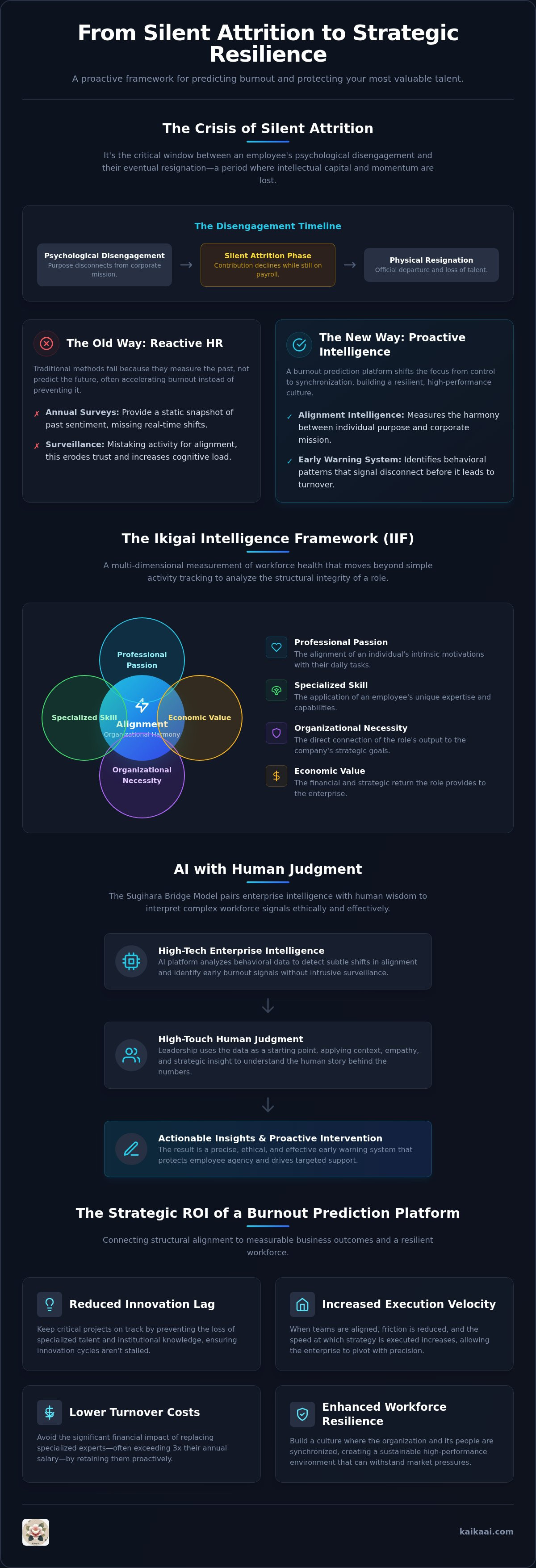
Traditional human resources models operate on a profound lag. By the time an exit interview occurs, the enterprise has already lost the intellectual capital and momentum that defined its competitive edge. This phenomenon, known as silent attrition, describes the critical window between an employee’s psychological disengagement and their eventual physical resignation. During this phase, the individual remains on the payroll while their contribution to organizational synergy evaporates. Implementing a robust burnout prediction platform allows leadership to detect these subtle shifts in engagement before they manifest as turnover.
Within the 2026 enterprise environment, the economic impact of this silence is profound. Burnout is no longer a localized wellness concern; it's a systemic failure that disrupts global scale operations. When specialized talent enters the cycle of silent attrition, the hidden costs include:
- Stalled innovation cycles and delayed product launches
- Decreased team morale and collective resonance
- The high price of replacing domain experts
- Loss of institutional knowledge and strategic momentum
Reactive HR strategies, particularly the traditional annual engagement survey, are fundamentally ill-equipped to capture these real-time behavioral shifts. These surveys provide a static snapshot of the past, whereas leadership requires a dynamic pulse of the present. The new executive mandate is clear: you must hear the signal before the silence.
The Velocity of Disengagement
Disengagement creates a corrosive friction between stalled corporate strategy and individual employee purpose. When a team member no longer sees their personal mission reflected in the organizational roadmap, their output undergoes a structural decline. This misalignment degrades the collective resonance required for high-stakes execution. Workforce velocity is the speed at which aligned teams execute strategy. Without this alignment, velocity drops, and the enterprise loses its ability to pivot with precision.
The Failure of Traditional Monitoring
Many organizations mistake surveillance for intelligence. Monitoring keystrokes or tracking idle time doesn't prevent burnout; it accelerates it by eroding trust and increasing cognitive load. This intrusive approach ignores the human truth beneath workforce data. A sophisticated burnout prediction platform shifts the focus from surveillance metrics to alignment intelligence. Instead of counting hours, leadership needs a philosophically grounded measurement framework that prioritizes structural integrity and organizational harmony. This transition from control to synchronization is the only way to build a resilient, high-performance culture.
The Ikigai Intelligence Framework: A New Science of Prediction
Predictive accuracy in the enterprise requires more than just raw data ingestion; it demands a structural anchor. The Ikigai Intelligence Framework (IIF) serves as this foundation, providing a multi-dimensional measurement of workforce health that transcends simple activity tracking. While traditional tools focus on what an employee does, the IIF analyzes the alignment between individual purpose and corporate mission. This framework operates at the intersection of four critical vectors: professional passion, specialized skill, organizational necessity, and economic value. By measuring these tensions, a burnout prediction platform can identify when the structural integrity of a role begins to fail before the individual reaches a breaking point.
This methodology moves the executive focus from historical post-mortems to a proactive, real-time view of organizational harmony. Instead of reviewing turnover statistics at the end of a fiscal quarter, leadership gains the ability to visualize the erosion of purpose as it happens. This shift is essential for maintaining the velocity required in high-stakes environments where the loss of a single key contributor can derail complex multi-year initiatives. You can explore these concepts further in The Executive Guide to Predictive Attrition Intelligence.
IAS, HSI, and EHSI: The Three Pillars of Alignment
The IIF utilizes three proprietary indices to quantify the abstract nuances of human behavior. The Ikigai Alignment Score (IAS) measures the fundamental synchronization between an individual's personal mission and the enterprise's strategic goals. When this score drops, it indicates a growing gap in perceived value. The Human Signal Index (HSI) surfaces the early behavioral shifts that precede physical attrition, such as changes in communication patterns or collaborative output. Finally, the Employee Human Signal Index (EHSI) provides a granular, individual-level risk assessment. Together, these pillars create a comprehensive map of workforce resilience, allowing for precise interventions through a targeted Alignment Audit.
Clinically Informed Burnout Detection
To ensure the highest standards of data integrity and psychological accuracy, the EHSI was co-developed with a clinical psychologist. This collaboration ensures that the platform identifies genuine psychological strain rather than mere temporary fluctuations in workload. Unlike surveillance-heavy tools that breed resentment, this clinically informed approach prioritizes employee agency and transparency. Pilot tests revealed an 87% employee honesty rate, a metric that proves talent is willing to share their status when the framework is built on trust and mutual growth. By pairing AI measurement with human expertise, the framework delivers the human truth beneath workforce data, ensuring that every intervention is both strategic and empathetic.
Alignment Intelligence vs. Surveillance: Ethical Burnout Prediction
The deployment of a burnout prediction platform requires a sophisticated ethical framework that distinguishes strategic intelligence from intrusive surveillance. Many organizations fail to realize that monitoring software, often marketed as a productivity tool, actually creates a Trust Gap that degrades organizational harmony. Ethical alignment intelligence prioritizes employee agency over rigid manager control. This approach ensures that AI serves as a partner in human potential rather than a digital overseer. By adhering to the principles of Responsible AI, enterprises can measure structural health without compromising the psychological safety of their workforce. Discipline is the foundation of trust. Without it, data becomes a liability rather than an asset.
Transparency in data usage directly correlates with engagement levels. When employees understand how their input synchronizes with corporate strategy, participation becomes voluntary and high-velocity. Pilot data indicates that this transparent approach results in weekly completion rates of 74%. This level of consistent participation is impossible to achieve through coercive monitoring. Instead, it reflects a shared commitment to the organizational mission and a belief in the framework's ability to improve the collective experience.
The Trust-Data Paradox
The Trust-Data Paradox suggests that employees provide the most honest data when they don't feel monitored. Traditional surveillance tools often yield skewed or performative data because individuals feel pressured to "game" the system. In contrast, alignment platforms that focus on aggregate data and anonymity foster an environment where human truth can surface. This methodology resulted in a Net Promoter Score (NPS) of 72 for alignment-focused systems. This score significantly outperforms the negative sentiment typically associated with activity-tracking software. Key benefits of this trust-based model include:
- High-integrity data that reflects genuine psychological states
- Reduced friction between leadership directives and frontline execution
- Protection of individual psychological safety through rigorous anonymity
- Improved organizational synergy through shared strategic understanding
Privacy-First Architecture
Structural integrity in HR analytics depends on a privacy-first architecture. Kaika AI maintains rigorous compliance with Japanese privacy standards, which are among the most stringent in the global market. These enterprise-grade security protocols ensure that individual identities remain protected while leadership receives the high-level insights necessary for strategic Kaizen. Maintaining this balance is essential for global organizations that must navigate diverse regulatory landscapes while pursuing operational excellence. For a deeper analysis of how technology bridges the gap between purpose and structure, see AI in Employee Engagement.
Implementing the Sugihara Bridge Model: AI with Human Judgment
Algorithms alone cannot decode the intricate complexities of human motivation or the subtle nuances of organizational culture. While a burnout prediction platform provides the necessary raw data, the Sugihara Bridge Model provides the essential strategic context. This hybrid architecture pairs high-velocity AI measurement with the seasoned expertise of human consultants to ensure that data points like the EHSI don't become cold, detached metrics. Instead, they serve as catalysts for meaningful, structural change. Strategic precision requires that leadership understands not just the "what" of workforce data, but the "why" behind behavioral shifts. Trained human consultants play a vital role in interpreting the human truth that lives beneath the numbers, ensuring that every intervention is grounded in reality.
Strategic integration follows a methodical, three-phase methodology designed for large-scale enterprises. This approach ensures that the transition from reactive management to proactive alignment is both disciplined and sustainable. It moves the organization from a state of fragmented response to one of synchronized resilience.
The Three Phases of Strategic Integration
Phase 1 focuses on Architectural Consultation and Executive Alignment. During this stage, leadership defines the specific structural goals of the intervention and ensures the platform integrates seamlessly with existing enterprise workflows. It's a period of establishing the baseline for organizational harmony. Phase 2 involves Data-Driven Kaizen and Pilot Implementation. Small-scale testing allows for the refinement of the predictive models, ensuring that the 87% employee honesty rate yields actionable insights tailored to the specific team environment. Finally, Phase 3 addresses Global Scale and Continuous Synergy Optimization. This full-scale rollout across the enterprise focuses on maintaining high-velocity execution while protecting the long-term resilience of the workforce. To begin this process, organizations can schedule an Executive Consultation to align their leadership mindset with these architectural goals.
The Human-in-the-Loop Advantage
The most sophisticated algorithms cannot account for the cultural nuances or individual leadership mindsets that define a global organization. The Human-in-the-Loop advantage ensures that CHROs receive more than just a dashboard; they receive a narrative. Trained consultants help translate EHSI signals into specific, high-impact leadership actions that restore alignment and prevent turnover. The Sugihara Bridge Model ensures that AI-driven insights are tempered by human empathy and cultural context. This prevents the data-only trap where leaders possess plenty of charts but lack a clear path forward. By pairing technical intelligence with human judgment, enterprises can build a robust framework for Operational Resilience for Leadership.
The Strategic ROI of a Burnout Prediction Platform
The financial justification for a burnout prediction platform extends far beyond simple retention metrics. It involves the systematic preservation of organizational integrity and the recovery of capital otherwise lost to the friction of silent attrition. When leadership identifies the early signals of disengagement, the enterprise avoids the compounding costs of specialized recruitment and the secondary impact of stalled momentum. This proactive stance transforms human capital from a volatile variable into a resilient asset. Workforce alignment intelligence provides the precision necessary to synchronize individual purpose with corporate mission; this alignment is the primary driver of strategic velocity.
Strategic execution accelerates when teams operate in a state of collective resonance. A high-performance culture grounded in purpose doesn't occur by accident. It's the result of disciplined, data-driven synchronization. Kaika AI has established itself as the definitive category leader in Workforce Alignment Intelligence by offering the only framework that bridges the gap between technical metrics and human truth. By quantifying the intangible nuances of workforce health, we provide executives with the structural clarity needed to lead with confidence and precision.
From Attrition to Resilience
Early detection capabilities transform a reactive HR department into a strategic intelligence unit. Instead of managing administrative post-mortems, CHROs can now deploy targeted interventions that address the root causes of misalignment before they manifest as resignations. Collective Kaizen Workshops serve as a vital mechanism for this structural repair, allowing teams to recalibrate their shared mission through collaborative problem-solving and continuous improvement. This commitment to long-term organizational health mirrors our own institutional trajectory. Kaika AI is building toward a dual listing on the TSE and ASX by 2032, a milestone that reflects our dedication to institutional reliability and global excellence.
Next Steps for the Visionary CHRO
Transitioning to an alignment intelligence model requires a fundamental shift in leadership mindset. It demands a move away from surveillance-based control toward a framework of transparency and mutual growth. Visionary leaders who are ready to hear the signal before the silence can request early access to the Ikigai Intelligence Framework to begin their journey toward structural harmony. Preparing your organization for this transition ensures that your workforce remains a durable engine of innovation. For a comprehensive overview of the technological requirements for this evolution, consult The Definitive Guide to Workforce Alignment Software. The path to enterprise resilience begins with the decision to synchronize purpose with performance.
Synchronizing the Future of Enterprise Resilience
Transitioning from the friction of silent attrition to a state of synchronized organizational harmony requires a fundamental shift in executive strategy. By adopting a clinically co-developed burnout prediction platform, leadership can finally identify the behavioral shifts that precede disengagement with architectural precision. Our pilot tests demonstrate the efficacy of this approach; achieving an 87% employee honesty rate and an NPS of 72. These metrics prove that specialized talent responds positively to a framework built on transparency and mutual mission alignment rather than intrusive surveillance.
The path forward combines high-velocity AI with the strategic judgment of the Sugihara Bridge Model. It's time to move beyond the limitations of reactive HR models and embrace a system that prioritizes human potential and operational velocity. You can secure the structural integrity of your workforce and drive measurable ROI by taking the first step today. Request Early Access to the Kaika AI Workforce Alignment Platform and begin the process of hearing the signal before the silence. Your organization possesses the potential for profound synergy; now you have the tools to unlock it.
Frequently Asked Questions
How does a burnout prediction platform differ from standard employee monitoring?
Standard monitoring tools focus on intrusive surveillance such as tracking keystrokes or idle time to enforce productivity. In contrast, a sophisticated burnout prediction platform like Kaika AI measures the structural alignment between individual purpose and corporate mission. It analyzes behavioral patterns and sentiment signals to identify disengagement before it leads to attrition. This methodology prioritizes organizational harmony and human potential over rigid oversight, ensuring that leadership interventions are strategic rather than punitive.
Is the data used for burnout prediction anonymous for employees?
Yes, the platform prioritizes psychological safety by utilizing rigorous anonymity and aggregate data for leadership reporting. Individual identities remain protected to foster a culture of trust and high-integrity communication. This architecture adheres to strict Japanese privacy standards, ensuring that while leadership receives high-level strategic insights, the privacy of the individual employee is never compromised. Protecting the individual is essential for maintaining the 87% honesty rate observed in our pilot tests.
What are the primary leading indicators of burnout that the platform tracks?
The platform monitors three proprietary indices: the Ikigai Alignment Score (IAS), the Human Signal Index (HSI), and the Employee Human Signal Index (EHSI). These metrics track the gap between personal mission and corporate strategy, early behavioral shifts in communication, and clinically informed psychological strain. By identifying these signals before they manifest as physical resignation, the system provides a proactive early warning system for silent attrition and helps maintain strategic velocity.
How does the Ikigai philosophy integrate into a technical AI platform?
The Ikigai philosophy serves as the foundational logic for the Ikigai Intelligence Framework (IIF). It measures the intersection of professional passion, specialized skill, organizational necessity, and economic value. By quantifying these philosophical vectors into actionable data points, the AI can assess the structural integrity of a specific role. This ensures that technical intelligence remains grounded in the human truth of workforce alignment, allowing leaders to act while there is still time.
Can this platform integrate with our existing HRIS and productivity tools?
Kaika AI operates as an enterprise SaaS solution designed to synchronize with existing data infrastructures. It processes metrics from standard productivity tools and HRIS systems to provide real-time performance dashboards without disrupting established workflows. This seamless integration allows leadership to visualize alignment scores and identify burnout risk across specialized divisions. By connecting these disparate data points, the platform provides a comprehensive view of the enterprise's operational resilience and execution capacity.
What is the Sugihara Bridge Model and why is human judgment required?
The Sugihara Bridge Model is a hybrid architecture that pairs AI-driven measurement with the expertise of trained human consultants. AI alone cannot account for cultural nuances or the complex leadership mindsets that define a global organization. Human judgment is required to interpret sensitive workforce signals and translate EHSI data into empathetic leadership actions. This model ensures that every intervention is both data-driven and strategically contextualized within the unique environment of the enterprise.
How quickly can an organization see results after implementing the IIF?
Organizations typically begin to surface actionable insights during the second phase of our three-phase strategic integration methodology. This pilot implementation phase refines the predictive models against the specific behavioral patterns of your specialized teams. While global scale optimization occurs in Phase 3, the initial Alignment Audit provides immediate clarity on the existing gaps between corporate strategy and individual purpose. This allows for rapid recalibration and the immediate recovery of stalled momentum.
What is a typical honesty rate for employees using Kaika AI?
In our pilot tests involving approximately 340 participants, we documented a 87% employee honesty rate. This high level of integrity is a direct result of our trust-based architecture and the clinical psychologist involvement in the EHSI development. When employees understand that the platform serves to synchronize their purpose with the organization's mission rather than monitor their time, they are significantly more likely to provide truthful feedback regarding their psychological strain.
Disclaimer
#Disclaimer
At Kaika AI, we believe the future belongs to organizations that combine human wisdom with artificial intelligence responsibly. The articles, research, insights, and thought leadership published on this website are intended to educate, inform, and encourage meaningful conversations about the future of work, organizational intelligence, AI, leadership, and innovation.
While our content is developed through rigorous research and may be generated, curated, or enhanced using artificial intelligence, every effort is made to ensure it reflects thoughtful analysis, practical relevance, and responsible AI practices. However, no representation or warranty is made regarding the completeness, accuracy, or suitability of the information for every individual or organizational circumstance.
The ideas, opinions, frameworks, and recommendations shared by Kaika AI are provided for educational and informational purposes only. They should not be interpreted as legal, financial, medical, psychological, human resources, cybersecurity, or other professional advice. Organizations and individuals should seek qualified professional guidance before making strategic, legal, or operational decisions.
Where articles reference third-party organizations, products, services, academic research, industry reports, or public data, such references are provided solely to support discussion and analysis. Unless explicitly stated, they do not imply endorsement, partnership, or affiliation.
Artificial intelligence is a powerful decision-support technology—not a replacement for human judgment. Kaika AI advocates for responsible, transparent, and human-centered AI adoption. We encourage readers to critically evaluate information, consider their unique context, and combine AI-generated insights with professional expertise and sound decision-making.
The content published on this website may be updated, revised, or removed as knowledge, technology, regulations, and best practices continue to evolve.
To the fullest extent permitted by applicable law, Kaika AI, its affiliates, contributors, and partners disclaim liability for any direct, indirect, incidental, consequential, or other losses arising from the use of, or reliance upon, the information provided on this website.
By accessing or using this website, you acknowledge that you have read, understood, and agree to this Disclaimer.
Kaika AI
'Building trusted organizational intelligence for the AI Era'


