
What if the most dangerous threat to your organization isn't a competitor's market share, but the quiet, compounding erosion of your team's collective purpose? For executive leadership, the business impact of low employee morale is often treated as a secondary concern until it manifests as a $1 trillion annual turnover cost or a stalled strategic initiative. You likely recognize the tension of silent attrition where high-potential talent remains physically present but psychologically absent. It's a high-stakes performance gap that traditional engagement surveys fail to bridge.
You'll discover how to quantify these hidden costs and transition from reactive HR fixes to a predictive framework of workforce alignment. We'll explore the clinical indicators of burnout that current systems overlook and provide the tools to synchronize individual purpose with corporate goals. By the end of this analysis, you'll have a methodical blueprint to transform disengagement into operational resilience and measurable structural impact. This approach moves beyond superficial sentiment to establish a foundation of institutional reliability and human velocity.
Key Takeaways
- Quantify the structural business impact of low employee morale by analyzing the compounding costs of voluntary turnover and the degradation of institutional innovation velocity.
- Evolve from retrospective sentiment snapshots to a predictive intelligence framework that detects disengagement signals before they escalate into systemic attrition.
- Diagnose the "Ikigai Gap" to restore the critical synchronization between individual professional purpose and the broader corporate mission.
- Leverage the Ikigai Alignment Score (IAS) as a high-integrity metric for measuring workforce health and ensuring long-term organizational harmony.
- Deploy the Sugihara Bridge Model to translate workforce intelligence into strategic leadership actions that foster operational resilience and cultural integrity.
The Economic Architecture of Workforce Morale
The business impact of low employee morale extends far beyond the HR dashboard; it represents a fundamental breakdown in the structural integrity of an organization. Executive leadership often misinterprets Employee morale as a simple measure of workplace satisfaction or general sentiment. This superficial perspective fails to account for the $350 billion annual drain on the American economy caused by disengagement. True morale is the collective synchronicity of individual purpose and the corporate mission. When this alignment fractures, it creates a friction point that slows workforce velocity, making strategic execution sluggish and unresponsive to market shifts.
The High Stakes of Institutional Silence
Waiting for a resignation letter is a reactive failure. By the time an employee departs, the organization has already suffered through the phase of silent attrition. This is a period where high-performers remain on the payroll but have effectively withdrawn their intellectual and emotional investment. Traditional annual surveys are insufficient tools for this challenge because they provide static, retrospective snapshots of past sentiment rather than real-time visibility into burnout risk. Workforce alignment is the synchronization of individual Ikigai with corporate goals. Organizations that lack this synchronization experience a gradual decay of institutional knowledge that no recruitment strategy can quickly repair. This institutional silence masks a growing performance gap that eventually leads to total system failure.
The ROI of Proactive Morale Management
Shift the focus from "employee happiness" to "systemic alignment" within corporate governance. Replacing a single employee can cost up to 200% of their annual salary, yet the investment in continuous alignment through predictive intelligence offers far higher returns. Proactive morale management builds operational resilience, allowing teams to navigate market volatility with strategic agility. When correctly aligned, human capital functions as an appreciative asset that grows in value through increased synchronization and collective kaizen. This transformation turns a potential liability into a sustainable performance engine. Leadership must recognize that the business impact of low employee morale is a measurable signal that precedes the silence of a mass exodus. It's a high-stakes performance indicator that demands a data-driven, strategic response to ensure long-term workforce stability.
The Anatomy of Disengagement: Purpose Misalignment and Burnout
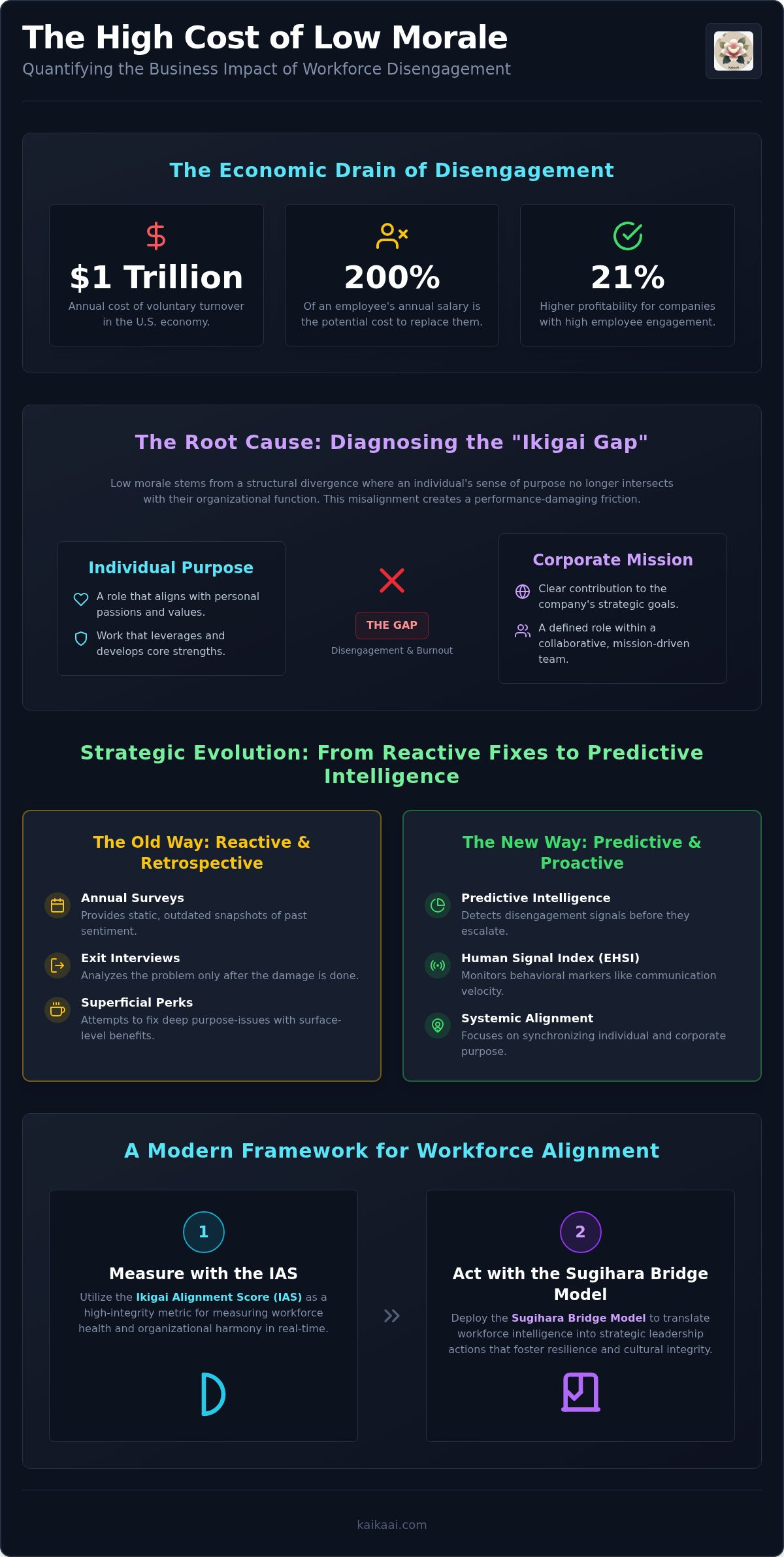
The business impact of low employee morale is rarely the result of a single event. It is the cumulative consequence of the "Ikigai Gap," a structural divergence where an individual's sense of purpose no longer intersects with their organizational function. When this misalignment occurs, traditional "happiness" initiatives or office perks become fundamentally ineffective. Free meals and flexible hours can't compensate for a total lack of professional meaning. Organizations that prioritize genuine alignment can increase profitability by 21%, yet many leaders continue to invest in superficial solutions that ignore the psychological strain of purpose-starved work. This neglect doesn't just lower spirits; it erodes the very foundation of enterprise value.
The Human Signal Index: Detecting Behavioral Shifts
Strategic workforce planning requires moving beyond the limitations of reactive metrics. Predictive intelligence identifies the subtle behavioral markers that precede total disengagement, such as shifts in communication velocity or a narrowing of collaborative focus. By utilizing the Employee Human Signal Index (EHSI), leadership can monitor these patterns through an ethical AI lens that prioritizes individual privacy while providing high-level visibility. Recognizing these leading indicators of employee burnout allows executives to intervene before the silence of attrition takes hold. This data-driven approach transforms vague cultural concerns into actionable operational intelligence, ensuring that the organization remains resilient against the friction of disengagement.
Burnout vs. Alignment: A Structural Distinction
Leadership must distinguish clearly between temporary fatigue and systemic burnout. Fatigue is often a result of high output; burnout is the result of high output without perceived value or mission synchronization. The EHSI is clinically grounded in detecting this psychological strain, identifying exactly where the friction of misalignment is eroding mental energy across divisions. When morale is low, cross-departmental synergy collapses as individuals retreat into survival-oriented silos. This fragmentation destroys the collective synchronization required for global scale and complex execution. It's a breakdown of the architectural integrity of the workforce, directly amplifying the business impact of low employee morale. To address these systemic risks, conducting an Alignment Audit can help identify where your structural integrity is most vulnerable. This ensures that performance remains sustainable and uncompromisingly focused on excellence rather than just survival.
Quantifying the Invisible: Turnover, Velocity, and Attrition Risks
The business impact of low employee morale is a quantifiable erosion of enterprise value that manifests in both direct financial loss and indirect structural decay. Recent data indicates that replacing a single employee costs between 50% and 200% of their annual salary; consequently, the total annual cost of voluntary turnover for U.S. businesses has reached approximately $1 trillion. These figures represent the visible surface of a deeper crisis. Beyond recruitment and onboarding expenses, organizations suffer a permanent loss of institutional knowledge and a significant degradation of brand integrity. When high-performers disengage, the intellectual capital of the firm begins to liquidate, leaving the organization vulnerable to more agile competitors.
To measure these risks effectively, executive leadership requires a high-integrity data source. The Ikigai Alignment Score (IAS) serves as a definitive metric for workforce health, providing a predictive look at future attrition risks before they materialize. Pilot studies have demonstrated an 87% employee honesty rate when using these frameworks, a critical threshold for ensuring data integrity. Without this level of transparency, any attempt to quantify morale remains speculative. High honesty rates allow for the identification of flight risks among "A-Players," whose departure creates a disproportionate vacuum in leadership and innovation capability.
Measuring Workforce Velocity and Efficiency
Workforce Velocity is the speed at which an organization executes its strategic mission. Low morale functions as organizational drag, a hidden friction that stalls project timelines and complicates simple operational tasks. This drag is not merely a cultural issue; it's a performance bottleneck that destroys efficiency. By integrating workforce resilience metrics, leaders can identify exactly where disengagement is slowing the collective output of the firm. This transition from measuring hours worked to measuring the velocity of alignment ensures long-term sustainability in high-pressure environments.
The Attrition Risk Dashboard
Predictive analytics have evolved to identify flight risks long before individuals enter the external job market. An Attrition Risk Dashboard provides real-time visibility into the psychological strain across various divisions, allowing for surgical interventions rather than broad, ineffective policy changes. The financial impact of losing top-tier talent is up to five times higher than losing average performers; therefore, early detection is a strategic necessity. Establishing a real-time ROI for workforce alignment platforms involves contrasting the cost of these predictive tools against the avoided costs of mass attrition and lost innovation velocity. This architectural approach to human capital management ensures that the organization remains synchronized and resilient.
Strategic Evolution: Shifting from Reactive Surveys to Predictive Intelligence
The traditional annual engagement review represents a structural inadequacy in modern leadership. It offers a static, retrospective snapshot that identifies cultural fractures only after they've already compromised organizational performance. To mitigate the business impact of low employee morale, leadership must evolve toward a model of predictive intelligence. This transition occurs in four distinct phases, moving from retrospective autopsies to real-time synchronization. By shifting the focus from historical sentiment to future-oriented alignment, organizations can detect the subtle signals of disengagement before they manifest as systemic failure.
The Sugihara Bridge Model: AI + Human Judgment
Algorithmic isolation often fails to capture the nuanced complexities of human emotion and cultural context. The Sugihara Bridge Model addresses this by positioning AI as a high-velocity data engine that must be interpreted through the lens of experienced human leadership. While continuous performance management software provides the necessary visibility, it's the integration of these insights with human-led workshops that drives actual evolution. This hybrid approach ensures that data doesn't just sit on a dashboard but translates into specific, phase-based methodologies for cultural optimization and strategic resilience.
Ethical Data Use and Privacy Standards
Predictive intelligence requires a foundation of absolute trust. Without enterprise-grade security and uncompromising privacy standards, employees won't provide the high-integrity signals necessary for accurate modeling. Our "Human Truth" philosophy posits that transparency is not a risk but a morale booster. When workforce members understand that data is used to align their individual purpose with corporate goals rather than for surveillance, honesty rates remain high. Adhering to global and Japanese privacy standards ensures that this intelligence gathering remains ethical and compliant. This disciplined focus on data integrity protects the organization while fostering a culture of mutual respect and operational excellence.
Establishing a culture of data-driven Kaizen allows for the ongoing optimization of workforce alignment. This is not a one-time intervention but a continuous cycle of measurement, realization, and strategic adjustment. By closing the loop between technical intelligence and human-centric outcomes, executives can effectively neutralize the business impact of low employee morale at a global scale. To see how this framework can protect your organization from the hidden costs of disengagement, explore our Workforce Alignment Intelligence Platform.
Cultivating Alignment: Leveraging the Ikigai Intelligence Framework
The Ikigai Alignment Score (IAS) serves as the definitive architecture for workforce health, providing a level of precision that traditional sentiment tools cannot replicate. It transforms vague cultural concepts into a high-integrity performance metric that executive leadership can trust. High completion rates of 74% reinforce the validity of this intelligence, ensuring that strategic decisions are based on a representative consensus rather than vocal outliers. By neutralizing the business impact of low employee morale through this framework, leadership can restore the synchronization required for complex, global execution. This represents a fundamental shift from managing people to orchestrating alignment.
Executive mindset undergoes a fundamental transformation during a bespoke Alignment Audit. This rigorous diagnostic process exposes the structural gaps between stated corporate strategy and the actualized purpose of the workforce. It's a strategic realization that moves the organization beyond the superficiality of "employee engagement" into the realm of systemic harmony. When purpose and performance are synchronized, the organization gains a resilient velocity that is difficult for competitors to disrupt. This audit provides the baseline intelligence required to move from a state of reactive crisis management to one of predictive strategic posture.
Implementing the Ikigai Intelligence Framework (IIF)
The framework operates through three distinct measurement indices that provide a 360-degree view of organizational health, addressing the business impact of low employee morale at its psychological root. The IAS measures the depth of purpose synchronization, identifying where individual goals intersect with the mission. The HSI tracks behavioral movement, offering real-time data on collaborative energy. Finally, the EHSI identifies psychological strain and burnout risk before they manifest as attrition. These indices allow leaders to visualize the internal landscape with unprecedented clarity and surgical precision. For detailed implementation strategies, refer to our workforce alignment software guide, which outlines the technical and philosophical integration required for success.
The Path to 2032: Building a Publicly Recognized Public Company
Our trajectory is defined by a commitment to institutional excellence and a vision of becoming a global benchmark for workforce intelligence by 2032. This mission aligns with the high standards of major exchanges like the TSE and ASX, emphasizing reliability, transparency, and long-term value creation. We invite visionary leaders to move beyond reactive management and join a movement dedicated to purpose-driven performance. This is an opportunity to build an organization that is not only productive but fundamentally synchronized. To begin your evolution, request early access to the Kaika AI platform today and secure your position at the forefront of the alignment revolution.
Securing Institutional Resilience through Strategic Alignment
Neutralizing the business impact of low employee morale requires a departure from retrospective snapshots toward a future of predictive synchronization. You've explored how identifying the "Ikigai Gap" and monitoring the Employee Human Signal Index can prevent the silent erosion of your firm's intellectual capital. By integrating these high-integrity metrics, you move from managing attrition to orchestrating a resilient, high-velocity workforce. This architectural shift ensures that individual purpose remains locked in step with your corporate mission, even during periods of global volatility.
Our platform delivers clinically-informed burnout detection developed through an academic partnership with Waseda University. Pilot studies confirm an 87% employee honesty rate, ensuring your leadership decisions rest on verified human truth rather than organizational speculation. It's time to transition from reactive HR fixes to a methodical framework of workforce alignment that prioritizes structural integrity and measurable outcomes. We invite you to lead this evolution by securing the tools necessary for long-term organizational harmony.
Request early access to the Kaika AI Workforce Alignment Intelligence Platform to begin your journey toward uncompromising excellence. Your organization's potential is waiting to be fully realized through the power of alignment.
Frequently Asked Questions
What is the primary cause of low employee morale in large enterprises?
The primary cause of low employee morale in large enterprises is the structural divergence between an individual's personal purpose and their organizational function. This "Ikigai Gap" creates a friction point where employees feel their contributions lack meaning or impact. When corporate missions are disconnected from daily tasks, the resulting psychological strain erodes commitment. Addressing this requires a systemic shift toward mission synchronization rather than superficial culture initiatives or office perks.
How does low morale impact a company’s bottom line?
The business impact of low employee morale manifests as a significant financial drain through voluntary turnover and lost productivity. Gallup reports that disengagement costs the global economy approximately $10 trillion in lost productivity, or 9% of global GDP. For individual firms, the cost of replacing a single employee reaches up to 200% of their annual salary. These direct and indirect expenses compromise the organization's financial stability and competitive edge in the market.
Can AI accurately predict employee burnout without invading privacy?
AI can predict burnout risk with high precision by identifying subtle behavioral markers through the Employee Human Signal Index (EHSI). This approach prioritizes ethical data use by focusing on anonymized patterns of communication and collaboration velocity rather than individual surveillance. By detecting these leading indicators early, leadership can intervene at a structural level. This ensures organizational health remains high while maintaining strict compliance with global privacy standards and individual trust.
What is the difference between employee engagement and workforce alignment?
Employee engagement typically focuses on general workplace satisfaction and sentiment snapshots. Workforce alignment, however, is the deep synchronization of an individual's professional purpose with the broader corporate mission. While an engaged employee might be "happy," an aligned employee is strategically focused and contributes to the organization's innovation velocity. Alignment represents a more durable and performance-oriented metric that directly influences long-term operational resilience and institutional reliability.
How does the Ikigai Intelligence Framework measure purpose?
The Ikigai Intelligence Framework measures purpose through the Ikigai Alignment Score (IAS), a definitive metric for workforce health. It quantifies the degree to which an employee's role intersects with what they love, what they are good at, and what the mission requires. This data-driven approach moves beyond subjective surveys to provide an architectural view of alignment. High completion rates ensure that this measurement remains a high-integrity signal for executive decision-making.
What is "silent attrition" and why is it dangerous for business growth?
Silent attrition refers to the phase where high-potential talent remains on the payroll but has psychologically withdrawn from their roles. It's dangerous for business growth because it creates "organizational drag" that stalls project timelines and degrades innovation velocity. Unlike visible turnover, silent attrition is invisible to traditional HR metrics until it's too late. It erodes the firm's intellectual capital and can lead to a contagion of disengagement across entire divisions.
How can leaders distinguish between temporary stress and systemic low morale?
Leaders can distinguish between temporary stress and systemic low morale by analyzing the duration and depth of disengagement signals. Temporary stress is often task-specific and resolves once a project concludes. Systemic low morale is a persistent state of mission misalignment that manifests as a chronic lack of initiative. Identifying these differences is critical for neutralizing the business impact of low employee morale before it evolves into a mass exodus of institutional talent.
What are the first steps to improving morale in a disengaged workforce?
The first steps to improving morale involve moving from reactive sentiment surveys to a comprehensive Alignment Audit. This diagnostic process identifies the structural gaps where individual purpose and corporate mission have diverged. Once these friction points are mapped, leadership can implement phase-based methodologies to restore synchronization. This strategic evolution requires a commitment to transparency and a shift toward data-driven kaizen, ensuring that every intervention is targeted and measurable.
Disclaimer
#Disclaimer
At Kaika AI, we believe the future belongs to organizations that combine human wisdom with artificial intelligence responsibly. The articles, research, insights, and thought leadership published on this website are intended to educate, inform, and encourage meaningful conversations about the future of work, organizational intelligence, AI, leadership, and innovation.
While our content is developed through rigorous research and may be generated, curated, or enhanced using artificial intelligence, every effort is made to ensure it reflects thoughtful analysis, practical relevance, and responsible AI practices. However, no representation or warranty is made regarding the completeness, accuracy, or suitability of the information for every individual or organizational circumstance.
The ideas, opinions, frameworks, and recommendations shared by Kaika AI are provided for educational and informational purposes only. They should not be interpreted as legal, financial, medical, psychological, human resources, cybersecurity, or other professional advice. Organizations and individuals should seek qualified professional guidance before making strategic, legal, or operational decisions.
Where articles reference third-party organizations, products, services, academic research, industry reports, or public data, such references are provided solely to support discussion and analysis. Unless explicitly stated, they do not imply endorsement, partnership, or affiliation.
Artificial intelligence is a powerful decision-support technology—not a replacement for human judgment. Kaika AI advocates for responsible, transparent, and human-centered AI adoption. We encourage readers to critically evaluate information, consider their unique context, and combine AI-generated insights with professional expertise and sound decision-making.
The content published on this website may be updated, revised, or removed as knowledge, technology, regulations, and best practices continue to evolve.
To the fullest extent permitted by applicable law, Kaika AI, its affiliates, contributors, and partners disclaim liability for any direct, indirect, incidental, consequential, or other losses arising from the use of, or reliance upon, the information provided on this website.
By accessing or using this website, you acknowledge that you have read, understood, and agree to this Disclaimer.
Kaika AI
'Building trusted organizational intelligence for the AI Era'


