
Internal Linking Opportunities:
- Workforce Alignment Intelligence Platform
- Alignment Audit
- Operational Resilience Training
- Executive Consultation
- Collective Kaizen Workshops
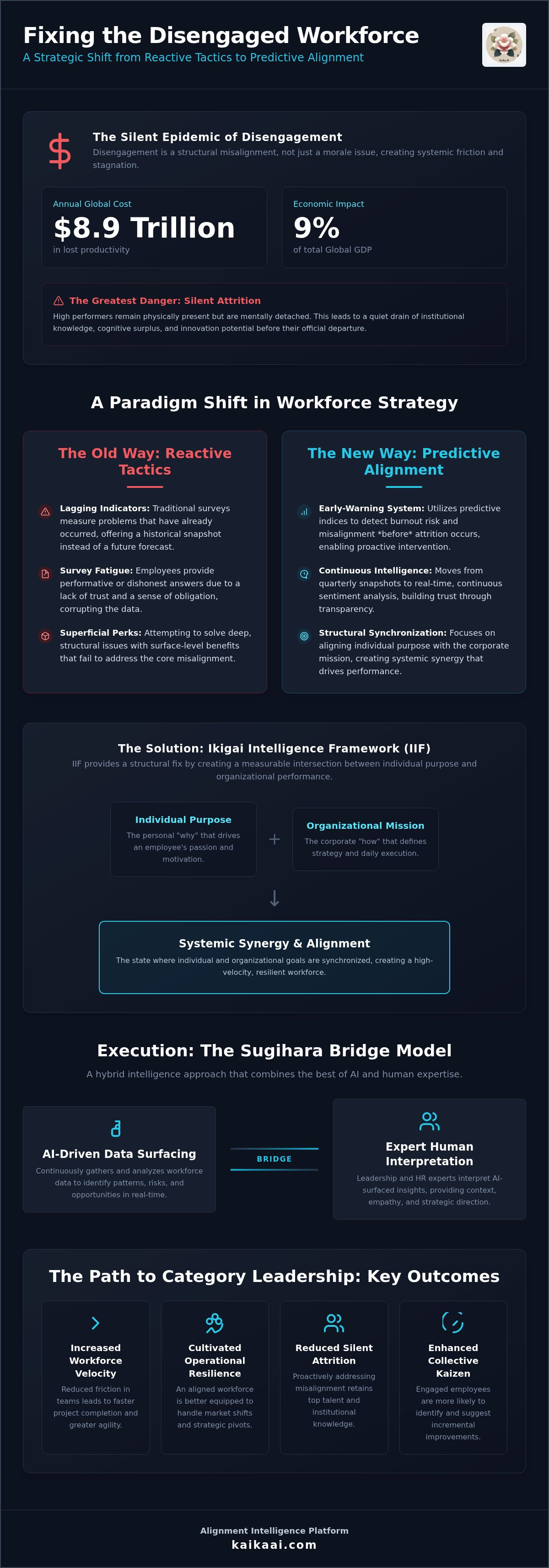
Low employee engagement currently costs the global economy an estimated $8.9 trillion in lost productivity, which represents roughly 9% of global GDP. You've likely felt the impact of this systemic friction through the silent attrition of your top performers and a persistent misalignment between high-level strategy and daily execution. Solving this doesn't involve superficial perks; it requires a deep understanding of how to fix a disengaged workforce through structural synchronization rather than reactive sentiment tracking.
This article outlines a transition from defensive HR interventions to a predictive workforce alignment strategy that anchors individual purpose within the organizational mission. We'll examine the Ikigai Intelligence Framework and the Sugihara Bridge Model to demonstrate how you can establish a measurable early-warning system for disengagement. By the end, you'll have the blueprint for increasing workforce velocity and building the operational resilience necessary for institutional stability. We'll move beyond the limitations of traditional surveys to explore a data-driven approach that prioritizes human potential and organizational harmony.
Key Takeaways
- Identify disengagement as a structural misalignment within your organizational architecture rather than a simple lapse in employee morale.
- Discover how to fix a disengaged workforce by deploying the Ikigai Intelligence Framework to synchronize individual purpose with the corporate mission.
- Replace reactive HR tactics with a predictive early-warning system that utilizes specialized indices to detect burnout risk before attrition occurs.
- Implement the Sugihara Bridge Model to leverage a hybrid approach that combines AI-driven data surfacing with expert human interpretation.
- Cultivate operational resilience and increased workforce velocity by prioritizing continuous alignment intelligence over superficial corporate perks.
The Anatomy of Workforce Disengagement: Identifying the Silent Signal
Disengagement is rarely a sudden collapse of corporate will. It's a slow, structural degradation. We define it as a fundamental misalignment between individual purpose and organizational architecture. While Employee engagement has historically focused on transient emotional satisfaction, true alignment intelligence prioritizes the synchronization of personal "why" with corporate "how." This distinction is critical for leaders learning how to fix a disengaged workforce effectively.
Silent attrition represents the most dangerous form of this decay. High performers remain physically present. They meet deadlines. They attend meetings. Yet, they're mentally detached, their cognitive surplus redirected elsewhere. This detachment creates a leadership imperative: hearing the signal before the silence. It's the transition from reactive sentiment tracking to proactive alignment intelligence. Leaders must identify the subtle shift in resonance before it becomes a loud, expensive departure.
The Hidden Cost of Disengagement in Enterprise Environments
The global economy loses an estimated $8.9 trillion annually to low engagement, which equals approximately 9% of global GDP. This isn't just a payroll leak; it's a source of strategic stagnation. Disengagement introduces friction into high-performing teams, slowing operational velocity and eroding the resilience needed for global scale. When the workforce is misaligned, corporate strategy fails at the ground level of execution. The result is a persistent drag on performance that no amount of superficial perks can resolve. This structural friction manifests as:
- Increased project lead times due to cognitive drag.
- The erosion of institutional knowledge as top talent quietly detaches.
- A decline in collective Kaizen, as employees stop identifying incremental improvements.
Why Traditional Engagement Surveys Fail the Modern Executive
Traditional surveys are failing because they're lagging indicators. They capture the ghost of a problem that's already metastasized. Executives often face survey fatigue, where employees provide performative answers that lack honesty. In fact, many annual assessments are completed with a sense of obligation rather than genuine reflection. To understand how to fix a disengaged workforce, leadership must move toward real-time, continuous workforce sentiment analysis. We need systems that prioritize transparency and ethical data use to rebuild trust. Only by moving from quarterly snapshots to a predictive early-warning system can an organization hope to maintain synchronization and drive long-term excellence.
The Ikigai Intelligence Framework: A Structural Fix for Disengagement
Transitioning from identifying symptoms to deploying a permanent solution requires a sophisticated architectural approach. The Ikigai Intelligence Framework (IIF) serves as the critical intersection of purpose and performance. By aligning individual and organizational goals with AI, leadership creates systemic synergy that moves beyond traditional management. This framework provides the definitive answer to how to fix a disengaged workforce by ensuring every contributor's personal mission resonates with the corporate trajectory. It represents a fundamental shift toward architecting alignment rather than merely supervising activity.
| Intelligence Index | Primary Focus | Strategic Outcome |
|---|---|---|
| Ikigai Alignment Score (IAS) | Purpose-Mission Proximity | Quantified strategic resonance |
| Human Signal Index (HSI) | Behavioral Deviation | Early detection of detachment |
| Employee Human Signal Index (EHSI) | Psychological Resilience | Burnout prevention and ethical support |
The Three Measurement Indices of Workforce Alignment
Precision in leadership requires data that captures the "signal before the silence." The IIF utilizes three proprietary indices to transform abstract sentiment into actionable intelligence. The IAS quantifies the distance between personal values and corporate strategy. The HSI surfaces behavioral patterns that suggest a shift toward detachment. Finally, the EHSI identifies psychological strain through a clinically informed lens. These metrics allow CHROs to treat alignment as a measurable engineering challenge rather than an elusive cultural goal.
Integrating Purpose into the Organizational Architecture
Mapping individual Ikigai to enterprise roles involves processing massive volumes of complex sentiment data. AI handles this complexity without losing human nuance, allowing for the synchronization of personal talent with organizational needs. When you address the underlying causes of disengagement, you treat them as structural gaps in the corporate architecture. Ikigai Alignment is the synchronization of human truth with workforce data. Consider initiating an Alignment Audit to identify where your structural integrity is currently compromised and where your mission is failing to cascade effectively.
Predictive Metrics vs. Reactive Tactics: Fixing the Attrition Loop
Reactive HR management often arrives too late, addressing symptoms rather than systemic causes. To truly Improve Employee Engagement, leadership must shift focus toward leading indicators of employee burnout. This transition is essential for any executive learning how to fix a disengaged workforce. By moving away from the post-mortem analysis of exit interviews, we can deploy predictive models that identify attrition risks months before a resignation letter is drafted. This foresight allows for structural adjustments that preserve institutional knowledge and maintain operational momentum.
The Employee Human Signal Index (EHSI) was developed in collaboration with clinical psychologists to ensure that detection remains both responsible and scientifically grounded. This methodology prioritizes transparency and ethical data use, which has resulted in an 87% employee honesty rate across our pilot programs. High honesty is a critical metric of trust. It ensures the data driving your strategic decisions is authentic rather than performative. Predictive intelligence allows organizations to stabilize their talent pools by identifying the early markers of psychological detachment before they manifest as turnover.
Detecting Burnout Risk Before the Resilience Break
Behavioral signals often precede a total collapse in resilience. These signals include subtle shifts in communication frequency, a decline in collaborative initiative, or a narrowing of focus to purely transactional tasks. Integrating psychological stamina training into modern corporate governance helps employees manage these stressors, but real-time metrics are what enable micro-interventions. These small, targeted adjustments prevent the need for radical, disruptive restructuring later. By addressing strain at the individual level, the enterprise maintains its collective strength.
Workforce Velocity: Measuring the Speed of Alignment
Workforce velocity is the speed at which an aligned team executes a corporate strategy. Disengagement acts as organizational drag, a silent friction that slows every initiative and erodes competitive advantage. By utilizing workforce resilience metrics, leadership can forecast quarterly performance with greater precision. Alignment intelligence doesn't just solve the immediate crisis of how to fix a disengaged workforce; it accelerates the entire enterprise toward its mission-critical objectives. This velocity is the hallmark of category-leading organizations that prioritize synchronization as a core competency.
The Sugihara Bridge Model: Hybrid Intelligence in Execution
The Sugihara Bridge Model serves as the definitive hybrid architecture for organizational synchronization. It rejects the simplistic choice between automated analytics and traditional management. Instead, it utilizes AI to surface deep-seated behavioral patterns while human consultants provide the nuanced interpretation necessary for strategic shifts. This approach provides a repeatable methodology for how to fix a disengaged workforce without sacrificing the human element. The framework operates through a three-phase integration: Audit, Alignment, and Velocity.
Phase 1: The Alignment Audit and Mission-Critical Gaps
The journey begins with a rigorous Alignment Audit to identify where corporate mission cascading has failed. In global enterprises, strategy often dissolves as it moves from the boardroom to the ground level. Our AI mapping identifies "shadow cultures," which are informal networks that operate in direct opposition to organizational goals. By establishing baseline Ikigai Alignment Scores (IAS) and Human Signal Indices (HSI), leadership gains a clear map of the structural gaps that cause friction. This phase ensures that the "signal before the silence" is captured before it impacts the bottom line.
Phase 2 & 3: Strategic Integration and Mindset Development
Moving from data to impact requires more than just a dashboard. Phase 2 involves high-level Executive Consultation to bridge the gap between AI-driven insights and leadership action. This process develops the specific Leadership Mindset needed to respond to early signals of disengagement with precision rather than panic. The effectiveness of this hybrid model is evident in our pilot programs. One 340-person pilot achieved an NPS of 72 among participants, demonstrating that employees value being heard through a structured, intelligent system. We've found that when data is delivered with human sensitivity, the path to re-alignment becomes clear.
Collective Kaizen Workshops: Repairing Cross-Departmental Synergy
Finally, we move into the Velocity phase to ensure long-term operational resilience. Collective Kaizen Workshops serve as the primary tool for repairing cross-departmental synergy. These sessions use alignment data to facilitate small, incremental improvements in how teams collaborate. They transform disengaged departments into high-velocity units by synchronizing their specific outputs with the broader mission. This isn't just about morale; it's about building a structural foundation for excellence. If you're ready to identify your shadow cultures and restore strategic flow, schedule an Alignment Audit today to begin your transition toward predictive leadership.
Cultivating Operational Resilience: The Path to Category Leadership
The ultimate objective of alignment intelligence isn't merely the resolution of a crisis. It's the establishment of a permanent state of synchronization. While many leaders focus on how to fix a disengaged workforce as a one-time intervention, true category leaders understand that engagement is a dynamic variable requiring constant calibration. We're moving beyond the era of reactive repairs. By deploying continuous performance management software, organizations can transform their human capital into an engine of operational resilience. This shift ensures that the enterprise doesn't just survive periods of change but accelerates through them with increased velocity and precision.
Building High-Performance Cultures through Data-Driven Kaizen
Continuous improvement principles, or Kaizen, are traditionally associated with manufacturing efficiency. However, when applied to human capital alignment, these principles create a culture of relentless excellence. This process relies on data trust. We adhere to rigorous Japanese privacy standards and enterprise-grade security to ensure that every participant feels safe contributing their authentic sentiment. This ethical foundation is why our pilot programs achieve such high completion and honesty rates. Establishing category leadership in Japan, a region with unique workforce challenges, provides the architectural blueprint for global workforce synchronization. Just as we value the precision of Japanese standards, we also appreciate the quality found in other regional traditions; for instance, you can explore Käpy Pöytävalaisin to see the level of Finnish craftsmanship that mirrors this dedication to detail. It's a methodical progression from localized stability to global scale.
For CHROs and executive leaders, the roadmap to total alignment begins with the immediate implementation of "Signal before Silence" protocols. This involves moving away from anecdotal feedback and toward the structured indices provided by the Ikigai Intelligence Framework. Integrating this framework into your existing HR tech stack doesn't require a radical overhaul. Instead, it adds a layer of predictive intelligence that informs every other talent initiative. The final vision is an organization where individual purpose isn't just acknowledged but is the primary fuel for the collective mission. This creates a seamless flow between personal fulfillment and corporate achievement; to see how artistic vision can similarly inspire a sense of focus and purpose, you can visit Ilkaa's Fine Art Gallery & Atelier.
As we work toward our target 2032 listing on the Tokyo Stock Exchange and the Australian Securities Exchange, we remain focused on providing institutional stability for our partners. We're not just offering a tool; we're proposing a comprehensive framework for organizational evolution. This is your opportunity to move from reactive management to visionary leadership. Request early access to the Kaika AI Workforce Alignment Intelligence Platform today to begin architecting a workforce that is resilient, synchronized, and uncompromisingly focused on excellence.
Establishing a resilient organization requires a fundamental shift from defensive management to proactive synchronization. You now understand that the definitive solution for how to fix a disengaged workforce lies in the Ikigai Intelligence Framework and the Sugihara Bridge Model. These systems don't just track sentiment; they architect alignment by connecting individual purpose to the corporate mission. By prioritizing the "signal before the silence," leadership can identify structural friction before it manifests as attrition or strategic stagnation.
Our pilot programs demonstrate the efficacy of this approach, achieving a verified 87% employee honesty rate and a 72 NPS. Supported by an academic partnership with Waseda University and clinically informed burnout detection through EHSI, Kaika AI provides the structural integrity your executive leadership team needs for global scale. It's time to move beyond the limitations of traditional surveys and embrace a future of measurable workforce velocity and organizational harmony. Your talent is your greatest asset; it deserves an architecture that honors its potential.
Request early access to the Kaika AI Workforce Alignment Intelligence Platform and begin your journey toward total organizational harmony today.
Frequently Asked Questions
How does Workforce Alignment Intelligence differ from traditional employee engagement?
Workforce Alignment Intelligence prioritizes structural synchronization between individual purpose and the organizational mission. Traditional engagement often focuses on transient emotional satisfaction or surface-level perks. Our approach utilizes the Ikigai Intelligence Framework to measure the resonance between a contributor's personal "why" and the enterprise's strategic "how." This distinction allows leaders to understand how to fix a disengaged workforce by addressing architectural root causes rather than merely treating the visible symptoms of detachment.
Can AI really detect employee burnout before the individual realizes it?
The Employee Human Signal Index (EHSI) identifies subtle behavioral shifts that serve as leading indicators of psychological strain. Developed in collaboration with clinical psychologists, this index detects patterns in communication and output that often precede an individual's conscious awareness of burnout. This "signal before the silence" methodology enables micro-interventions that preserve resilience. Our pilot programs reached an 87% employee honesty rate, proving that participants trust the system's ability to provide proactive support.
What is the Ikigai Alignment Score (IAS) and how is it calculated?
The Ikigai Alignment Score (IAS) is a proprietary metric that quantifies the proximity of an employee's personal mission to corporate goals. It's calculated by processing complex sentiment data against the four pillars of Ikigai: passion, mission, vocation, and profession. By mapping these human truths against organizational architecture, the IAS provides CHROs with a mathematical baseline for synchronization. This score allows for precise adjustments in role placement and strategic cascading to ensure long-term harmony.
How does the Sugihara Bridge Model ensure employee privacy and data security?
The Sugihara Bridge Model utilizes a hybrid architecture that separates raw data surfacing from sensitive human interpretation. AI identifies patterns without compromising individual identities; meanwhile, human consultants provide the contextual oversight necessary for ethical action. We maintain enterprise-grade security protocols and adhere to strict Japanese privacy standards. This rigorous framework ensures that data trust remains high, which is reflected in our 74% weekly completion rate among pilot participants in Tokyo.
What industries benefit most from the Ikigai Intelligence Framework?
While the framework is versatile, it provides the most significant impact in high-stakes enterprise environments and knowledge-intensive sectors. Industries such as technology, global finance, and advanced manufacturing benefit from the increased workforce velocity that alignment provides. These sectors often face the highest risks from silent attrition and strategic stagnation. Large-scale organizations with complex, cross-border operations use our platform to maintain structural integrity and ensure that ground-level execution matches executive vision.
How long does it take to see measurable results after implementing Kaika AI?
Organizations typically begin surfacing actionable signals within the first thirty days of an initial Alignment Audit. The first phase identifies shadow cultures and mission-critical gaps, providing immediate clarity for leadership. By the second quarter, teams often see a measurable increase in workforce velocity and a reduction in burnout risk markers. This rapid realization of value is a core component of our strategy as we move toward a targeted public listing by 2032.
Is the platform compliant with international and Japanese privacy standards?
Our platform is engineered to meet the highest global benchmarks for data protection, including specific Japanese privacy laws. We prioritize transparency and ethical data use to maintain the trust of every contributor. Our partnership with Waseda University ensures that our methodologies remain at the forefront of both academic research and regulatory compliance. This commitment to institutional stability makes our platform a reliable partner for global enterprises navigating complex legal and ethical landscapes.
How do Collective Kaizen Workshops help with cross-departmental disengagement?
Collective Kaizen Workshops utilize alignment data to resolve friction between disparate departments. By identifying where departmental goals have drifted away from the collective mission, these workshops facilitate incremental improvements in collaboration and communication. This process is a vital part of learning how to fix a disengaged workforce at scale. It transforms isolated units into a synchronized force, ensuring that cross-functional projects move with precision and resilience rather than organizational drag.
Disclaimer
#Disclaimer
At Kaika AI, we believe the future belongs to organizations that combine human wisdom with artificial intelligence responsibly. The articles, research, insights, and thought leadership published on this website are intended to educate, inform, and encourage meaningful conversations about the future of work, organizational intelligence, AI, leadership, and innovation.
While our content is developed through rigorous research and may be generated, curated, or enhanced using artificial intelligence, every effort is made to ensure it reflects thoughtful analysis, practical relevance, and responsible AI practices. However, no representation or warranty is made regarding the completeness, accuracy, or suitability of the information for every individual or organizational circumstance.
The ideas, opinions, frameworks, and recommendations shared by Kaika AI are provided for educational and informational purposes only. They should not be interpreted as legal, financial, medical, psychological, human resources, cybersecurity, or other professional advice. Organizations and individuals should seek qualified professional guidance before making strategic, legal, or operational decisions.
Where articles reference third-party organizations, products, services, academic research, industry reports, or public data, such references are provided solely to support discussion and analysis. Unless explicitly stated, they do not imply endorsement, partnership, or affiliation.
Artificial intelligence is a powerful decision-support technology—not a replacement for human judgment. Kaika AI advocates for responsible, transparent, and human-centered AI adoption. We encourage readers to critically evaluate information, consider their unique context, and combine AI-generated insights with professional expertise and sound decision-making.
The content published on this website may be updated, revised, or removed as knowledge, technology, regulations, and best practices continue to evolve.
To the fullest extent permitted by applicable law, Kaika AI, its affiliates, contributors, and partners disclaim liability for any direct, indirect, incidental, consequential, or other losses arising from the use of, or reliance upon, the information provided on this website.
By accessing or using this website, you acknowledge that you have read, understood, and agree to this Disclaimer.
Kaika AI
'Building trusted organizational intelligence for the AI Era'


