
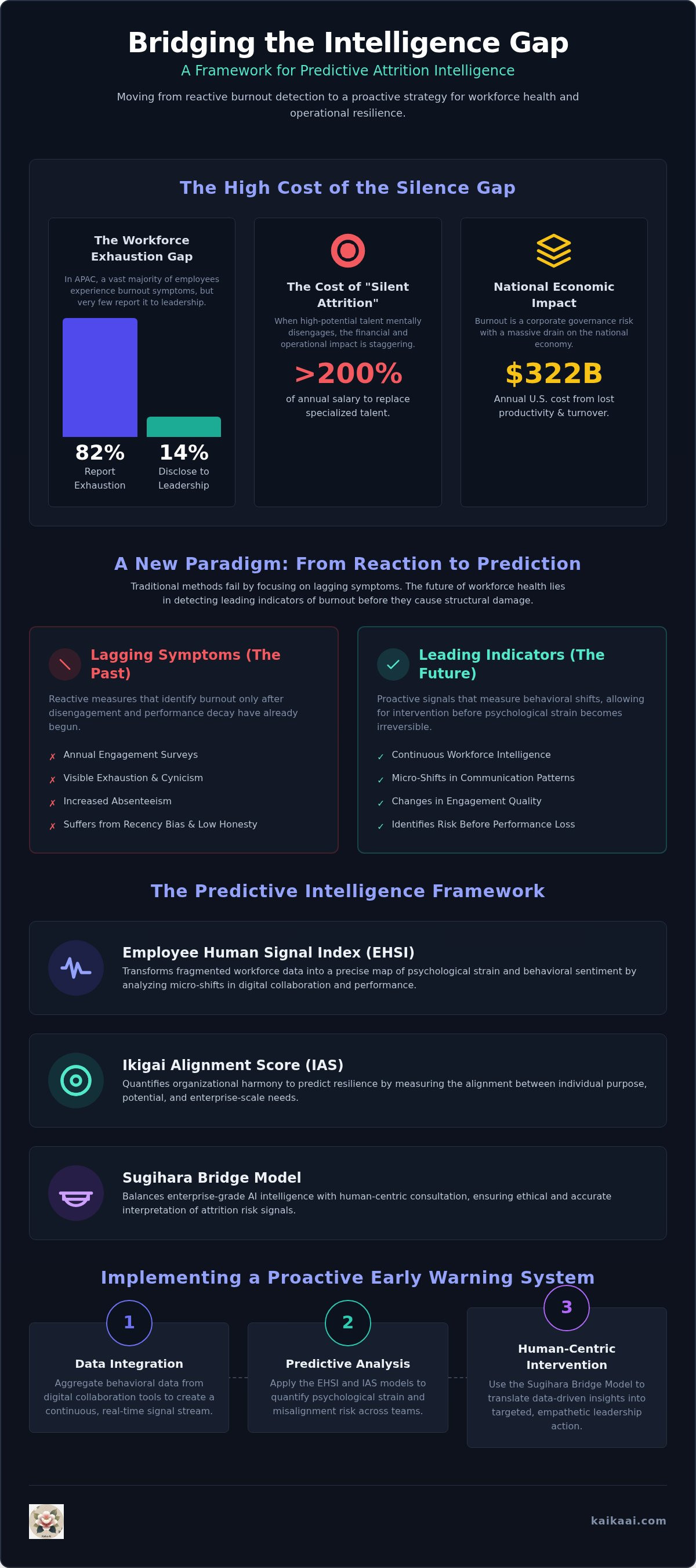
In 2026, 82% of employees in the Asia-Pacific region report at least one symptom of exhaustion, yet the disclosure rate to leadership remains a mere 14%. This creates a high-stakes intelligence gap where the leading indicators of employee burnout are obscured by cultural silence and fragmented data systems. You understand that the high cost of silent attrition isn't just a human resources concern; it's a structural performance failure that threatens the core of organizational velocity. Traditional annual surveys often fail to capture these psychological strains until the damage to your talent architecture is already irreversible.
This guide introduces a sophisticated framework for predictive attrition intelligence to bridge that gap. You'll discover how to identify the subtle, predictive signals of workforce exhaustion before they manifest as systemic collapse. We'll examine the transition from reactive data collection to a proactive system for detecting attrition risk, utilizing the Ikigai Intelligence Framework to ensure organizational synergy. This analysis provides the data-driven proof of workforce health required for modern corporate governance and long-term operational resilience.
Key Takeaways
- Understand the critical distinction between lagging symptoms and the leading indicators of employee burnout to intervene before talent disengagement becomes structural failure.
- Deploy the Employee Human Signal Index (EHSI) to transform fragmented workforce data into a precise map of psychological strain and behavioral sentiment.
- Quantify organizational harmony using the Ikigai Alignment Score (IAS) to predict resilience by aligning individual potential with enterprise scale needs.
- Establish a proactive early warning system through a three-phase strategic integration that applies Kaizen principles to workforce health and attrition prevention.
- Master the Sugihara Bridge Model to balance enterprise grade AI intelligence with human centric consultation for ethical and accurate risk interpretation.
Beyond Lagging Symptoms: Defining Leading Indicators of Burnout
Most executive leadership teams view burnout through the lens of the World Health Organization's definition of burnout, which characterizes it as a syndrome of exhaustion and cynicism. This perspective is inherently reactive. By the time these lagging indicators surface, the structural integrity of your workforce has already begun to erode. Leading indicators of employee burnout are measurable behavioral shifts that precede psychological strain, representing the subtle decay of alignment before it manifests as a total loss of performance velocity.
Waiting for clinical exhaustion is a failure of attrition prevention. You're witnessing "Silent Attrition," a phenomenon where high-potential talent remains on the payroll while mentally disengaging from the organizational mission. This creates a signal gap that traditional metrics simply cannot bridge. When signals of misalignment are missed, the resulting friction slows down every operational layer. It's a silent drain on your enterprise's kinetic energy.
The Failure of Traditional Annual Engagement Surveys
Static feedback loops suffer from severe recency bias. They capture a single moment in time, often influenced by the immediate week's specific stressors rather than long-term psychological health. In many corporate environments, honesty rates in these surveys are remarkably low because employees fear the repercussions of transparency. This lack of psychological safety masks the true burnout risk. Real-time, continuous workforce intelligence is necessary to detect the signal variance that precedes a structural performance failure. You need a system that captures honesty through architectural design rather than just asking for it.
The Economic Impact of the "Silence Gap"
The cost of replacing specialized talent in large enterprises often exceeds 200% of the individual's annual salary. Beyond the immediate financial drain, burnout-induced disengagement stalls strategic execution and disrupts collective momentum. In the U.S. alone, burnout-related costs from lost productivity and turnover are estimated at $322 billion annually. This is a corporate governance risk that demands the same level of scrutiny as financial auditing. When leadership can't see the psychological strain within their teams, they can't guarantee operational resilience to their stakeholders or the board. It's time to treat workforce health as a measurable pillar of structural integrity.
The Behavioral Architecture of Burnout: The Employee Human Signal Index
The structural integrity of a global enterprise depends on the precise synchronization of its human components. While traditional HR systems track attendance or output, the Employee Human Signal Index (EHSI) provides a deeper, clinically-informed measurement of the behavioral architecture within your teams. Co-developed with clinical psychologist Michelle Kwamboka, the EHSI translates subtle behavioral shifts into actionable intelligence. It moves beyond the visible symptoms of exhaustion to address the root causes of employee burnout, such as unmanageable workloads and the erosion of manager support. By quantifying workforce velocity against individual stamina, leadership can finally see the leading indicators of employee burnout before they crystallize into structural failure.
Behavioral sentiment analysis acts as the central nervous system of this intelligence framework. It doesn't merely count errors or track hours; it analyzes the quality of engagement and the resilience of the collective. When individual stamina is consistently outpaced by organizational velocity, the resulting friction creates psychological strain. This strain is the primary precursor to attrition. Understanding these dynamics requires a move away from superficial metrics toward a system that respects the complexity of human potential and organizational harmony.
Identifying Micro-Shifts in Communication and Performance
Early withdrawal often occurs in the digital workspace long before it appears in performance reviews. The "Signal Before Silence" philosophy focuses on detecting these micro-shifts in digital collaboration patterns. When a high-velocity contributor suddenly shifts from collaborative problem-solving to perfunctory task completion, it signals a decay in engagement. AI-driven sentiment markers identify "presenteeism," where employees are digitally present but mentally detached. Detecting these shifts allows leadership to initiate an Alignment Audit to identify exactly where the connection between person and purpose has frayed. This proactive approach prevents the silent attrition that often follows missed signals.
Clinical Validity in Workforce Intelligence
Responsible AI implementation requires more than just technical precision; it demands ethical rigor and academic validation. Our partnership with Waseda University ensures that the data models used to detect psychological strain are grounded in established organizational psychology. Standard analytics tools often suffer from "algorithmic bias," misinterpreting cultural communication nuances as performance deficits. The EHSI avoids these pitfalls by utilizing a hybrid architecture that respects individual privacy while providing enterprise-level clarity. Clinical oversight ensures that these signals remain a tool for empowerment rather than a mechanism for surveillance. This creates a foundation for sustainable excellence, where the intersection of technology and human behavior is managed with strategic wisdom and institutional reliability.
Structural Gaps: How Purpose Misalignment Drives Exhaustion
Burnout is rarely a simple byproduct of excessive hours. Instead, it often stems from "purpose friction," a structural misalignment where individual contribution lacks a meaningful connection to organizational velocity. While traditional management focuses on resilience as an individual trait, the Ikigai Alignment Score (IAS) serves as a superior predictor of long-term resilience. By measuring the intersection of passion, skill, and enterprise need, the IAS identifies the leading indicators of employee burnout before they manifest as the 14 signs of burnout typically cited in standard coaching. Strategic excellence requires aligning individual and organizational goals to create a preventative buffer against psychological strain.
The Ikigai philosophy provides a framework for this synchronization. It suggests that peak performance exists only where personal mastery meets organizational mission. When these elements diverge, the resulting friction creates a drain on individual stamina. This isn't a failure of the employee; it's a failure of the organizational architecture. Identifying these structural gaps allows leadership to recalibrate roles before the strain leads to total performance failure.
The Correlation Between Purpose and Performance
Data from Kaika AI pilot programs reveals an 87% employee honesty rate, suggesting that workers are remarkably transparent when the framework prioritizes their potential. When individuals see their work as an extension of their Ikigai, the perceived cognitive load of complex tasks decreases significantly. Mission-alignment acts as a psychological shock absorber. Conversely, an "Ikigai Alignment Deficit" creates immediate friction. This deficit is a primary leading indicator. It signals that even your most capable high performers are operating on borrowed time. Performance remains sustainable only when the architecture of the role supports the human potential within it.
Closing the Gap Between Executive Vision and Individual Action
Cascading goals frequently fail because they prioritize top-down metrics over horizontal synchronization. Without true corporate mission synchronization, the executive vision remains an abstract concept rather than a lived reality for the global workforce. High-performance teams often experience purpose friction when their daily operational outputs feel disconnected from the broader enterprise mission. Identifying these gaps requires a framework that looks beyond task completion to measure the integrity of the purpose-to-action link. Solving this misalignment restores organizational harmony and ensures that your talent remains invested in the long-term evolution of the enterprise. This synchronization is the foundation of operational resilience.
Implementing a Predictive Early Warning System for Attrition
Modern workforce management requires a transition from reactive crisis control to a data-driven Kaizen approach. This methodology treats organizational stability as a continuous process of refinement rather than a static benchmark. To achieve this, leadership must integrate enterprise-grade HR data analytics that capture deep behavioral signals instead of surface-level sentiment. Success in these systems depends on high-frequency engagement. For instance, Kaika AI pilot programs achieved a 74% weekly completion rate, providing the granular data necessary to track the leading indicators of employee burnout with architectural precision. This consistent stream of intelligence allows executives to identify friction points before they escalate into structural failures.
Phase 1: Establishing the Baseline with an Alignment Audit
The journey toward operational resilience begins with a mission critical alignment audit. This phase establishes a strategic baseline by mapping existing workforce data to the Ikigai Intelligence Framework. It uncovers the "blind spots" where leadership perception diverges from the actual lived experience of the global workforce. By auditing these gaps, you reveal the structural vulnerabilities and leading indicators of employee burnout that typically drive silent attrition. This baseline is essential for measuring the efficacy of subsequent interventions and ensuring that all organizational components are synchronized with the enterprise mission.
Phase 2: Real-Time Signal Monitoring and Privacy Compliance
Transitioning to real-time signal monitoring requires a commitment to uncompromising privacy standards. We adhere to rigorous Japanese privacy regulations and global enterprise security protocols to protect individual data integrity. The "Continuous Performance Reimagined" model maintains employee trust through total transparency and ethical AI application. It’s about building a culture where data empowers the individual while providing leadership with the intelligence needed to maintain workforce velocity. Ethical oversight ensures that monitoring serves as a support mechanism, fostering a sense of psychological safety that is critical for long-term engagement and honesty in reporting.
Phase 3: Operationalizing Resilience Training
The final phase involves operationalizing workforce resilience metrics to drive long-term growth. These metrics inform executive-level architectural consultations, allowing for precise structural adjustments based on data rather than intuition. Leadership moves beyond simple data collection and into "Collective Kaizen" workshops to co-create sustainable solutions with their teams. This collaborative approach transforms predictive intelligence into a tangible framework for excellence. To begin your journey toward predictive stability, you can schedule an Executive Consultation to evaluate your current workforce architecture and identify immediate opportunities for alignment.
The Sugihara Bridge Model: AI Intelligence Meets Human Judgment
The Sugihara Bridge Model represents the zenith of our intelligence architecture. It functions as a hybrid system that fuses enterprise-grade AI with the nuanced perspective of human experts. While software excels at identifying the leading indicators of employee burnout across global divisions, pure data remains a cold abstraction without contextual interpretation. This bridge ensures that sensitive workforce signals are not just measured but understood with clinical precision. Trained consultants work directly with CHROs to interpret the Human Signal Index (HSI), transforming raw behavioral variance into a strategic roadmap for organizational harmony. This positioning establishes Kaika AI as a Strategic Sage, guiding leadership through the complexities of human potential within a high-velocity enterprise.
Interpreting the Human Truth Beneath the Data
Data alone can be misinterpreted. A sudden shift in communication might signal burnout, or it might reflect a temporary external stressor. Our consultants prevent the "black box" effect by providing the clinical oversight necessary to distinguish between transient friction and structural decay. This process requires a shift in leadership mindset, moving away from surveillance toward a framework of mutual evolution. In one instance, our consultants moved a global team from a state of "burnout detected" to "alignment restored" by identifying that the friction wasn't caused by workload, but by a lack of clarity in mission-critical objectives. This human-led intervention is what turns predictive intelligence into measurable structural impact.
Future-Proofing the Enterprise for 2032 and Beyond
The vision for the enterprise extends far beyond immediate attrition prevention. As we progress toward our 2032 TSE/ASX listing vision, we remain focused on building institutional stamina through operational resilience for leadership. This long-term commitment ensures that your organization remains synchronized even as the global market shifts. Future-proofing requires more than just better software; it demands a comprehensive framework for evolution that respects the intersection of technology and human behavior. The ability to detect leading indicators of employee burnout is the first step in creating an indestructible workforce. It’s time to hear the signal before the silence defines your future performance.
Securing Organizational Velocity Through Predictive Intelligence
The transition from reactive crisis management to proactive structural alignment is a strategic necessity for the modern enterprise. By identifying the leading indicators of employee burnout through behavioral sentiment and purpose synchronization, leadership can finally close the intelligence gap that fuels silent attrition. This methodology, co-developed with clinical psychologists and validated by research partners like Waseda University, ensures that workforce health becomes a measurable pillar of corporate governance.
Pilot programs have demonstrated an 87% employee honesty rate. This proves that workers respond to frameworks designed for their potential rather than mere surveillance. Moving beyond lagging symptoms allows you to maintain organizational velocity and secure the long-term stamina of your most valuable talent. It's time to transition from fragmented data to a unified system of predictive attrition intelligence. Take the first step toward a resilient, synchronized workforce architecture today.
Request Early Access to the Kaika AI Workforce Alignment Platform
Your organization's future performance depends on the clarity of the signals you choose to hear today.
Frequently Asked Questions
What is the difference between burnout symptoms and leading indicators?
Exhaustion and cynicism act as lagging indicators that appear only after structural damage occurs. We define leading indicators of employee burnout as measurable behavioral shifts and purpose friction that precede psychological strain. These signals identify the decay of alignment between individual potential and organizational mission before performance fails. Leadership uses these insights to implement structural interventions instead of relying on reactive damage control after talent has already disengaged.
How does the Ikigai Alignment Score predict burnout risk?
The Ikigai Alignment Score (IAS) quantifies the intersection of passion, skill, and enterprise need to forecast long-term resilience. We observe that high burnout risk correlates directly with purpose friction, where an individual's contribution lacks a meaningful link to the broader mission. A dropping IAS score warns that the psychological buffer against cognitive load is failing. Leadership then uses this data to recalibrate roles before the strain causes total performance collapse.
Is the Employee Human Signal Index (EHSI) clinically validated?
We co-developed the EHSI with clinical psychologist Michelle Kwamboka and validated the framework through research partnerships with Waseda University. This clinical rigor ensures the index measures true psychological strain rather than simple productivity fluctuations. By grounding the analytics in established organizational psychology, our framework avoids the algorithmic bias common in standard HR tools. It provides an ethical, evidence-based interpretation of workforce signals that respects the complexity of human behavior.
How does Kaika AI ensure employee data privacy and anonymity?
We adhere to stringent Japanese privacy standards and global enterprise security protocols to protect individual anonymity. Our platform focuses on aggregate behavioral patterns and signal variance rather than invasive individual surveillance. This commitment to ethical data use drove the 87% employee honesty rate we observed in our pilot programs. We maintain trust through total transparency regarding signal capture, ensuring psychological safety remains a core pillar of the organizational architecture.
Can this platform identify burnout in remote or hybrid workforces?
We specifically designed the platform to bridge communication gaps inherent in distributed environments. Leading indicators of employee burnout often manifest as subtle shifts in digital collaboration patterns and engagement quality. Since remote workers report higher burnout rates, our behavioral sentiment analysis provides critical visibility that managers often miss during standard video conferences. Our technology detects presenteeism and early withdrawal signals, ensuring structural integrity across all geographic divisions regardless of physical location.
What is the Sugihara Bridge Model and why is it necessary?
The Sugihara Bridge Model utilizes a hybrid architecture that combines AI intelligence with human judgment. We find this necessary because sensitive workforce signals require a nuanced interpretation that pure software cannot provide alone. While our AI detects the signal, trained consultants interpret the human truth beneath the data for executive leadership. This bridge prevents the misinterpretation of behavioral shifts and transforms raw intelligence into a sophisticated roadmap for organizational harmony.
How long does it take to see results from a workforce alignment audit?
An initial Alignment Audit establishes a strategic baseline during the first phase of integration. Executives begin receiving actionable intelligence on workforce friction and signal variance immediately upon system activation. Most organizations realize measurable improvements in engagement and alignment honesty within the first 90 days of implementation. This timeline allows for a methodical transition toward predictive stability while providing leadership with immediate visibility into structural vulnerabilities that threaten talent retention.
What industries benefit most from burnout prediction software?
High-velocity industries with complex, specialized talent pools realize the most significant impact from this intelligence. This includes global enterprise technology, financial services, and healthcare sectors where the high cost of silent attrition threatens performance. Any organization that depends on the precise synchronization of human potential can leverage these insights. When the cost of replacing talent exceeds 200% of an annual salary, predictive intelligence becomes a critical pillar of corporate governance and operational resilience.
Disclaimer
#Disclaimer
At Kaika AI, we believe the future belongs to organizations that combine human wisdom with artificial intelligence responsibly. The articles, research, insights, and thought leadership published on this website are intended to educate, inform, and encourage meaningful conversations about the future of work, organizational intelligence, AI, leadership, and innovation.
While our content is developed through rigorous research and may be generated, curated, or enhanced using artificial intelligence, every effort is made to ensure it reflects thoughtful analysis, practical relevance, and responsible AI practices. However, no representation or warranty is made regarding the completeness, accuracy, or suitability of the information for every individual or organizational circumstance.
The ideas, opinions, frameworks, and recommendations shared by Kaika AI are provided for educational and informational purposes only. They should not be interpreted as legal, financial, medical, psychological, human resources, cybersecurity, or other professional advice. Organizations and individuals should seek qualified professional guidance before making strategic, legal, or operational decisions.
Where articles reference third-party organizations, products, services, academic research, industry reports, or public data, such references are provided solely to support discussion and analysis. Unless explicitly stated, they do not imply endorsement, partnership, or affiliation.
Artificial intelligence is a powerful decision-support technology—not a replacement for human judgment. Kaika AI advocates for responsible, transparent, and human-centered AI adoption. We encourage readers to critically evaluate information, consider their unique context, and combine AI-generated insights with professional expertise and sound decision-making.
The content published on this website may be updated, revised, or removed as knowledge, technology, regulations, and best practices continue to evolve.
To the fullest extent permitted by applicable law, Kaika AI, its affiliates, contributors, and partners disclaim liability for any direct, indirect, incidental, consequential, or other losses arising from the use of, or reliance upon, the information provided on this website.
By accessing or using this website, you acknowledge that you have read, understood, and agree to this Disclaimer.
Kaika AI
'Building trusted organizational intelligence for the AI Era'


