
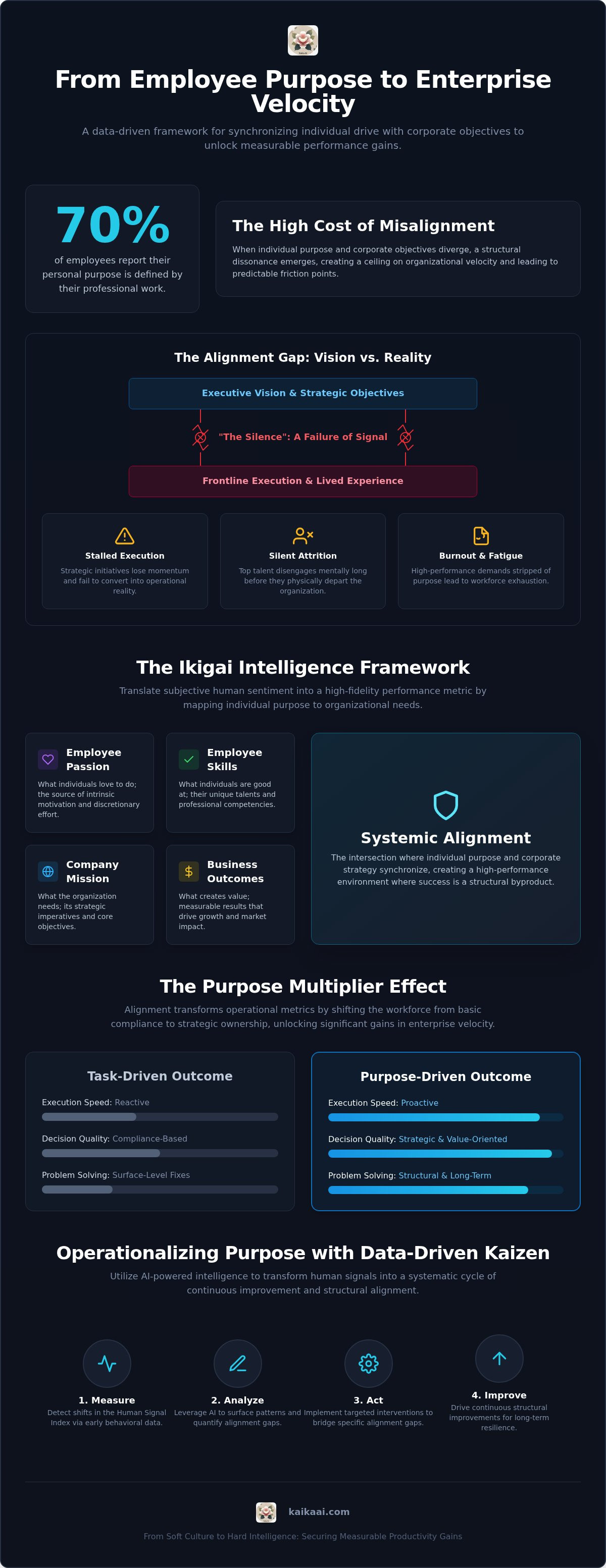
70% of employees report that their sense of personal purpose is defined by their professional work, yet many executive leaders struggle to translate this individual drive into operational momentum. You likely recognize the cost of this friction. It manifests as stalled strategic execution, the sudden attrition of top talent, and a persistent difficulty in measuring the ROI of corporate culture. When individual aspirations and corporate objectives exist in isolation, the resulting structural dissonance creates a ceiling on your organizational velocity.
Connecting employee purpose to business outcomes is no longer a soft human resources ambition; it's a data-driven necessity for enterprise resilience. This article explores how to transform subjective human sentiment into high-fidelity performance metrics using AI-powered workforce alignment intelligence. You'll discover a sophisticated framework designed to synchronize global divisions, reduce burnout risk, and secure measurable productivity gains through the lens of the Ikigai Intelligence Framework. We'll examine the transition from stated values to lived purpose, providing a methodical blueprint for leaders who demand both philosophical depth and institutional excellence.
Key Takeaways
- Identify the structural risks of silent attrition and how misaligned individual purpose creates a definitive ceiling on strategic execution.
- Quantify the relationship between purpose-alignment and enterprise velocity to prove the measurable ROI of organizational culture.
- Master the process of connecting employee purpose to business outcomes using the Ikigai Intelligence Framework to bridge the gap between human potential and operational results.
- Apply the Sugihara Bridge Model to transform complex human signals into a systematic cycle of Collective Kaizen and continuous structural improvement.
- Leverage AI-powered workforce alignment intelligence to mitigate burnout risks and ensure long-term operational resilience across global divisions.
The Strategic Imperative of Purpose-Outcome Synchronization
Workforce alignment represents the sophisticated synchronization of an individual’s Ikigai, their reason for being, with the rigid requirements of corporate architecture. When these two forces diverge, organizations experience "The Silence." This isn't the absence of noise; it's the absence of signal. It manifests as stalled strategic execution and silent attrition, where top-tier talent disengages mentally long before they physically depart. Traditional engagement surveys fail because they're post-mortem tools. They measure what happened yesterday, not the latent potential of tomorrow. Modern organizational development requires a shift toward connecting employee purpose to business outcomes through active, real-time intelligence. By utilizing AI to surface early behavioral signals, leaders can hear the signal before the silence, intervening before disengagement becomes a structural liability.
Defining the Alignment Gap in Modern Enterprises
The disconnect between executive vision and frontline execution is rarely a matter of effort. It's a failure of structural linkage. Leaders often broadcast a mission that fails to resonate with the lived experience of the workforce, leading to a profound alignment gap. This phenomenon occurs when employees feel their contribution lacks personal meaning, even if they're meeting their KPIs. We identify three primary friction points that erode enterprise velocity: communication breakdowns that obscure the "why," value-clashes that undermine trust, and burnout resulting from high-performance demands stripped of purpose. Without a data-driven framework to bridge this gap, organizations remain vulnerable to a fragmented culture that cannot sustain long-term growth.
From Soft Culture to Hard Intelligence
Purpose has transitioned from a peripheral cultural concept to a mission-critical metric for the modern CHRO. Static annual engagement scores are no longer sufficient for global workforce management. We must move toward dynamic alignment intelligence that treats human sentiment as a lead indicator of performance. By leveraging AI to surface early behavioral signals, leaders can detect shifts in the Human Signal Index before disengagement solidifies. This shift allows for the transformation of subjective sentiment into hard data, ensuring that connecting employee purpose to business outcomes becomes a repeatable, measurable driver of enterprise velocity. It's about moving from guessing how people feel to knowing how they'll perform.
Quantifying the Impact: How Alignment Drives Enterprise Velocity
Workforce Velocity represents the precise rate at which strategic objectives are converted into operational reality. It is the measurement of how quickly an organization moves from conceptual vision to tangible market impact. When an enterprise succeeds at connecting employee purpose to business outcomes, it removes the friction of manual oversight. Purpose acts as a natural filter for decision-making. It empowers frontline contributors to make complex choices that mirror executive intent without the need for constant hierarchical validation. Research published in When Employees Feel a Sense of Purpose suggests that deep alignment creates high-performance environments where success is a structural byproduct. This synergy reduces cross-departmental silos, replacing internal competition with collective momentum.
Productivity Metrics and the Purpose Multiplier
Individual purpose drives discretionary effort, the extra energy employees contribute when they find personal meaning in their professional tasks. The result is a significant shift in output quality and execution speed. Organizations that master this synchronization see a distinct transition from basic compliance to strategic ownership. The Purpose Multiplier is the ratio of organizational alignment to measurable operational output.
| Performance Metric | Task-Driven Outcome | Purpose-Driven Outcome |
|---|---|---|
| Execution Speed | Reactive; dictated by deadlines | Proactive; driven by mission urgency |
| Decision Quality | Compliance-based; risk-averse | Strategic; value-oriented |
| Problem Solving | Surface-level; temporary fixes | Structural; long-term resilience |
Reducing Attrition through Early Signal Detection
Alignment indicators predict turnover months before a resignation letter reaches a manager's desk. Mission synchronization is the primary defense against losing A-players, as high performers rarely leave for compensation alone; they leave when their work feels disconnected from their identity. Detecting these shifts early is essential for maintaining institutional knowledge. This predictive capability is intrinsically linked to identifying the leading indicators of employee burnout. By monitoring these human signals, leadership can intervene with precision, securing the workforce before performance plateaus. To understand your current organizational standing, you might consider scheduling an Alignment Audit to identify hidden friction points within your leadership structure.
The Ikigai Intelligence Framework: Measuring the Human Truth
Traditional metrics like eNPS offer a flattened, often deceptive view of organizational health. They lack the conceptual depth required for connecting employee purpose to business outcomes at a structural level. The Ikigai Intelligence Framework (IIF) operates as a three-dimensional measurement system, capturing the human truth beneath workforce data. By analyzing the intersection of individual passion, professional competency, and organizational requirement, the IIF provides a high-fidelity map of enterprise alignment. It moves beyond superficial satisfaction scores to quantify the Human Signal Index (HSI), surfacing the behavioral patterns that precede systemic disengagement and strategic stagnation.
The Science of the Ikigai Alignment Score
The Ikigai Alignment Score (IAS) serves as the primary metric for mapping individual purpose to the overarching organizational mission. Unlike traditional surveys that suffer from respondent bias, our internal pilots demonstrate an 87% employee honesty rate. This integrity is achieved through AI-driven anonymity and a psychological safety layer that encourages genuine expression. The IAS functions as a lead indicator for the effectiveness of workforce alignment software, allowing executives to see exactly where the connection between personal drive and corporate goals is fraying. It provides a granular, data-driven view of how well the company's architecture supports the human potential within its ranks.
Detecting the Signal Before the Silence
The Employee Human Signal Index (EHSI) represents a specialized evolution of our intelligence framework. Developed with direct involvement from clinical psychologists, it monitors burnout risk by detecting subtle shifts in psychological strain and engagement velocity. This isn't about monitoring hours worked; it's about identifying the early erosion of mental resilience. Real-time data allows leadership to act while there's still time to prevent attrition or catastrophic performance drops. When you hear the signal before the silence, you transition from reactive damage control to proactive structural optimization. This approach ensures that connecting employee purpose to business outcomes remains a sustainable strategy rather than a temporary performance spike. It secures the human foundation upon which all enterprise velocity is built.
Operationalizing Purpose through Data-Driven Kaizen
Purpose without a mechanism for execution remains a mere sentiment. To achieve true organizational harmony, leaders must transform static alignment data into a continuous improvement cycle known as Collective Kaizen. This systematic approach ensures that the synchronization between individual drive and corporate goals isn't a one-time intervention but a perpetual state of structural refinement. By connecting employee purpose to business outcomes through iterative adjustments, organizations build the operational resilience necessary to navigate global market shifts. This phased strategic integration moves beyond simple observation, embedding purpose directly into the daily cadence of strategic execution.
Implementing the Collective Kaizen Workshop
The transition from insight to action requires a structured methodology. Our framework utilizes a specific three-phase process to ensure systemic alignment:
- Step 1: Alignment Audit. We conduct a comprehensive Alignment Audit to surface mission-critical gaps where individual aspirations and corporate requirements diverge.
- Step 2: Cross-Functional Synchronization. Leadership facilitates workshops designed to harmonize goals across disparate divisions, fostering cross-departmental synergy through shared purpose visibility.
- Step 3: Dynamic Feedback Loops. Organizations establish a continuous monitoring system using real-time IAS and HSI metrics to ensure alignment remains intact during rapid scaling.
The Sugihara Bridge: AI Intelligence Meets Human Judgment
Algorithmic precision provides the foundation, yet AI alone is insufficient for the delicate complexities of workforce transformation. The Sugihara Bridge Model combines high-fidelity AI measurement with sophisticated human-centric consultation. While the platform identifies the Human Signal, executive consultants provide the contextual interpretation required to resolve deep-seated cultural friction. This hybrid approach ensures that data serves the human element rather than replacing it. For a deeper analysis of these methodologies, consult our executive guide to data-driven Kaizen. By integrating technology with clinical psychological insights, leaders can secure a future-proof workforce capable of sustained high-performance. To begin this transformation, you can register for our specialized Collective Kaizen Workshops today.
Achieving Systemic Alignment with Kaika AI
Kaika AI serves as the definitive category leader in Workforce Alignment Intelligence. We've engineered a platform that transcends traditional management software by directly connecting employee purpose to business outcomes at an enterprise scale. Our infrastructure adheres to the most rigorous Japanese standards for security and data privacy. This ensures that the Human Signal Index remains protected while providing actionable institutional insights to executive leadership. As we progress toward a global dual listing, our commitment to institutional reliability remains uncompromising. We offer large-scale enterprises a visionary path toward organizational harmony, moving beyond fragmented cultures into a state of synchronized excellence.
Platform Capabilities and Executive Dashboards
CHROs require more than surface-level data to lead a successful workforce transformation. The Kaika AI platform provides real-time visibility into productivity, engagement, and latent burnout risk across global divisions. Our executive dashboards translate complex human variables into high-fidelity performance metrics, allowing leaders to identify where strategic velocity is being compromised. By integrating our intelligence into existing operational resilience for leadership frameworks, organizations can move from reactive management to proactive structural optimization. This level of transparency empowers the C-suite to make evidence-based decisions that respect both human potential and fiscal responsibility.
The Future of Organizational Health
Our vision for the future involves setting the global standard for workforce alignment. We believe that the most resilient organizations are those that possess the technical capability to hear the signal before the silence. This philosophy drives our continuous innovation in AI-powered alignment intelligence. By securing the connection between individual Ikigai and corporate architecture, we help enterprises build a foundation for sustained growth and innovation. The era of guessing at cultural health is over. We invite CHROs of large-scale enterprises to join this evolution and secure their operational future. You can Request Early Access to the Kaika AI Platform today to begin your journey toward systemic alignment and measurable organizational velocity.
Securing the Future of Organizational Synchronization
The transition from subjective human sentiment to measurable organizational velocity requires a fundamental shift in executive perspective. We've explored how the Ikigai Intelligence Framework provides a three-dimensional map for connecting employee purpose to business outcomes. By utilizing real-time metrics like the Human Signal Index, leaders can identify structural friction and burnout risk before they compromise strategic execution. This shift from reactive management to proactive alignment is the hallmark of the modern, resilient enterprise.
Our methodology is built on institutional reliability. We maintain an 87% employee honesty rate in our pilot programs and a 72 Net Promoter Score. This foundation is further strengthened by our academic partnership with Waseda University; this ensures our framework remains at the intersection of clinical psychology and enterprise intelligence. We don't just measure culture; we quantify the human truth that drives performance.
The era of relying on lagging indicators is over. It's time to build a workforce that's not just engaged, but fundamentally synchronized with your corporate mission. We invite you to Request Early Access to the Kaika AI Workforce Alignment Intelligence Platform to begin your journey toward systemic harmony. Your organization's highest potential is waiting to be unlocked.
Frequently Asked Questions
How do you measure something as subjective as employee purpose?
We utilize the Ikigai Intelligence Framework to quantify purpose through a three-dimensional measurement system. This framework maps individual passion and professional competency against specific organizational requirements. The resulting Ikigai Alignment Score transforms subjective sentiment into a high-fidelity metric. It allows executives to see exactly where personal drive intersects with corporate architecture, providing a hard data point for what was previously considered an intangible cultural asset.
Is it possible to align individual goals with corporate missions in large enterprises?
Scalable synchronization is achievable through AI-powered workforce alignment intelligence. Large enterprises use these platforms to identify shared value clusters across global divisions, ensuring that individual contributors see the direct impact of their work on enterprise-level objectives. This process replaces fragmented local cultures with a unified operational architecture. It ensures that strategic execution remains consistent regardless of the organization's geographic scale or departmental complexity.
What is the difference between an engagement survey and an alignment audit?
An engagement survey measures past satisfaction, while an Alignment Audit identifies future strategic friction. Surveys are lagging indicators that often lack the depth required for complex decision-making. An audit utilizes the Human Signal Index to detect the gap between executive vision and frontline execution. It provides the structural clarity needed for connecting employee purpose to business outcomes by revealing the hidden friction points that stall strategic velocity.
How does Kaika AI ensure employee data privacy and psychological safety?
The platform adheres to the highest Japanese standards for enterprise security and data privacy. We utilize AI-driven anonymity layers to protect individual identities while surfacing collective behavioral trends to leadership. This architectural safety encourages "human truth," leading to the 87% honesty rate seen in our pilot programs. Employees feel secure sharing genuine insights because the system prioritizes structural integrity over individual surveillance.
Can connecting purpose to outcomes actually reduce employee burnout?
Connecting employee purpose to business outcomes reduces burnout by restoring a sense of meaning and agency to high-performance roles. Burnout often stems from intense performance demands that lack personal significance. By monitoring the Employee Human Signal Index, developed with clinical psychologists, leaders can detect early signs of psychological strain. This allows for proactive interventions that align workloads with individual purpose, securing long-term operational resilience and workforce health.
What are the first signs of a mission-alignment gap in a team?
The earliest indicators include "The Silence," which manifests as a lack of proactive communication and a shift from strategic ownership to basic compliance. You may also notice stalled strategic execution and a sudden increase in attrition among your top-tier talent. These signals suggest that the connection between individual drive and corporate goals has frayed. Using predictive intelligence allows you to hear these signals before they result in permanent disengagement.
How does the Sugihara Bridge Model differ from traditional consulting?
Traditional consulting often relies on subjective interviews and static reports that quickly become obsolete. The Sugihara Bridge Model combines high-fidelity AI measurement with sophisticated human-centric consultation. The platform identifies the "Human Signal," while executive consultants provide the contextual interpretation required for deep cultural resolution. This hybrid approach ensures that workforce transformation is driven by real-time data rather than temporary observations or generic management theories.
What role does AI play in predicting employee attrition?
AI serves as a lead indicator by detecting subtle shifts in engagement velocity and alignment scores months before a resignation occurs. It analyzes behavioral patterns that suggest a disconnect between an individual's Ikigai and the organization's mission. This predictive capability allows leadership to intervene with precision while there is still time to re-engage A-players. It provides a strategic window to secure the workforce before performance plateaus or talent departs.
Disclaimer
#Disclaimer
At Kaika AI, we believe the future belongs to organizations that combine human wisdom with artificial intelligence responsibly. The articles, research, insights, and thought leadership published on this website are intended to educate, inform, and encourage meaningful conversations about the future of work, organizational intelligence, AI, leadership, and innovation.
While our content is developed through rigorous research and may be generated, curated, or enhanced using artificial intelligence, every effort is made to ensure it reflects thoughtful analysis, practical relevance, and responsible AI practices. However, no representation or warranty is made regarding the completeness, accuracy, or suitability of the information for every individual or organizational circumstance.
The ideas, opinions, frameworks, and recommendations shared by Kaika AI are provided for educational and informational purposes only. They should not be interpreted as legal, financial, medical, psychological, human resources, cybersecurity, or other professional advice. Organizations and individuals should seek qualified professional guidance before making strategic, legal, or operational decisions.
Where articles reference third-party organizations, products, services, academic research, industry reports, or public data, such references are provided solely to support discussion and analysis. Unless explicitly stated, they do not imply endorsement, partnership, or affiliation.
Artificial intelligence is a powerful decision-support technology—not a replacement for human judgment. Kaika AI advocates for responsible, transparent, and human-centered AI adoption. We encourage readers to critically evaluate information, consider their unique context, and combine AI-generated insights with professional expertise and sound decision-making.
The content published on this website may be updated, revised, or removed as knowledge, technology, regulations, and best practices continue to evolve.
To the fullest extent permitted by applicable law, Kaika AI, its affiliates, contributors, and partners disclaim liability for any direct, indirect, incidental, consequential, or other losses arising from the use of, or reliance upon, the information provided on this website.
By accessing or using this website, you acknowledge that you have read, understood, and agree to this Disclaimer.
Kaika AI
'Building trusted organizational intelligence for the AI Era'


