
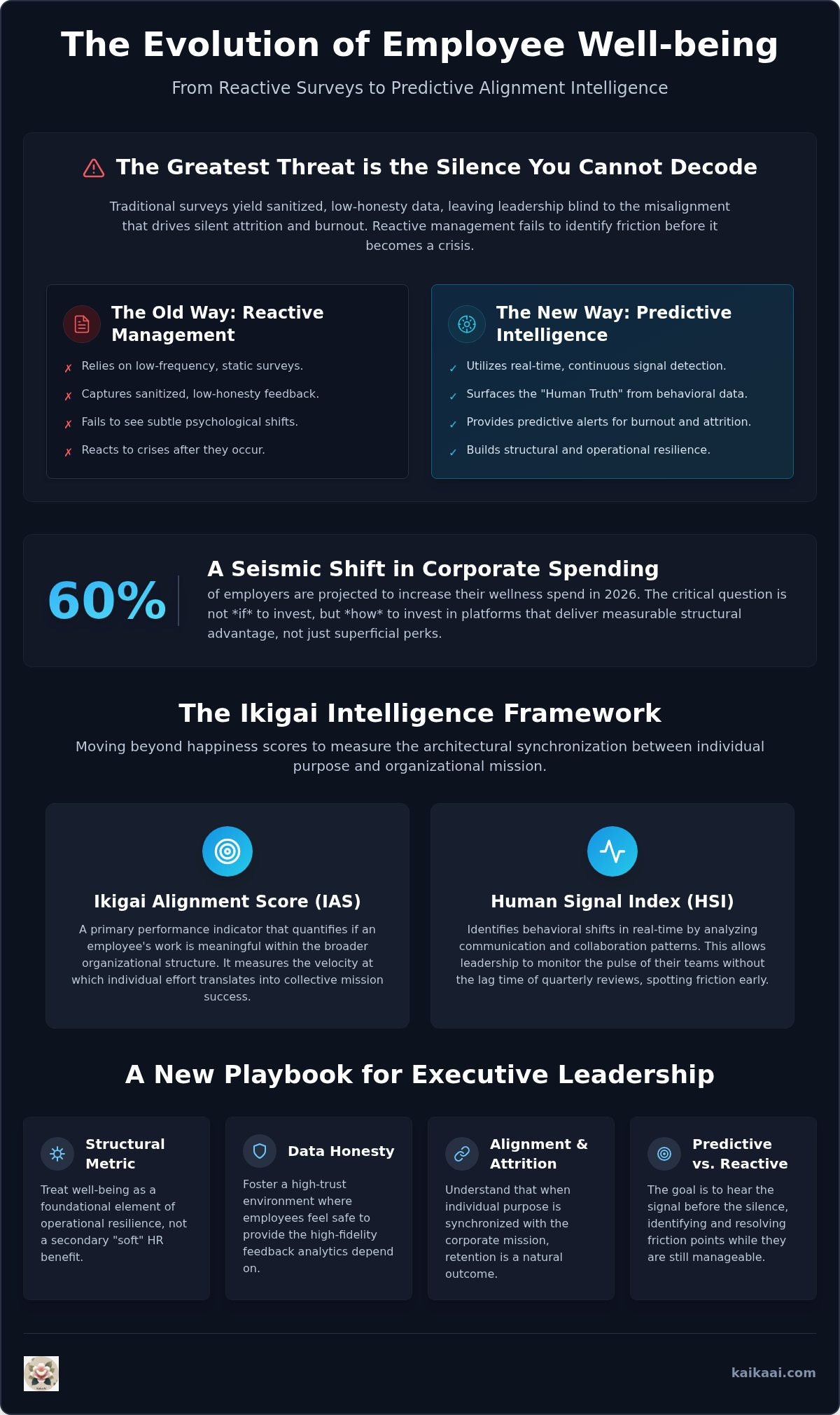
The most dangerous threat to your enterprise isn't the feedback you receive; it's the silence you cannot decode. While 60% of employers are increasing their wellness spend in 2026, many remain trapped in a cycle of reactive management because they lack a high-fidelity employee well-being analytics platform capable of identifying friction before it becomes a crisis. You understand that traditional surveys often yield sanitized data, leaving leadership blind to the misalignment between corporate mission and individual purpose that drives silent attrition.
This guide moves beyond superficial engagement scores to explore how AI-driven alignment intelligence surfaces the human truth required to build operational resilience. We'll demonstrate how to transition from low-honesty data to predictive attrition alerts, ensuring your workforce remains synchronized and high-performing. You will learn the strategic framework for using clinical-grade data to bridge the gap between organizational velocity and human potential, ultimately transforming well-being from a perk into a measurable structural advantage.
Key Takeaways
- Transition from reactive sentiment surveys to a real-time employee well-being analytics platform that identifies behavioral signals and prevents burnout before it impacts your bottom line.
- Utilize the Ikigai Intelligence Framework to measure the architectural synchronization between individual purpose and organizational mission through the Ikigai Alignment Score.
- Adopt the Sugihara Bridge Model to balance AI precision with human judgment, ensuring your data remains ethical, clinical-grade, and contextually relevant.
- Follow a structured implementation roadmap that begins with a comprehensive Alignment Audit to surface mission-critical gaps in your workforce health.
- Strengthen operational resilience by leveraging predictive psychological stamina metrics to maintain organizational velocity during periods of global market volatility.
What is an Employee Well-being Analytics Platform in 2026?
In 2026, a high-performance organization is no longer defined by its output alone but by the integrity of its internal alignment. An employee well-being analytics platform has evolved into a strategic intelligence system that deciphers behavioral and sentiment signals to assess the structural health of an organization. Unlike the rudimentary tools of the past, these platforms don't just measure physical health or surface-level satisfaction. They serve as a sophisticated diagnostic layer that reveals the "Human Truth" beneath the noise of standard corporate reporting.
The historical approach to Workplace wellness programs often relied on reactive, low-frequency surveys that captured a moment in time rather than a continuous reality. Today, the focus has shifted from tracking "happiness" to measuring "Workforce Alignment Velocity." This metric quantifies the speed and precision with which individual effort translates into collective mission success. While traditional HRIS platforms excel at managing administrative data, they frequently fail to capture the subtle psychological shifts that precede a total breakdown in productivity.
The Architecture of Modern Well-being Intelligence
Modern intelligence systems move beyond static annual reviews toward continuous signal detection. By analyzing patterns in communication, collaboration, and output, an employee well-being analytics platform can identify the early indicators of burnout and "Silent Attrition" before they manifest as a resignation letter. This predictive capability allows leadership to intervene with precision rather than broad, ineffective policy changes. The architecture of these systems integrates clinical-grade metrics directly into corporate governance, treating human stamina as a mission-critical asset that requires the same level of monitoring as financial liquidity.
The failure of legacy systems lies in their inability to account for context. Data without a human-centric framework is merely noise. By pairing AI precision with psychological depth, leaders can finally see the stressors that remain invisible on a standard spreadsheet. This isn't about surveillance; it's about creating a transparent environment where the needs of the individual and the goals of the enterprise are architecturally synchronized.
Key Takeaways for Executive Leadership
- Well-being is a structural performance metric. It's a foundational element of operational resilience, not a secondary benefit or "soft" HR initiative.
- Data honesty is the foundation. Effective analytics depend on an environment where employees feel safe enough to provide high-fidelity feedback.
- Alignment reduces attrition. When an individual's "Ikigai" or sense of purpose is synchronized with the corporate mission, retention becomes a natural outcome of organizational harmony.
- Predictive over reactive. The goal is to hear the signal before the silence, identifying friction points while they are still manageable.
The Ikigai Intelligence Framework: Measuring What Matters
Strategic resilience requires more than tracking attendance or satisfaction; it demands a deep understanding of the intersection between an individual’s professional identity and the company’s trajectory. The Ikigai Intelligence Framework (IIF) provides this clarity by utilizing the Ikigai Alignment Score (IAS) as a primary performance indicator. This metric doesn't just measure if an employee is "happy." It measures if their work is meaningful within the broader organizational architecture. When purpose is synchronized, the resulting workforce velocity becomes a competitive advantage that competitors cannot easily replicate.
Complementing the IAS is the Human Signal Index (HSI), which identifies behavioral shifts in real-time. This index allows leadership to monitor the pulse of their teams without relying on the lag time of quarterly reviews. When integrated into a comprehensive employee well-being analytics platform, these indices provide a multi-dimensional view of organizational health. This visibility is essential for identifying the precise moment when cross-departmental synergy begins to erode due to a lack of shared purpose.
Synchronizing Individual Purpose and Organizational Goals
Within a global enterprise, "Ikigai" represents the precise point where personal capability meets professional mission. Quantifying this correlation is essential for maintaining workforce productivity and reducing the high cost of turnover. Recent data from purpose-driven pilots showed high completion rates of 74%, demonstrating that employees with high alignment scores are significantly more likely to sustain peak performance over long durations. Achieving this level of synergy requires a proactive Alignment Audit to identify where individual purpose and corporate goals have drifted apart, allowing for surgical adjustments to team structures.
Predictive Burnout Detection: The EHSI Advantage
Burnout prevention has traditionally been reactive; businesses wait for the crash before offering support. The Employee Human Signal Index (EHSI) changes this dynamic through a clinical approach to sentiment analysis. Co-developed with clinical psychologists, the EHSI detects psychological strain through AI-driven signal detection before it escalates into silent attrition. By moving beyond "burnout surveys" toward predictive models, an employee well-being analytics platform ensures that organizational velocity is never achieved at the expense of human stamina. This ethical use of data prioritizes the long-term resilience of the workforce while maintaining high standards of privacy and transparency. Leaders who embrace this clinical-grade intelligence can protect their top talent from the invisible pressures of high-stakes environments.
To see how clinical-grade data can be transformed into engaging, actionable insights for health management, check out Olympus AI Technologies, which specializes in converting complex lab results into interactive health dashboards.
Evaluating Platform Integrity: The Sugihara Bridge Model
Efficiency without empathy is a risk few enterprises can afford. While many competitors prioritize total automation, the Sugihara Bridge Model recognizes that raw data requires a human lens to become actionable intelligence. An employee well-being analytics platform must do more than aggregate scores; it must decode the subtle cultural nuances that algorithms often overlook. In high-context corporate environments, particularly those influenced by Japanese management philosophies, "AI-only" solutions frequently fail because they lack the capacity to understand the "why" behind behavioral shifts. The Sugihara Bridge Model solves this by pairing algorithmic precision with human judgment, ensuring that every signal is interpreted with clinical accuracy and cultural relevance.
Integrity is the foundation of data fidelity. If employees suspect that their data will be used punitively, honesty evaporates, and the resulting insights become worthless. Pilots utilizing this hybrid approach have achieved an 87% employee honesty rate, a figure that far exceeds industry averages for standard engagement surveys. This high level of participation is achieved through radical transparency and a commitment to ethical data use. By focusing on collective resonance rather than individual surveillance, leadership can maintain a high-fidelity view of organizational health without compromising the trust of their top talent.
The Hybrid Approach: AI Measurement + Human Consultation
Intelligence is most effective when it informs human intervention. Trained consultants interpret the sensitive workforce signals surfaced by the AI, ensuring that the "human touch" remains central to the continuous improvement process. This methodology moves beyond automated dashboards to include an Executive Consultation, where data is translated into specific architectural adjustments for the organization. Maintaining a Kaizen-focused environment requires this blend of high-tech detection and high-touch interpretation. It prevents the dehumanization of the workforce while providing leaders with the clarity needed to make high-stakes decisions regarding performance and resilience.
Data Security and Ethical AI in HR
Adhering to rigorous Japanese privacy standards provides a global benchmark for data security and ethical AI implementation. These standards ensure that granular insights never come at the cost of individual anonymity or psychological safety. Building long-term trust requires a "Signal before Silence" communication strategy, where leadership proactively shares how data protects the workforce from burnout. For a comprehensive look at integrating these tools into your broader tech stack, explore The Definitive Guide to Workforce Alignment Software. Compliance is not merely a legal hurdle; it is a strategic commitment to the resilience and stamina of your most valuable asset.
Implementing Alignment Intelligence: A Strategic Roadmap
Deploying an employee well-being analytics platform is a structural evolution rather than a simple software installation. It requires a methodical, phase-based approach to synchronize technological capabilities with human behavior. The roadmap begins with a rigorous Alignment Audit to identify where organizational friction is eroding performance. This initial diagnostic phase surfaces the discrepancies between stated corporate objectives and the actual lived experience of the workforce, providing the baseline data necessary for meaningful transformation.
Phase two focuses on the seamless integration of the Ikigai Intelligence Framework (IIF) into existing operational workflows. This ensures that data collection doesn't disrupt the natural rhythm of work but instead enhances it through continuous signal detection. Finally, phase three involves cultivating a leadership mindset that is prepared to respond proactively to the signals surfaced by the platform. Without this commitment to decisive action, even the most sophisticated intelligence remains a passive observation rather than a catalyst for growth.
Identifying Mission-Critical Alignment Gaps
Leaders must use the Ikigai Alignment Score (IAS) to pinpoint exactly where strategy is stalling due to disengagement. Disengagement isn't a vague sentiment; it's a measurable deficit in synergy that can be tracked through cross-departmental friction metrics. Establishing a baseline for "Workforce Velocity" allows the enterprise to quantify the impact of alignment intelligence as it scales across the organization. By identifying these gaps early, you can prevent the silent attrition that often follows a period of prolonged misalignment between individual purpose and corporate mission.
Scaling Continuous Improvement (Kaizen)
True resilience is achieved through the transition from seasonal, isolated workshops to a continuous data-driven Kaizen environment. Empowering middle management with real-time engagement dashboards allows for localized adjustments that maintain team stamina and focus. This is where Collective Kaizen Workshops play a vital role, providing a structured space for teams to synchronize their efforts based on high-fidelity data. Understanding the Leading Indicators of Employee Burnout is essential for ensuring these workshops address the root causes of friction rather than just the symptoms. This systematic approach ensures that operational resilience becomes a permanent feature of your corporate architecture.
To begin your journey toward architectural synchronization, schedule an Alignment Audit to assess the current health of your workforce and identify hidden friction points.
The Future of Organizational Health and Operational Resilience
Future-proofing the enterprise requires a definitive transition from descriptive HR analytics to prescriptive Workforce Intelligence. As we look toward 2032, the most resilient organizations will be those that have moved beyond tracking historical trends to mastering predictive psychological stamina metrics. In a volatile global landscape, the ability to maintain organizational velocity depends on how well a leader can synchronize individual purpose with corporate mission. An employee well-being analytics platform is the foundational technology that enables this level of architectural precision, transforming human potential into a measurable and sustainable asset.
Kaika AI’s vision for the next decade centers on category leadership in Workforce Alignment Intelligence. We anticipate a shift where global synchronization becomes the standard for high-stakes enterprise management. By integrating proprietary indices like the IAS and EHSI into the core of corporate governance, businesses can move from reactive crisis management to a state of continuous, data-driven evolution. This evolution isn't merely about improving the "employee experience." It's about building an institutional framework that thrives under pressure and remains aligned through every market shift.
Operational Resilience for Leadership
Operational resilience is the structural "shock-absorber" that allows an organization to navigate rapid change without losing its top talent. When you align individual purpose with organizational goals, you create a workforce that is inherently more resistant to burnout and disengagement. The long-term ROI of this strategy is evident in reduced silent attrition and a significant boost in overall performance. Leaders who prioritize this level of synchronization position their firms to capture market share while competitors struggle with the high cost of turnover. You can now request early access to the Kaika AI Workforce Alignment Intelligence Platform to begin building this resilience within your own teams.
Conclusion: Hearing the Signal Before the Silence
The transition from engagement to alignment marks a new era in executive leadership. Engagement scores often mask the underlying friction that precedes a total breakdown in productivity. Alignment, however, provides the "Human Truth" required to act decisively. Leaders must embrace an employee well-being analytics platform that surfaces these signals while there is still time to intervene. The imperative is clear: you must hear the signal before the silence of a departing workforce defines your legacy. It's time to move beyond superficial metrics and invest in the structural harmony of your organization.
Connect your workforce's purpose with your organization's goals today.
Architecting the Future of Workforce Resilience
The shift from tracking seasonal sentiment to mastering real-time workforce alignment is the defining challenge for modern leadership. By adopting a clinical-grade employee well-being analytics platform, your organization gains the clarity required to synchronize individual purpose with collective velocity. This isn't merely about preventing burnout; it's about building an institutional framework that remains resilient under the pressures of global market volatility.
Our approach is grounded in rigorous scientific validation. This includes an academic partnership with Waseda University and the implementation of the clinical-grade EHSI index. With a proven NPS of 72 in Tokyo-based pilots, Kaika AI provides the precision necessary to hear the signal before the silence of attrition. You have the opportunity to transform your human potential into a measurable structural advantage.
Request Early Access to the Kaika AI Workforce Alignment Platform and begin your journey toward architectural synchronization today. The path to organizational harmony starts with a single, data-driven realization.
Frequently Asked Questions
What is the difference between employee engagement and workforce alignment?
Workforce alignment is the architectural synchronization of individual purpose with organizational goals, whereas engagement is merely a measure of sentiment. Engagement tools often track how employees feel at a single point in time. Alignment intelligence tracks the velocity of collective effort. It ensures that every human signal contributes to mission-critical outcomes rather than dissipating in friction.
How does the Ikigai Intelligence Framework predict burnout better than surveys?
The Ikigai Intelligence Framework utilizes real-time behavioral indices to detect psychological strain before it manifests as attrition. Traditional surveys suffer from lag time and sanitization. By monitoring the Human Signal Index, an employee well-being analytics platform can surface the "Human Truth" beneath the data. This allows for predictive intervention rather than reactive damage control.
Is the platform compliant with international privacy standards like GDPR and Japanese regulations?
Our platform adheres to the most rigorous Japanese privacy standards and international frameworks like GDPR. We prioritize ethical data use and transparency to ensure psychological safety. As of 2026, we also incorporate documented privacy risk assessments required by California's CPRA. This commitment to security is essential for maintaining high-fidelity data and institutional trust.
What is the 'Sugihara Bridge Model' and why is it necessary?
The Sugihara Bridge Model is a hybrid framework that pairs AI-driven precision with expert human interpretation. Purely automated solutions often fail to decode the cultural nuances of high-stakes corporate environments. This model ensures that sensitive workforce signals are interpreted by trained consultants. It bridges the gap between raw data and strategic operational outcomes.
How long does a typical Alignment Audit take for a large enterprise?
A typical Alignment Audit for a large enterprise requires approximately four to six weeks to complete. This timeframe allows for a thorough diagnostic of mission-critical gaps and the establishment of a "Workforce Velocity" baseline. The process concludes with a comprehensive architectural roadmap. This strategic foundation is necessary before scaling the platform across specialized divisions.
Can this platform integrate with our existing HRIS like Workday or SAP?
Yes, the platform is designed to integrate seamlessly with major HRIS ecosystems like Workday and SAP. It functions as a sophisticated intelligence layer that sits on top of your existing administrative data. By enriching standard records with behavioral signals, it provides a more holistic view of organizational health. You don't need to replace your current systems to gain alignment intelligence.
What kind of ROI can we expect from an employee well-being analytics platform?
ROI is realized through the measurable reduction of silent attrition and the mitigation of high turnover costs. An employee well-being analytics platform protects your top talent by identifying burnout risks before they lead to resignations. By boosting workforce velocity and synchronization, the platform directly impacts the bottom line. It transforms well-being from a secondary benefit into a structural performance metric.
How does Kaika AI ensure an 87% honesty rate in employee responses?
We achieve an 87% honesty rate by fostering a culture of radical transparency and psychological safety. Employees provide high-fidelity feedback when they understand that data protects their stamina rather than monitoring their compliance. This trust is built through our "Signal before Silence" communication philosophy. When leadership acts on signals to improve the work environment, participation becomes a tool for collective Kaizen.
Disclaimer
#Disclaimer
At Kaika AI, we believe the future belongs to organizations that combine human wisdom with artificial intelligence responsibly. The articles, research, insights, and thought leadership published on this website are intended to educate, inform, and encourage meaningful conversations about the future of work, organizational intelligence, AI, leadership, and innovation.
While our content is developed through rigorous research and may be generated, curated, or enhanced using artificial intelligence, every effort is made to ensure it reflects thoughtful analysis, practical relevance, and responsible AI practices. However, no representation or warranty is made regarding the completeness, accuracy, or suitability of the information for every individual or organizational circumstance.
The ideas, opinions, frameworks, and recommendations shared by Kaika AI are provided for educational and informational purposes only. They should not be interpreted as legal, financial, medical, psychological, human resources, cybersecurity, or other professional advice. Organizations and individuals should seek qualified professional guidance before making strategic, legal, or operational decisions.
Where articles reference third-party organizations, products, services, academic research, industry reports, or public data, such references are provided solely to support discussion and analysis. Unless explicitly stated, they do not imply endorsement, partnership, or affiliation.
Artificial intelligence is a powerful decision-support technology—not a replacement for human judgment. Kaika AI advocates for responsible, transparent, and human-centered AI adoption. We encourage readers to critically evaluate information, consider their unique context, and combine AI-generated insights with professional expertise and sound decision-making.
The content published on this website may be updated, revised, or removed as knowledge, technology, regulations, and best practices continue to evolve.
To the fullest extent permitted by applicable law, Kaika AI, its affiliates, contributors, and partners disclaim liability for any direct, indirect, incidental, consequential, or other losses arising from the use of, or reliance upon, the information provided on this website.
By accessing or using this website, you acknowledge that you have read, understood, and agree to this Disclaimer.
Kaika AI
'Building trusted organizational intelligence for the AI Era'


