
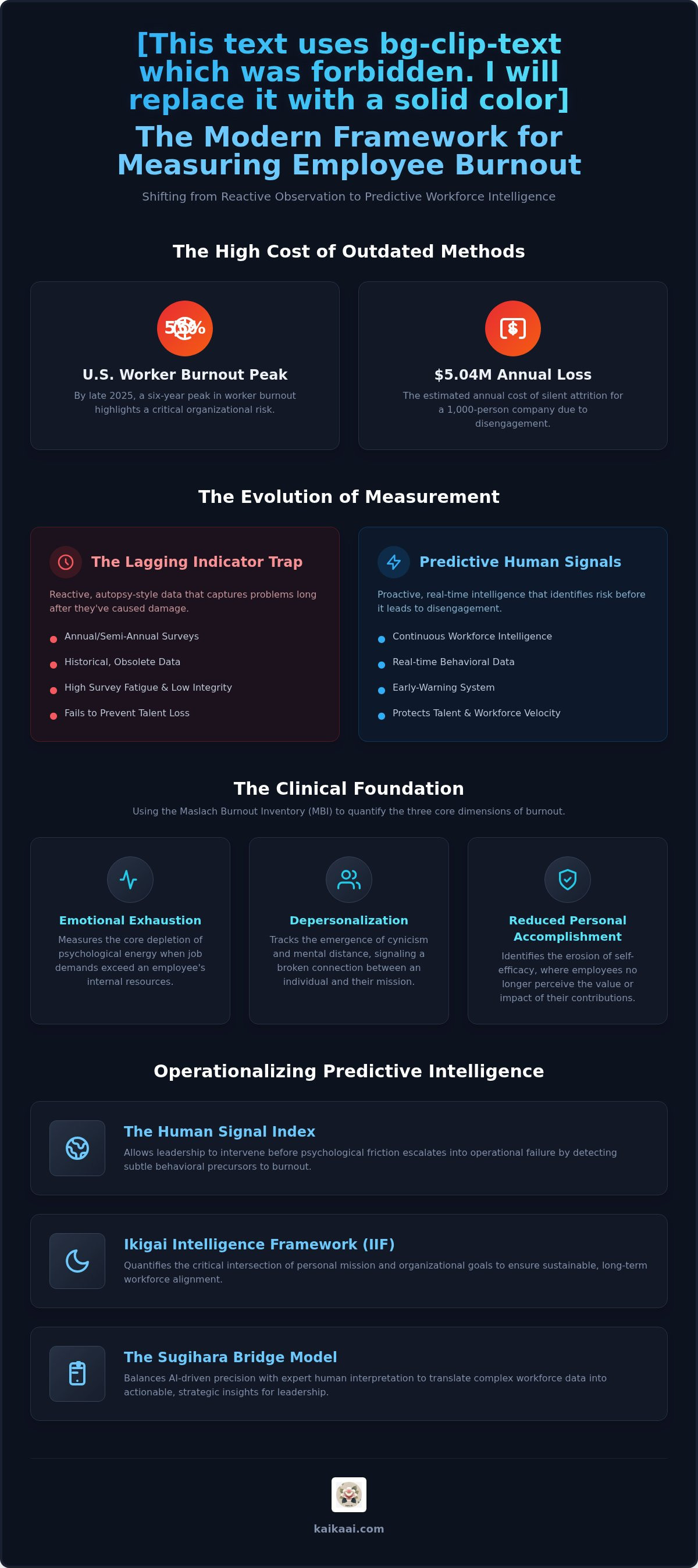
By late 2025, 55% of U.S. workers reached a six-year burnout peak, yet most leadership teams only recognize the damage when a resignation letter arrives. Traditional surveys are historical artifacts; they capture the smoke long after the fire has consumed your most vital talent. You likely agree that monitoring morale through annual snapshots is no longer sufficient for high-velocity enterprises. If you're searching for how to measure employee burnout with precision, you must move beyond autopsy-style data. Silent attrition occurs when the connection between personal mission and organizational output severs, leaving leaders with expensive vacancies and diminished velocity.
This article introduces a sophisticated framework to transition from reactive observation to predictive human signals. You'll learn to establish a clinical-grade early-warning system that identifies burnout risk before it leads to disengagement. We'll explore the measurable correlation between purpose and performance, providing you with a systematic architecture for workforce intelligence. By adopting these ethical, AI-driven methodologies, you can ensure your organization maintains the structural integrity required for long-term excellence and operational harmony.
Key Takeaways
- Transition from reactive, lagging indicators to a proactive architecture of predictive human signals to forestall silent attrition.
- Discover how to measure employee burnout by integrating validated clinical instruments with real-time behavioral data for a comprehensive risk profile.
- Quantify the critical intersection of personal mission and organizational goals using the Ikigai Intelligence Framework to ensure long-term workforce alignment.
- Identify subtle behavioral precursors through the Human Signal Index, allowing leadership to intervene before psychological friction scales into operational failure.
- Operationalize complex workforce intelligence using the Sugihara Bridge Model to balance AI-driven precision with expert human interpretation.
Understanding Burnout Measurement: The Evolution from Lagging to Leading Indicators
Burnout is not merely a psychological state; it is a structural failure within the enterprise architecture. When leadership views exhaustion as an individual's inability to cope, they ignore the systemic friction that erodes organizational resilience. To understand how to measure employee burnout effectively, executives must stop treating it as a static metric and start viewing it as a dynamic signal of misalignment. In a large scale organization, this misalignment manifests as silent attrition. This is a phenomenon where employees disengage long before they officially resign, costing a 1,000 person company approximately $5.04 million annually according to 2025 research data.
The WHO Definition and Its Operational Limitations
The World Health Organization identifies burnout in the ICD-11 as an occupational phenomenon resulting from chronic workplace stress that hasn't been successfully managed. While this Occupational burnout overview provides a necessary clinical baseline, it offers little tactical utility for the C-suite. The definition focuses on three dimensions: feelings of energy depletion, increased mental distance from one's job, and reduced professional efficacy. However, these are symptoms, not sources. Clinical definitions describe the state of a person who has already reached a breaking point. For leadership, the goal is not to diagnose a condition that already exists but to identify the systemic precursors that make that condition inevitable.
Why Traditional HR Analytics Miss the Signal
Most organizations rely on annual or semi-annual engagement surveys to gauge workforce health. This approach creates a "Lagging Indicator Trap" where the data collected is already obsolete by the time it's analyzed. High-stakes environments move too fast for retrospective snapshots. Traditional surveys often suffer from survey fatigue, leading to a decline in data integrity. When employees feel that their feedback doesn't result in structural change, they stop providing honest insights. Research suggests that perceived anonymity increases honest reporting of burnout symptoms by 3.2 times, yet traditional HR tools often fail to provide the psychological safety required for such transparency.
Workforce velocity is the rate at which an organization converts human potential into mission-aligned outcomes without compromising psychological safety. When this velocity drops, it's a primary indicator of rising burnout risk. Transitioning to a methodology of continuous workforce alignment intelligence allows leaders to see the "Signal before the Silence." By shifting from lagging autopsies to leading indicators, organizations can protect their most valuable assets before the friction of misalignment leads to irreversible talent loss.
Validated Survey Instruments: The Clinical Foundation of Burnout Assessment
Strategic leadership requires a clinical baseline to transform subjective feelings into objective, actionable data. When determining how to measure employee burnout, the Maslach Burnout Inventory (MBI) serves as the primary architectural baseline. It provides a validated structure to quantify the psychological erosion occurring within high-stakes environments. While the MBI is foundational, secondary instruments like the Oldenburg Burnout Inventory (OLBI) and the Copenhagen Burnout Inventory (CBI) offer additional layers of precision, particularly regarding work engagement and physical fatigue.
The Three Dimensions of the Maslach Burnout Inventory
The MBI assesses burnout across three specific axes of human experience, providing a comprehensive view of organizational health. Emotional exhaustion measures the core depletion of psychological energy, identifying where the demands of the role exceed the employee's internal resources. Depersonalization tracks the emergence of cynicism and detachment, signaling a breakdown in the connection between the individual and their mission. Finally, reduced personal accomplishment identifies the erosion of self-efficacy, where the employee no longer perceives the value or impact of their contributions. These metrics don't just describe a state; they predict a trajectory of disengagement.
Integrating Clinical Expertise into Enterprise SaaS
Moving these measurements from static surveys to a digital intelligence platform requires rigorous clinical oversight. Metrics like the EHSI (Clinical Burnout Risk) must be co-developed with clinical psychologists to ensure questions bypass cognitive biases and defensive responding. This psychological precision is what drives the 87% honesty rates observed in pilot studies. Without total anonymity and clinical validation, surveys become performance theater rather than intelligence tools. Research indicates that guaranteed anonymity increases honest reporting by 3.2 times, providing the raw data necessary for authentic intervention.
Integrating these clinical metrics allows leadership to establish a workforce resilience framework that functions as a structural early-warning system. This systematic approach ensures that burnout detection isn't left to chance or manager intuition. It's about building a sustainable architecture of performance. To begin evaluating your organization's current risk profile, consider an Alignment Audit to identify where clinical gaps may be obscuring your view of talent health.
The Human Signal Index: Detecting Burnout Patterns Before Disengagement
Traditional metrics fail because they capture the aftermath of exhaustion rather than the velocity of its approach. To understand how to measure employee burnout in a high-stakes environment, leadership must transition to real-time behavioral telemetry. The Human Signal Index (HSI) serves as this early-warning system, identifying the "Signal before the Silence." While lagging surveys wait for an employee to voice their distress, the HSI monitors the subtle shifts in organizational synchronization that precede disengagement. This predictive intelligence allows for structural intervention before friction scales into silent attrition.
The correlation between leading indicators of employee burnout and long-term retention is absolute. Recent data from 2026 indicates that 45% of frequent AI users report burnout, compared to 35% of non-users, suggesting that technological integration often increases workload pressure. By analyzing these micro-patterns, the HSI identifies where AI or operational complexity is adding unsustainable strain rather than driving efficiency. It creates a measurable distinction between high-velocity performance and the frantic, disorganized energy that signals impending collapse.
Surfacing Behavioral and Sentiment Signals
Detection begins with the analysis of workforce velocity and communication patterns. AI-driven intelligence identifies "purpose-friction" by tracking how daily operational tasks align with stated mission objectives. When communication becomes transactional and response patterns deviate from established baselines, the system flags a decline in psychological safety and engagement. These aren't just HR concerns; they are indicators of systemic instability. Identifying these patterns allows executives to adjust workloads or realign goals before the cumulative weight of chronic stress triggers a mass exit event.
The Employee Human Signal Index (EHSI)
The Employee Human Signal Index (EHSI) provides a clinically informed individual-level risk assessment. Co-developed with clinical psychologists, the EHSI translates complex behavioral data into a clear risk profile without compromising individual privacy. This index focuses on the intersection of personal resilience and organizational demand. In a 340-person pilot study, this early detection methodology successfully identified high-risk clusters, allowing for targeted leadership consultation that significantly reduced attrition risk. By maintaining 100% anonymity, the platform achieves the 87% honesty rate required for authentic workforce intelligence. This systematic approach ensures that the most talented contributors remain aligned with the organizational mission, protecting both human potential and enterprise performance.
Measuring Purpose-Alignment: The Ikigai Intelligence Framework (IIF)
Burnout often stems from a fundamental fracture between an individual's sense of purpose and their daily operational output. While workload is a contributing factor, the true catalyst for chronic exhaustion is the erosion of meaning. The Ikigai Intelligence Framework (IIF) provides the structural solution to this crisis. It redefines how to measure employee burnout by quantifying the "Purpose Gap" that exists when an employee's personal mission no longer intersects with the organization's trajectory. This misalignment creates a psychological friction that drains resilience far faster than high-volume tasks alone.
The Ikigai Alignment Score (IAS) provides a quantitative lens into this friction. It measures the synchronization between individual aspirations and corporate objectives, identifying where the connection has severed. During large-scale transformations, these gaps manifest as a 65% increase in burnout mentions in employee reviews, as recorded in the first quarter of 2026. Understanding how to measure employee burnout through the lens of purpose allows leaders to identify where mission-cascading has failed, enabling structural correction before the friction leads to a total loss of workforce velocity.
The Four Pillars of Workforce Alignment
The IIF evaluates alignment across four architectural pillars: what employees love, what they excel at, what the world requires, and what the organization incentivizes. When these pillars are out of equilibrium, the resulting strain is often misdiagnosed as simple fatigue. By quantifying the "Human Truth" beneath workforce data, leadership can identify specific departments where mission-cascading has fractured. Integrating aligning individual and organizational goals creates a natural psychological stamina, as employees find their daily efforts reinforced by a clear sense of contribution and professional fulfillment.
Building Systematic Synergy through Collective Kaizen
Alignment data is not a static report; it is the raw material for continuous improvement. By utilizing the executive guide to data-driven Kaizen platforms, organizations can transform burnout prevention into a discipline of performance synchronization. This methodology uses real-time alignment signals to drive Collective Kaizen Workshops, where teams collaboratively resolve the friction points that lead to exhaustion. This shift moves the organization from a defensive posture to one of proactive evolution, ensuring that workforce resilience is built into the very fabric of the operational model.
To secure the long-term integrity of your talent architecture, you must bridge these purpose gaps with precision. Deploy the Workforce Alignment Intelligence Platform to synchronize your human potential with your strategic mission.
Operationalizing Burnout Data: The Sugihara Bridge Model
Data without a framework for execution is merely noise. While understanding how to measure employee burnout through clinical and behavioral indices is vital, leadership must bridge the gap between raw intelligence and structural change. The Sugihara Bridge Model provides this essential architecture. It pairs the precision of the Workforce Alignment Intelligence Platform with expert human consultation to ensure that sensitive workforce signals are interpreted with the necessary nuance. This hybrid approach prevents the "Lagging Indicator Trap" by synthesizing AI-driven velocity with the strategic judgment required for responsible intervention.
Phase 1: Architectural Consultation and Alignment Audit
Execution begins with a comprehensive Alignment Audit. This initial phase identifies existing hotspots where chronic stress has already begun to erode performance. By establishing a division-level baseline for the IAS, HSI, and EHSI, leadership gains a clear map of the organization's psychological and operational terrain. This process is more than a diagnostic; it's about building executive-level buy-in for a "Signal before Silence" culture. It shifts the leadership mindset from reactive firefighting to proactive, data-driven synchronization.
Phase 2: Real-Time Monitoring and AI-Human Synthesis
Once the baseline is set, the Workforce Alignment Intelligence Platform provides a continuous stream of predictive insight. However, complex psychological strain signals don't exist in a vacuum. Human consultants play a critical role in this phase, identifying the cultural and operational contexts that AI might flag but cannot fully resolve. These experts facilitate Collective Kaizen Workshops, where teams use real-time data to collaboratively eliminate the friction points leading to exhaustion. This synthesis ensures that interventions are both technically accurate and human-centric, maintaining the honesty and trust required for high-integrity data.
Phase 3: Structural Framework Implementation and Resilience
The final phase involves hard-coding burnout prevention into the organizational architecture. Resilience isn't a temporary state; it's a structural property. By monitoring workforce velocity, leadership ensures that growth remains sustainable and that the alignment between personal mission and corporate goals stays intact. This systematic approach transforms "burnout prevention" into a core discipline of operational excellence. To begin your evolution toward a more synchronized, resilient workforce, you can request early access to the Kaika AI platform and start building your strategic early-warning system today.
Architecting a Future of Operational Harmony
Organizations can no longer afford to treat burnout as an inevitable byproduct of high performance. It's a structural misalignment that demands both a technical and philosophical solution. You've explored how to measure employee burnout by moving beyond retrospective surveys into a realm of predictive intelligence. By integrating the Ikigai Intelligence Framework with real-time behavioral signals, leadership can finally identify the "Signal before the Silence." This transition ensures that your talent remains synchronized with your strategic mission while maintaining psychological integrity.
This methodology represents a new clinical standard for the enterprise. Validated through a research partnership with Waseda University and co-developed with clinical psychologists, the platform achieves an 87% employee honesty rate. This level of transparency is essential for building authentic workforce resilience. It's time to move from reactive crisis management to a disciplined architecture of synchronization. Request Early Access to the Kaika AI Workforce Alignment Platform to begin your journey toward lasting organizational excellence. The future of global leadership belongs to those who treat human potential as a finite resource requiring precise stewardship.
Frequently Asked Questions
How is the EHSI different from a standard employee engagement survey?
The EHSI differs from standard surveys by providing a clinical-grade assessment of psychological strain rather than mere satisfaction. While traditional tools capture lagging sentiment, the EHSI uses indices co-developed with clinical psychologists to identify risk before it manifests as attrition. It transforms subjective feedback into an objective risk profile. This allows leadership to understand how to measure employee burnout through a lens of clinical validity rather than generic engagement scores.
Can AI accurately predict burnout without violating employee privacy?
AI predicts burnout by analyzing anonymized behavioral telemetry and communication patterns without compromising individual identities. The platform maintains 100% anonymity; this is why pilot studies show an 87% employee honesty rate. By focusing on aggregate Human Signals and divisional trends, the system identifies structural friction. This ensures that privacy is preserved while providing the executive team with the predictive intelligence needed for systemic intervention.
What is a "Human Signal" in the context of burnout measurement?
A Human Signal is a subtle, real-time behavioral precursor that indicates a shift in an employee's psychological or operational state. These signals include changes in communication cadence, workforce velocity, and mission-alignment levels. By detecting these patterns early, the system provides the "Signal before the Silence." This enables leaders to intervene during the early stages of strain before the individual reaches a point of total clinical exhaustion.
How does the Ikigai Alignment Score (IAS) correlate with employee retention?
The Ikigai Alignment Score (IAS) directly correlates with retention by quantifying the intersection of personal mission and organizational goals. When this score is high, employees possess the psychological stamina to navigate high-pressure environments. A declining IAS is a primary leading indicator of silent attrition. It signals that the purpose-connection has fractured, making the employee 2.6 times more likely to seek new opportunities outside the organization.
Why is the Sugihara Bridge Model necessary for interpreting burnout data?
The Sugihara Bridge Model is essential because it synthesizes AI precision with human strategic judgment. While algorithms are excellent at identifying patterns of strain, they lack the context to interpret complex organizational nuances. This model ensures that sensitive data leads to responsible action. By pairing automated intelligence with expert consultation, leadership can facilitate Collective Kaizen Workshops that address the root causes of misalignment rather than just the symptoms.
What is the "Signal before the Silence" philosophy?
The "Signal before the Silence" philosophy posits that employee disengagement is a gradual process with detectable behavioral warnings. Most leaders only recognize burnout when an employee becomes silent through resignation or complete withdrawal. This approach prioritizes the identification of early friction points. By capturing these precursors, organizations can implement structural changes to protect their talent architecture before the cost of turnover becomes a reality.
How often should an organization measure burnout risk?
Organizations should measure burnout risk continuously to maintain operational resilience in high-velocity markets. Waiting for annual or quarterly snapshots creates a Lagging Indicator Trap where the data is obsolete by the time leadership reviews it. Real-time monitoring allows for immediate adjustments to workload or mission-alignment. This proactive cadence is the most effective way to understand how to measure employee burnout while there is still time to prevent irreversible disengagement.
What industries benefit most from workforce alignment intelligence?
High-stakes industries with elevated chronic stress levels benefit most from workforce alignment intelligence. According to 2026 research, healthcare faces a 76% burnout rate, while technology and customer support sectors report rates of 71% and 74% respectively. These sectors require sophisticated tools to manage the high costs of executive and specialized talent turnover. Implementing a predictive framework helps these organizations protect their mission-critical human capital against systemic exhaustion.
Disclaimer
#Disclaimer
At Kaika AI, we believe the future belongs to organizations that combine human wisdom with artificial intelligence responsibly. The articles, research, insights, and thought leadership published on this website are intended to educate, inform, and encourage meaningful conversations about the future of work, organizational intelligence, AI, leadership, and innovation.
While our content is developed through rigorous research and may be generated, curated, or enhanced using artificial intelligence, every effort is made to ensure it reflects thoughtful analysis, practical relevance, and responsible AI practices. However, no representation or warranty is made regarding the completeness, accuracy, or suitability of the information for every individual or organizational circumstance.
The ideas, opinions, frameworks, and recommendations shared by Kaika AI are provided for educational and informational purposes only. They should not be interpreted as legal, financial, medical, psychological, human resources, cybersecurity, or other professional advice. Organizations and individuals should seek qualified professional guidance before making strategic, legal, or operational decisions.
Where articles reference third-party organizations, products, services, academic research, industry reports, or public data, such references are provided solely to support discussion and analysis. Unless explicitly stated, they do not imply endorsement, partnership, or affiliation.
Artificial intelligence is a powerful decision-support technology—not a replacement for human judgment. Kaika AI advocates for responsible, transparent, and human-centered AI adoption. We encourage readers to critically evaluate information, consider their unique context, and combine AI-generated insights with professional expertise and sound decision-making.
The content published on this website may be updated, revised, or removed as knowledge, technology, regulations, and best practices continue to evolve.
To the fullest extent permitted by applicable law, Kaika AI, its affiliates, contributors, and partners disclaim liability for any direct, indirect, incidental, consequential, or other losses arising from the use of, or reliance upon, the information provided on this website.
By accessing or using this website, you acknowledge that you have read, understood, and agree to this Disclaimer.
Kaika AI
'Building trusted organizational intelligence for the AI Era'


