
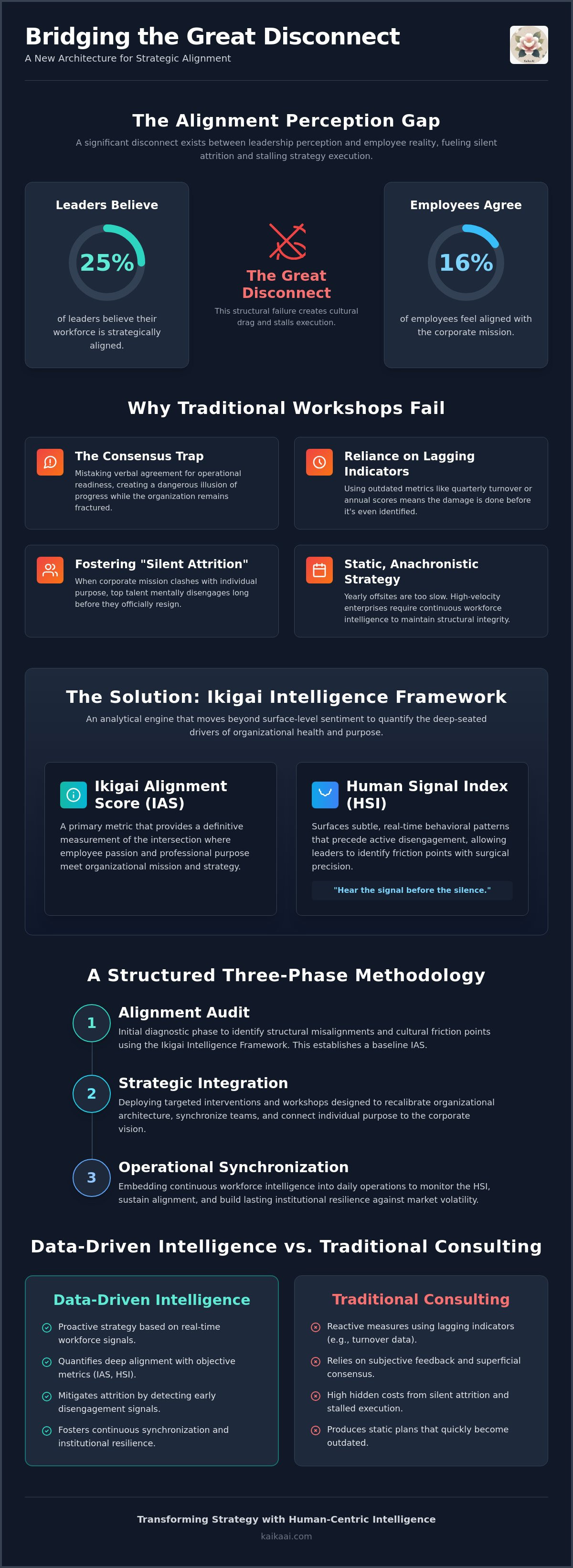
In 2026, while 25% of leaders believe their workforce is aligned, only 16% of employees agree. This "Great Disconnect" represents a structural failure that fuels silent attrition and stalls strategy execution, making the traditional strategic alignment workshop for executives feel increasingly obsolete. You've likely felt the friction when corporate mission fails to resonate with individual purpose. This creates a cultural drag that standard off-site retreats often fail to address, leaving leadership teams with a veneer of agreement that dissolves under operational pressure.
You can transform these static meetings into dynamic, AI-powered synchronization events that align purpose with performance. This article explores how to leverage the Ikigai Intelligence Framework to detect organizational signals before they turn into silence. We'll examine a three-phase methodology designed to produce a measurable alignment score, reduce attrition through early signal detection, and foster enduring cross-departmental synergy through architectural precision and human-centric intelligence.
Key Takeaways
- Identify the structural limitations of traditional consensus-based planning and why real-time data is essential for bridging the disconnect between leadership and execution.
- Discover how a data-driven strategic alignment workshop for executives employs the Ikigai Intelligence Framework to synchronize organizational mission with individual employee purpose.
- Evaluate the impact of the Ikigai Alignment Score as a primary metric for measuring organizational harmony and institutional resilience.
- Implement a structured three-phase methodology that transitions from initial alignment audits to full-scale operational synchronization.
- Adopt a "signal before silence" strategy to proactively identify cultural friction and mitigate the risk of high-performer attrition.
Beyond Consensus: Why Traditional Strategic Alignment Workshops Fail
Nodding heads in a boardroom don't guarantee results. Many leadership teams mistake verbal agreement for operational readiness, falling into the "Consensus Trap" where executives agree on a vision without verifying the structural capacity for execution. This superficial alignment creates a dangerous illusion of progress while the underlying machinery of the organization remains fractured. To solve these failures, one must first revisit the foundational question: What is Strategic Alignment? in a modern, data-driven context. It isn't just a shared goal; it's the precise synchronization of organizational architecture and human purpose.
To better understand this concept, watch this helpful video:
Traditional workshops rely on lagging indicators like quarterly turnover or annual engagement scores. By the time these metrics surface, the damage is already done. A modern strategic alignment workshop for executives must replace these reactive measures with real-time workforce signals. Relying on "vibe checks" and qualitative feedback leads to "Silent Attrition," a state where top talent mentally checks out long before they resign. Transitioning from these subjective assessments to quantitative leadership alignment metrics provides the clarity needed for proactive course correction.
The High Cost of Misaligned Purpose
When corporate mission clashes with individual Ikigai, the result isn't just burnout; it's a systemic drain on institutional energy. Large enterprises lose millions each year to stalled strategy execution caused by cultural friction. Workforce velocity is the speed at which aligned teams execute strategy. Without this momentum, brilliant plans fail at the first point of contact with the operational layer, leading to expensive delays and missed market opportunities.
From Static Strategy to Dynamic Synchronization
Yearly offsites are anachronistic in a high-velocity enterprise environment. You need continuous workforce intelligence to maintain structural integrity. This requires hearing the signal before the silence, identifying subtle shifts in employee sentiment before they manifest as attrition. This strategic alignment workshop for executives serves as a structural intervention that recalibrates organizational architecture. It moves beyond the boardroom and into the daily flow of global operations.
The Ikigai Intelligence Framework: A New Architecture for Alignment
The core of a high-performance strategic alignment workshop for executives isn't a slide deck; it's an analytical engine. We call this the Ikigai Intelligence Framework (IIF). It functions as the workshop's architectural foundation, moving beyond surface-level sentiment to uncover the deep-seated drivers of organizational health. By quantifying the alignment between individual purpose and corporate strategy, the IIF transforms subjective cultural goals into precise operational variables. It provides the structural clarity required to lead a global enterprise through periods of rapid evolution.
Central to this framework is the Ikigai Alignment Score (IAS). This metric provides a definitive measurement of the intersection where employee passion meets organizational mission. To achieve institutional resilience, leaders must adopt A Systems Perspective on Alignment, treating the workforce as a complex, interconnected architecture rather than a collection of isolated roles. Complementing the IAS is the Human Signal Index (HSI), which surfaces subtle behavioral patterns that precede active disengagement. These data points allow executives to identify friction points with surgical precision before they escalate into systemic failures.
Integrating Clinical Psychology into Strategy
Strategic planning often suffers from a "burnout blindspot," where high-performance expectations ignore the underlying psychological strain on talent. The Employee Human Signal Index (EHSI) addresses this by flagging early indicators of exhaustion and misalignment. Integrating clinically informed indices into executive governance ensures that strategy remains sustainable. This approach aligns with modern requirements for board-level burnout risk oversight, moving workforce well-being from a human resources concern to a core governance mandate. We prioritize responsible AI and ethical data use to ensure transparency and trust across the enterprise.
The Sugihara Bridge Model: Hybrid Intelligence
Pure data lacks the capacity for cultural interpretation. The Sugihara Bridge Model solves this by creating a synergy between AI-driven measurement and human-led consultation. While the platform detects the "what" of organizational misalignment, human experts provide the "why," interpreting sensitive workforce signals through the lens of institutional history. This hybrid approach is particularly critical for global corporations where cultural nuance and "Ba" (shared space) influence decision-making. By balancing technical intelligence with philosophical insight, leaders can build a more resilient organizational structure. To begin assessing your current structural health, consider scheduling an Alignment Audit to establish your baseline.
Measuring ROI: Data-Driven Intelligence vs. Traditional Consulting
Traditional executive retreats often yield a "consensus of convenience" rather than a synchronization of purpose. By replacing qualitative perception with high-integrity data, the strategic alignment workshop for executives transforms the ROI calculation from a theoretical exercise into an architectural audit. This transition moves the leadership team from managing by intuition to leading through workforce intelligence, ensuring that strategic investment yields measurable structural impact.
The following table illustrates the shift from legacy consulting models to the data-driven synchronization framework:
| Feature | Traditional Consulting | Data-Driven Synchronization |
|---|---|---|
| Primary Metrics | Lagging Indicators (NPS, Churn) | Leading Signals (IAS, HSI) |
| Data Source | Subjective Interviews/Surveys | AI-Powered Signal Detection |
| Leadership Goal | Boardroom Consensus | Operational Synchronization |
| Sustainability | Static Annual Reports | Continuous Intelligence Flow |
The efficacy of this intelligence-backed approach is anchored in the integrity of its data. Unlike standard engagement surveys that suffer from performative responses, the Ikigai Intelligence Framework achieves an 87% employee honesty rate. This transparency allows for the application of specific workforce resilience metrics that measure the structural stability of the organization, providing a definitive justification for workshop investment.
Predictive Attrition Intelligence
Traditional workshops are reactive, addressing friction only after it manifests as turnover. In contrast, data-driven synchronization identifies attrition risks six months before they occur by surfacing behavioral patterns that precede disengagement. The Human Signal Index acts as a leading indicator of organizational health, providing executives with the foresight needed to preserve institutional knowledge and reduce the exorbitant costs associated with emergency recruitment.
Quantifying Cross-Departmental Synergy
Silos are essentially information bottlenecks that impede workforce velocity and stall strategy execution. Utilizing workforce alignment software enables leadership to measure the flow of shared purpose data between disparate divisions. When cross-departmental rhythms are synchronized, the organization achieves a state of collective kaizen, ensuring every operational unit contributes to the overall structural integrity of the enterprise.
The Three-Phase Strategic Integration Methodology
Execution is a structural discipline. To move from static consensus to dynamic synchronization, an organization must follow a rigorous, phase-based methodology that bridges the gap between executive intent and workforce reality. This process begins with an Alignment Audit to establish a data-driven baseline. It then culminates in a strategic alignment workshop for executives where leadership teams transition from passive observers to strategic architects. Throughout this lifecycle, we maintain enterprise-grade security and strict compliance with Japanese privacy standards to ensure the integrity of the organizational signal.
Phase 1: Deep Signal Extraction
Most organizations suffer from "survey fatigue" because they ask the wrong questions. Our approach utilizes deep signal extraction to collect honest employee data without the friction of traditional polling. This measurement model is validated through our academic partnership with Waseda University, ensuring that the insights we gather are both scientifically sound and operationally relevant. By establishing the Human Signal Index (HSI) early, we set the stage for an Executive Consultation that is grounded in reality rather than boardroom assumptions. This phase allows us to detect the "signal before the silence," identifying hidden cultural friction before it impacts the bottom line.
Phase 2 & 3: From Mindset to Movement
The second phase is the Executive Synchronization, facilitated through a Collective Kaizen Workshop. Here, leadership teams analyze the Alignment Audit results to recalibrate their architectural mindset. We don't focus on superficial communication tactics; we focus on the structural synchronization of purpose and performance. Once the executive team is aligned, the focus shifts to Phase 3: Operational Resilience Training. This phase embeds the framework into the daily rhythms of the organization, ensuring that the insights gained during the workshop aren't lost to the momentum of daily operations.
Sustainability is maintained through our Workforce Alignment Intelligence Platform. This SaaS integration provides continuous performance monitoring, allowing leadership to scale the results of the workshop across global divisions. It ensures that the organization remains resilient in the face of market volatility by providing real-time visibility into workforce velocity. By treating alignment as a continuous process of refinement rather than a one-time event, enterprises can achieve a state of institutional harmony that drives long-term profitability. To begin this transformation, you can schedule an Executive Consultation to review your current organizational architecture.
Securing Early Access: The Path to Institutional Resilience
The 2026 workforce demands a shift from reactive management to proactive synchronization. As market volatility increases, the "signal before silence" approach becomes the only viable strategy for maintaining institutional resilience. This methodology empowers CHROs to move beyond administrative oversight and become strategic architects of human capital. By integrating workforce intelligence directly into the executive suite, organizations can detect the subtle vibrations of misalignment before they manifest as operational failure. Our long-term vision includes a dual listing on the Tokyo Stock Exchange (TSE) and the Australian Securities Exchange (ASX), cementing our position as the global category leader in alignment intelligence.
The Future of People Operations
People operations are undergoing a fundamental transformation. The focus is shifting from generic engagement metrics toward the synchronization of human purpose and organizational architecture. This evolution is driven by the sophisticated application of AI in employee engagement, which allows for real-time calibration of workforce velocity. Kaika AI leads this Japan-first global category, providing the high-integrity data needed for visionary leaders to build enduring harmony. It's time to move beyond the superficial and embrace a framework that respects both human potential and enterprise performance.
Requesting Your Executive Consultation
We're currently offering an early access program for enterprise partners ready to transition from traditional methods to data-driven synchronization. Your journey begins with a strategic alignment workshop for executives, tailored to the specific complexities of your global operations. During your initial strategic integration call, we'll outline the parameters of your Alignment Audit and identify the primary friction points within your current structure. This isn't a standard sales meeting; it's a high-level consultation designed to establish the roadmap for your organization's evolution. Access the Kaika AI platform today to request your consultation and secure your place in the next cohort of resilient enterprises.
Architecting Institutional Harmony
Strategic success depends on the precision of your organizational architecture. By moving beyond the consensus trap and embracing the Ikigai Intelligence Framework, you ensure that every operational layer resonates with your core mission. This transformation requires a shift from lagging indicators to real-time workforce signals, a process facilitated through our academic partnership with Waseda University. Our clinically informed EHSI index provides the predictive clarity needed to protect your talent from psychological strain while maintaining peak performance.
The strategic alignment workshop for executives serves as the critical intervention point for this evolution. It's the moment where leadership teams synchronize their architectural mindset with the data-driven reality of their workforce. With an NPS of 72 in pilot programs, our methodology demonstrates that institutional harmony isn't just a philosophical goal; it's a measurable business outcome. You have the opportunity to lead your enterprise toward a state of collective kaizen where purpose and performance exist in perfect balance.
Secure your organization's future and build a legacy of resilience. Request Early Access to the Kaika AI Alignment Platform today and begin your journey toward synchronized excellence. Your workforce is waiting for a mission that matters.
Frequently Asked Questions
What is a strategic alignment workshop for executives?
A strategic alignment workshop for executives is a high-level structural intervention designed to synchronize leadership vision with operational reality. Unlike traditional planning retreats, these events utilize data-driven frameworks to ensure that executive intent is compatible with the organization's architectural capacity. It focuses on removing the friction between corporate mission and employee purpose, creating a unified path for strategy execution across global divisions.
How does AI improve executive alignment compared to traditional methods?
AI transforms alignment from a static boardroom consensus into a dynamic, real-time synchronization of human capital. By processing vast quantities of workforce signals, AI identifies subtle patterns of cultural friction that traditional consulting often misses. This allows leadership to replace subjective "vibe checks" with objective intelligence, providing a clear window into the organization's structural health and its readiness for transformation.
How do you measure the success of an alignment workshop?
Success is quantified through the generation of a baseline alignment score and the subsequent stabilization of workforce velocity. We track the reduction of silent attrition signals and the measurable increase in cross-departmental synergy. These quantitative metrics provide a definitive ROI, demonstrating how a strategic alignment workshop for executives translates into reduced operational drag and enhanced institutional resilience.
What is the Ikigai Intelligence Framework (IIF)?
The IIF is a proprietary analytical core that measures the intersection of employee passion, individual purpose, and organizational mission. It functions as the workshop's architectural foundation, allowing leaders to visualize the structural integrity of their workforce. By quantifying these philosophical concepts, the framework provides executives with the precise data needed to align human potential with long-term enterprise performance.
How long does a strategic alignment integration take?
A standard integration follows a structured three-phase methodology that typically spans several weeks. This progression begins with a deep-signal alignment audit to establish the baseline, followed by the executive synchronization event. The final phase involves operational resilience training, which embeds the framework into the organization's daily rhythms to ensure that the synchronization remains sustainable across all levels of the enterprise.
Is employee data privacy protected during the alignment audit?
Privacy and ethical data use are foundational to our intelligence gathering process. We adhere to enterprise-grade security protocols and strict Japanese privacy standards to ensure that all workforce signals remain anonymized and secure. This commitment to transparency is essential for maintaining high honesty rates, as it fosters the institutional trust required for employees to provide authentic feedback.
What is the Sugihara Bridge Model in executive consulting?
The Sugihara Bridge Model is a hybrid intelligence approach that combines AI-driven measurement with human-centric consultation. It ensures that technical data insights are contextualized through the lens of institutional history and cultural nuance. This model allows leaders to interpret complex workforce signals with greater accuracy, ensuring that strategic decisions are both data-driven and philosophically grounded in human behavior.
How much does a strategic alignment workshop cost?
The investment for a strategic alignment workshop for executives depends on the scale of the organization and the complexity of the global synchronization required. Enterprise-level engagements are typically project-based, accounting for the depth of the initial audit and the scope of the subsequent operational training. Leadership teams should view this as a structural investment in institutional resilience and long-term strategy execution.
Disclaimer
#Disclaimer
At Kaika AI, we believe the future belongs to organizations that combine human wisdom with artificial intelligence responsibly. The articles, research, insights, and thought leadership published on this website are intended to educate, inform, and encourage meaningful conversations about the future of work, organizational intelligence, AI, leadership, and innovation.
While our content is developed through rigorous research and may be generated, curated, or enhanced using artificial intelligence, every effort is made to ensure it reflects thoughtful analysis, practical relevance, and responsible AI practices. However, no representation or warranty is made regarding the completeness, accuracy, or suitability of the information for every individual or organizational circumstance.
The ideas, opinions, frameworks, and recommendations shared by Kaika AI are provided for educational and informational purposes only. They should not be interpreted as legal, financial, medical, psychological, human resources, cybersecurity, or other professional advice. Organizations and individuals should seek qualified professional guidance before making strategic, legal, or operational decisions.
Where articles reference third-party organizations, products, services, academic research, industry reports, or public data, such references are provided solely to support discussion and analysis. Unless explicitly stated, they do not imply endorsement, partnership, or affiliation.
Artificial intelligence is a powerful decision-support technology—not a replacement for human judgment. Kaika AI advocates for responsible, transparent, and human-centered AI adoption. We encourage readers to critically evaluate information, consider their unique context, and combine AI-generated insights with professional expertise and sound decision-making.
The content published on this website may be updated, revised, or removed as knowledge, technology, regulations, and best practices continue to evolve.
To the fullest extent permitted by applicable law, Kaika AI, its affiliates, contributors, and partners disclaim liability for any direct, indirect, incidental, consequential, or other losses arising from the use of, or reliance upon, the information provided on this website.
By accessing or using this website, you acknowledge that you have read, understood, and agree to this Disclaimer.
Kaika AI
'Building trusted organizational intelligence for the AI Era'


