

A global survey of 700 executives confirms that leadership alignment is the single most critical predictor of success in enterprise-wide AI implementation. Despite this reality, many organizations continue to navigate high-stakes shifts using the blunt instruments of retrospective quarterly surveys and anecdotal sentiment. You require a more precise methodology to quantify executive synchronization. By implementing advanced leadership alignment metrics, you can transform abstract organizational harmony into a measurable vector of operational velocity and structural integrity.
You recognize the heavy cost of structural friction. You've likely seen strategic initiatives stall within departmental silos or watched high-performing talent succumb to the weight of misaligned expectations. It's a common executive burden to feel the gap between visionary intent and workforce execution widening. This guide promises to bridge that divide by introducing the sophisticated metrics required to monitor real-time organizational flow. We will detail the transition from outdated KPIs to a dynamic dashboard of leading indicators, providing the data-backed evidence needed to sustain collective resilience and strategic realization across your entire enterprise.
Key Takeaways
- Transition from lagging financial indicators to proactive leadership alignment metrics that quantify the precision of strategic execution in real time.
- Identify the hidden costs of the "Alignment Gap" by auditing whether resource allocation and budget expenditures truly mirror your stated corporate priorities.
- Monitor the synchronization between individual purpose and organizational goals to proactively identify burnout risks and maintain workforce velocity.
- Implement a structured, multi-phase Alignment Audit to map your current organizational architecture and establish a foundation for intelligence integration.
- Leverage AI-powered analytics to bridge the divide between high-level executive intent and daily operational flow across the entire enterprise.
The Architecture of Alignment: Why Traditional KPIs Fail Executives
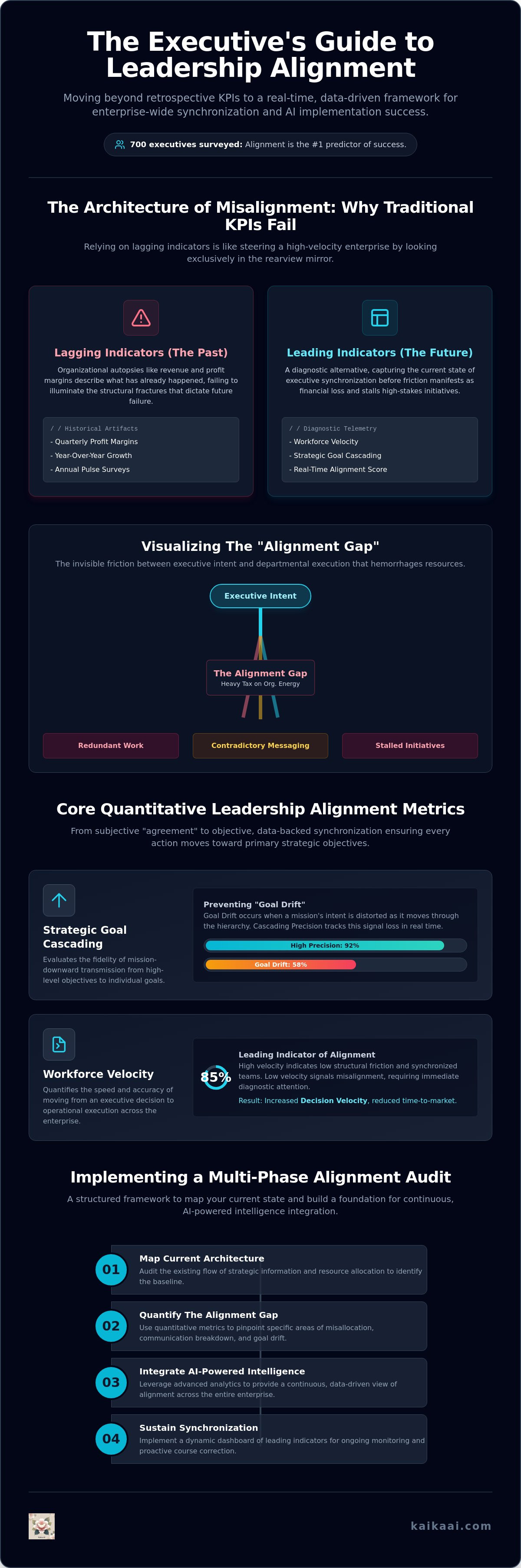
Traditional performance indicators are historical artifacts. Revenue, quarterly profit margins, and year-over-year growth function as organizational autopsies; they describe what has already transpired without illuminating the structural fractures that will dictate future failure. For the global executive, relying on these lagging indicators is a strategic risk. Real-time leadership alignment metrics offer a diagnostic alternative, capturing the current state of executive synchronization before friction manifests as financial loss. You can't steer a high-velocity enterprise by looking exclusively in the rearview mirror. You need to measure the structural integrity of your leadership team today.
The "Alignment Gap" is the silent killer of strategic intent. It's the invisible friction that occurs when leadership teams agree on a vision in the boardroom but diverge during departmental execution. This misalignment creates a heavy tax on organizational energy. It leads to redundant work, contradictory messaging, and stalled initiatives. Annual pulse surveys are insufficient to capture this. In a fast-paced environment, waiting twelve months to identify a breakdown in communication is a recipe for obsolescence. You need a continuous, data-driven view of how your strategy is being transmitted and received across the entire workforce.
The Limitations of Lagging Indicators
Profit margins don't tell the full story of leadership health. A department might hit its fiscal targets while simultaneously eroding its long-term viability through silent attrition. This phenomenon occurs when misaligned senior teams project a facade of agreement while harboring deep-seated strategic contradictions. Traditional metrics overlook this cross-departmental friction. They fail to measure the "Alignment Gap" that quietly hemorrhages resources and stalls high-stakes initiatives during the critical execution phase. If you're only looking at the balance sheet, you're missing the psychological and structural erosion that precedes a collapse.
Defining Organizational Synchronization
Alignment is not a static state of consensus; it's a measure of structural integrity. We define organizational synchronization as the precise calibration of mission-critical focus across every layer of the enterprise. It's the difference between a workforce that is merely busy and one that possesses high Workforce Velocity. By moving beyond superficial corporate buzzwords and adopting measurable leadership alignment metrics, executives can bridge the gap between strategic intent and operational reality. This transition shifts the focus from subjective "agreement" to objective, data-backed synchronization. It ensures that every resource is allocated with precision and every action moves the needle toward your primary strategic objectives.
Core Quantitative Leadership Alignment Metrics
Quantifying the intangible requires a transition from sentiment to systems. While the previous section established the necessity of moving beyond lagging indicators, the executive must now deploy specific, high-resolution leadership alignment metrics to secure the enterprise's structural integrity. These metrics function as the telemetry for your strategic engine, providing the empirical evidence required to determine if your executive team operates as a synchronized unit or a fragmented collection of high-performing silos. Precision in measurement is the only antidote to strategic drift.
Measuring Strategic Goal Cascading
Cascading Precision evaluates the fidelity of mission-downward transmission. It's a calculation of how accurately high-level strategic objectives are translated into departmental and individual goals. Without this metric, organizations suffer from Goal Drift, a phenomenon where the original intent of a global division or specialized unit becomes distorted as it moves through the hierarchy. A global survey of 700 executives confirms that alignment is the primary predictor of success in complex enterprise transitions, particularly in AI integration. By utilizing a Workforce Alignment Intelligence Platform, leaders can track these drifts in real time, identifying exactly where the signal is lost before it compromises the mission.
Operational Synergy and Velocity
Alignment is also revealed in the ledger through Resource Allocation Accuracy. If your stated strategic priority is digital transformation, yet your resource allocation remains tethered to legacy maintenance, a fundamental synchronization failure exists. Measuring the delta between strategic intent and actual capital expenditure provides a cold, data-driven reality check for any executive team. True synchronization requires that financial fuel is directed precisely toward the strategic engine's most critical components. When your budget, your timeline, and your leadership goals converge, you achieve the structural resilience necessary for global scale.
Qualitative and Behavioral Synchronization Indicators
Performance is ultimately a human outcome. While the quantitative telemetry established in the previous section provides the structural skeleton of an organization, qualitative indicators represent the pulse of the enterprise. We must move beyond the fallacy that behavioral synchronization is too subjective to measure. Sophisticated leadership alignment metrics now allow for the objective analysis of executive mindset and cultural resilience, turning abstract sentiment into actionable intelligence. This transition from feeling to fact is essential for maintaining integrity in high-stakes environments.
Cultural resilience is not a static trait. It's the measurable capacity for "Collective Kaizen," the systematic and continuous improvement of the organizational whole. When leadership is aligned, this resilience manifests as a self-correcting mechanism where friction is identified and resolved before it can metastasize into structural failure. Measuring this requires a deep dive into the synchronization of purpose and the psychological state of the leadership core.
The Purpose-Performance Correlation
Individual purpose and collective mission must exist in a state of high-resolution alignment. We define the "Purpose Gap" as the delta between an employee's intrinsic drivers and the organization's strategic objectives. When this gap widens, workforce velocity inevitably decays. Modern leadership alignment metrics utilize AI to identify these gaps at scale, providing executives with early warnings of strategic drift. This is not about superficial morale; it's about ensuring that the human energy of the enterprise is focused entirely on mission-critical outcomes. A leadership mindset that prioritizes this synchronization creates a natural state of organizational harmony that traditional management techniques cannot replicate.
Burnout as a Symptom of Misalignment
Burnout is rarely a result of high workload alone. It's more frequently a symptom of structural friction and psychological exhaustion caused by misaligned expectations. Predictive burnout analytics allow us to identify attrition risk at the leadership level by monitoring the behavioral markers of misalignment. When an executive team is out of sync, the resulting cognitive dissonance creates a mental health risk that can destabilize entire divisions. To mitigate this, organizations are increasingly turning to:
- Predictive Risk Identification: Using real-time data to spot the behavioral precursors of exhaustion.
- Operational Resilience Training: Equipping leaders with the tools to navigate high-pressure environments without losing strategic focus.
- Structural Friction Audits: Identifying the specific misalignments that are draining executive energy.
Implementing an Alignment Audit Framework
Strategic realization requires more than intent; it demands a disciplined, phase-based methodology for structural evolution. To effectively operationalize leadership alignment metrics, an enterprise must move through a methodical progression from assessment to integration. This architectural approach ensures that synchronization isn't a temporary state but a permanent feature of the organizational design. We view this transition as a three-phase journey toward operational resilience and mission-critical focus.
The diagnostic foundation of this journey is the Alignment Audit. This initial intervention identifies the specific gaps between executive vision and workforce execution. By mapping the existing architecture, leaders can pinpoint exactly where strategic velocity is lost. It's an uncompromising look at the structural integrity of the leadership core, providing the empirical baseline necessary for all future intelligence integration.
Phase 2: Intelligence Integration involves the deployment of real-time monitoring tools that connect the visionary core to the operational edge. This is where the Workforce Alignment Intelligence Platform becomes the central nervous system of the enterprise. By integrating these technical capabilities, leaders gain immediate visibility into the health of their strategic transmission. This phase bridges the gap between assessment and evolution, turning static data into dynamic, actionable intelligence.
The Structural Assessment Phase
Phase 1 focuses on mapping the existing alignment architecture. This involves auditing executive-level architectural consultations to ensure consistency across the C-suite. We meticulously trace the flow of information from the visionary core down to the operational front lines. This process allows us to identify "Silo Hotspots," those specific departmental junctions where strategic intent becomes diluted or distorted. By visualizing these bottlenecks, executives can begin the work of dismantling the barriers to collective synchronization. It's about establishing a clear, unobstructed path for mission-downward transmission.
Data-Driven Kaizen Cycles
The final phase moves the enterprise into a state of Strategic Evolution. This involves transitioning from periodic, one-off audits to continuous, data-driven improvement cycles. Collective Kaizen Workshops play a critical role here, fostering a culture of shared responsibility and systematic refinement. We establish a rigorous cadence for strategic integration reviews, ensuring that the organization remains resilient in the face of shifting global demands. This isn't a static achievement; it's a perpetual commitment to organizational harmony and operational excellence. By embedding these cycles into the corporate DNA, you secure a future of sustained velocity and uncompromising strategic realization.
The Kaika AI Approach: Precision Alignment at Scale
Precision in leadership is no longer a luxury of the patient. In a global landscape where 93% of AI leaders rely on their CHRO to bridge the gap between technology and human capital, the necessity for real-time visibility is absolute. Kaika AI provides the definitive architecture for this synchronization. By deploying advanced leadership alignment metrics through our Workforce Alignment Intelligence Platform, enterprises can finally move beyond the limitations of retrospective analysis into a state of predictive operational flow. This is the synthesis of systems engineering and organizational psychology, designed for the uncompromising executive.
Our methodology treats alignment as a dynamic vector rather than a static state. We utilize a three-phase strategic integration framework to ensure that every layer of the organization is calibrated for maximum velocity. This process reduces the structural friction that leads to silent attrition and stalled initiatives. By focusing on measurable structural impact, we help you transform your leadership team into a synchronized engine of strategic realization.
Workforce Intelligence for the Modern Enterprise
The Kaika AI platform functions as a high-resolution lens for organizational health. It distills complex behavioral data into a singular, authoritative "Alignment Score." This metric provides an immediate assessment of how effectively individual purpose is calibrated against the collective mission. As of July 2026, our platform remains available exclusively through an early access program for verified enterprises seeking to secure their strategic trajectory. This is not merely a monitoring tool; it's a comprehensive framework for data-driven strategic evolution that identifies burnout risks and productivity bottlenecks before they compromise the mission.
Operational Resilience and Strategic Integration
Achieving structural synchronization requires a balance of technical intelligence and human expertise. We combine our AI-powered analytics with a rigorous three-phase strategic integration methodology, supported by bespoke executive consultation. This ensures that the platform is architecturally integrated into your specific corporate governance structure rather than functioning as a superficial add-on. Security remains paramount in our design. Our systems are built to exceed Japanese privacy standards, providing the institutional reliability required for sensitive workforce data. By establishing real-time productivity metrics, you create a culture of transparency and resilience that sustains workforce velocity at scale.
Request early access to the Kaika AI Alignment Platform to begin your transition from fragmented execution to precision alignment.
Securing Your Strategic Trajectory through Structural Synchronization
The transition from anecdotal sentiment to empirical synchronization is a prerequisite for the modern, high-velocity enterprise. By adopting sophisticated leadership alignment metrics, you replace the inherent friction of departmental silos with the precision of workforce velocity. You've seen how real-time intelligence transforms abstract visionary intent into measurable operational flow. Now is the moment to move beyond passive observation and secure your organization's structural integrity.
Our three-phase strategic integration methodology provides the architectural framework required to sustain this evolution. With AI-powered burnout prediction and enterprise-grade security compliant with Japanese privacy standards, you can manage your most sensitive human capital data with absolute institutional reliability. This isn't merely about data collection; it's about the uncompromising pursuit of organizational harmony and strategic realization.
Request an Alignment Audit and discover your workforce velocity to begin your journey toward a more resilient, synchronized future. Your organization's potential is waiting to be fully realized.
Frequently Asked Questions
What are the most important leadership alignment metrics for large enterprises?
Leading leadership alignment metrics for large enterprises include Cascading Precision, Workforce Velocity, and Resource Allocation Accuracy. These indicators move beyond lagging financial results to measure the fidelity of strategic transmission across global divisions. Large organizations must quantify the delta between executive vision and frontline execution to maintain structural integrity. By monitoring these vectors, leadership teams can identify and resolve strategic drift before it impacts the bottom line.
How do you measure the alignment between individual and organizational goals?
Measuring the alignment between individual and organizational goals requires a Purpose-Performance Correlation analysis. This approach identifies the synchronization between an employee's intrinsic drivers and the enterprise mission. AI-powered tools now detect "Purpose Gaps" by analyzing behavioral data and task orientation. When individual purpose is architecturally integrated into organizational objectives, you achieve a self-sustaining state of high performance and collective resilience.
What is the difference between leadership alignment and employee engagement?
Leadership alignment is a measure of strategic synchronization while employee engagement focuses on emotional commitment. Alignment ensures everyone moves in the same direction; engagement ensures they have the energy to do so. You can have a highly engaged workforce that is misaligned, leading to high-energy activity that fails to achieve strategic goals. True organizational harmony requires both a shared vector and a motivated workforce.
Can AI accurately predict burnout risk caused by misalignment?
AI can accurately identify the behavioral markers of burnout risk specifically caused by structural misalignment. By monitoring patterns of friction and cognitive dissonance, leadership alignment metrics within intelligence platforms detect psychological exhaustion before it leads to attrition. It's a shift from reactive mental health support to proactive architectural correction. This predictive capability allows executives to intervene with operational resilience training before talent loss occurs.
How often should a leadership alignment audit be conducted?
An enterprise should initiate its synchronization journey with a comprehensive Alignment Audit to establish a definitive baseline. Following this structural assessment, organizations should transition to continuous, real-time monitoring. Traditional annual reviews aren't sufficient for high-velocity markets; you need a dynamic intelligence platform for persistent visibility. This ensures that leadership remains calibrated through every market shift and maintains the momentum required for strategic evolution.
What tools are available for tracking cross-departmental alignment in real-time?
Real-time tracking of cross-departmental alignment is best achieved through a Workforce Alignment Intelligence Platform. These systems provide executive dashboards that visualize Cross-Functional Synergy Scores and Decision Velocity across the entire enterprise. By integrating these tools, leaders can spot "Silo Hotspots" where information flow breaks down. This technical capability ensures that inter-departmental collaboration remains a measurable asset rather than a subjective hope.
How does leadership mindset impact workforce velocity?
Leadership mindset serves as the primary catalyst for workforce velocity. When the executive core is synchronized, the organization experiences reduced friction and accelerated project completion rates. A fragmented mindset at the top creates contradictory signals that stall execution and drain organizational energy. Cultivating a unified strategic mindset through Collective Kaizen Workshops, or by leading professional referral groups with Network In Action, ensures that every decision contributes to a cohesive, high-speed trajectory.
What is the ROI of improving executive leadership alignment?
The ROI of improved leadership alignment manifests as reduced executive turnover, faster strategic realization, and optimized resource allocation. Organizations that prioritize synchronization see a direct reduction in the "Alignment Gap" tax that quietly hemorrhages capital through redundant work. By securing the structural integrity of the leadership team, you protect your most valuable talent. It ensures that every dollar spent aligns perfectly with your highest strategic priorities.
Disclaimer
#Disclaimer
At Kaika AI, we believe the future belongs to organizations that combine human wisdom with artificial intelligence responsibly. The articles, research, insights, and thought leadership published on this website are intended to educate, inform, and encourage meaningful conversations about the future of work, organizational intelligence, AI, leadership, and innovation.
While our content is developed through rigorous research and may be generated, curated, or enhanced using artificial intelligence, every effort is made to ensure it reflects thoughtful analysis, practical relevance, and responsible AI practices. However, no representation or warranty is made regarding the completeness, accuracy, or suitability of the information for every individual or organizational circumstance.
The ideas, opinions, frameworks, and recommendations shared by Kaika AI are provided for educational and informational purposes only. They should not be interpreted as legal, financial, medical, psychological, human resources, cybersecurity, or other professional advice. Organizations and individuals should seek qualified professional guidance before making strategic, legal, or operational decisions.
Where articles reference third-party organizations, products, services, academic research, industry reports, or public data, such references are provided solely to support discussion and analysis. Unless explicitly stated, they do not imply endorsement, partnership, or affiliation.
Artificial intelligence is a powerful decision-support technology—not a replacement for human judgment. Kaika AI advocates for responsible, transparent, and human-centered AI adoption. We encourage readers to critically evaluate information, consider their unique context, and combine AI-generated insights with professional expertise and sound decision-making.
The content published on this website may be updated, revised, or removed as knowledge, technology, regulations, and best practices continue to evolve.
To the fullest extent permitted by applicable law, Kaika AI, its affiliates, contributors, and partners disclaim liability for any direct, indirect, incidental, consequential, or other losses arising from the use of, or reliance upon, the information provided on this website.
By accessing or using this website, you acknowledge that you have read, understood, and agree to this Disclaimer.
Kaika AI
'Building trusted organizational intelligence for the AI Era'


