
High-performance is not a byproduct of employee perks; it's an architectural outcome of synchronizing individual purpose with organizational mission. You've likely felt the weight of reactive tools that only capture dissatisfaction after your top talent has already checked out. This silent attrition is a symptom of a deeper structural misalignment that erodes the velocity of even the most ambitious firms. Integrating advanced high-performance culture software allows leadership to move beyond post-mortem data into a state of real-time organizational harmony.
We agree that survey fatigue has rendered many traditional HR tools obsolete for the modern executive. This resource promises to guide you through the transition from reactive sentiment gathering to predictive workforce alignment intelligence. We'll explore how the intersection of systems engineering and human psychology creates a framework where individual Ikigai fuels company goals. By analyzing the latest shifts in workforce analytics, we'll demonstrate how to build a culture of operational resilience and measurable excellence through precise, data-driven synchronization.
Key Takeaways
- Differentiate between passive employee engagement and active organizational alignment to move beyond superficial sentiment tracking.
- Utilize predictive intelligence to detect early behavioral signals of attrition and burnout before they impact organizational velocity.
- Implement high-performance culture software that integrates a proven framework to synchronize individual Ikigai with the corporate mission.
- Prioritize platforms with robust architectural integrity and enterprise-grade security to ensure long-term operational resilience.
- Transition from static annual reviews to real-time workforce alignment intelligence for more precise strategic execution.
Beyond Engagement: The Evolution of High-Performance Culture Software
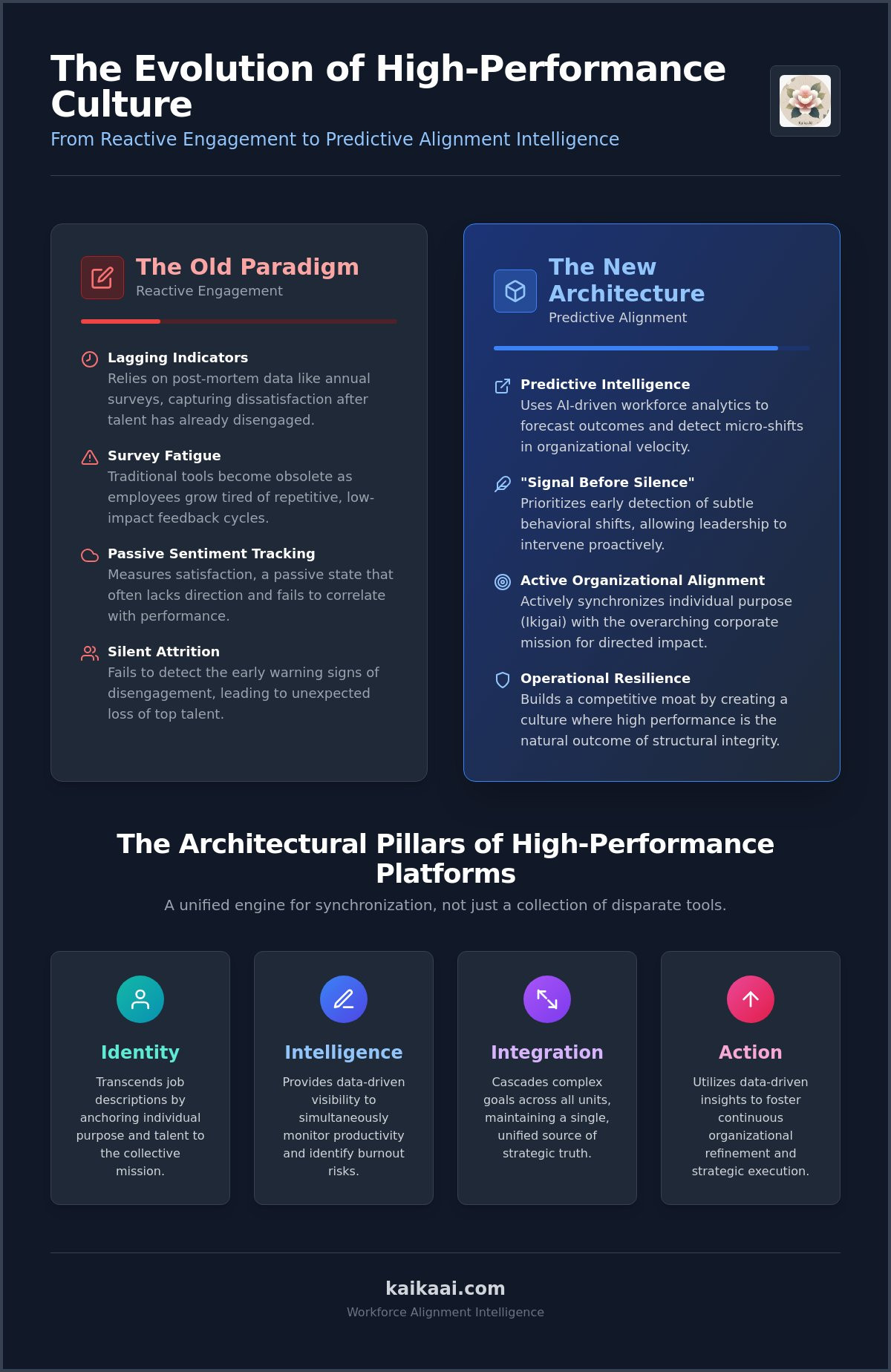
High-performance culture software is not a tool for measuring how employees feel on a Friday afternoon; it is a system for engineering structural alignment. Traditional HR departments have long relied on "engagement" as a proxy for success, yet engagement is often a passive state of satisfaction that lacks direction. True alignment is active synchronization. It requires the precise calibration of individual talent with the overarching corporate mission. When an organization functions as a High performance organization (HPO), every micro-action taken by a contributor advances a macro-strategic goal.
Legacy tools frequently fail because they act as lagging indicators. They document the "Architecture of Inertia" after momentum has already stalled. By the time an annual survey reveals dissatisfaction, the symptoms of poor organizational alignment have likely already manifested as silent attrition or stalled innovation. We advocate for a "Signal before silence" philosophy. This approach prioritizes the detection of subtle behavioral shifts while leadership still possesses the tactical window to intervene and realign.
To better understand the shift toward integrated performance systems, watch this helpful overview:
The Shift from Reactive to Predictive Culture
The transition into 2026 demands a departure from historical reporting. Predictive high-performance culture software utilizes workforce intelligence to identify micro-shifts in organizational velocity. Instead of asking what happened last quarter, these platforms predict what will happen next month. AI-driven analytics now surface patterns in communication and output that human observation might miss. This architectural approach ensures the corporate mission remains a living directive rather than a static document gathering dust in a digital folder.
Workforce Alignment as a Competitive Moat
Alignment is a primary driver of operational resilience. When individual purpose, or Ikigai, is successfully mapped to company objectives, the cost of attrition plummets. Top talent doesn't leave because of a lack of perks; they leave because of a lack of impact. Utilizing a Definitive Guide to Workforce Alignment Software allows executives to build a culture where performance is a natural outcome of structural integrity. This synchronization creates a competitive moat that is difficult for rivals to replicate through salary alone.
The Architectural Pillars of High-Performance Culture Platforms
Constructing an elite organization requires more than a collection of disparate HR tools. It demands a systematic architecture. While competitors often present features as an uncoordinated shopping list, effective high-performance culture software functions as a unified engine for synchronization. This architecture rests on four distinct pillars: Identity, Intelligence, Integration, and Action. Each pillar serves to reinforce the structural integrity of the enterprise, ensuring that strategic intent translates into operational reality without friction.
The Identity Pillar transcends traditional job descriptions by anchoring the individual to the collective mission. The Intelligence Pillar provides the data-driven visibility necessary to monitor productivity and burnout risk simultaneously. Through the Integration Pillar, leadership can cascade complex goals across global units and specialized divisions, maintaining a single source of truth. Finally, the Action Pillar utilizes data-driven Kaizen to foster continuous organizational refinement. This systematic approach is essential for building a high-performance culture that remains resilient under the pressures of global scale.
The Ikigai Alignment Framework
At the center of this architectural model is the Ikigai Intelligence Framework. This methodology moves beyond passive employee satisfaction to measure the intersection of what contributors love, what they excel at, and what the organization requires for growth. Modern high-performance culture software now quantifies this relationship through an Ikigai Alignment Score (IAS). By shifting focus toward purpose-role synchronization, executives can ensure that talent is not just occupied but deeply invested. If you're ready to evaluate your current structural health, consider undergoing a comprehensive Alignment Audit to identify hidden friction points.
Measuring Workforce Velocity and Synergy
Velocity is the speed of execution directed by strategic intent. High-growth environments require sophisticated workforce agility metrics that track how quickly teams adapt to shifting market demands. Real-time dashboards provide CHROs with the intelligence needed to eliminate organizational silos and foster cross-departmental synergy. This visibility allows leadership to detect micro-fluctuations in performance before they impact the bottom line, ensuring that the organization moves with precision and collective strength.
From Reactive Surveys to Predictive Intelligence: Detecting the Signal
Static data is a relic. In the era of high-performance culture software, relying on an annual review is akin to navigating a high-velocity market with a map from the previous decade. These historical snapshots fail to capture the fluid dynamics of a modern workforce. By the time leadership identifies a trend through traditional surveys, the institutional momentum has already shifted toward attrition. Executives now require a Human Signal Index (HSI) that surfaces disengagement while it remains a whisper, rather than waiting for the silence of a resignation letter.
Detecting these signals requires a shift toward clinically informed workforce analytics. We must move beyond simple productivity tracking to evaluate the psychological integrity of the organization. This entails utilizing indices that flag cognitive strain and burnout risk before they manifest as operational failure. Addressing the privacy paradox is paramount; responsible AI must protect the individual as much as it informs the institution. Transparency in data usage ensures that intelligence serves as a bridge, not a barrier, to organizational trust.
Burnout Prediction vs. Performance Monitoring
Sustainable high-performance cultures prioritize mental health as a core component of operational resilience. Monitoring output alone is insufficient. The Employee Human Signal Index (EHSI) serves as a specialized layer of intelligence designed for early intervention. By identifying leading indicators of employee burnout, leadership can adjust workloads and expectations before a critical talent loss occurs. This predictive capability transforms performance management from a punitive exercise into a protective strategy that preserves the company's most valuable intellectual assets.
The Honesty Rate: Why Psychological Safety Matters
Data is only as valuable as its accuracy. Traditional feedback formats often suffer from "honesty bias" where employees provide sanitized answers to avoid perceived repercussions. Trust-based design is the solution. Kaika AI achieved an 87% employee honesty rate in pilot studies by emphasizing a philosophy rooted in mutual respect and transparency. This distinction between "monitoring" and "listening" at scale creates a feedback loop where contributors feel safe sharing authentic insights. When employees trust the system, the resulting intelligence provides a crystal-clear reflection of organizational health, allowing for precise strategic calibration.
Strategic Evaluation: How to Select an Alignment-First Platform
Choosing high-performance culture software isn't a task for middle management. It's an executive directive that requires a focus on structural integrity over superficial aesthetics. Security serves as the bedrock. You must ensure rigorous compliance with global privacy standards to safeguard your talent data. Methodological depth is the next layer. If the software doesn't include a proven philosophical framework, such as Kaizen or Ikigai, it'll fail to drive sustainable change. A tool without a methodology is just a data collector without a soul.
Human-AI hybridity is a critical evaluation criterion. While AI excels at detecting micro-signals of friction, human judgment remains essential for interpreting the nuances of psychological strain. Scalability is the final hurdle for global organizations. Synchronizing mission in the AI era demands a system that maintains consistency across diverse cultural units while allowing for localized execution. To begin your transition toward predictive intelligence, request a consultation for our Workforce Alignment Intelligence Platform.
The Executive Selection Matrix
Technical interoperability isn't optional. Your platform must integrate seamlessly with your existing HRIS and communication stacks to prevent data silos. Strategic requirements should focus on the long game. You're looking for alignment trajectories that span quarters, not just ephemeral weekly pulses. Partnership requirements are the final piece of the matrix. Choose a vendor that provides more than a license; they should offer leadership mindset workshops that facilitate true cultural evolution.
Avoiding the "Feature Trap"
Feature bloat often masks a lack of strategic clarity. Don't get distracted by a long list of buttons that your team won't use. More features often lead to less organizational clarity. Prioritize platforms that emphasize a robust "Strategic Integration and Consultation" phase. This ensures the technology is configured to your specific organizational architecture. Investigate the vendor's academic pedigree. A partnership with institutions like Waseda University signals a commitment to rigorous, evidence-based development rather than chasing trendy corporate buzzwords.
Kaika AI: Synchronizing Individual Ikigai with Organizational Excellence
Kaika AI represents the definitive high-performance culture software for organizations that demand precision. It is not merely a tracking tool; it is a comprehensive Workforce Alignment Intelligence Platform. At its core lies the Ikigai Intelligence Framework (IIF). This system provides the structural clarity needed to bridge the gap between individual purpose and corporate objectives. We don't just measure engagement; we engineer synchronization. When individual talent is perfectly calibrated with the macro-strategy, the organization achieves a state of effortless velocity.
The Sugihara Bridge Model distinguishes our methodology from traditional analytics. While AI provides the precision of measurement, human expertise provides the depth of interpretation. We believe that sensitive behavioral signals require the nuanced judgment of seasoned leadership to be truly effective. This human-AI hybridity ensures that data translates into actionable wisdom rather than cold, disconnected metrics. Our academic partnership with Waseda University reinforces this commitment to rigorous, evidence-based frameworks that stand up to the complexities of global scale.
The efficacy of this approach is documented through measurable outcomes. In Tokyo-based enterprise trials, Kaika AI achieved an NPS of 72, reflecting deep institutional satisfaction. Pilot studies revealed an 87% employee honesty rate, proving that trust-based design yields superior data quality compared to legacy survey tools. These metrics reflect an organization in harmony. High completion rates signal that contributors see the platform as a bridge to their own fulfillment rather than a mechanism for surveillance.
The Three Pillars of Kaika AI Intelligence
Our platform utilizes three distinct indices to provide a holistic view of organizational health and performance:
- Ikigai Alignment Score (IAS): This metric quantifies the synchronization between individual purpose and the company's strategic mission, ensuring every contributor is positioned for maximum impact.
- Human Signal Index (HSI): This index provides behavioral foresight by detecting micro-shifts in workforce velocity before disengagement or attrition occurs.
- Employee Human Signal Index (EHSI): This specialized tool monitors psychological strain to maintain operational resilience and prevent burnout through early intervention.
The Path to Continuous Improvement
Evolution is a continuous process. By implementing data-driven Kaizen at the executive level, leadership can ensure that the organization remains agile and resilient. This isn't about incremental changes; it's about systematic refinement of the entire organizational architecture. The journey toward excellence begins with a clear understanding of your current structural health. We invite you to Request an Alignment Audit from Kaika AI to identify the friction points hindering your organizational velocity. Requesting early access to our platform is the final step in securing your competitive moat for 2026 and beyond.
Architecting the Future of Organizational Harmony
Strategic success in 2026 requires a departure from historical reporting. We've established that high-performance culture software must function as a predictive engine for synchronization; it shouldn't act as a passive repository for sentiment. By integrating the Ikigai Intelligence Framework, leadership can successfully bridge the gap between individual purpose and corporate mission. This architectural approach ensures your organization moves with collective velocity and resilient structural integrity.
The efficacy of this framework is validated by rigorous academic collaboration with Waseda University. Pilot results demonstrate the power of trust-based design, showing an 87% employee honesty rate and a remarkable NPS of 72 among Tokyo-based enterprise participants. These metrics represent more than just numbers. They indicate a workforce in total alignment. It's time to move beyond passive engagement and secure your competitive moat through active, data-driven harmony.
Request Early Access to the Kaika AI Alignment Intelligence Platform to begin your transition from reactive surveys to predictive excellence. The journey toward a synchronized, high-performance future begins with a single strategic realization.
To effectively evaluate the transition from traditional HR management to a synchronized intelligence model, executives should consider the structural differences in data application and organizational outcomes. The following table contrasts the capabilities of legacy systems with modern alignment intelligence.
| Capability | Legacy Engagement Tools | Alignment Intelligence Platforms |
|---|---|---|
| Data Orientation | Lagging; historical snapshots of sentiment. | Leading; predictive signals of behavior. |
| Core Objective | Passive satisfaction and morale tracking. | Active synchronization of talent and mission. |
| Organizational Impact | Reactive turnover reduction. | Proactive velocity and operational resilience. |
Frequently Asked Questions
What is the difference between engagement software and high-performance culture software?
Engagement software typically measures passive employee satisfaction and sentiment through reactive surveys. In contrast, high-performance culture software focuses on active organizational synchronization. It aligns individual purpose with the corporate mission to ensure every action contributes to macro-strategic goals. While engagement tools tell you how people feel, alignment intelligence shows you how effectively they're moving toward your objectives.
How does high-performance culture software predict employee burnout?
This technology utilizes specialized indices, such as the Employee Human Signal Index (EHSI), to monitor micro-shifts in workforce velocity and psychological strain. By identifying patterns of cognitive overload and diminishing engagement before they manifest as attrition, the software allows for early leadership intervention. This predictive approach transforms mental health from a reactive HR concern into a proactive component of operational resilience.
Is high-performance culture software compliant with international privacy standards?
Yes, enterprise-grade platforms are built with rigorous security protocols to ensure compliance with global and local privacy regulations. Responsible AI use is a core pillar of these systems, utilizing trust-based design to protect individual anonymity while providing leadership with aggregate workforce intelligence. This balance ensures that data collection serves as a tool for organizational harmony rather than a mechanism for invasive surveillance.
Can this software help with cross-departmental alignment in global companies?
High-performance culture software is specifically designed to eliminate organizational silos by cascading strategic goals across specialized divisions and global units. It creates a single source of truth that synchronizes diverse teams under a unified corporate identity. This visibility allows CHROs to track cross-departmental synergy in real time, ensuring that localized execution remains consistent with the overarching global mission.
How long does it take to see results from an alignment intelligence platform?
Initial visibility into behavioral signals and friction points is often immediate following the deployment phase. However, measurable shifts in structural alignment and cultural velocity typically emerge within three to six months of consistent use. The process usually begins with an Alignment Audit, which provides a diagnostic baseline for rapid tactical adjustments and long-term strategic integration.
What is the "Ikigai" philosophy and how does it apply to corporate culture?
Ikigai is a Japanese concept representing the intersection of what you love, what you're good at, what the world needs, and what you can be paid for. In a corporate context, it applies by synchronizing an employee's personal purpose with their professional role. When an organization utilizes this framework, it fosters a culture where individual fulfillment directly fuels the company's performance and resilience.
Does high-performance culture software replace traditional HR managers?
No, the software is a force multiplier for HR leadership rather than a replacement. It provides the predictive intelligence and data-driven visibility that human managers need to make informed, strategic decisions. While the AI detects micro-signals of friction, HR professionals provide the nuanced interpretation and human empathy required to realign teams and mentor talent effectively.
What is an "Alignment Audit" and why should my organization start with one?
An Alignment Audit is a comprehensive diagnostic evaluation of your organization's current structural health and mission synchronization. It identifies hidden friction points, communication gaps, and areas of purpose-role misalignment that hinder performance. Starting with an audit allows leadership to establish an evidence-based roadmap for evolution before committing to full-scale platform integration.
LinkedIn Summary:
Silent attrition and strategic misalignment are the primary inhibitors of organizational velocity in 2026. Discover how high-performance culture software is moving beyond reactive engagement surveys toward predictive workforce alignment intelligence. By synchronizing individual purpose (Ikigai) with the corporate mission, executives can build resilient, high-velocity organizations. Explore the architectural pillars of alignment and learn how Kaika AI is setting new standards for workforce honesty and operational excellence. #WorkforceAlignment #HighPerformanceCulture #ExecutiveLeadership #KaikaAI #IkigaiIntelligence
Disclaimer
#Disclaimer
At Kaika AI, we believe the future belongs to organizations that combine human wisdom with artificial intelligence responsibly. The articles, research, insights, and thought leadership published on this website are intended to educate, inform, and encourage meaningful conversations about the future of work, organizational intelligence, AI, leadership, and innovation.
While our content is developed through rigorous research and may be generated, curated, or enhanced using artificial intelligence, every effort is made to ensure it reflects thoughtful analysis, practical relevance, and responsible AI practices. However, no representation or warranty is made regarding the completeness, accuracy, or suitability of the information for every individual or organizational circumstance.
The ideas, opinions, frameworks, and recommendations shared by Kaika AI are provided for educational and informational purposes only. They should not be interpreted as legal, financial, medical, psychological, human resources, cybersecurity, or other professional advice. Organizations and individuals should seek qualified professional guidance before making strategic, legal, or operational decisions.
Where articles reference third-party organizations, products, services, academic research, industry reports, or public data, such references are provided solely to support discussion and analysis. Unless explicitly stated, they do not imply endorsement, partnership, or affiliation.
Artificial intelligence is a powerful decision-support technology—not a replacement for human judgment. Kaika AI advocates for responsible, transparent, and human-centered AI adoption. We encourage readers to critically evaluate information, consider their unique context, and combine AI-generated insights with professional expertise and sound decision-making.
The content published on this website may be updated, revised, or removed as knowledge, technology, regulations, and best practices continue to evolve.
To the fullest extent permitted by applicable law, Kaika AI, its affiliates, contributors, and partners disclaim liability for any direct, indirect, incidental, consequential, or other losses arising from the use of, or reliance upon, the information provided on this website.
By accessing or using this website, you acknowledge that you have read, understood, and agree to this Disclaimer.
Kaika AI
'Building trusted organizational intelligence for the AI Era'


