
What if the most influential person in your organization doesn't appear on your organizational chart? For many executives, the formal hierarchy is a comfortable fiction that masks the complex reality of how work actually gets done. You've likely felt the impact of silent attrition when a key connector leaves unexpectedly. Integrating a sophisticated workforce intelligence platform changes this dynamic by surfacing the human signal before it becomes silence. It allows leadership to move beyond structural blind spots and manage the organization as a high-velocity, synchronized system.
In this guide, you'll discover how to leverage Organizational Network Analysis (ONA) software to visualize hidden collaboration patterns and prevent the loss of unrecognized influencers. We'll provide an architectural framework for synchronizing individual purpose with corporate mission through measurable alignment. By the end, you'll understand how real-time visibility into organizational health transforms cultural change into a strategic outcome. We'll examine the transition from descriptive reporting to predictive alignment using the Sugihara Bridge Model, ensuring your corporate architecture supports both operational resilience and human potential.
Key Takeaways
- Map the invisible architecture of your organization to reveal how influence and collaboration flow beyond the limitations of formal hierarchies.
- Balance active survey data with passive metadata to create a multidimensional view of organizational health and communication velocity.
- Detect early warning signals of burnout and silent attrition by identifying isolated nodes and overextended central connectors within the network.
- Select a high-compliance workforce intelligence platform that prioritizes measurable alignment and structural integrity over basic productivity tracking.
- Apply a structured framework to synchronize individual employee purpose with the corporate mission, fostering enduring operational resilience.
What is Organizational Network Analysis Software?
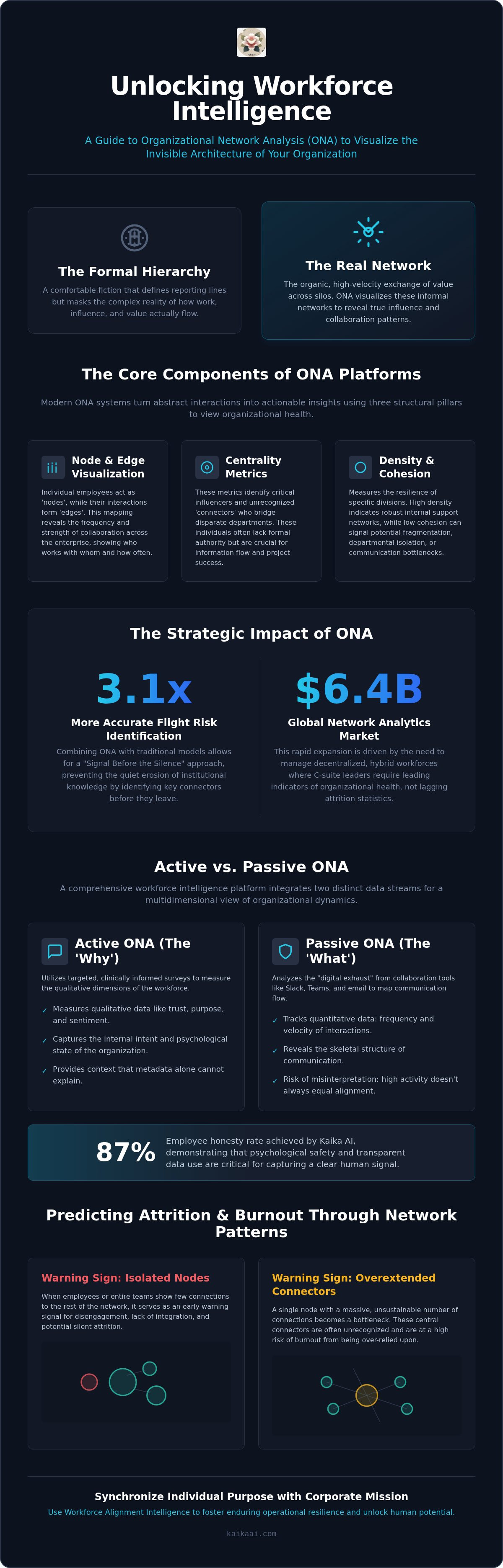
Organizational Network Analysis (ONA) software is a high-precision diagnostic tool designed to map the invisible architecture of human interaction. While a traditional organizational chart defines formal reporting lines, it fails to capture the organic, high-velocity exchange of value that occurs across silos. ONA visualizes these informal networks of influence and communication to reveal how work actually flows. By shifting from static annual surveys to a real-time workforce intelligence platform, executives gain immediate visibility into the structural integrity of their teams. This represents the emergence of Workforce Alignment Intelligence. It's a strategic category defined by the synchronization of operational data with human purpose.
The Core Components of ONA Platforms
Modern ONA systems utilize sophisticated data modeling to turn abstract interactions into actionable insights. Just as modern marketing relies on multi-touch attribution software UK to identify value across customer journeys, these platforms apply similar attribution logic to internal networks to reveal which interactions drive the most organizational value. These platforms rely on three structural pillars to provide a comprehensive view of organizational health:
- Node and edge visualization: Individual employees act as nodes, while their interactions form edges. Mapping these connections reveals the frequency and strength of collaboration across the enterprise.
- Centrality metrics: These identify critical influencers and "the Mitchells." These are the unrecognized connectors who bridge disparate departments but often lack formal authority.
- Density and cohesion: These metrics measure the resilience of specific divisions. High density indicates robust internal support; low cohesion signals potential fragmentation or departmental isolation.
Why Enterprises are Adopting ONA in 2026
The global network analytics market is currently valued at approximately $6.4 billion. This rapid expansion is driven by the necessity of managing decentralized, hybrid workforces where physical proximity no longer dictates collaboration patterns. C-suite leaders are moving away from lagging attrition statistics toward leading indicators of organizational health. Identifying a key connector before they burn out is a strategic imperative rather than a tactical HR function.
Research indicates that combining ONA with traditional models makes identifying flight risk 3.1 times more accurate. This level of precision allows for a "Signal before the Silence" approach. It prevents the quiet erosion of institutional knowledge by recognizing those who facilitate the most work. A robust workforce intelligence platform ensures that these high-potential influencers are protected and aligned with the corporate mission. It transforms culture from a vague concept into a measurable structural asset.
Active vs. Passive ONA: Navigating the Workforce Intelligence Spectrum
Modern leadership requires a dual-lens approach to organizational visibility. A comprehensive workforce intelligence platform integrates two distinct data streams: active and passive. Active ONA utilizes targeted, clinically informed surveys to measure qualitative dimensions such as trust, purpose, and sentiment. Passive ONA analyzes the "digital exhaust" from collaboration tools like Slack, Microsoft Teams, and email. While passive data reveals the skeletal structure of communication, active data captures the internal intent of the organization. Balancing these streams allows for a multidimensional understanding of how workforce dynamics influence strategic execution.
Data integrity depends entirely on psychological safety. Adhering to rigorous Japanese privacy standards and global protection protocols ensures that data collection serves collective evolution rather than invasive surveillance. Kaika AI achieves an 87% employee honesty rate by explicitly prioritizing this foundation of trust. When employees recognize that their input fuels organizational harmony and individual growth, the human signal becomes remarkably clear. It's this transparency that transforms raw metadata into a strategic asset for the C-suite.
The Limitations of Purely Passive Data
Activity doesn't equate to alignment. Metadata tracks the frequency and velocity of interaction, but it frequently misses the human truth behind the exchange. A high volume of messages between departments might indicate robust collaboration; conversely, it could signal a breakdown in processes that requires constant, redundant clarification. Without an active lens, executives risk misinterpreting digital noise as productive output. True workforce intelligence requires understanding the purpose behind the connection to ensure that high activity actually generates corporate value. Just as internal communication requires clarity, your external digital channels should be built with clear intent; you can visit Eclipse Workshop by Keanu to explore professional media and development services that align with your business goals.
The Ikigai Intelligence Framework (IIF) Approach
The IIF methodology bridges the gap between individual purpose and corporate mission through precise measurement. By calculating the Ikigai Alignment Score (IAS), leaders can quantify how deeply employees connect their personal "why" to organizational objectives. This metric is supplemented by the Human Signal Index (HSI), which identifies subtle behavioral shifts long before they manifest as attrition or burnout. Integrating these proprietary indices into high-performance culture software creates a systemic environment for sustainable growth. It moves the enterprise from reactive management to a state of predictive synchronization. For organizations ready to identify hidden friction points, conducting an Alignment Audit provides the necessary baseline for this strategic evolution.
Predicting Attrition and Burnout through Network Patterns
Network position is a primary determinant of employee well-being and retention. A sophisticated workforce intelligence platform does more than map connections; it serves as a predictive diagnostic for organizational resilience. By analyzing the structural integrity of the human network, leadership can identify psychological strain long before it manifests as a resignation letter. This proactive visibility allows CHROs to transition from reactive damage control to a "Signal before the Silence" strategy. Understanding these patterns is essential for maintaining the high-velocity synchronization required in global enterprises.
Peripheral isolation occurs when individuals drift toward the network edge. These employees often lack the necessary social capital to navigate complex projects, leading to a gradual erosion of belonging. Conversely, connector burnout represents a different structural risk. Central nodes who facilitate excessive cross-departmental flow often face unmanageable cognitive loads. They become single points of failure. When these "Mitchells" experience strain, the entire network's velocity decreases. Executives must monitor these nodes to prevent the systemic collapse of information flow. For a deeper analysis of these risks, refer to our guide on the leading indicators of employee burnout.
The Employee Human Signal Index (EHSI)
The EHSI represents a significant advancement in workforce intelligence. Developed in partnership with clinical psychologists, this index detects subtle shifts in psychological strain within the network architecture. It moves beyond basic activity tracking to evaluate the quality of human interaction. Ethical data use remains the cornerstone of this methodology. By utilizing aggregated, anonymized data, the platform flags departmental risks without compromising individual privacy. This clinically-informed approach ensures that interventions are grounded in human psychology rather than just digital metadata. It provides the intellectual depth necessary for serious executive leadership.
Visualizing the Signal Before the Silence
Quiet quitting is not an invisible phenomenon. It manifests as a measurable decay in network centrality and a reduction in the density of informal connections. When an individual's "Human Signal" weakens, it often indicates a misalignment between their personal purpose and the corporate mission. CHROs can use these behavioral shifts as leading indicators to trigger strategic interventions. Actionable steps include conducting targeted Kaizen workshops to re-synchronize team goals or re-evaluating workload distribution for overextended connectors. Maintaining operational resilience requires this level of precision. It ensures that the organizational architecture remains both robust and harmonized with the human potential it houses.
Selecting Organizational Network Analysis Software: A Checklist for CHROs
Selecting the right workforce intelligence platform is a high-stakes architectural decision that dictates the future of organizational synchronization. CHROs must look beyond basic collaboration volume to identify tools that offer deep structural insights. It's not enough to track how many messages are sent; you must understand if those interactions drive the corporate mission. Prioritize platforms that measure structural alignment and synergy across departments to ensure your corporate architecture remains robust. This is the standard of Workforce Alignment Intelligence.
When evaluating potential solutions, leadership should focus on institutional reliability and data integrity. High-compliance environments require platforms that meet rigorous Japanese privacy standards. This is especially critical for organizations targeting dual listing on the TSE/ASX by 2032. The checklist for a sophisticated enterprise solution includes:
- Alignment over Activity: The software must distinguish between redundant digital noise and value-generating collaboration using indices like the IAS.
- Security and Compliance: Verification of enterprise-grade security protocols that protect sensitive human capital data.
- Cross-Departmental Synergy: Reporting that quantifies how effectively information flows between traditionally siloed divisions.
- Real-Time Velocity: The ability to move from periodic reporting to continuous, live dashboards of organizational health.
The Sugihara Bridge Model: Why Software Alone is Not Enough
Raw AI data provides the necessary signal, but executive-level architectural decisions require human wisdom. The Sugihara Bridge Model acts as the delivery architecture for this strategic insight. It bridges the gap between technical intelligence and operational execution by utilizing expert consultants to interpret sensitive workforce signals. This hybrid approach respects the cultural nuances inherent in global organizations that pure software often misses. It ensures that data leads to meaningful evolution rather than just observation. Without this human bridge, the most sophisticated data remains a set of disconnected metrics.
Technical Integration and Scalability
A robust solution must integrate seamlessly with existing HRIS and productivity suites to provide a unified view of the enterprise. This integration allows for the consistent tracking of workforce resilience metrics alongside traditional financial KPIs. Real-time dashboards enable leadership to monitor the structural integrity of the organization with the same precision applied to supply chain management. This continuous visibility ensures that the organization remains agile and responsive to shifting market demands. For leaders ready to refine their organizational architecture, our Executive Consultation services provide the framework for this high-level selection process.
Kaika AI: The Future of Workforce Alignment Intelligence
Kaika AI stands as the definitive category leader in workforce alignment. It provides a sophisticated workforce intelligence platform that transcends simple connectivity mapping. The methodology we employ utilizes a three-phase framework designed for large-scale enterprise success. This process ensures that the transition from raw data to operational harmony is both methodical and architectural. During the initial diagnostic phase, we establish a baseline of organizational health. The synchronization phase then aligns individual purpose with the corporate mission. Finally, the resilience phase embeds these patterns into the institutional fabric. In our recent pilot studies, we achieved a Net Promoter Score (NPS) of 72 and an 87% employee honesty rate. These figures demonstrate that prioritizing the human signal generates unprecedented data integrity. We invite forward-thinking executives to request early access to this framework to begin their journey toward data-driven Kaizen.
The Power of Collective Kaizen
ONA software serves as the primary engine for continuous performance management. While traditional models focus on the individual, Kaika AI emphasizes organizational synergy. Our methodology recognizes that the most profound insights emerge from the collective network rather than isolated performance reviews. Collective Kaizen Workshops allow leadership to develop the necessary mindset for structural alignment. These sessions move beyond superficial training; they address the deep intersection of technology and human behavior. By fostering a culture of continuous improvement, the enterprise gains the velocity required to navigate global complexities. It's about building a system where individual excellence and corporate mission are perfectly synchronized. This approach ensures that every employee understands their role in the broader organizational architecture.
Strategic Vision for 2032 and Beyond
The roadmap for our evolution is built on a foundation of institutional resilience and academic rigor. Through our partnership with Waseda University, we continue to refine the psychological indices that power our platform. Utilizing the Ikigai Intelligence Framework (IIF), Kaika AI aims for global category leadership and a dual listing on the TSE/ASX by 2032. This vision is not just about growth. It's about proposing a comprehensive framework for organizational evolution. We're building the infrastructure for a future where leadership is informed by the precise synchronization of human potential. Our delivery architecture utilizes the Sugihara Bridge Model to ensure that technical intelligence translates into executive action. Maintaining this level of excellence requires a partner that understands the nuances of a global scale. Join the movement to hear the signal before the silence. Request an Alignment Audit today to secure the structural integrity of your workforce.
Synchronizing the Human Signal for Global Resilience
Modern leadership requires more than structural observation; it demands the precise synchronization of human potential with corporate mission. By adopting a sophisticated workforce intelligence platform, executives can transition from reactive crisis management to predictive alignment. Our Tokyo-based pilot demonstrated the efficacy of this approach, achieving an NPS of 72 and an 87% employee honesty rate. These results prove that when employees feel psychologically safe, the data signal becomes a strategic asset rather than a surveillance tool. The clinically-informed EHSI provides the necessary depth for early burnout detection, ensuring your key connectors remain resilient and cross-departmental silos remain bridged. This isn't just about operational efficiency; it's about the long-term architectural integrity of your global organization. The ability to hear the human signal before it fades into silence is what defines the next generation of visionary leadership. We invite you to Request Early Access to the Kaika AI Workforce Alignment Platform and begin your journey toward data-driven Kaizen. Your organization's future depends on the signals you choose to prioritize today.
Frequently Asked Questions
What is the primary difference between ONA and traditional HR analytics?
Traditional HR analytics focus on linear, individual data points like tenure or salary. Organizational Network Analysis evaluates the relational architecture of the enterprise. It maps the informal connections that dictate how information actually flows across departments. While standard analytics provide a static snapshot of the workforce, a workforce intelligence platform offers a dynamic view of the living network. This allows leaders to manage the organization as a synchronized system rather than a collection of isolated roles.
How does ONA software protect employee privacy in passive data collection?
Security is maintained by analyzing metadata instead of private message content. The software tracks the frequency and timing of interactions without ever accessing the text of emails or chats. Adherence to rigorous Japanese privacy standards ensures that all data is aggregated and anonymized. This protects individual identity while providing CHROs with clear visibility into departmental health. Ethical data use is the foundation of high-performance culture, ensuring that intelligence serves collective growth rather than surveillance.
Can ONA software really predict when an employee is about to quit?
Prediction is achieved by identifying subtle shifts in network centrality and peripheral drift. When an employee's connections begin to decay, it signals a loss of belonging or alignment. Research indicates that ONA models are 3.1 times more accurate at identifying flight risk than traditional attrition models alone. By detecting these leading indicators, leadership can intervene before the silence of a resignation occurs. It transforms retention from a reactive HR function into a predictive strategic capability.
What are the Mitchells in an organization and why do they matter?
"The Mitchells" represent the unrecognized high-impact connectors who bridge disparate silos within the organization. These individuals often lack formal leadership titles but facilitate the majority of cross-departmental collaboration. They are critical because they prevent information bottlenecks and maintain operational velocity. Identifying these connectors is essential for preventing systemic burnout. If a Mitchell leaves, the resulting loss of social capital can significantly slow down strategic execution and erode institutional knowledge across multiple divisions.
How long does it take to see ROI from an ONA implementation?
Strategic insights usually emerge within the first 90 days of implementation. Executives can immediately identify hidden silos and overextended connectors during this period. Measurable ROI, such as reduced attrition costs and improved project velocity, typically manifests within six to twelve months. The value scales as the organization applies the Sugihara Bridge Model to synchronize its human architecture. Long-term gains include enhanced operational resilience and a more precise alignment between individual purpose and corporate objectives.
Is ONA software suitable for small teams or only large enterprises?
Large enterprises with complex, decentralized structures gain the most significant value from these platforms. While small teams can track relationships manually, organizations with over 500 employees face structural blind spots that only ONA can reveal. A workforce intelligence platform is essential for global corporations where physical proximity no longer dictates collaboration. It provides the necessary visibility to manage scale without losing the human touch. It ensures that the organic network remains synchronized across vast distances.
How does the Ikigai Alignment Score differ from standard engagement scores?
Standard engagement scores capture temporary employee sentiment or job satisfaction. The Ikigai Alignment Score (IAS) measures the deep synchronization between an individual's personal "why" and the corporate mission. It's a structural metric rather than a psychological snapshot. High alignment indicates that work serves both the employee's purpose and the organization's goals. This creates a sustainable foundation for performance that standard engagement surveys often miss. It focuses on enduring harmony rather than fleeting satisfaction.
What is the Sugihara Bridge Model and why is it necessary?
This model is the delivery architecture that bridges the gap between raw AI data and executive action. It's necessary because data alone cannot account for the cultural nuances of a global workforce. By combining technical intelligence with human expert consultation, the model ensures that insights lead to meaningful architectural evolution. It provides a structured framework for interpreting sensitive human signals. This ensures that leadership decisions are both data-driven and grounded in established organizational psychology principles.
Disclaimer
#Disclaimer
At Kaika AI, we believe the future belongs to organizations that combine human wisdom with artificial intelligence responsibly. The articles, research, insights, and thought leadership published on this website are intended to educate, inform, and encourage meaningful conversations about the future of work, organizational intelligence, AI, leadership, and innovation.
While our content is developed through rigorous research and may be generated, curated, or enhanced using artificial intelligence, every effort is made to ensure it reflects thoughtful analysis, practical relevance, and responsible AI practices. However, no representation or warranty is made regarding the completeness, accuracy, or suitability of the information for every individual or organizational circumstance.
The ideas, opinions, frameworks, and recommendations shared by Kaika AI are provided for educational and informational purposes only. They should not be interpreted as legal, financial, medical, psychological, human resources, cybersecurity, or other professional advice. Organizations and individuals should seek qualified professional guidance before making strategic, legal, or operational decisions.
Where articles reference third-party organizations, products, services, academic research, industry reports, or public data, such references are provided solely to support discussion and analysis. Unless explicitly stated, they do not imply endorsement, partnership, or affiliation.
Artificial intelligence is a powerful decision-support technology—not a replacement for human judgment. Kaika AI advocates for responsible, transparent, and human-centered AI adoption. We encourage readers to critically evaluate information, consider their unique context, and combine AI-generated insights with professional expertise and sound decision-making.
The content published on this website may be updated, revised, or removed as knowledge, technology, regulations, and best practices continue to evolve.
To the fullest extent permitted by applicable law, Kaika AI, its affiliates, contributors, and partners disclaim liability for any direct, indirect, incidental, consequential, or other losses arising from the use of, or reliance upon, the information provided on this website.
By accessing or using this website, you acknowledge that you have read, understood, and agree to this Disclaimer.
Kaika AI
'Building trusted organizational intelligence for the AI Era'


