
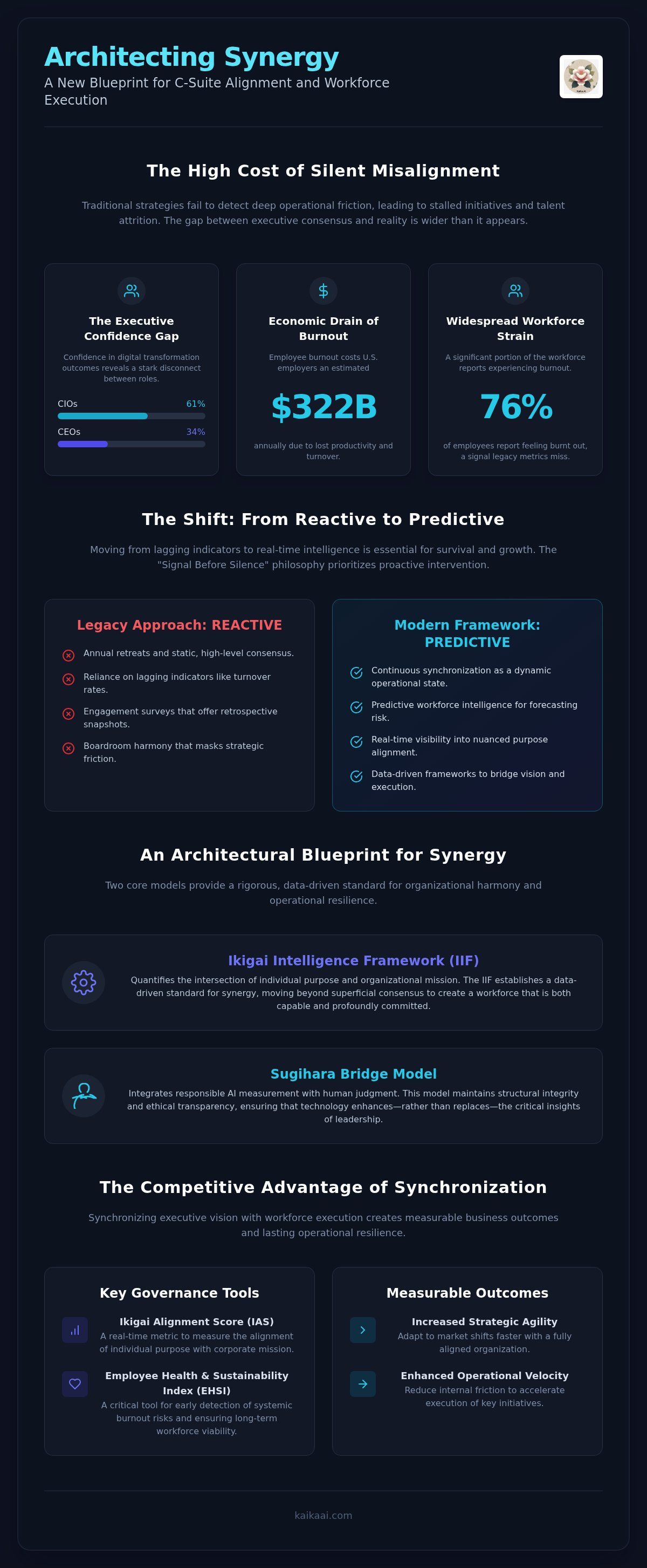
What if the consensus reached in your boardroom is actually a mask for deep-seated operational friction that traditional c-suite alignment strategies fail to address? Research indicates a stark confidence gap between leadership roles; for instance, 61% of CIOs feel confident in digital transformation outcomes while only 34% of CEOs share that conviction. This disconnect suggests that legacy approaches are failing to capture the nuance of modern enterprise complexity. You likely recognize the high-stakes urgency of strategic initiatives that stall in departmental silos or the silent attrition of top talent whose purpose no longer resonates with corporate goals.
Discover how to move beyond static executive agreements and build a dynamic, AI-driven framework for organizational synergy and operational resilience. This article provides an architectural blueprint for synchronizing executive vision with workforce execution. We will explore the Ikigai Intelligence Framework (IIF) and the Sugihara Bridge Model, demonstrating how predictive workforce intelligence transforms human potential into a measurable competitive advantage. By architecting a state of continuous synchronization, you can secure the long-term viability of your strategic vision.
Key Takeaways
- Learn how moving beyond static executive agreements to dynamic c-suite alignment strategies enables the detection of silent organizational friction that traditional surveys overlook.
- Understand how the Ikigai Intelligence Framework (IIF) establishes a data-driven standard for synergy by quantifying the intersection of individual purpose and organizational mission.
- Discover the role of the Employee Health and Sustainability Index (EHSI) as a critical tool for corporate governance and the early detection of systemic burnout risks.
- Explore the Sugihara Bridge Model to see how responsible AI measurement integrates with human judgment to maintain structural integrity and ethical transparency.
- Identify how synchronizing executive vision with workforce execution creates a measurable competitive advantage, driving both strategic agility and operational velocity.
The High Cost of Silent Misalignment: Why Traditional C-Suite Strategies Fail
C-suite alignment is the structural synchronization of executive vision and workforce execution. It represents the foundational integrity of a high-performance enterprise. Most traditional Strategic alignment efforts focus on high-level consensus during annual retreats. These events often fail to create lasting cross-departmental synergy because they treat alignment as a static milestone rather than a dynamic operational state. Effective c-suite alignment strategies must identify friction points before they manifest as systemic failures.
Our 'Signal before Silence' philosophy addresses the reality that by the time an executive notices a problem, the damage is already done. Silent attrition and stalled strategic initiatives create a massive economic drain on global organizations. For example, employee burnout costs U.S. employers an estimated $322 billion annually due to lost productivity and turnover. This financial erosion happens quietly, hidden beneath the surface of standard operational reports. Waiting for turnover rates to spike is a reactive posture that modern enterprises cannot afford in a high-velocity market. Successful c-suite alignment strategies require a move toward real-time visibility into organizational health.
The Illusion of Agreement vs. Actual Alignment
Executive meetings often suffer from social desirability bias. Leaders may nod in agreement to maintain boardroom harmony while harboring deep-seated strategic friction regarding resource allocation or priority. These micro-misalignments cascade down into departmental silos, where the corporate mission becomes diluted and distorted. Strategic drift is the cumulative result of unmeasured micro-misalignments that gradually pull an organization away from its core objectives. Without a mechanism to detect these deviations, the gap between intent and execution widens until the organization loses its competitive velocity and structural coherence.
Limitations of Legacy HR Analytics
Traditional engagement surveys and lagging indicators fail to provide the visibility required for proactive leadership. Turnover rates tell you who has already left, not who is currently disengaged or misaligned with the corporate purpose. These legacy tools don't capture the subtle nuances of individual purpose alignment, offering only a retrospective snapshot rather than a predictive forecast. Transitioning to predictive workforce intelligence allows leaders to move from reactive reporting to a model of continuous synchronization. This shift is essential for maintaining operational resilience in an environment where up to 76% of employees report experiencing burnout, a signal that traditional metrics often miss until it's too late.
The Ikigai Intelligence Framework: An Architectural Approach to Synergy
Most organizations treat alignment as a vague byproduct of corporate culture. The Ikigai Intelligence Framework (IIF) redefines this concept by establishing a rigorous, data-driven standard for organizational synergy. Developed through an academic partnership with Waseda University, this framework moves beyond superficial consensus. It provides an architectural blueprint for leadership teams seeking to stabilize their enterprise during volatile market shifts. Effective c-suite alignment strategies now require this level of technical precision to bridge the gap between high-level vision and granular workforce execution.
Philosophical grounding does not weaken corporate performance; it fortifies it. When an organization aligns its structural objectives with the existential fulfillment of its people, it achieves a state of operational grace. This systemic harmony reduces the friction often associated with global scale and rapid transformation. Leaders who prioritize this depth of intelligence often begin with an Alignment Audit to establish a baseline for their transformation journey. This methodical approach ensures that every strategic pivot is supported by a workforce that is both capable and profoundly committed.
Measuring Purpose with the Ikigai Alignment Score
The Ikigai Alignment Score (IAS) serves as the core metric within this framework. It quantifies the intersection of four critical pillars: passion, mission, vocation, and profession at scale. By measuring how individual aspirations resonate with the corporate mission, the IAS identifies the specific degree of purpose-driven synchronization within a team. Integrating these metrics into a modern workforce alignment software stack allows leaders to visualize the invisible threads of commitment that hold an organization together. This transition from abstract values to measurable "Human Truth" metrics empowers executives to make decisions based on the actual state of their workforce rather than optimistic assumptions.
The Human Signal Index: Detecting the Signal Before the Silence
Detecting shifts in organizational momentum requires more than annual reviews or lagging performance indicators. The Human Signal Index (HSI) provides a continuous stream of behavioral and sentiment intelligence. It identifies the subtle behavioral deviations that precede active disengagement or the quiet rejection of a corporate strategy. In pilot studies, this methodology achieved an 87% employee honesty rate in detecting workforce sentiment. This high level of transparency is vital for Navigating Uncertain Times With Strong Leadership; it ensures that the signals reaching the boardroom are accurate, ethical, and actionable. By capturing these early signals, the HSI prevents the silent erosion of performance before it becomes a visible crisis.
Predictive Intelligence for Corporate Governance and Burnout Prevention
Modern corporate governance requires a fundamental shift from monitoring financial output to safeguarding the psychological stability of the workforce. When c-suite alignment strategies neglect the human cost of high-stakes mandates, they create fragile systems prone to sudden failure. Burnout is no longer just an individual struggle; it is a systemic risk that threatens the execution of a long-term vision. By prioritizing workforce sustainability metrics, executives can identify where strategic pressure exceeds human capacity, ensuring that performance remains both high-velocity and sustainable.
The Science of the Employee Human Signal Index (EHSI)
The EHSI serves as a clinically informed tool for identifying burnout risk at the individual level before it manifests as attrition. While traditional tools rely on self-reported happiness, the EHSI utilizes clinical psychology principles to detect early signals of cognitive and emotional fatigue. This predictive approach is essential because there is a direct correlation between leading indicators of employee burnout and the eventual collapse of strategic initiatives. The EHSI focuses on three critical dimensions of sustainability:
- Cognitive load and processing capacity during rapid transformation phases
- Emotional resonance with the corporate mission and leadership intent
- Early behavioral markers of strategic rejection or psychological withdrawal
Comparing Legacy Metrics and Predictive Intelligence
To move toward a more resilient governance model, leaders must understand the structural differences between reactive reporting and predictive intelligence. The following table outlines the evolution of workforce measurement:
| Metric Category | Legacy HR Analytics (Reactive) | Predictive Workforce Intelligence (Proactive) |
|---|---|---|
| Detection Timing | Lagging: Measured through turnover and exit interviews. | Leading: Measured through early behavioral and sentiment shifts. |
| Data Source | Static: Derived from annual or pulse engagement surveys. | Dynamic: Derived from continuous Human Signal Index (HSI) tracking. |
| Insight Level | Surface: Focuses on general job satisfaction scores. | Structural: Focuses on the alignment of individual purpose and mission. |
| Primary Outcome | Reporting: Explaining why talent has already left the firm. | Resilience: Adjusting strategic velocity to prevent attrition. |
From Burnout Prediction to Operational Resilience
Transforming these insights into action requires a new framework for operational resilience for leadership. A Workforce Sustainability dashboard provides the C-suite with real-time oversight, allowing for the calibration of strategic goals based on actual organizational health. Adjusting the tempo of an organization based on these signals is a hallmark of sophisticated c-suite alignment strategies. This visibility prevents "quiet quitting" by addressing psychological strain before it reaches a terminal stage. It ensures the organization maintains its momentum without sacrificing the human potential that drives its competitive advantage. True resilience is built on the transparency of these human signals, allowing for a more disciplined and visionary approach to global scale.
Implementing the Sugihara Bridge Model: AI Measurement Meets Human Judgment
The Sugihara Bridge Model represents a hybrid architecture designed for responsible workforce intelligence. It acknowledges that while AI provides unprecedented visibility, the interpretation of sensitive workforce signals requires the nuanced perspective of human leadership. This model prevents the dehumanization of data, ensuring that technical intelligence serves the broader organizational mission. By implementing this framework, CHROs evolve into Alignment Architects, utilizing data-driven insights to construct a more resilient enterprise. Effective c-suite alignment strategies depend on this equilibrium between algorithmic precision and strategic wisdom.
The Three Phases of Strategic Integration
Execution follows a methodical, three-phase methodology to ensure enterprise-scale synchronization. Sophisticated c-suite alignment strategies require this continuous feedback loop to remain effective across diverse business units.
- Phase 1: The Alignment Audit. We begin by mapping the current gaps between executive mission and workforce reality. This phase identifies the structural friction points that hinder operational velocity.
- Phase 2: Deployment of the Ikigai Intelligence Framework. The IIF is integrated across specialized divisions, establishing a standardized language for purpose and performance throughout the hierarchy.
- Phase 3: Continuous Kaizen. This phase focuses on refining strategy based on real-time workforce signals, ensuring the organization remains agile and responsive to shifting market conditions.
The Role of Trained Human Consultants in the Bridge Model
Human judgment acts as the essential safeguard against algorithmic bias in performance management. Trained consultants ensure that cultural nuance is respected during global enterprise deployments, providing a layer of empathy that raw data cannot replicate. These experts facilitate strategic alignment workshops for executives, translating complex AI signals into actionable leadership interventions. This collaborative approach ensures that the "Human Truth" metrics discussed earlier are applied with ethical rigor and organizational sensitivity. By bridging the gap between intelligence and action, the model secures the structural integrity of the corporate vision.
To begin your journey toward structural synchronization, consider scheduling an Alignment Audit to identify your organization's hidden friction points and unlock latent performance capacity.
Securing the Future: C-Suite Alignment as a Competitive Advantage
Strategic alignment is not a soft skill or a temporary state of agreement. It is a measurable, scalable asset that dictates the velocity of an enterprise. Organizations that master sophisticated c-suite alignment strategies transform their workforce from a collection of individuals into a synchronized engine of execution. This synchronization creates a sustainable competitive moat, making the organization more agile and resilient than competitors who remain bogged down by internal friction. By leveraging AI for organizational health, leadership teams can build a high-performance architecture that is globally recognized for its precision and integrity.
Velocity requires the removal of structural resistance. When every executive and employee operates with a unified purpose, the time between strategic decision and operational result collapses. This systemic efficiency allows the organization to pivot with grace, securing market opportunities that others miss. Building this future requires a commitment to intelligence that spans both the technical and the human. It is about creating a legacy of excellence where performance and purpose are permanently fused.
The ROI of Continuous Alignment
The financial impact of alignment is profound and quantifiable. Enterprises utilizing the Ikigai Intelligence Framework have observed a significant reduction in silent attrition and a marked increase in strategic execution speed. In pilot studies, this methodology achieved an 87% employee honesty rate, providing leaders with a level of transparency that traditional surveys cannot match. This data-driven clarity is reflected in a Net Promoter Score (NPS) of 72 among participants, indicating a deep resonance with the organizational mission. Beyond these metrics, alignment transforms human capital from a volatile cost center into a predictable value driver. It ensures that every dollar invested in the workforce yields a measurable return in the form of operational resilience and innovation.
Taking the First Step: The Alignment Audit
The transition from traditional HR management to Workforce Alignment Intelligence begins with a low-friction diagnostic. The Alignment Audit provides a comprehensive map of your current workforce synergy, identifying the hidden gaps that dilute your strategic intent. This process allows CHROs and CEOs to visualize the state of their organization with architectural clarity. It moves the conversation from gut feelings to evidence-based interventions. To initiate this transformation and secure your organization's future, visit our homepage to request an executive consultation. We invite visionary leaders to request early access to the Kaika AI platform and begin the journey toward total organizational synchronization.
Architecting the Future of Enterprise Synergy
True organizational resilience depends on the continuous synchronization of executive intent and workforce reality. By moving beyond static consensus toward dynamic c-suite alignment strategies, leaders can detect silent friction before it erodes performance. The integration of the Ikigai Intelligence Framework and the Sugihara Bridge Model ensures that strategic pivots are supported by a workforce that is both capable and profoundly committed. This isn't just a management philosophy; it's a rigorous architectural standard for high-performance governance.
To help leaders identify the most effective entry points for these technologies, YPrtnrs offers a My Pulse AI evaluation designed to pinpoint specific opportunities for AI-driven transformation within the organization.
Our methodology is grounded in an academic partnership with Waseda University and adheres to exacting Japanese privacy standards. With an NPS of 72 in enterprise pilots, we've demonstrated that data-driven intelligence can enhance human potential rather than diminish it. It's time to transform your human capital from a volatile cost center into a predictable driver of strategic velocity. We invite you to request early access to the Kaika AI Workforce Alignment Intelligence Platform and begin architecting a more harmonious enterprise. Your journey toward total synchronization starts here.
Frequently Asked Questions
What are the most effective C-suite alignment strategies for 2026?
Modern strategies prioritize results-oriented management and the integration of predictive analytics into the leadership core. Effective leaders now utilize workforce intelligence to bridge the gap between high-level vision and granular execution. This shift involves moving away from traditional "managing by walking around" toward an asynchronous-first model. These c-suite alignment strategies focus on creating structural synchronization that accommodates flexible work while maintaining high-velocity performance across global teams.
How does AI measure employee purpose alignment without compromising privacy?
AI utilizes the Human Signal Index (HSI) to track behavioral and sentiment patterns at an aggregate level. This methodology focuses on identifying systemic friction rather than individual surveillance. By adhering to rigorous Japanese privacy standards, the system anonymizes data to protect personal identity. It measures how closely workforce actions resonate with corporate goals, providing a "Human Truth" metric that respects ethical boundaries while delivering actionable intelligence for executive decision-making.
What is the difference between executive alignment and strategic consensus?
Strategic consensus is often a passive, surface-level agreement reached during annual retreats. Executive alignment is a dynamic and continuous state of operational synchronization. While consensus might mask deep-seated friction, true alignment ensures that every leader's objectives are structurally integrated with the organization's mission. It requires real-time visibility into workforce execution to confirm that the boardroom's intent is actually manifesting in the daily operations of the enterprise.
Can workforce intelligence platforms predict employee burnout before it happens?
Platforms like Kaika AI use the Employee Human Signal Index (EHSI) to detect early indicators of psychological strain. This clinically informed index identifies subtle shifts in cognitive and emotional fatigue before they lead to active disengagement. By monitoring these leading indicators, leadership teams can adjust strategic velocity and provide support. This proactive approach prevents the terminal exhaustion that typically results in "quiet quitting" or high-cost attrition in high-pressure environments.
How do C-suite alignment strategies impact employee retention in large enterprises?
Successful c-suite alignment strategies directly reduce the "retention tax" caused by rigid or misaligned mandates. When an organization's purpose is clearly synchronized with the individual aspirations of its people, turnover rates naturally decline. Employees stay longer when they see a measurable connection between their work and the corporate mission. This alignment transforms the workforce into a stable, committed engine of growth, significantly lowering the costs associated with talent replacement.
What is the Sugihara Bridge Model in workforce alignment?
The Sugihara Bridge Model is a hybrid architecture that balances technical AI measurement with human executive judgment. It ensures that sensitive workforce signals aren't interpreted by algorithms alone. Human consultants provide the necessary cultural nuance and empathy to translate data into leadership interventions. This model prevents algorithmic bias and maintains the human-centric focus of the organization, ensuring that workforce intelligence remains an ethical tool for building long-term operational resilience.
How can I measure the ROI of a C-suite alignment initiative?
ROI is quantified through increased strategic execution speed and a measurable reduction in attrition-related costs. Leaders track the Ikigai Alignment Score (IAS) to see how synchronization affects productivity and innovation. When an organization is aligned, the "collaboration tax" of remote and hybrid work decreases, leading to higher output with fewer resources. These improvements convert human capital from a volatile cost center into a predictable, high-value driver of enterprise value.
What role does Ikigai play in modern organizational architecture?
Ikigai provides the philosophical and technical foundation for the Ikigai Intelligence Framework (IIF). It serves as a standard for quantifying the intersection of passion, mission, vocation, and profession within a corporate setting. By measuring this alignment, organizations can ensure their structures support both high performance and human fulfillment. This architectural approach creates a more resilient culture, where the workforce's existential drive is permanently fused with the organization's strategic objectives.
More Articles

Building an Employee Burnout Early Warning System: The Executive Framework for Predictive Alignment

Aligning Individual and Organizational Goals: A Strategic Framework for Workforce Intelligence
