
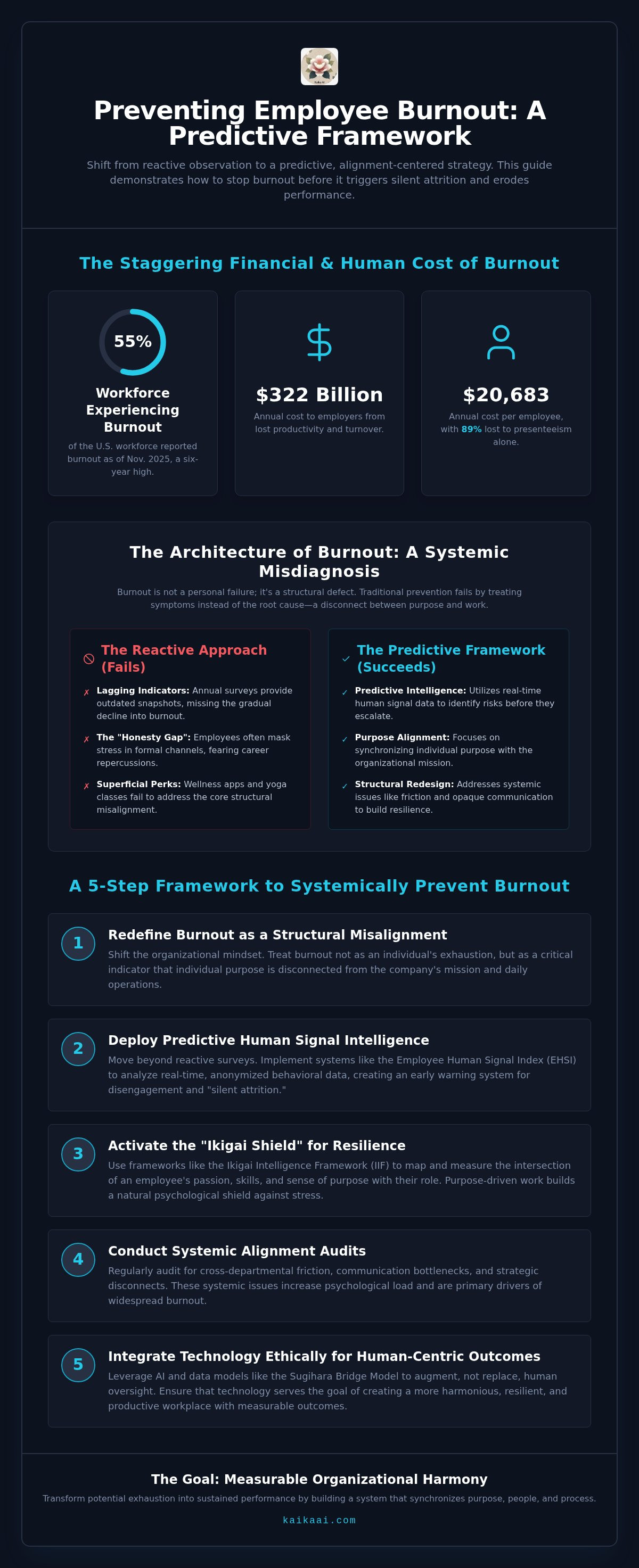
55% of the U.S. workforce reported experiencing burnout as of November 2025; this six-year high costs employers an estimated $322 billion annually in lost productivity and turnover. You've likely recognized that traditional engagement surveys function as structural post-mortems rather than proactive safeguards. They offer fragmented data that fails to resolve the critical disconnect between corporate mission and the daily operational reality of your talent. Precision is the antidote to attrition. This guide demonstrates how to prevent employee burnout by transitioning from reactive observation to a predictive, alignment-centered framework.
We'll explore the Sugihara Bridge Model and the Employee Human Signal Index (EHSI) to establish a data-driven early warning system. By synchronizing individual purpose with organizational goals, you can stop burnout before it triggers the high cost of silent attrition. This strategic evolution ensures your workforce maintains its velocity and structural integrity, transforming potential exhaustion into sustained performance through precise human signal intelligence. The goal is to move beyond superficial wellness perks toward a system of measurable organizational harmony.
Key Takeaways
- Redefine burnout as a structural misalignment between individual purpose and organizational mission rather than a mere symptom of exhaustion.
- Identify the leading indicators of silent attrition by shifting from reactive annual surveys to predictive behavioral signal intelligence.
- Discover how to prevent employee burnout by implementing a systemic five-step framework that prioritizes alignment audits and real-time workforce data.
- Leverage the Ikigai Intelligence Framework (IIF) to build psychological resilience and restore workforce velocity through deeper organizational harmony.
- Utilize the Sugihara Bridge Model to ethically integrate clinical precision with AI, ensuring human-centric outcomes and measurable operational resilience.
The Architecture of Burnout: Why Traditional Prevention Fails
Burnout is often mischaracterized as a personal failure of stamina. In reality, it's a structural defect within the organizational architecture. When we analyze What is occupational burnout?, we see a syndrome rooted in chronic workplace stress that remains unmanaged. It's the friction between an individual’s internal purpose and the external demands of their role. This misalignment triggers "silent attrition," a phenomenon where high-performers disengage mentally months before they physically resign. By the time an employee voices their exhaustion, the structural integrity of their commitment has already collapsed.
Enterprise leaders must view this through a fiscal lens. Gallup estimates that burnout costs U.S. employers roughly $322 billion annually in lost productivity and turnover. For large organizations, the cost per employee can reach $20,683 per year; 89% of this value is lost to presenteeism. Understanding how to prevent employee burnout isn't just a human resources initiative. It's a critical strategy for protecting operational velocity and capital efficiency.
The Limits of Annual Engagement Surveys
Traditional HR tools rely on lagging indicators. Annual or quarterly surveys provide a static snapshot of a dynamic, evolving workforce. These snapshots inevitably miss the "burnout curve," the gradual decline in synchronization that precedes a total breakdown. There's also a pervasive honesty gap. Employees often mask their stress in formal channels, fearing that vulnerability might jeopardize their career trajectory. To bridge this gap, leaders are looking toward ai in employee engagement to capture real-time metrics that reflect the actual lived experience of the workforce.
Burnout as a Systemic Alignment Failure
We must abandon the "individual problem" myth. Burnout is a systemic failure of alignment. It occurs when cross-departmental friction and opaque communication channels increase the psychological load on talent. Stalled strategy execution is often the first visible symptom of this exhaustion. When the corporate mission is disconnected from daily reality, employee resilience erodes. Preventing this requires a shift from reactive wellness perks to a structural redesign that prioritizes organizational harmony. Realizing how to prevent employee burnout requires identifying these mission-critical gaps before they manifest as turnover.
The Ikigai Shield: Using Purpose Alignment to Build Resilience
Most strategies for how to prevent employee burnout focus on reducing workload. This is a tactical error. Resilience isn't built by doing less; it's built by doing what matters. The Ikigai philosophy, the intersection of what you love, what you're good at, what the world needs, and what you're paid for, serves as a structural shield. When an employee's daily tasks align with their personal "why," they possess a psychological buffer. This synchronization reduces the cognitive load of high-stakes environments, transforming potential exhaustion into focused energy. Purpose isn't a luxury. It's the foundation of operational velocity.
Connecting Individual Purpose to Organizational Goals
Meaningful work is a biological necessity. Research indicates that employees who find deep purpose in their roles exhibit lower cortisol levels and higher stress tolerance. According to Gallup's research on preventing burnout, the quality of the work experience is often more influential than the hours worked. Modern workforce alignment software bridges the gap between executive strategy and individual execution. For instance, a software developer shouldn't just see lines of code. They should see how that code facilitates global synchronization or solves a critical human problem. When the "why" is clear, the "what" becomes sustainable. This clarity eliminates the "meaning gap" that often leads to silent attrition.
Measuring the Ikigai Alignment Score (IAS)
To manage alignment, you must measure it. The Ikigai Alignment Score (IAS) provides a real-time metric of how closely individual purpose maps to the corporate mission. This proprietary index, part of the Ikigai Intelligence Framework (IIF), isn't a static data point. It's a dynamic indicator that allows leadership to identify at-risk teams before productivity collapses. High IAS values correlate directly with superior operational resilience. By delivering these insights through the Sugihara Bridge Model, organizations can combine AI precision with human judgment. This ensures that leadership interventions are both data-driven and empathetic. Leaders can begin this process by conducting an Alignment Audit to establish their baseline resilience and discover how to prevent employee burnout at the structural level.
From Reactive to Predictive: The Human Signal Intelligence Revolution
Traditional management relies on turnover rates and exit interviews to understand attrition. These are lagging indicators; by the time they're measured, the talent has already left. To truly understand how to prevent employee burnout, leadership must pivot toward leading indicators. These are behavioral signals that manifest long before a resignation letter appears. We call this the "Signal before the Silence." It involves identifying subtle shifts in communication frequency, project velocity, and linguistic sentiment that indicate a loss of alignment within the organizational architecture.
The Human Signal Index (HSI) surfaces these patterns with mathematical precision. AI-driven sentiment analysis offers a level of accuracy that self-reported stress levels simply cannot match. In traditional surveys, employees often filter their responses due to social desirability bias or fear of professional repercussions. Predictive intelligence bypasses these filters by analyzing objective behavioral data. This transition from subjective observation to objective signal intelligence allows for a systematic, data-driven approach to workforce health. By identifying these patterns early, executives can maintain workforce velocity and protect the organization's most valuable assets.
The Employee Human Signal Index (EHSI)
The EHSI represents a significant advancement in organizational psychology. It's a clinically-informed metric co-developed with clinical psychologists to provide a sophisticated early warning system for psychological strain. By identifying these signals early, the EHSI flags potential disengagement without compromising individual privacy. This methodology yields an 87% employee honesty rate in pilots, significantly higher than traditional self-reporting methods. For a deeper dive into these predictive metrics, consult our executive guide on leading indicators of employee burnout. This framework ensures that leadership interventions are proactive rather than remedial.
The Sugihara Bridge Model: Ethical AI Implementation
Data alone is insufficient for managing the complexities of human potential. The Sugihara Bridge Model establishes an ethical framework that prioritizes a "human-in-the-loop" approach. While AI provides the precision required to detect subtle behavioral shifts, trained consultants interpret these signals to provide empathetic, high-impact interventions. This model ensures that the process of how to prevent employee burnout remains grounded in human judgment. It maintains enterprise-grade security and rigorous privacy standards, ensuring that workforce alignment intelligence is used responsibly. This balanced architecture allows for the seamless synchronization of technical precision and human-centric outcomes, fostering long-term operational resilience.
A 5-Step Framework to Prevent Employee Burnout Systemically
Securing the structural integrity of a global workforce requires a transition from anecdotal management to architectural precision. To understand how to prevent employee burnout at scale, leadership must deploy a framework that prioritizes alignment over mere activity. This methodology addresses the root causes of friction before they manifest as silent attrition. By following these five phases, executives can transform their organizational health from a lagging metric into a leading strategic advantage.
| Phase | Strategic Action | Operational Outcome |
|---|---|---|
| 1. Alignment Audit | Map gaps between executive strategy and front-line execution. | Identification of high-friction departments. |
| 2. Platform Deployment | Establish baseline indices using workforce alignment software. | Real-time visibility into IAS and HSI scores. |
| 3. Leadership Training | Adopt the Sugihara Bridge mindset for early signal detection. | Ethical interpretation of behavioral signals. |
| 4. Collective Kaizen | Execute iterative workshops to resolve friction points. | Continuous improvement of work design. |
| 5. Continuous EHSI Monitoring | Track clinically-informed psychological signals. | Proactive prevention of workforce exhaustion. |
Phase 1: The Alignment Audit
The initial phase involves a rigorous mapping of the disconnect between C-suite vision and daily employee reality. High-friction departments often hide behind standard performance metrics, yet they represent the highest risk for burnout-related turnover. An audit identifies these structural weaknesses, allowing for targeted resource allocation. You can initiate this process by requesting a comprehensive Alignment Audit to establish your organization's resilience baseline and learn how to prevent employee burnout at its source.
Operationalizing Collective Kaizen
Collective Kaizen applies the philosophy of continuous improvement to the human experience of work. Instead of waiting for annual survey results to trigger major overhauls, leadership uses data-driven insights to fuel small, iterative changes in work design. This approach treats workforce alignment as a dynamic process. When signal intelligence identifies a friction point, team-based workshops co-create practical solutions. This moves the organization beyond reactive crisis management into a state of continuous synchronization, where resilience is built into the daily operational rhythm.
Building Operational Resilience with Kaika AI
The Kaika AI Workforce Alignment Intelligence Platform represents the technical realization of the methodologies discussed previously. It provides executive leadership with a structured environment to manage the intersection of human potential and organizational architecture. By utilizing the Ikigai Intelligence Framework (IIF), the platform offers a sophisticated lens through which global enterprises can synchronize individual purpose with large-scale corporate missions. This is the definitive solution for how to prevent employee burnout by addressing the core structural misalignments that traditional HR tools ignore.
Our recent 340-person pilot in Tokyo demonstrated the efficacy of this approach. The platform achieved an 87% employee honesty rate; this is a significant deviation from the filtered responses common in annual engagement surveys. This high level of transparency resulted in a Net Promoter Score (NPS) of 72, indicating deep workforce trust in the Sugihara Bridge Model. These results prove that when employees see a direct connection between their personal purpose and the company's mission, they engage with higher velocity and resilience. Kaika AI Inc. empowers leaders to hear the signal before the silence, identifying the behavioral patterns of attrition long before they impact the bottom line.
Institutional Credibility and Clinical Rigor
The EHSI isn't just a technical metric. It's a clinically-informed index developed in partnership with Waseda University and clinical psychologist Michelle Kwamboka. This collaboration ensures that our predictive intelligence remains grounded in established psychological principles while adhering to the most rigorous Japanese privacy standards. We prioritize enterprise-grade security to protect the sensitive human signals that fuel our indices. Our vision for 2032 includes dual listing on the TSE and ASX, positioning Kaika AI Inc. as the global category leader in workforce alignment intelligence.
Next Steps for CHROs
Strategic evolution begins with a commitment to precision. CHROs looking for a measurable way to manage how to prevent employee burnout should consider requesting early access to the Kaika AI platform. This allows for a phased integration within specialized divisions, providing a testing ground for Collective Kaizen workshops and Alignment Audits. The transition toward a high-performance, burnout-resistant culture requires moving beyond superficial wellness perks toward a data-driven framework of organizational harmony. By initiating this integration, you secure your talent pipeline and ensure your organization remains resilient in the face of global scale and complexity.
A Strategic Blueprint for How to Prevent Employee Burnout
Adopting a predictive approach to workforce health is no longer a luxury; it's a structural necessity for global enterprises. We've moved beyond the limitations of lagging indicators toward a future where signal intelligence defines organizational health. By prioritizing the Ikigai Intelligence Framework, leaders can resolve the fundamental misalignments that lead to silent attrition. This methodology provides a permanent answer for how to prevent employee burnout by ensuring every individual’s daily task contributes to a larger, shared mission. Precision remains the most effective antidote to exhaustion.
Our collaborative research with Waseda University and clinical psychologists ensures that these strategies are both scientifically rigorous and ethically sound. With an 87% honesty rate in recent pilots and an NPS of 72, the results speak to the trust created by the Sugihara Bridge Model. It's time to secure your operational resilience and foster a culture of sustained high performance. Request early access to the Kaika AI Workforce Alignment Platform today.
Frequently Asked Questions
What are the earliest signs of employee burnout that managers often miss?
Identifying how to prevent employee burnout requires observing task fragmentation and social siloing. Managers often miss the subtle shift from fluid collaboration to transactional communication. When an employee begins to isolate their workflow, it often indicates a defensive psychological posture. These early behavioral signals precede the physical exhaustion typically associated with burnout. Recognizing these micro-trends allows leadership to adjust the organizational architecture before the individual’s commitment to the mission fully erodes.
How does workforce alignment software differ from traditional HR analytics?
Traditional HR analytics focus on lagging engagement metrics, whereas workforce alignment software prioritizes predictive synchronization. Analytics tell you how employees felt last month; alignment intelligence tells you how well their current actions map to your strategic goals. This distinction is critical for leaders learning how to prevent employee burnout. By measuring the friction between individual purpose and corporate mission, this software provides a dynamic early warning system that traditional sentiment surveys simply cannot replicate.
Is it possible to predict burnout using AI without invading employee privacy?
Prediction is possible through the analysis of aggregated behavioral metadata rather than personal content. By focusing on patterns of velocity, communication cadence, and project synchronization, AI identifies structural risks without accessing private messages. This ethical boundary ensures that the organization maintains clinical precision while upholding enterprise-grade privacy. The goal is to detect systemic misalignment at the team level, allowing for proactive adjustments that protect individual well-being without compromising personal confidentiality or trust.
What is the Ikigai Alignment Score (IAS) and how is it calculated?
The Ikigai Alignment Score (IAS) is a weighted measure of the synchronization between an individual's core competencies and the organization's strategic needs. It is calculated by cross-referencing behavioral signals with self-reported mission-alignment indices. This creates a multi-dimensional view of how closely an employee’s daily reality mirrors their personal purpose. A declining IAS acts as a leading indicator of disengagement, providing executives with the data required to perform targeted structural interventions before productivity begins to decline.
How can the Sugihara Bridge Model help in sensitive human resource interventions?
The Sugihara Bridge Model facilitates sensitive interventions by introducing a human-mediated interpretation phase. After AI identifies a significant drop in alignment indices, trained consultants analyze the data to provide context-aware recommendations. This prevents the "algorithmic bias" that can occur in purely automated systems. By combining clinical precision with human empathy, the model allows HR leaders to address psychological strain through constructive, alignment-focused dialogues that preserve the employee's dignity and professional standing within the enterprise.
What are the primary causes of 'silent attrition' in large corporations?
Silent attrition is primarily driven by the erosion of mission-relevance in daily tasks. When employees perceive their contributions as disconnected from the corporate purpose, their psychological commitment collapses. This "purpose-reality gap" often stems from opaque communication or departmental siloing that prevents talent from seeing the impact of their work. Large corporations must address these structural misalignments systemically to maintain workforce velocity and prevent the high financial costs associated with the loss of mission-critical expertise.
How does purpose alignment affect employee retention and productivity?
Purpose alignment creates a biological state of resilience by reducing metabolic stress and cortisol levels. When an individual’s work is synchronized with their personal "why," their cognitive efficiency increases, allowing them to handle high-pressure environments with less psychological strain. This alignment directly correlates with improved retention rates and sustained operational velocity. By fostering a burnout-resistant culture, organizations ensure that their talent remains engaged and productive, even during periods of intense strategic execution or global scale-up.
What role does a clinical psychologist play in developing burnout prediction tools?
Clinical psychologists ensure that burnout prediction tools are benchmarked against established clinical norms for psychological health. Their role is to validate that the indices, such as the EHSI, accurately reflect human behavior and strain. This adds a layer of clinical rigor that standard data science lacks. By incorporating psychological expertise, Kaika AI Inc. provides a platform that is not only mathematically precise but also human-centric, ensuring that interventions are both effective and ethically sound.
More Articles

Building an Employee Burnout Early Warning System: The Executive Framework for Predictive Alignment

Aligning Individual and Organizational Goals: A Strategic Framework for Workforce Intelligence
