
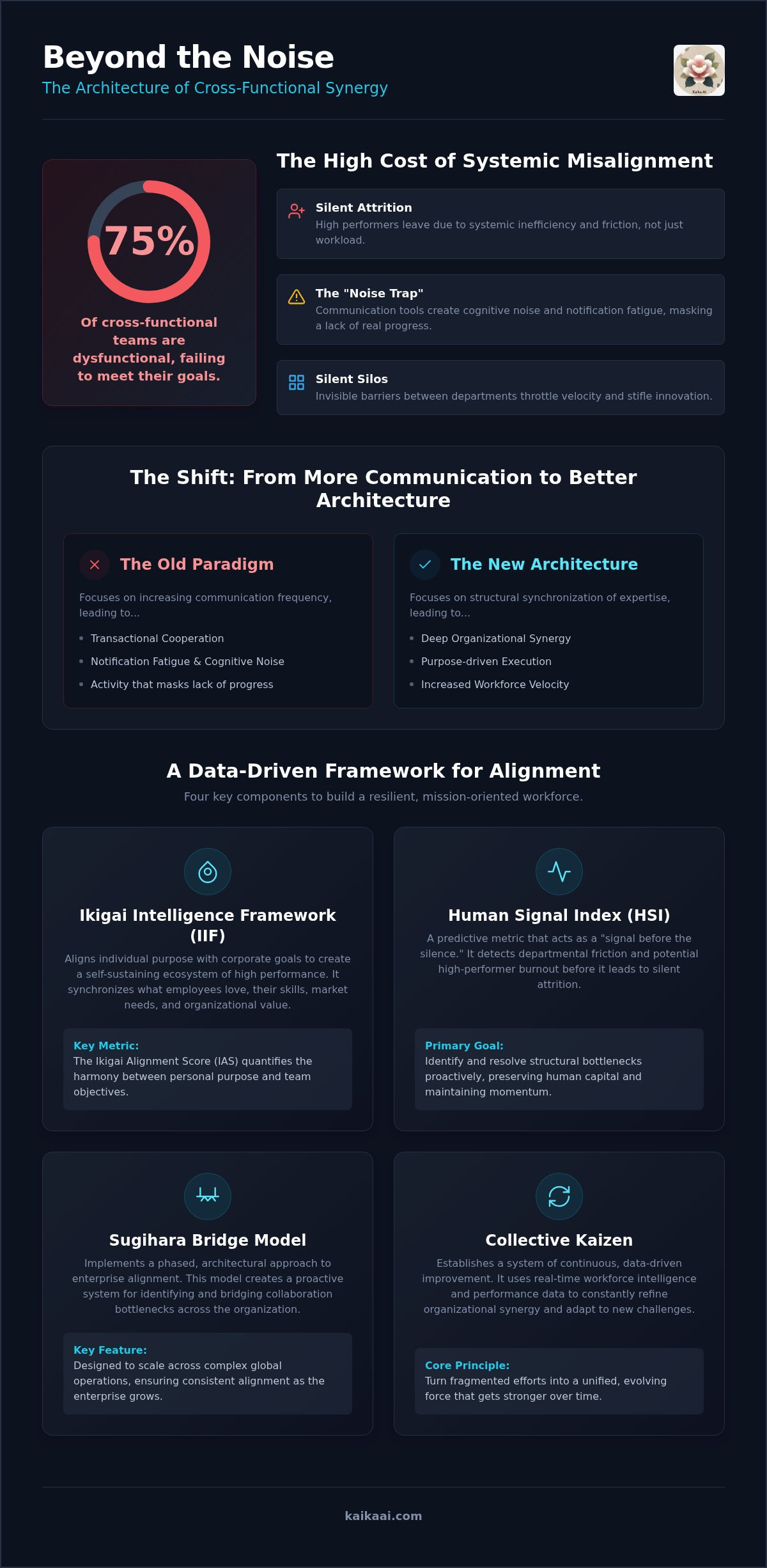
Roughly 75% of cross-functional teams are considered dysfunctional, failing to meet their planned goals and timelines despite having access to the latest communication tools. This systemic failure often manifests as silent attrition among your highest performers or a persistent misalignment between departmental KPIs and the overarching corporate mission. You've likely felt the high-stakes urgency of project delays caused by inefficient friction, yet traditional methods for improving cross-functional team collaboration continue to focus on superficial tactics rather than structural integrity.
It's time to move beyond the noise of constant messaging and embrace a data-driven approach to organizational harmony. This article provides a strategic framework for transcending communication silos by integrating predictive AI and purpose-driven alignment into your enterprise architecture. We'll explore how the Sugihara Bridge Model creates a proactive system for identifying collaboration bottlenecks, ensuring that human potential and technical intelligence function in perfect synchronization. By the end of this guide, you'll understand how to achieve measurable increases in synergy and reduce attrition through a more resilient, mission-oriented workforce design.
Key Takeaways
- Understand why structural synchronization of diverse expertise is more critical for enterprise velocity than simply increasing the frequency of digital communication.
- Discover how the Ikigai Intelligence Framework (IIF) provides a measurable strategy for improving cross-functional team collaboration by aligning individual purpose with corporate goals.
- Utilize the Human Signal Index (HSI) as a predictive metric to detect departmental friction and prevent high-performer burnout before it leads to silent attrition.
- Adopt the Sugihara Bridge Model to implement a phased, architectural approach to enterprise alignment that scales across complex global operations.
- Establish a system of Collective Kaizen to continuously refine organizational synergy using real-time workforce intelligence and performance data.
Beyond Communication: The Architecture of Cross-Functional Synergy
True synergy requires more than frequent interaction. It demands the structural synchronization of diverse expertise across an entire enterprise. While a traditional cross-functional team often operates as a temporary assembly of specialists, modern enterprise alignment requires a permanent architectural shift. We must distinguish between transactional cooperation, where departments merely trade information, and deep organizational synergy, where every individual action reinforces the collective mission. Without this distinction, organizations suffer from "Silent Silos." These invisible barriers throttle enterprise velocity and stifle innovation by trapping critical insights within departmental boundaries. Improving cross-functional team collaboration is no longer a cultural preference; it's a survival imperative driven by Workforce Alignment Intelligence. This intelligence framework acts as the modern prerequisite for any organization seeking to turn fragmented efforts into a unified force.
The Failure of Conventional Communication Tools
Most leadership teams mistake activity for alignment. Digital platforms like Slack and Microsoft Teams often exacerbate the problem by increasing cognitive noise without providing strategic direction. Notification fatigue sets in when employees are bombarded by cross-departmental requests that lack context or priority. This creates a "noise trap" where the volume of communication masks a lack of actual progress. Large-scale projects frequently stall because team members are managing tools rather than executing strategy. In this environment, workforce velocity, defined as the speed of purpose-driven execution, begins to plummet. True alignment isn't found in a chat window; it's built into the organizational architecture through disciplined systems.
The High Stakes of Cross-Departmental Friction
Friction between divisions is the primary driver of strategic stalling. When departmental KPIs conflict with the corporate mission, the resulting tension leads to "Silent Attrition." High performers don't always leave because of workload; they leave because of the soul-crushing inefficiency of misaligned systems. They feel the friction long before leadership notices the decline in output. To preserve your human capital, you need a "signal before the silence" in your team dynamics. This predictive insight allows executives to identify structural bottlenecks and resolve them before they manifest as burnout or missed quarterly targets. Identifying these signals is the first step toward improving cross-functional team collaboration at scale.
The Ikigai Factor: Synchronizing Individual Purpose with Departmental Goals
Improving cross-functional team collaboration requires moving beyond task management and addressing the existential core of why people work. The Ikigai Intelligence Framework (IIF) serves as the primary instrument for this evolution. It doesn't treat employees as fungible assets; it views them as mission-driven individuals whose personal fulfillment must resonate with the corporate mission. By aligning individual and organizational goals, enterprises create a self-sustaining ecosystem of high performance. This framework identifies the intersection of what employees love, what they are skilled at, what the market needs, and where the organization creates value. When these four quadrants synchronize, the result is deep organizational synergy rather than mere transactional cooperation.
Measuring the Ikigai Alignment Score (IAS)
The Ikigai Alignment Score (IAS) provides a quantitative metric for this qualitative harmony. It identifies the specific gaps between an individual's personal purpose and the team's immediate objectives. High IAS scores correlate directly with reduced cross-functional conflict, as teams find common ground in shared values rather than just shared deadlines. Leaders can use this data to compose more resilient multi-disciplinary teams, ensuring that every project starts with a foundation of mutual understanding. This data-driven approach is essential for Enhancing Collaboration Across Teams, turning abstract vision into measurable structural strength. Organizations that prioritize this score see a marked increase in operational resilience.
Fostering a Culture of "Human Truth"
Alignment is impossible without radical transparency. Kaika AI pilots have demonstrated an 87% employee honesty rate, a figure that suggests a significant shift in corporate communication. This "Human Truth" is only achievable when employees feel psychologically safe enough to admit misalignment. When leaders prioritize alignment over mere compliance, they create a culture where silos naturally dissolve. This transparency allows for the identification of friction before it escalates into burnout. To begin this transformation, executives should consider an Alignment Audit to establish a baseline for their current workforce dynamics. Prioritizing human truth ensures that the data driving your intelligence platform remains accurate and actionable.
Predictive Intelligence: Detecting Collaboration Friction Before It Becomes Silent Attrition
Reactive management is a legacy of the industrial era. Waiting for a project to fail or a high performer to resign before intervening is an expensive, inefficient strategy. In contrast, predictive workforce intelligence utilizes the Human Signal Index (HSI) to monitor the structural health of an organization in real time. These behavioral signals provide an early warning system, identifying the subtle shifts in sentiment and engagement that precede project stagnation. By focusing on these metrics, leaders can shift their energy toward improving cross-functional team collaboration through proactive adjustment rather than damage control. This approach recognizes that collaboration is a dynamic system requiring constant, data driven calibration.
The Employee Human Signal Index (EHSI)
The development of the EHSI involved clinical psychologists to ensure that the platform accurately detects the nuance of psychological strain. When cross-functional friction occurs, it leaves a digital footprint in communication patterns and engagement levels. EHSI flags these markers, specifically identifying the leading indicators of employee burnout before they lead to attrition. This monitoring is conducted with a strict focus on ethical AI and data transparency, ensuring that the system serves as a tool for support rather than surveillance. It empowers leadership to address the root causes of friction, such as misaligned KPIs or resource scarcity, with surgical precision.
Sensing the "Signal Before the Silence"
The "Signal Before the Silence" philosophy represents a shift from reactive to sentient leadership. Traditional annual surveys are post mortem exercises; they capture sentiment that has already soured. Real time HSI monitoring identifies shifts in divisional sentiment as they happen. If the engineering team's alignment with marketing begins to erode, the system detects the signal of friction before the silence of disengagement sets in. This immediate feedback loop allows for the continuous refinement of team dynamics. It transforms the process of improving cross-functional team collaboration from a seasonal initiative into a core operational capability, ensuring that enterprise velocity remains unhindered by invisible departmental walls.
The Sugihara Bridge Model: Implementing a Hybrid Framework for Structural Alignment
Assigning a single point of contact for each department is a superficial remedy for a structural disease. Real enterprise synchronization requires a more profound architectural solution. The Sugihara Bridge Model represents the definitive delivery framework for large organizations seeking a disciplined method for improving cross-functional team collaboration. It rejects the notion that technology alone can resolve human friction. Instead, it utilizes a hybrid methodology that pairs the precision of the Workforce Alignment Intelligence Platform with the strategic nuance of trained human consultants. This dual approach ensures that predictive data is translated into actionable leadership decisions, ultimately building a foundation for operational resilience for leadership across every division.
Phase 1: The Alignment Audit
The journey toward synchronization begins with a rigorous Alignment Audit. During this initial phase, executive leadership identifies mission critical gaps between departmental objectives and the overarching corporate mission. We map existing data structures against the Ikigai Intelligence Framework to reveal where individual purpose has become decoupled from organizational goals. This isn't a passive survey; it's an executive level architectural consultation. We analyze communication flows and resource allocation to pinpoint the exact coordinates of structural friction. By establishing this baseline, leaders can visualize the "Silent Silos" that currently throttle innovation and velocity, setting the stage for a targeted intervention.
Phases 2 & 3: Integration and Velocity Scale
Once the audit identifies the vulnerabilities, the focus shifts to the deployment of the AI powered work alignment platform across all divisions. Integration involves more than software installation; it requires the development of a leadership mindset through intensive workshops. These sessions move beyond traditional management training, focusing on the intersection of human psychology and systems engineering. As the platform begins to provide real time insights, organizations achieve workforce velocity through continuous feedback loops. This phase transforms the enterprise into a sentient system capable of self correction. Improving cross-functional team collaboration becomes an automated byproduct of a system where every employee's effort is precisely aligned with the collective vision. To begin this transformation, schedule an Executive Consultation to evaluate your current organizational architecture.
Scaling Organizational Resilience through Data-Driven Kaizen
Improving cross-functional team collaboration is not a static achievement but a perpetual state of refinement. Collective Kaizen represents this continuous improvement of organizational synergy, shifting the enterprise from a rigid hierarchy to a fluid, responsive architecture. By utilizing real-time metrics, leadership can iterate on team structures with the same precision used in high-tech systems engineering. This iterative process relies heavily on continuous performance management software to maintain alignment across shifting project demands. Kaika AI serves as the strategic partner in this journey, providing the intelligence necessary to build long-term operational resilience. Organizations that embrace this data-driven evolution don't just solve immediate friction; they build a foundation for sustained excellence.
Achieving Institutional Velocity
Enterprise growth often carries a hidden "friction tax" caused by departmental misalignment and inefficient communication. Data-driven Kaizen focuses on reducing this tax by streamlining how diverse teams interact and execute. When teams operate in total synchronization, workforce velocity increases, allowing the organization to pivot with speed and precision. The impact of this alignment is measurable. In our Tokyo-based pilots, we recorded a Net Promoter Score (NPS) of 72 among participants, reflecting a profound improvement in internal sentiment and collaborative efficiency. The future of global organizations belongs to those who can harmonize purpose and performance at scale. By improving cross-functional team collaboration through a lens of continuous refinement, enterprises can achieve a level of institutional velocity that was previously impossible.
Ethical Data Use and Japanese Privacy Standards
Sophisticated workforce intelligence requires an uncompromising commitment to trust and security. Kaika AI adheres to enterprise-grade security protocols and rigorous Japanese privacy standards to ensure that all human signals are handled with the highest level of integrity. Transparency is the cornerstone of our AI-driven workforce analytics. We don't just monitor data; we surface "human truth" responsibly to empower both the individual and the organization. Our commitment to ethical data use is reflected in the 87% employee honesty rate observed in our pilot programs. This high level of trust is achieved through the involvement of clinical psychologists in our EHSI development, ensuring that our methods prioritize human well-being. When employees understand that the system is designed to support their potential and reduce friction, they become active participants in the collective mission.
Architect Your Evolution
Transitioning from fragmented communication to structural synchronization is the ultimate competitive advantage for the modern enterprise. We've explored how the Ikigai Intelligence Framework aligns individual purpose with departmental goals, while the Sugihara Bridge Model provides a disciplined methodology for implementing this change. By leveraging predictive signals rather than reactive surveys, leaders can master the art of improving cross-functional team collaboration while ensuring long-term operational resilience.
Our pilot results, co-developed with clinical psychologists for responsible burnout detection, demonstrate the efficacy of this approach with an 87% employee honesty rate and an NPS of 72. These metrics aren't just numbers; they represent a fundamental shift toward a more harmonious and high-performing workforce. It's time to replace institutional friction with a culture of collective Kaizen.
Request early access to the Kaika AI Workforce Alignment Intelligence Platform and begin your journey toward a unified, purpose-driven future. The path to excellence starts with alignment.
Frequently Asked Questions
What is the primary difference between cross-functional collaboration and alignment?
Collaboration is the act of diverse teams working together on specific tasks, while alignment is the structural synchronization of their underlying goals and incentives. Improving cross-functional team collaboration is often impossible without first achieving strategic alignment. If departments operate with conflicting KPIs, even the best communication tools won't prevent friction. Alignment ensures that every team's effort reinforces the corporate mission, creating a unified architecture where collaboration becomes a natural byproduct of shared purpose.
How does the Ikigai Alignment Score (IAS) actually measure team synergy?
The Ikigai Alignment Score (IAS) quantifies the resonance between individual purpose and organizational objectives. It analyzes data points across the four Ikigai quadrants: passion, proficiency, market necessity, and corporate value. By identifying specific gaps where personal mission diverges from team targets, the IAS provides a numerical value for cohesion. This allows leadership to compose teams based on objective purpose-fit rather than just technical skill sets, ensuring long-term operational resilience.
Can AI really predict when a cross-functional team is about to fail?
Yes, by identifying shifts in behavioral signals that precede project stagnation. Predictive workforce intelligence monitors communication patterns and engagement metrics to detect friction before it escalates. When the frequency or tone of interaction changes across divisions, the system flags these as leading indicators of potential failure. This "signal before the silence" allows for proactive intervention, ensuring that structural bottlenecks are resolved before they impact the organization's bottom line or institutional velocity.
What is the Sugihara Bridge Model, and why is it called a hybrid architecture?
The Sugihara Bridge Model is a structured methodology that integrates AI-powered data with human strategic consultation. It's called a hybrid architecture because it balances the cold precision of workforce analytics with the nuanced judgment of executive leadership. This framework moves through three disciplined phases: audit, integration, and velocity scaling. It ensures that technical intelligence is always grounded in human-centric leadership principles, providing a resilient delivery system for large-scale enterprise alignment and harmony.
How does Kaika AI ensure employee privacy while monitoring collaboration signals?
Kaika AI adheres to rigorous Japanese privacy standards and enterprise-grade security protocols. The platform focuses on high-level organizational health signals rather than invasive individual surveillance. Transparency is a core principle, ensuring that employees understand how their feedback contributes to a more harmonious work environment. This ethical approach resulted in an 87% honesty rate during pilot programs, as participants felt secure sharing their "human truth" to improve collective synergy and organizational health.
Is purpose-driven alignment applicable to traditional, non-tech industries?
Purpose-driven alignment is universally applicable across traditional sectors such as manufacturing, healthcare, and finance. In these environments, rigid departmental silos often hinder institutional velocity. Improving cross-functional team collaboration in non-tech industries involves mapping legacy operational structures against the Ikigai Intelligence Framework. This process identifies friction points in complex supply chains or administrative workflows, allowing leadership to restore harmony and drive measurable performance outcomes through better human-centric synchronization and data-driven Kaizen.
What are the first steps to conducting a cross-departmental alignment audit?
An Alignment Audit begins by mapping existing departmental KPIs against the overarching corporate mission. Leadership then identifies critical gaps where divisional efforts are decoupled from long-term strategic goals. The process involves:
- Analyzing cross-departmental data structures for hidden friction.
- Conducting executive-level architectural consultations to define mission-critical objectives.
- Identifying specific misalignment points using the Human Signal Index.
This baseline allows for targeted interventions to restore organizational harmony and execution speed.
How does the Human Signal Index (HSI) help in reducing silent attrition?
The Human Signal Index (HSI) serves as a sentient early-warning system for psychological strain and disengagement. High performers often experience "silent attrition," where they mentally check out due to persistent cross-functional friction before physically resigning. HSI detects these subtle shifts in sentiment and alignment. By addressing the root causes of burnout early, leadership can retain top talent and maintain institutional knowledge, preventing the high costs associated with turnover and project disruption.
Disclaimer
#Disclaimer
At Kaika AI, we believe the future belongs to organizations that combine human wisdom with artificial intelligence responsibly. The articles, research, insights, and thought leadership published on this website are intended to educate, inform, and encourage meaningful conversations about the future of work, organizational intelligence, AI, leadership, and innovation.
While our content is developed through rigorous research and may be generated, curated, or enhanced using artificial intelligence, every effort is made to ensure it reflects thoughtful analysis, practical relevance, and responsible AI practices. However, no representation or warranty is made regarding the completeness, accuracy, or suitability of the information for every individual or organizational circumstance.
The ideas, opinions, frameworks, and recommendations shared by Kaika AI are provided for educational and informational purposes only. They should not be interpreted as legal, financial, medical, psychological, human resources, cybersecurity, or other professional advice. Organizations and individuals should seek qualified professional guidance before making strategic, legal, or operational decisions.
Where articles reference third-party organizations, products, services, academic research, industry reports, or public data, such references are provided solely to support discussion and analysis. Unless explicitly stated, they do not imply endorsement, partnership, or affiliation.
Artificial intelligence is a powerful decision-support technology—not a replacement for human judgment. Kaika AI advocates for responsible, transparent, and human-centered AI adoption. We encourage readers to critically evaluate information, consider their unique context, and combine AI-generated insights with professional expertise and sound decision-making.
The content published on this website may be updated, revised, or removed as knowledge, technology, regulations, and best practices continue to evolve.
To the fullest extent permitted by applicable law, Kaika AI, its affiliates, contributors, and partners disclaim liability for any direct, indirect, incidental, consequential, or other losses arising from the use of, or reliance upon, the information provided on this website.
By accessing or using this website, you acknowledge that you have read, understood, and agree to this Disclaimer.
Kaika AI
'Building trusted organizational intelligence for the AI Era'


