
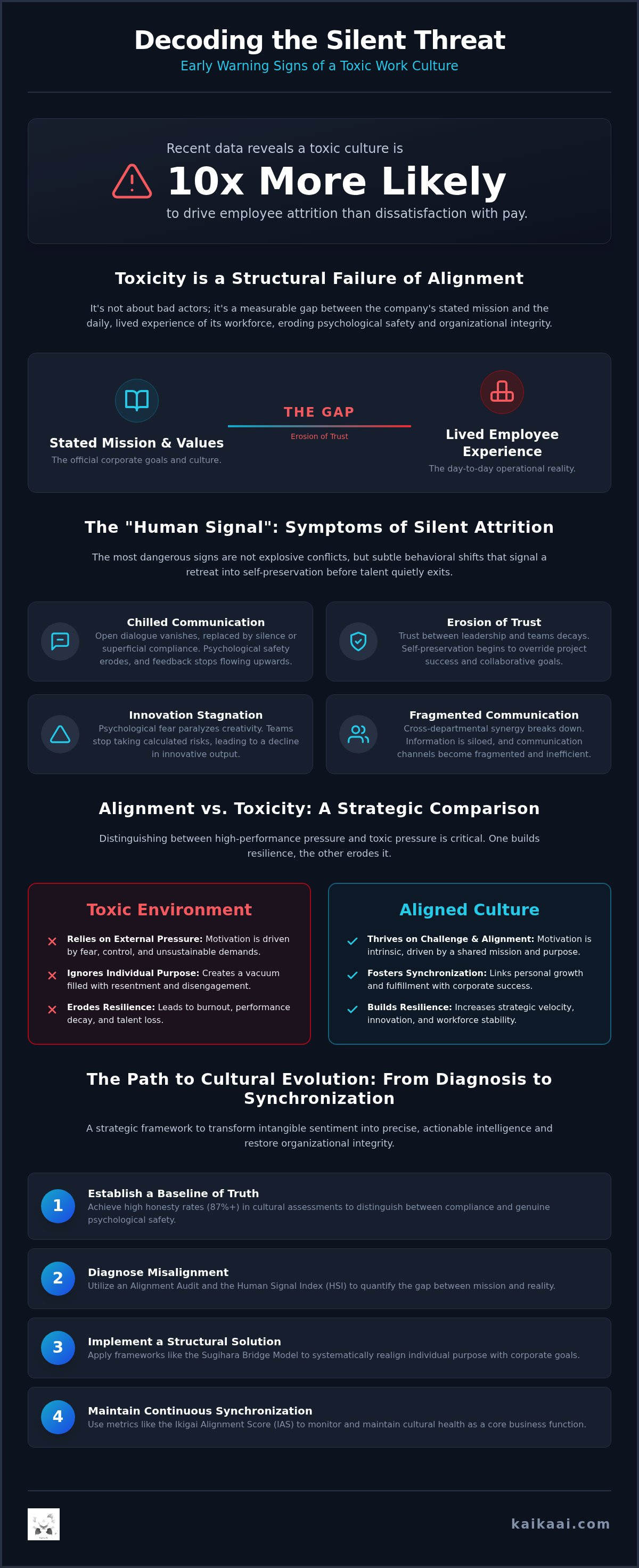
Recent data reveals that a toxic culture is 10 times more likely to drive employee attrition than dissatisfaction with pay. Despite this, many executive leaders remain blind to structural decay until their most valuable talent begins to exit. You likely sense the mounting friction: a subtle deceleration in workforce velocity, a chilling of open communication, or a widening gap between stated values and daily operations. Identifying the early signs of a toxic work culture isn't about monitoring obvious conflict. It's about auditing the invisible erosion of psychological safety and organizational harmony before the silence of disengagement takes hold.
You don't have to wait for an organizational failure to understand why your culture is fracturing. This guide provides a clear diagnostic framework to detect behavioral and structural indicators before they manifest as burnout or attrition. We'll outline a methodology to realign individual purpose with corporate goals, transforming intangible sentiment into precise, actionable intelligence. By recognizing these early warning signals, you can restore structural integrity and ensure your workforce remains synchronized with a shared mission of excellence.
Key Takeaways
- Redefine toxicity as a measurable structural failure where the gap between your stated mission and the lived experience of your workforce erodes organizational integrity.
- Learn to identify the subtle behavioral signs of a toxic work culture to detect the "human signal" of disengagement before it translates into silent attrition.
- Understand why high honesty rates in cultural assessments are essential for distinguishing between surface-level compliance and genuine psychological safety.
- Quantify the economic impact of cultural decay by examining how imminent burnout risk often hides behind traditional productivity metrics.
- Establish a strategic baseline for cultural evolution by utilizing an Alignment Audit and the Sugihara Bridge Model to maintain continuous organizational synchronization.
Defining Toxicity: The Structural Failure of Organizational Alignment
Organizational toxicity is rarely the result of a single bad actor. It's a structural failure of alignment. This phenomenon manifests as a measurable gap between a company's stated mission and the granular, lived experience of its workforce. A Toxic workplace functions as a closed system where structural silence effectively smothers individual purpose. For the modern CHRO, identifying the signs of a toxic work culture early is the only viable path to maintaining operational resilience and protecting high-value talent assets.
We must move beyond surface-level symptoms like gossip or low morale. True toxicity is a systemic misalignment of individual Ikigai. To solve this, leadership requires an objective baseline for cultural health. The Ikigai Alignment Score (IAS) fulfills this need by quantifying the degree of synchronization between organizational goals and individual fulfillment. This framework provides a data-driven signal before the silence of attrition begins, allowing for strategic interventions that preserve workforce velocity.
To better understand how these dynamics manifest within modern human resource operations, watch this educational breakdown:
The Philosophical Roots of a Healthy Culture
Healthy organizational culture rests on a foundation where individual love, skill, and societal need intersect within the corporate hierarchy. When leadership ignores individual purpose, the resulting vacuum is filled by resentment and disengagement. This is not a soft HR concern. It's a fundamental architectural requirement for long-term stability. A leadership mindset focused on fostering synchronization ensures that personal growth and corporate success remain inextricably linked. Organizations that fail this philosophical alignment inevitably face a decay of their internal human capital and a loss of institutional reliability.
Toxicity as a Barrier to Strategic Velocity
Understanding the signs of a toxic work culture is essential because cultural misalignment creates institutional friction that actively decelerates strategic velocity. This friction erodes cross-departmental synergy and turns routine operational tasks into high-effort hurdles. We see a direct correlation between cultural decay and the catastrophic failure of long-term strategic initiatives. When the internal culture is toxic, the organization loses its ability to pivot or scale with precision. This misalignment often results in:
- Stagnation of innovative output due to psychological fear.
- Fragmented communication channels that prioritize self-preservation over project success.
- The erosion of trust between executive leadership and operational teams.
Workforce alignment serves as the primary antidote to systemic toxicity.
The Behavioral Signals: Identifying Symptoms of Silent Attrition
The most dangerous signs of a toxic work culture aren't found in explosive confrontations. They exist in the silence that precedes a mass exodus of high performers. We call this the "Human Signal": a collection of subtle behavioral shifts that indicate a fundamental break in organizational synchronization. When talent begins to retreat into self-preservation, the resulting quiet is often mistaken for compliance. However, without high honesty rates, which reached 87% in our pilot programs, executive leadership remains insulated from the reality of cultural decay.
Distinguishing between healthy high-performance pressure and the signs of a toxic work culture is critical for maintaining long-term workforce velocity. High performance thrives on challenge and alignment. Toxicity, by contrast, relies on external pressure that erodes individual resilience. To surface these early sentiment shifts across global divisions, leaders need the Human Signal Index (HSI). This metric provides a sophisticated view of organizational health, allowing for an Alignment Audit that identifies friction before it results in structural failure.
Psychological Strain and the EHSI
Our clinically informed individual-level index (EHSI) utilizes insights from psychologists to detect burnout risk before it manifests physically. Behavioral markers of strain often include a decrease in creative contribution and a withdrawal from collaborative cohesion. Responsible AI implementation requires more than just raw data processing. The Sugihara Bridge Model ensures a human-in-the-loop approach, combining technical intelligence with human judgment to handle sensitive signals with the necessary nuance and empathy.
The Erosion of Transparency and Trust
Trust is the lubricant of strategic execution. When it erodes, cliquishness emerges as a defensive mechanism, signaling a failure of cross-departmental alignment. Micromanagement further exacerbates this by signaling a lack of trust in the workforce's autonomous purpose. This fear-based leadership style directly impacts data integrity. If employees fear retribution, they'll prioritize safety over honesty, effectively blinding the organization to its own vulnerabilities. Maintaining transparency isn't just an ethical choice; it's a strategic necessity for accurate cultural assessment.
Alignment vs. Toxicity: A Strategic Comparison Framework
The Aligned Enterprise operates with a precision that toxic organizations simply cannot replicate. While a toxic environment relies on fear-driven compliance, an aligned culture leverages a synchronized mission to drive performance. We see this reflected in a Net Promoter Score (NPS) of 72 and consistent weekly completion rates of 74%. These figures represent the difference between a workforce that's merely present and one that's fully integrated into the corporate vision. Recognizing the signs of a toxic work culture requires looking beyond surface metrics to see how cultural health dictates operational outcomes.
To visualize the structural differences between these two states, we utilize a comparison framework that identifies key performance indicators and their cultural equivalents:
| Operational Metric | Aligned Enterprise | Toxic Organization |
|---|---|---|
| Primary Driver | Individual Ikigai & Mission Sync | External Pressure & Fear |
| Communication | Transparent & Vocal Dissent | Opaque & Silent Attrition |
| Performance Basis | Sustainable Value Creation | Short-term Output Grinding |
| Institutional Trust | High (87% Honesty Rate) | Low (Data Integrity Decay) |
Sophisticated workforce intelligence platforms provide the analytical depth required to differentiate between vocal dissent and the far more catastrophic silent attrition. Vocal employees often provide the necessary friction that sparks innovation and structural improvement. Silent employees, by contrast, represent a profound failure of engagement where the individual has already mentally exited the organization. Through Collective Kaizen Workshops, organizations can shift from a state of fragmentation to one of strategic synergy.
Healthy Synergy vs. Toxic Friction
Workforce velocity measures the speed and efficiency with which an organization moves toward its strategic objectives. In a synchronized environment, cross-departmental synergy acts as an accelerant. Conversely, internal friction acts as a structural drag, siphoning off energy that should be directed toward innovation. You can learn more about Measuring Workforce Velocity for Strategic Growth to understand how these dynamics impact your bottom line. Measuring this drag is the first step in dismantling the signs of a toxic work culture that hinder long-term performance.
Purpose-Driven Engagement vs. Fear-Driven Compliance
Compliance-based cultures are inherently fragile. They rely on external pressure and surveillance, which inevitably leads to widespread burnout and a decay of institutional reliability. Resilience is found in organizations where individual Ikigai is mapped directly to organizational goals. This alignment creates a robust psychological buffer against external market volatility and competitive pressure. An Alignment Audit serves as a mission-critical diagnostic tool to identify exactly where these purpose-gaps exist. By bridging the divide between individual fulfillment and corporate strategy, leaders can foster an environment that's not only productive but fundamentally sustainable.
The Economic Impact: From Burnout Risk to Performance Decay
Cultural toxicity is a silent balance sheet killer. While traditional accounting focuses on tangible assets, the erosion of human capital through attrition and lost productivity often goes unmeasured until it reaches a critical mass. Identifying the signs of a toxic work culture requires a shift from reactive observation to predictive analysis. In the U.S. alone, the average cost of employee replacement reached $45,236 in 2026. These costs extend far beyond recruitment fees. They include the systemic loss of institutional knowledge and the deceleration of strategic velocity that occurs when high performers exit.
The "Burnout Correlation" presents a unique challenge for executive leadership. Standard productivity metrics often hide the risk of imminent talent loss by showing high output right up until the point of collapse. This creates a dangerous illusion of health. Traditional engagement surveys fail because they capture a static moment in time rather than the high-velocity signals of enterprise decay. To protect your organization's future, you must build operational resilience at a structural level. You can start this transformation by deploying a Workforce Alignment Intelligence Platform to surface the human truth within your data.
Predictive Attrition Intelligence
Modern CHROs can't rely on exit interviews to understand why talent leaves. We utilize AI to identify patterns of disengagement long before they manifest as a resignation letter. The Employee Human Signal Index (EHSI) serves as a vital tool for maintaining workforce sustainability by monitoring shifts in individual and collective sentiment. This data-driven approach allows for proactive intervention, ensuring the organization remains synchronized with its human core. For a deeper dive into these methodologies, consult our executive guide on Leading Indicators of Employee Burnout.
Protecting Corporate Governance and Mental Health
The intersection of mental health risk prediction and corporate responsibility is now a cornerstone of modern governance. Toxic cultures don't just hurt people; they expose organizations to significant legal and reputational risks that can take years to repair. Leadership has a fiduciary duty to maintain a psychologically safe environment. Kaika AI ensures strict compliance with Japanese privacy standards while surfacing the human truth necessary for ethical leadership. By addressing toxicity at its root, organizations protect both their people and their institutional integrity, fostering a culture of long-term resilience and excellence.
Implementing Alignment Intelligence: The Path to Cultural Evolution
Transitioning from a reactive posture to a proactive cultural strategy requires a methodical, architectural approach. Identifying the signs of a toxic work culture is merely the initial diagnostic phase. The evolution toward an Aligned Enterprise begins with a comprehensive Alignment Audit to establish your baseline Ikigai Alignment Score (IAS). This metric serves as the foundation for all subsequent interventions, providing a precise measurement of the current gap between corporate mission and individual workforce reality.
Once the baseline is established, organizations must deploy the Sugihara Bridge Model for continuous, sensitive signal monitoring. This is followed by the integration of data-driven Collective Kaizen Workshops designed to realign departmental missions with individual purpose. Finally, executive leadership is empowered with real-time performance and burnout risk dashboards. These tools transform abstract cultural sentiment into actionable strategic intelligence, ensuring the organization remains synchronized and resilient against the friction of disengagement.
The Sugihara Bridge Model: AI + Human Judgment
Technology alone cannot resolve the complex psychological roots of a fractured culture. The Sugihara Bridge Model recognizes that responsible AI must be paired with clinical and strategic expertise. Our human-in-the-loop approach, developed alongside clinical psychologists, ensures that sensitive workforce signals are interpreted with the necessary nuance. This three-phase strategic integration methodology allows global enterprises to move from initial diagnostic discovery to deep calibration and, eventually, total organizational synchronization. By combining technical intelligence with human judgment, we provide a framework for evolution that respects the complexity of human behavior.
Continuous Performance Reimagined
The era of the annual engagement survey is over. These static snapshots are insufficient for identifying the high-velocity signs of a toxic work culture before they result in structural failure. We've reimagined continuous performance through real-time workforce alignment intelligence. This shift allows leaders to intervene in weeks rather than months, protecting their most valuable talent assets from the decay of disengagement. You can now request early access to the Kaika AI platform to begin your organizational transformation. Taking this step ensures your leadership remains visionary, disciplined, and uncompromisingly focused on excellence.
Request an Alignment Audit with Kaika AI to secure your organization's future and restore strategic velocity.
Restoring Structural Integrity through Alignment Intelligence
Leadership is the art of architecting an environment where individual purpose and corporate mission are perfectly synchronized. We've explored how identifying the early signs of a toxic work culture requires moving beyond surface-level morale checks to measure deep behavioral shifts. By utilizing clinical frameworks and strategic intelligence, you can detect the friction of disengagement before it results in catastrophic talent loss. Our pilot programs achieved an 87% employee honesty rate and an NPS of 72, demonstrating that transparency thrives when psychological safety is prioritized. Through our academic research partnership with Waseda University, we've refined a methodology that balances technical precision with human judgment. You have the power to transform cultural silence into strategic velocity. Hear the signal before the silence; Request early access to the Kaika AI platform today. Your organization's future resilience depends on the clarity of your cultural signal.
Frequently Asked Questions
What are the most common early signs of a toxic work culture?
Early indicators include a noticeable drop in workforce velocity and the emergence of silent attrition, where employees mentally disengage before resigning. In these instances, tech professionals often turn to tools like QuickApply to quietly explore opportunities that offer better alignment and culture. You might observe fragmented communication or a shift from collaborative synergy to siloed self-preservation. These signs of a toxic work culture often hide behind stable productivity metrics. When high performers stop offering creative friction and transition into passive compliance, the structural integrity of the organization is already at risk.
Yes, AI identifies behavioral patterns and sentiment shifts that are invisible to manual observation. By analyzing the human signal within organizational data, our platform detects the subtle erosion of psychological safety. This predictive capability allows leadership to intervene weeks before disengagement manifests as a formal resignation. Our Sugihara Bridge Model ensures these technical insights are balanced with human judgment, providing a sophisticated early warning system for enterprise-scale cultural decay.
How does the Ikigai Intelligence Framework differ from traditional HR surveys?
Traditional surveys provide static, reactive snapshots that often suffer from low participation or biased responses. The Ikigai Intelligence Framework (IIF) offers continuous, real-time analysis of organizational alignment. It measures the intersection of individual purpose and corporate mission through proprietary indices like the IAS. In pilot programs, this approach achieved an 87% employee honesty rate. It moves beyond surface-level morale to quantify the structural synchronization required for long-term operational resilience.
What is the "Human Signal Index" and why does it matter for CHROs?
The Human Signal Index (HSI) is a proprietary metric that surfaces early sentiment shifts across global divisions. For CHROs, it provides an objective dashboard to monitor the health of the corporate culture without relying on anecdotal evidence. It matters because it quantifies the silence that precedes talent loss. By tracking the HSI, leadership can identify which departments are experiencing friction, allowing for targeted interventions that protect workforce velocity and institutional knowledge.
How can an organization fix a toxic culture that has existed for years?
Reversing long-standing toxicity requires a methodical realignment of individual purpose with corporate goals. The process begins with an Alignment Audit to establish an objective baseline of cultural health. Following the audit, leadership should implement Collective Kaizen Workshops to dismantle siloed cliquishness and restore transparency. This isn't a quick fix but a structural evolution. It demands disciplined, visionary leadership and a commitment to data-driven synchronization across every level of the enterprise.
What role does individual purpose (Ikigai) play in workplace toxicity?
Toxicity often stems from a profound misalignment between an individual's sense of purpose and their daily operational reality. When an organization ignores the Ikigai of its workforce, it breeds resentment and psychological strain. This gap is one of the primary signs of a toxic work culture. By mapping individual fulfillment to organizational objectives, leaders create a resilient culture where employees feel synchronized with a shared mission, significantly reducing the risk of burnout.
Is the Kaika AI platform compliant with privacy standards?
Security and ethical data use are foundational to our architecture. The Kaika AI platform is fully compliant with Japanese privacy standards and international data protection regulations. We utilize a clinically informed individual-level index (EHSI) developed with psychologists to ensure that sentiment analysis is conducted responsibly. Our focus is on surfacing organizational human truth while maintaining the highest standards of transparency and individual data integrity for every workforce member.
How long does it take to see results from a workforce alignment audit?
Initial diagnostic insights are typically available within the first few weeks of deployment. An Alignment Audit establishes a baseline Ikigai Alignment Score (IAS) that immediately highlights mission-critical gaps. While total cultural evolution is a cumulative process, most organizations observe a measurable shift in workforce synchronization and an increase in Net Promoter Scores (NPS) within the first quarter. Our pilot programs consistently show an NPS of 72 following the implementation of our alignment methodologies.
Disclaimer
#Disclaimer
At Kaika AI, we believe the future belongs to organizations that combine human wisdom with artificial intelligence responsibly. The articles, research, insights, and thought leadership published on this website are intended to educate, inform, and encourage meaningful conversations about the future of work, organizational intelligence, AI, leadership, and innovation.
While our content is developed through rigorous research and may be generated, curated, or enhanced using artificial intelligence, every effort is made to ensure it reflects thoughtful analysis, practical relevance, and responsible AI practices. However, no representation or warranty is made regarding the completeness, accuracy, or suitability of the information for every individual or organizational circumstance.
The ideas, opinions, frameworks, and recommendations shared by Kaika AI are provided for educational and informational purposes only. They should not be interpreted as legal, financial, medical, psychological, human resources, cybersecurity, or other professional advice. Organizations and individuals should seek qualified professional guidance before making strategic, legal, or operational decisions.
Where articles reference third-party organizations, products, services, academic research, industry reports, or public data, such references are provided solely to support discussion and analysis. Unless explicitly stated, they do not imply endorsement, partnership, or affiliation.
Artificial intelligence is a powerful decision-support technology—not a replacement for human judgment. Kaika AI advocates for responsible, transparent, and human-centered AI adoption. We encourage readers to critically evaluate information, consider their unique context, and combine AI-generated insights with professional expertise and sound decision-making.
The content published on this website may be updated, revised, or removed as knowledge, technology, regulations, and best practices continue to evolve.
To the fullest extent permitted by applicable law, Kaika AI, its affiliates, contributors, and partners disclaim liability for any direct, indirect, incidental, consequential, or other losses arising from the use of, or reliance upon, the information provided on this website.
By accessing or using this website, you acknowledge that you have read, understood, and agree to this Disclaimer.
Kaika AI
'Building trusted organizational intelligence for the AI Era'


