
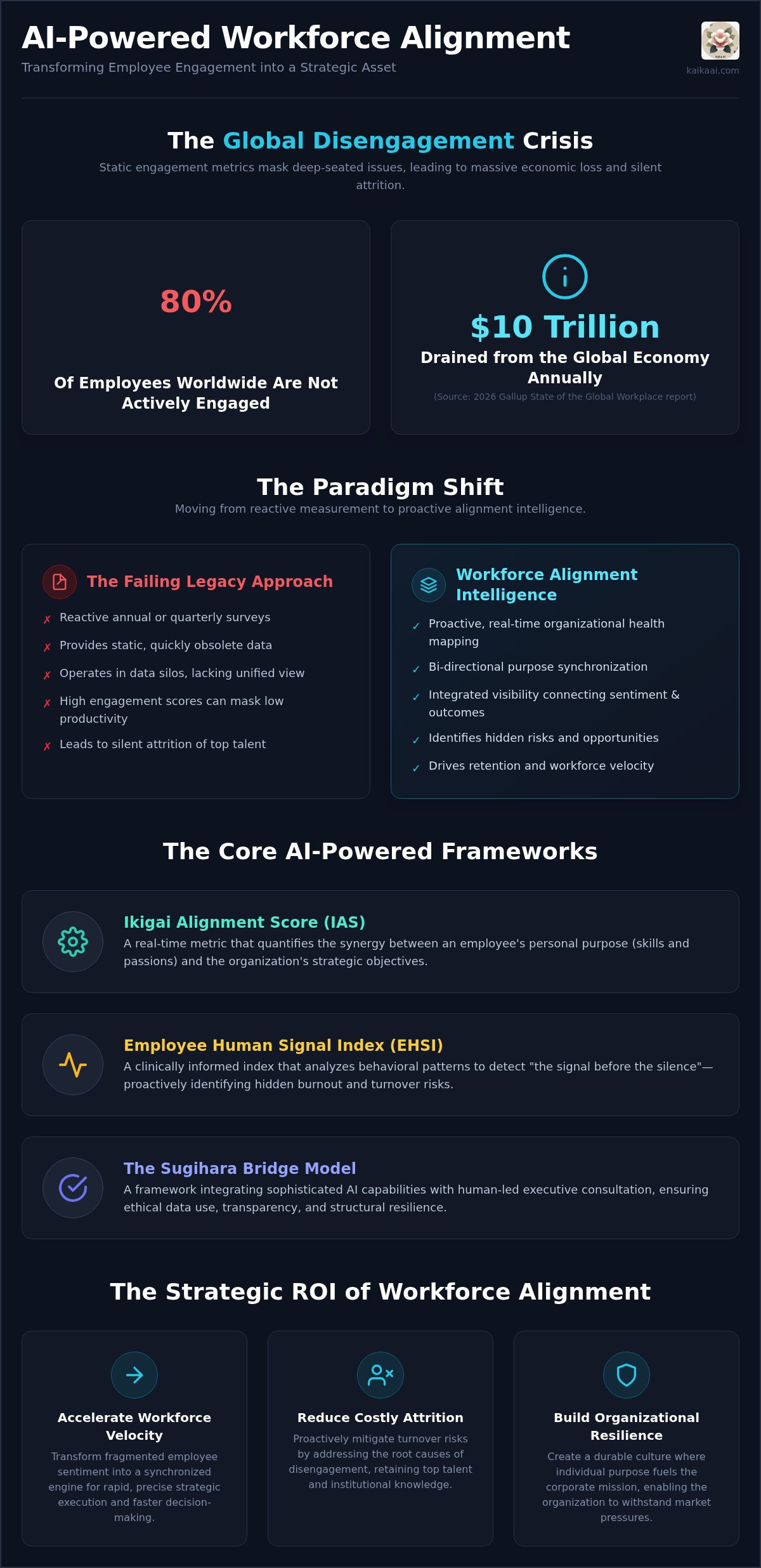
According to the 2026 Gallup State of the Global Workplace report, a staggering 80% of employees worldwide are not actively engaged at work, a systemic deficit that drains $10 trillion from the global economy every year. You likely feel this friction within your own organization as the silent attrition of top talent or a persistent disconnect between executive strategy and departmental execution. It’s a high-stakes environment where surface-level productivity metrics often mask deep-seated burnout and structural misalignment. Utilizing ai for aligning employee engagement with business goals isn't merely a technical upgrade; it’s a fundamental shift toward workforce alignment intelligence.
We understand that true organizational harmony requires more than just surveys; it demands a precision synchronization of individual purpose with corporate architecture. This article provides a strategic framework to transform fragmented engagement into a high-velocity engine for performance. You’ll discover how to detect early signals of turnover, mitigate burnout through clinically informed indices, and build a culture where individual purpose fuels your corporate mission. We’ll move from high-level visionary concepts down to the structured, phase-based methodologies required to achieve measurable structural impact and operational resilience.
Key Takeaways
- Transition from static surveys to a proactive intelligence model that synchronizes individual human purpose with organizational mission-critical objectives.
- Leverage ai for aligning employee engagement with business goals through the Ikigai Alignment Score (IAS), a metric designed to quantify the synergy between personal "Ikigai" and corporate strategy.
- Proactively manage organizational health by identifying "the signal before the silence" using the clinically informed Employee Human Signal Index (EHSI) to detect hidden burnout risks.
- Implement the Sugihara Bridge Model to integrate sophisticated AI capabilities with human-led executive consultation, ensuring ethical data use and structural resilience.
- Accelerate Workforce Velocity by transforming fragmented employee sentiment into a synchronized engine capable of rapid strategic execution and reduced attrition.
The Convergence of Individual Purpose and Organizational Mission
Workforce Alignment Intelligence is the systematic synchronization of human truth and corporate data. It represents a fundamental departure from the administrative tracking of the past. Traditionally, leadership relied on top-down goal cascading, a linear process that often ignored the internal motivations of the individual. Utilizing ai for aligning employee engagement with business goals transforms this dynamic into a bi-directional purpose synchronization. It identifies the precise intersection of an employee's skills and passions with the organization's strategic requirements. This intersection is Ikigai, the point where personal fulfillment fuels institutional excellence.
The transition from reactive engagement surveys to proactive alignment intelligence is a strategic necessity. Reactive models merely document dissatisfaction after it has already impacted the bottom line. Proactive intelligence, however, creates a real-time map of organizational health. It allows executives to move beyond the superficiality of employee satisfaction and toward a deeper, more resilient state of mission-critical synergy. By leveraging ai for aligning employee engagement with business goals, leadership can ensure that every unit of human effort contributes directly to the overarching corporate architecture.
Why Traditional Engagement Strategies Fail in 2026
Annual or quarterly pulse surveys are increasingly inadequate in a high-velocity market. These tools provide a static snapshot of a workforce that is constantly in motion. By the time leadership analyzes the results, the data is often obsolete. This creates a dangerous engagement-performance gap. In this scenario, high engagement scores mask low productivity or hidden burnout because the metrics fail to measure actual alignment. Data silos further complicate the issue, as CHROs often lack the integrated visibility needed to connect sentiment with operational outcomes. Without a unified view, executive strategy and departmental execution remain disconnected, leading to the silent attrition of top talent and wasted organizational energy.
The Strategic Importance of Purpose-Goal Symmetry
Achieving strategic alignment requires more than just clear communication; it requires a structural integration of personal and corporate missions. When you integrate AI in employee engagement, you create a unified organizational architecture where individual development and corporate growth are inseparable. This symmetry is a powerful driver of long-term retention. Employees don't just work for the company; they work through the company to achieve their own sense of purpose. For the executive, the benefits are measurable. A workforce that views corporate goals as personal milestones operates with significantly higher velocity. Decisions are made faster, execution is more precise, and the organization becomes resilient enough to withstand the pressures of global scale.
The Mechanism of Alignment Intelligence: Moving Beyond Static Data
Static data is the graveyard of strategic intent. The Ikigai Intelligence Framework (IIF) serves as the core engine for this evolution, moving beyond the limitations of legacy HR systems that only record the past. By utilizing ai for aligning employee engagement with business goals, the IIF identifies complex behavioral patterns that traditional tools overlook. It interprets the subtle nuances of digital collaboration and project velocity to build a comprehensive picture of organizational health. This intelligence allows leadership to move from guessing to knowing, transforming vague sentiment into actionable architecture.
Trust is the foundation of this architectural shift. Maintaining data integrity requires enterprise-grade security protocols that ensure every human signal remains protected. When implementing AI for workforce alignment, transparency about data usage is non-negotiable. This ethical framework ensures that employees feel safe contributing their human truth to the system. Without this psychological safety, data becomes skewed and alignment fails. A secure environment fosters the honesty required for the system to function as a reliable strategic partner.
Decoding the Ikigai Alignment Score (IAS)
The IAS quantifies the qualitative link between an individual's sense of purpose and the company's strategic objectives. It synthesizes diverse data inputs, including self-reported aspirations, skill development trajectories, and real-time performance outcomes. This score isn't a retrospective grade; it functions as a leading indicator for strategic success. It allows leadership to see where mission-critical synergy is thriving and where it is beginning to fracture. Organizations seeking this level of precision often start with a Workforce Alignment Intelligence Platform to establish a data-driven baseline for evolution.
Real-Time Metrics vs. Historical Reporting
Traditional performance reviews are administrative post-mortems of missed opportunities. We advocate for continuous measurement that offers immediate visibility into the workforce's current state. Real-time dashboards enable leaders to pivot strategy before misalignment causes structural damage. This transition from historical reporting to live intelligence ensures that the organization remains agile. Utilizing ai for aligning employee engagement with business goals through continuous listening prevents the friction of sudden, unannounced strategic shifts. For those evaluating their current tech stack, the definitive guide to workforce alignment software provides a comprehensive comparison of modern tools designed for this purpose.
Quantifying the Qualitative: How AI Surfaces Hidden Human Signals
Leadership excellence often depends on the ability to perceive what remains unsaid. The Human Signal Index (HSI) functions as a strategic ear, allowing executives to hear the signal before the silence of a resignation letter. While traditional sentiment analysis often relies on superficial word clouds, the Employee Human Signal Index (EHSI) provides a clinically informed perspective on workforce health. Co-developed with clinical psychologists, this index moves beyond binary "happy or sad" metrics. It identifies the subtle psychological markers of strain and the gradual erosion of mission-critical commitment. Utilizing ai for aligning employee engagement with business goals requires this level of depth to ensure that the human foundation of the enterprise remains structurally sound.
Trust is the primary currency of any effective intelligence system. In pilot studies involving 340 participants, the Ikigai Intelligence Framework achieved an 87% employee honesty rate. This high level of transparency is achieved because the system prioritizes human potential over invasive surveillance. When employees understand that their data fuels their own professional fulfillment and well-being, they provide the authentic "human truth" required for accurate modeling. This honesty creates a reliable data stream that allows AI to flag psychological strain long before it manifests as a drop in productivity or a resignation.
Identifying Silent Attrition Before It Happens
Silent attrition is a slow, expensive drain on organizational velocity. It begins with behavioral signals that traditional HR tools frequently overlook, such as subtle shifts in communication frequency or a retreat from collaborative initiatives. AI identifies these patterns by differentiating between temporary, acute stress and systemic, chronic burnout. Early detection is a significant cost-saving measure. Given that replacing a disengaged employee can cost up to 200% of their annual salary, hearing the signal early protects both the culture and the balance sheet. This proactive approach allows for targeted interventions, such as adjusting workloads or realigning projects with an individual's Ikigai, before the talent is lost to a competitor. To explore how technology can facilitate these interventions, visit Elli and discover how workforce intelligence can transform your retention rates.
The Ethics of Predictive Attrition Intelligence
The use of predictive intelligence in the workplace demands a rigorous ethical framework. Responsible AI use isn't just a regulatory requirement; it's a strategic imperative for maintaining long-term organizational harmony. We believe that intelligence should serve the employee as much as the executive. By focusing on clinically informed indices, organizations ensure that well-being remains a core component of the performance equation. Leaders who master these leading indicators of employee burnout can build more resilient teams. This ethical transparency transforms AI from a monitoring tool into a supportive architecture that fosters a culture of mutual respect and shared mission.
Implementing a Strategic Alignment Framework: The Sugihara Bridge Model
The Sugihara Bridge Model serves as the definitive architectural link between technical intelligence and executive judgment. Enterprise-scale transformation cannot rely on algorithms alone; it requires a sophisticated synthesis of data-driven insights and human consultation. This hybrid approach ensures that the use of ai for aligning employee engagement with business goals remains grounded in ethical reality and strategic nuance. The CHRO emerges as the primary architect of this system, moving beyond administrative duties to design a workforce environment where technology amplifies human potential. This methodology demonstrates that using ai for aligning employee engagement with business goals is most effective when technical precision meets human wisdom.
Phase 1: The Alignment Audit and Baseline Measurement
Every successful evolution begins with an objective assessment of the current state. The Alignment Audit is a rigorous process designed to surface the human truth hidden beneath existing workforce data and traditional performance metrics. We identify mission-critical alignment gaps across global divisions, pinpointing where departmental execution has decoupled from executive strategy. The deliverables of this audit include a comprehensive map of organizational health and a baseline for the Ikigai Alignment Score (IAS). This foundational stage provides the clarity required to move from fragmented effort toward synchronized movement. Organizations ready to begin this process can initiate an Alignment Audit to secure their strategic baseline.
Phase 2 & 3: Strategic Integration and Continuous Kaizen
Once the baseline is established, the framework moves into strategic integration. This phase embeds alignment intelligence into the daily flow of operations, enhancing operational resilience. It transforms AI signals into actionable management nudges that prevent misalignment before it occurs. The third phase focuses on Collective Kaizen, an iterative approach to organizational improvement where every employee contributes to the mission's refinement. This is not a static implementation but a living system that evolves alongside the business.
Trained human consultants play a vital role in this phase by interpreting sensitive AI signals that require psychological depth. These experts ensure that the transition between technical intelligence and human-centric outcomes is seamless. By combining high-tech enterprise terminology with a focus on organizational harmony, the Sugihara Bridge Model creates a resilient structure. It ensures that the organization remains agile enough to respond to market shifts while keeping individual purpose at the center of the corporate mission. This methodology provides the discipline and vision necessary for global scale and long-term excellence.
The Strategic ROI of Workforce Alignment Intelligence
Strategic ROI manifests as a measurable acceleration of corporate intent. While traditional engagement programs focus on morale, the use of ai for aligning employee engagement with business goals prioritizes structural movement. We define this as Workforce Velocity. It's the speed at which an aligned organization transforms executive strategy into operational reality. By synchronizing individual purpose with the corporate mission, enterprises eliminate the internal friction that typically stalls large-scale initiatives. This alignment creates a synchronized engine for performance, ensuring that every contributor's effort pushes the organization toward its long-term objectives with precision and resilience.
The long-term impact of this framework extends to corporate governance and mental health risk management. By utilizing clinically informed indices like the EHSI, leadership can proactively manage psychological strain before it impacts the balance sheet. Kaika AI serves as the definitive partner for global enterprises seeking category leadership through this intersection of technology and human behavior. This approach ensures that performance is not achieved at the cost of human potential but is fueled by it.
From Engagement Scores to Workforce Velocity
To extend these performance gains beyond internal team dynamics, many forward-thinking leaders also explore AI Business Automation and Web Development to modernize their customer-facing infrastructure and automate routine interactions.
Traditional engagement metrics often serve as "feel-good" indicators that lack a direct correlation with bottom-line results. In contrast, alignment intelligence focuses on performance metrics that quantify mission-critical synergy. When teams are synchronized through the Ikigai Intelligence Framework, cross-departmental friction vanishes. This clarity allows for the rapid deployment of resources and talent to the areas of highest strategic impact. Leaders can track these advancements using workforce resilience metrics to ensure sustainable growth. This data-driven approach moves the HR function from a cost center to a primary driver of operational excellence.
Building Institutional Resilience for the Future
Institutional resilience is the byproduct of a workforce that remains aligned during unforeseen market shifts. As global enterprises navigate complex regulatory environments, such as the 2026 APPI amendments in Japan, the ability to manage human data ethically becomes a competitive advantage. This structural integrity is essential for organizations aiming for dual-listing standards on the TSE or ASX by the 2032 listing target. Kaika AI provides the architectural foundation for these high-stakes milestones. We invite executives to request early access to the Kaika AI platform to begin a journey of data-driven Kaizen. This proactive strategy ensures your organization doesn't just survive market volatility but actively leads the evolution of the global workforce.
Synchronizing Human Potential with Global Strategy
The evolution of the modern enterprise depends on its ability to move beyond administrative tracking and toward a state of structural harmony. By implementing ai for aligning employee engagement with business goals, leadership can finally hear the signal before the silence. Alignment is the ultimate competitive advantage. This framework identifies hidden burnout risks through the clinically informed EHSI index, replacing fragmented effort with a synchronized engine for performance. This strategic shift drives measurable gains in Workforce Velocity and ensures institutional resilience against market volatility.
Our pilot studies confirm the efficacy of this architectural approach, yielding an 87% employee honesty rate and an NPS of 72 among global participants. These benchmarks demonstrate that when technology serves the individual's sense of purpose, the entire organization achieves a state of mission-critical synergy. It is time to transition your workforce from passive engagement to active, purpose-driven alignment. We invite you to request early access to the Kaika AI Workforce Alignment Intelligence Platform to begin your journey toward data-driven Kaizen and global excellence. Building the future of your organization starts with the precision of alignment today.
Frequently Asked Questions
How does AI specifically align individual goals with business objectives?
AI identifies the intersection between personal aptitude and strategic needs by analyzing behavioral patterns and digital collaboration data. This creates a precise map of how individual aspirations fit into the corporate architecture. Utilizing ai for aligning employee engagement with business goals ensures that personal development directly fuels organizational milestones. It transforms static goal-setting into a dynamic, bi-directional synchronization that increases workforce velocity and reduces the friction of strategic execution.
Is AI-driven employee engagement analysis ethical and private?
Ethical integrity is the foundation of our intelligence systems. We prioritize transparency and responsible AI use, adhering to modern standards like Japan's 2026 APPI amendments. Data is processed to provide structural insights rather than invasive surveillance. Our pilot studies achieved an 87% employee honesty rate because participants trust the platform to support their well-being. Security protocols ensure that human signals remain protected and are utilized only for organizational harmony.
What is the difference between engagement and workforce alignment intelligence?
Engagement measures how employees feel, while alignment intelligence measures how they move. Engagement surveys often provide a static snapshot of morale that doesn't always correlate with productivity. Utilizing ai for aligning employee engagement with business goals focuses on the structural integration of individual purpose with corporate strategy. This shift from feel-good metrics to performance-driven outcomes allows leadership to manage organizational health with precision and resilience.
How does the Ikigai Intelligence Framework (IIF) measure employee purpose?
The IIF utilizes the Ikigai Alignment Score (IAS) to quantify the qualitative link between purpose and goals. It synthesizes diverse data points, including self-reported passions and real-time performance trajectories. By identifying the intersection of what employees love, what they're good at, and what the business requires, the framework creates a map of human potential. This systematic approach ensures that individual purpose remains the core engine of corporate excellence and long-term retention.
Can AI really predict employee burnout before it happens?
Yes, AI identifies the signal before the silence by detecting subtle behavioral shifts that precede chronic exhaustion. The clinically informed Employee Human Signal Index (EHSI) differentiates between temporary acute stress and systemic burnout risk. This early detection allows for proactive interventions, such as workload adjustments or project realignment, before attrition occurs. It protects the organization's human foundation and prevents the high costs associated with disengagement and the loss of top-tier talent.
What is the Sugihara Bridge Model and why is it hybrid?
The Sugihara Bridge Model is an architectural framework that connects technical intelligence with human judgment. It's hybrid because enterprise-scale alignment requires both algorithmic precision and expert consultation. While AI surfaces complex patterns, human consultants provide the psychological depth needed to interpret sensitive signals. This synergy ensures that strategic decisions are data-driven yet remains grounded in the nuances of leadership mindset. It's a gold standard for maintaining ethical transparency in global HR.
How long does it take to implement a workforce alignment platform in a large enterprise?
Implementation typically follows a structured, phase-based methodology. The initial Alignment Audit and baseline measurement usually occur within the first month. Full strategic integration and the establishment of Collective Kaizen workshops generally take three to six months, depending on the organization's scale and complexity. This methodical progression ensures the system is properly calibrated to the specific strategic requirements and cultural nuances of the global enterprise, ensuring long-term operational resilience.
Does alignment intelligence replace traditional performance reviews?
It evolves them from administrative post-mortems into continuous strategic dialogues. Traditional reviews focus on retrospective reporting, but alignment intelligence provides real-time visibility into mission-critical synergy. It supplements periodic evaluations with live data, allowing managers to offer proactive support rather than delayed feedback. This transition ensures that performance management isn't a static exercise but a dynamic driver of workforce velocity. It creates a culture where individual purpose and corporate mission are perfectly synchronized.
Disclaimer
#Disclaimer
At Kaika AI, we believe the future belongs to organizations that combine human wisdom with artificial intelligence responsibly. The articles, research, insights, and thought leadership published on this website are intended to educate, inform, and encourage meaningful conversations about the future of work, organizational intelligence, AI, leadership, and innovation.
While our content is developed through rigorous research and may be generated, curated, or enhanced using artificial intelligence, every effort is made to ensure it reflects thoughtful analysis, practical relevance, and responsible AI practices. However, no representation or warranty is made regarding the completeness, accuracy, or suitability of the information for every individual or organizational circumstance.
The ideas, opinions, frameworks, and recommendations shared by Kaika AI are provided for educational and informational purposes only. They should not be interpreted as legal, financial, medical, psychological, human resources, cybersecurity, or other professional advice. Organizations and individuals should seek qualified professional guidance before making strategic, legal, or operational decisions.
Where articles reference third-party organizations, products, services, academic research, industry reports, or public data, such references are provided solely to support discussion and analysis. Unless explicitly stated, they do not imply endorsement, partnership, or affiliation.
Artificial intelligence is a powerful decision-support technology—not a replacement for human judgment. Kaika AI advocates for responsible, transparent, and human-centered AI adoption. We encourage readers to critically evaluate information, consider their unique context, and combine AI-generated insights with professional expertise and sound decision-making.
The content published on this website may be updated, revised, or removed as knowledge, technology, regulations, and best practices continue to evolve.
To the fullest extent permitted by applicable law, Kaika AI, its affiliates, contributors, and partners disclaim liability for any direct, indirect, incidental, consequential, or other losses arising from the use of, or reliance upon, the information provided on this website.
By accessing or using this website, you acknowledge that you have read, understood, and agree to this Disclaimer.
Kaika AI
'Building trusted organizational intelligence for the AI Era'


