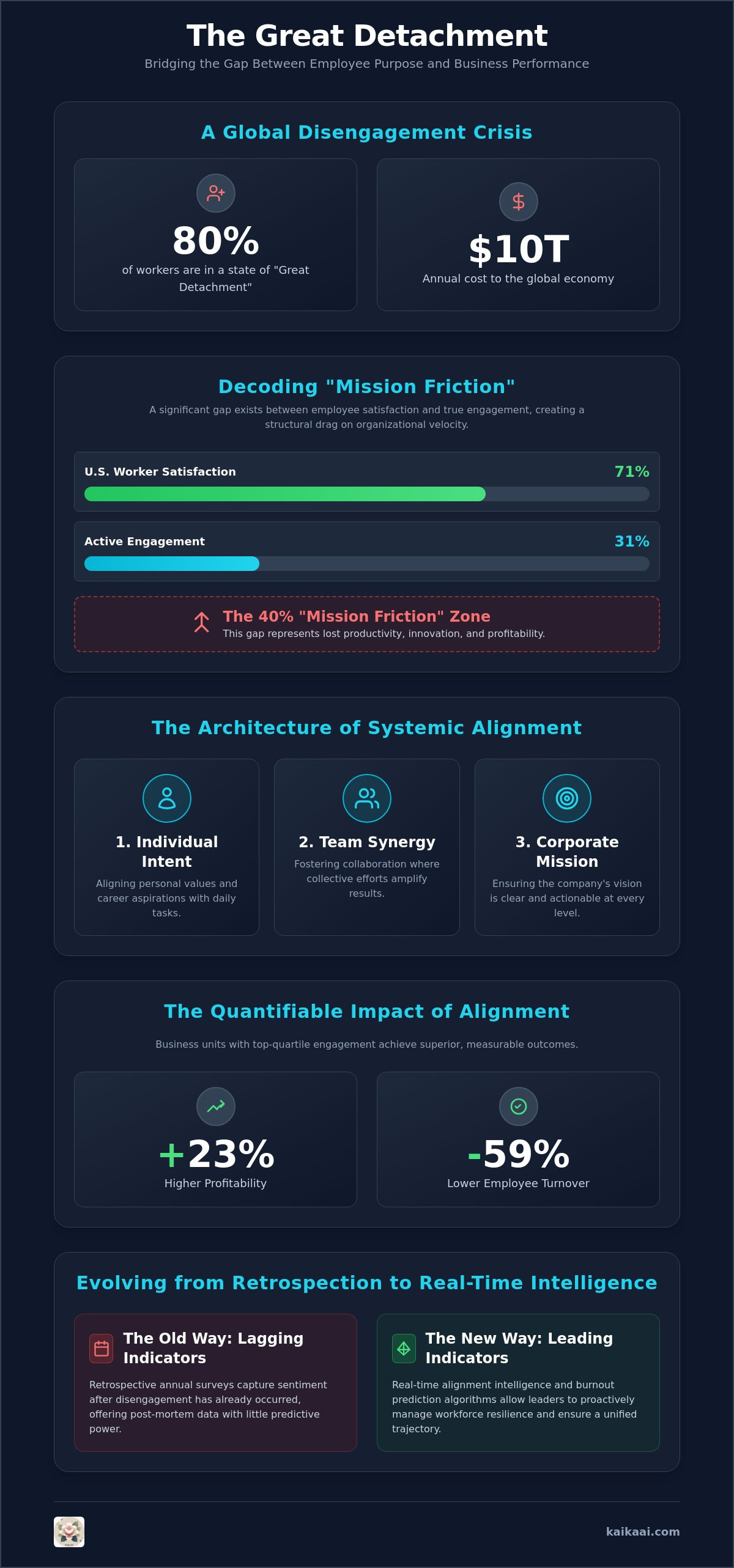
Global disengagement has reached a critical threshold. Gallup's 2026 State of the Global Workplace report indicates that 80% of workers exist in a state of "Great Detachment" that costs the world economy $10 trillion annually. This systemic inertia persists despite record investments in talent acquisition, revealing a profound structural disconnect between individual intent and institutional objectives. You've likely observed this friction as declining organizational velocity or the quiet erosion of your most vital talent pools. Executives often feel the weight of this misalignment as departmental execution drifts further from the strategic core.
Mastering the science of linking employee purpose to business outcomes is the only viable path to restoring operational equilibrium in a volatile market. You'll discover how to transform abstract personal values into a high-precision engine for growth through advanced alignment intelligence. We provide a comprehensive framework for 2026 that replaces traditional, lagging surveys with real-time metrics and burnout prediction algorithms. This methodology allows leadership to synchronize human potential with measurable performance, ensuring that every unit of effort contributes to a unified trajectory of excellence.
Key Takeaways
- Recognize that "Mission Friction" is a structural failure that impedes organizational velocity and creates significant financial leakage across global enterprises.
- Master the three critical vectors of alignment: Individual Intent, Team Synergy, and Corporate Mission, to begin linking employee purpose to business outcomes.
- Transition from static corporate culture to dynamic alignment to unlock the "Velocity Multiplier" and outpace competitors through superior operational precision.
- Implement a structured, three-phase architectural framework to audit mission-critical gaps and synchronize departmental execution with the strategic core.
- Replace retrospective annual surveys with real-time alignment intelligence to proactively identify burnout risks and ensure long-term workforce resilience.
The Purpose Gap: Why Strategic Intent Fails Without Structural Alignment
Enterprise leaders in 2026 recognize a harsh reality. Traditional engagement initiatives have failed to stem the tide of the "Great Detachment." While 71% of U.S. workers report satisfaction, only 31% are actively engaged. This gap represents "Mission Friction," a structural drag that erodes profitability and slows departmental execution. When strategic intent remains trapped in the C-suite, it creates a vacuum where velocity should be. Linking employee purpose to business outcomes is no longer a cultural experiment; it's an architectural necessity for institutional survival.
This friction isn't a failure of individual will but a symptom of outdated organizational development models that prioritize static reporting over dynamic synchronization. Annual surveys are post-mortem artifacts. They capture sentiment after the damage is done, offering little more than a retrospective look at why talent has already checked out. True performance requires "Organizational Harmony," a state where individual intent and corporate mission exist in mutual reinforcement. Without this baseline, even the most sophisticated strategies collapse under the weight of systemic inertia.
To better understand this concept, watch this helpful video:
The Architecture of Disengagement
Structural barriers often prevent the corporate mission from cascading effectively to the frontline. Specialized divisions frequently operate in "Purpose Vacuums," where technical tasks feel divorced from the broader organizational vision. When a developer or analyst cannot see the direct line between their daily output and the company's global impact, their internal drive plateaus. This misalignment leads to silent attrition in key talent pools. High-performing individuals don't just seek competitive compensation; they demand structural relevance and a clear understanding of how their specific expertise moves the needle.
From Sentiment to Operational Excellence
Reframing purpose as a driver of workforce velocity is the first step toward systemic integration. We must move beyond superficial culture initiatives that offer short-term morale boosts but fail to alter the operational DNA of the firm. Institutional reliability depends on the synchronization of individual intent with measurable performance metrics. By linking employee purpose to business outcomes, organizations can replace performative productivity with genuine momentum. This shift ensures that every unit of human effort is precisely calibrated to achieve high-stakes strategic goals, turning subjective intent into a quantifiable competitive advantage.
The Quantifiable Correlation: Decoding Employee Purpose and Performance Metrics
In an economy increasingly dictated by algorithmic precision, the subjective nature of "purpose" must be translated into the language of the enterprise: metrics. Data from 2026 confirms that business units with top-quartile engagement see 23% higher profitability and 59% lower turnover. This isn't a coincidence of culture; it's a result of high-stakes structural synchronization. There is a direct correlation between highly engaged employees and business performance, yet modern leadership requires a deeper dive into multi-vector alignment. We analyze performance through three distinct lenses: Individual Intent, Team Synergy, and Corporate Mission. When these vectors converge, they produce a measurable "Alignment Score" that serves as a leading indicator for quarterly revenue and operational stability.
The Science of High-Stakes Performance
Cognitive endurance isn't an infinite resource. It's fueled by neural markers of purpose that allow top-tier talent to maintain focus under high-pressure conditions. Workforce velocity is the speed of goal achievement through synchronized intent. When mission clarity is high, institutional reliability increases because employees don't waste cognitive cycles questioning the "why" behind their tasks. They move with the precision of a well-engineered system. This data-driven link between mission clarity and operational resilience ensures that the organization remains agile even as market conditions fluctuate. Teams that understand their structural relevance consistently outpace those operating in a vacuum of intent.
Predictive Intelligence in People Operations
AI now identifies the "Hidden Correlation" where traditional surveys fail. By analyzing behavioral patterns and communication flows, advanced intelligence platforms detect a purpose gap before it manifests as physical burnout or attrition. Purpose misalignment is the primary driver of "Quiet Quitting" in 2026, a state where employees perform the minimum requirements while mentally detaching from the corporate outcome. Real-time productivity metrics validate the ROI of purpose by showing exactly how alignment reduces friction in the production cycle.
Identifying these risks early allows leadership to intervene strategically rather than reacting to a resignation. When you link intent to execution, you move from a defensive posture to one of offensive growth. Leaders who prioritize these data-driven insights often begin with a comprehensive Alignment Audit to establish their performance baseline. This transition from retrospective sentiment to predictive intelligence is the hallmark of the 2026 framework, ensuring that human potential is never sacrificed to structural inefficiency. Linking employee purpose to business outcomes provides the measurable transparency required to sustain global scale.
Mapping Purpose to Organizational Velocity: A Comparative Analysis
Static culture initiatives are legacy burdens. While traditional organizations focus on passive sentiment and trust-based environments, the high-velocity enterprise of 2026 prioritizes dynamic alignment. This distinction is critical for survival in a market defined by rapid cycles of disruption. Research from Harvard Business School underscores the connection between personal and organizational purpose as a fundamental driver of economic performance. Linking employee purpose to business outcomes creates a "Velocity Multiplier" effect. Synchronized teams move with a coordinated precision that misaligned competitors cannot replicate, turning strategic intent into immediate operational impact.
Operational friction often stems from cross-departmental silos where mission clarity dissolves. When divisions operate with conflicting micro-purposes, the resulting drag slows the entire institution. Enterprise tech firms that have successfully closed this mission alignment gap report a measurable increase in synergy and a reduction in redundant effort. By linking employee purpose to business outcomes, leadership can transform fragmented activities into a unified movement. This architectural approach ensures that every project, sprint, and initiative contributes to the core organizational objective without the waste of internal competition.
Qualitative Intent vs. Quantitative Outcomes
Translating the "Why" of individual motivation into the "What" and "How" of business execution requires a sophisticated analytical framework. We move beyond subjective anecdotes to measure the "Synergy Coefficient," a metric that quantifies how effectively team members work toward shared goals. The role of AI in employee engagement is pivotal here. Advanced intelligence platforms analyze communication patterns and output consistency to provide a real-time view of workforce alignment. This data allows for global scaling without the loss of mission integrity, ensuring that the corporate vision remains intact across thousands of specialized roles.
Operationalizing the Kaizen Philosophy
Structural evolution depends on the synchronization of Individual Kaizen and Collective Kaizen. Individual Kaizen focuses on the continuous growth of the employee, connecting their personal professional trajectory to the evolution of the business. When an individual sees their own development as a byproduct of organizational success, their commitment deepens.
Collective Kaizen takes this a step further by aligning team-level improvement with enterprise-wide objectives. This shift from top-down command to synchronized autonomy allows teams to innovate within a structured mission framework. It replaces rigid hierarchies with a fluid, resilient architecture where every employee acts as a strategic partner. This disciplined approach to continuous improvement ensures that the organization doesn't just grow; it evolves with purpose and precision.
The Three-Phase Architecture of Systemic Workforce Alignment
Evolution is not accidental. It is engineered. Moving beyond the conceptual understanding of linking employee purpose to business outcomes requires a methodical, architectural approach that treats alignment as a structural priority rather than a cultural byproduct. This framework replaces fragmented initiatives with a cumulative, data-driven methodology designed to sustain organizational velocity at global scale. By following a structured progression, leadership can ensure that every individual contributor is precisely calibrated to the enterprise mission.
- Phase I: The Alignment Audit. This diagnostic stage involves identifying mission-critical gaps across diverse divisions. It moves beyond high-level sentiment to pinpoint where specialized teams have lost sight of their structural relevance.
- Phase II: Strategic Integration. During this phase, leadership synchronizes departmental goals with the corporate core. It involves re-mapping operational workflows to ensure that individual intent directly fuels institutional objectives.
- Phase III: Continuous Evolution. The final stage leverages real-time metrics to drive data-driven Kaizen. It establishes a feedback loop where performance data informs ongoing adjustments, maintaining synchronization even as market conditions shift.
Executive consultation plays a vital role in this transition by developing a leadership mindset focused on uncompromising excellence. It isn't enough for the platform to provide data; leaders must possess the strategic depth to interpret these signals and act with precision. This top-down commitment to alignment ensures that the framework remains resilient against the friction of organizational growth. To begin this transformation, leadership should engage in a comprehensive Alignment Audit to establish a clear performance baseline.
Implementing an Enterprise Engagement Platform
Modern enterprise engagement platforms serve as the bedrock of this three-phase architecture. These systems integrate real-time sentiment analysis with productivity dashboards, providing a transparent view of the workforce's internal drive and external output. By utilizing advanced workforce intelligence, organizations can detect subtle shifts in alignment before they manifest as operational drag. Maintaining rigorous privacy and security standards, such as Japanese compliance protocols, ensures that data gathering remains ethical and transparent, fostering the trust necessary for long-term institutional harmony.
Building Operational Resilience
Operational resilience is the byproduct of synchronized intent. Training leadership to recognize and bridge alignment gaps is essential for maintaining workforce velocity during periods of rapid change or market volatility. Resilience workshops provide the tactical tools necessary to recalibrate teams in real-time, ensuring that the mission remains clear even when the path forward is complex. This focus on structural integrity transforms purpose from a subjective feeling into a measurable driver of workforce synergy and institutional reliability.
Kaika AI: Synchronizing Human Intent with Enterprise Excellence
The gap between strategic ambition and operational reality is often a failure of synchronization. Kaika AI serves as the architectural bridge in this divide, offering a Workforce Alignment Intelligence Platform that translates the philosophical depth of human purpose into the cold precision of enterprise performance. By linking employee purpose to business outcomes, our technology provides leaders with a real-time dashboard of organizational health. This shift from retrospective analysis to predictive intelligence allows global enterprises to move with a velocity previously reserved for small, agile teams. In an era where the world economy loses $10 trillion annually to disengagement, alignment is the only sustainable competitive advantage.
Retention is no longer a matter of competitive compensation alone. It requires the mitigation of "Mission Friction" before it manifests as physical exhaustion or silent attrition. The Kaika AI burnout prediction platform utilizes sophisticated algorithms to identify misalignments in individual intent and departmental execution. By detecting these structural vulnerabilities early, leadership can intervene with precision, maintaining institutional reliability and protecting their most vital talent pools. This proactive stance ensures that the 80% of workers currently existing in a state of "Great Detachment" are successfully reintegrated into the corporate mission through measurable, meaningful contribution.
The Future of Organizational Architecture
We are witnessing a fundamental transition from traditional, top-down management to AI-powered synchronization. The implementation of workforce alignment software is the catalyst for this evolution, providing the transparency required for global growth without the loss of mission integrity. Visionary leaders are now joining the Collective Kaizen, a movement dedicated to continuous, synchronized improvement across every level of the organization. This collaborative approach ensures that innovation is not an isolated event but a systemic byproduct of a workforce that is fully aligned with the strategic core.
Strategic Next Steps for Executives
Structural evolution requires a disciplined point of departure. For organizations seeking to reclaim their operational momentum, the first step is scheduling a mission-critical Alignment Audit. This diagnostic process identifies the specific gaps where intent has decoupled from outcome, providing a roadmap for strategic integration. Following the audit, our Executive Consultation services help leadership teams refine their mindset and recalibrate their internal systems for uncompromising excellence.
Purpose is the fuel that drives human effort, but alignment is the engine that converts that fuel into business results. Organizations that fail to build this engine will continue to suffer the drag of systemic inertia. To secure your position at the forefront of global enterprise evolution, request early access to the Kaika AI workforce alignment intelligence platform today. Begin the process of transforming subjective intent into a quantifiable driver of organizational velocity and long-term resilience.
Mastering the Architecture of Synchronized Intent
The transition from passive engagement to systemic alignment represents the defining leadership challenge of the 2026 enterprise. We've established that purpose isn't a cultural byproduct but a fundamental structural asset. By linking employee purpose to business outcomes, organizations transform subjective intent into a quantifiable engine for growth and institutional resilience. This shift replaces the lag of retrospective surveys with the precision of real-time intelligence, ensuring that every unit of human effort contributes to a unified strategic trajectory.
The path to operational excellence requires a framework grounded in both technical precision and human potential. Our platform remains compliant with Japanese privacy standards for enterprise security while utilizing a proprietary three-phase strategic integration methodology. With real-time burnout risk identification, you can proactively protect your talent pools and maintain organizational velocity.
Request early access to the Kaika AI Workforce Alignment Intelligence Platform to begin your structural evolution. The future of global scale belongs to those who move with synchronized intent.
Frequently Asked Questions
How do you measure employee purpose and performance metrics in real-time?
Real-time measurement involves integrating continuous feedback loops with live performance dashboards. By analyzing communication patterns and task completion rates, workforce intelligence platforms quantify how individual intent correlates with output. This methodology replaces the lag of annual reviews with immediate transparency. It allows leadership to observe the "Alignment Score" of any division at any moment, ensuring that organizational velocity remains constant despite market volatility.
Can AI truly predict employee burnout and attrition risk?
AI identifies burnout risks by detecting subtle shifts in workload velocity and communication frequency. When behavioral patterns deviate from an established baseline of synchronization, algorithms flag these as early indicators of attrition. This allows leadership to intervene before a purpose gap results in a resignation. Our proprietary algorithms analyze these patterns to predict risks with high accuracy, protecting the institution's most vital talent pools from silent attrition.
What is the difference between employee engagement and workforce alignment?
Employee engagement measures how workers feel about their environment, while workforce alignment focuses on the structural synchronization of their efforts with strategic goals. A worker can be happy but fundamentally misaligned. True organizational velocity requires that individual intent and corporate mission move in the same direction with total precision. Alignment ensures that every unit of human potential is utilized to achieve high-stakes business outcomes rather than just morale.
How does linking individual purpose to business outcomes improve ROI?
Linking employee purpose to business outcomes improves ROI by reducing the $10 trillion global cost of disengagement. Business units with high alignment see 23% higher profitability and 59% lower turnover according to 2026 benchmarks. Synchronized intent eliminates wasted effort and accelerates the speed of goal achievement. When individual drive is calibrated to enterprise excellence, the organization experiences a measurable increase in workforce synergy and operational resilience.
Is it possible to synchronize purpose across a global, multi-divisional enterprise?
Synchronization at scale requires a three-phase architectural methodology that audits gaps and integrates departmental goals into the corporate core. Scalable workforce alignment software ensures that the mission remains intact across specialized divisions. This prevents the formation of purpose vacuums in global operations. By establishing a unified intelligence layer, leadership can maintain mission clarity across thousands of roles, ensuring that geographic distance doesn't erode strategic focus or institutional reliability.
What role does the Kaizen philosophy play in modern workforce alignment?
Kaizen provides the philosophical foundation for continuous, incremental evolution within the workforce. Individual Kaizen connects personal professional growth to organizational success, while Collective Kaizen ensures team-level improvements drive enterprise-wide velocity. This creates a resilient culture of uncompromising excellence. By operationalizing these principles, organizations move from a state of static management to one of dynamic, synchronized autonomy where every employee acts as a strategic partner.
How does Kaika AI ensure data privacy while monitoring alignment metrics?
Kaika AI maintains rigorous compliance with Japanese privacy standards to ensure enterprise-grade security. Our platform prioritizes ethical data use and transparency, monitoring alignment metrics without compromising individual confidentiality. We focus on structural patterns and mission-critical data rather than invasive surveillance. This approach fosters the institutional trust necessary for long-term harmony while providing the data-driven insights required for high-stakes leadership decisions and operational precision.
What are the first steps to closing the purpose gap in my organization?
The first step is conducting a comprehensive Alignment Audit to identify where strategic intent has decoupled from departmental execution. Following this diagnostic, leadership should engage in executive consultation to develop a roadmap for structural integration. This process establishes the performance baseline necessary for linking employee purpose to business outcomes. By identifying these mission-critical gaps early, organizations can begin the transition toward a more synchronized, high-velocity architectural model for 2026.
Disclaimer
#Disclaimer
At Kaika AI, we believe the future belongs to organizations that combine human wisdom with artificial intelligence responsibly. The articles, research, insights, and thought leadership published on this website are intended to educate, inform, and encourage meaningful conversations about the future of work, organizational intelligence, AI, leadership, and innovation.
While our content is developed through rigorous research and may be generated, curated, or enhanced using artificial intelligence, every effort is made to ensure it reflects thoughtful analysis, practical relevance, and responsible AI practices. However, no representation or warranty is made regarding the completeness, accuracy, or suitability of the information for every individual or organizational circumstance.
The ideas, opinions, frameworks, and recommendations shared by Kaika AI are provided for educational and informational purposes only. They should not be interpreted as legal, financial, medical, psychological, human resources, cybersecurity, or other professional advice. Organizations and individuals should seek qualified professional guidance before making strategic, legal, or operational decisions.
Where articles reference third-party organizations, products, services, academic research, industry reports, or public data, such references are provided solely to support discussion and analysis. Unless explicitly stated, they do not imply endorsement, partnership, or affiliation.
Artificial intelligence is a powerful decision-support technology—not a replacement for human judgment. Kaika AI advocates for responsible, transparent, and human-centered AI adoption. We encourage readers to critically evaluate information, consider their unique context, and combine AI-generated insights with professional expertise and sound decision-making.
The content published on this website may be updated, revised, or removed as knowledge, technology, regulations, and best practices continue to evolve.
To the fullest extent permitted by applicable law, Kaika AI, its affiliates, contributors, and partners disclaim liability for any direct, indirect, incidental, consequential, or other losses arising from the use of, or reliance upon, the information provided on this website.
By accessing or using this website, you acknowledge that you have read, understood, and agree to this Disclaimer.
Kaika AI
'Building trusted organizational intelligence for the AI Era'


