
Most executive leadership teams are currently navigating their organizations using a rearview mirror, mistaking historical activity for future velocity. While 78% of U.S. employers have adopted monitoring tools, focus efficiency has dropped to a three-year low of 60%. You've likely felt the friction of this paradox; it's the frustration of seeing high activity levels that fail to translate into strategic progress. When you rely on lagging indicators, you only discover a crisis after the window for a tactical pivot has closed. This opacity leads to the quiet attrition of your most valuable assets and a slow drift into departmental silos.
It's time to bridge the gap between human potential and organizational harmony. By integrating real-time productivity metrics into your leadership architecture, you can transform raw data into a predictive engine for workforce alignment. This guide demonstrates how real-time intelligence builds operational resilience and fosters a culture of continuous improvement. We'll outline a sophisticated framework for synchronizing individual output with institutional mission, ensuring your organization moves with precision and purpose in the complex landscape of 2026.
Key Takeaways
- Shift your focus from lagging historical data to leading indicators that measure the immediate synchronization of workforce activity with strategic goals.
- Establish a framework for real-time productivity metrics to distinguish superficial busyness from actual workforce velocity across your global enterprise.
- Detect the invisible threshold where high performance becomes burnout by monitoring subtle work rhythms and communication patterns before they lead to attrition.
- Adopt a methodical Kaizen approach to operational resilience, moving from an initial Alignment Audit to a full architectural consultation.
- Integrate enterprise-grade intelligence designed to maintain the delicate balance between high-stakes performance and human-centric privacy standards.
Beyond Activity Tracking: Redefining Real-Time Productivity Metrics in 2026
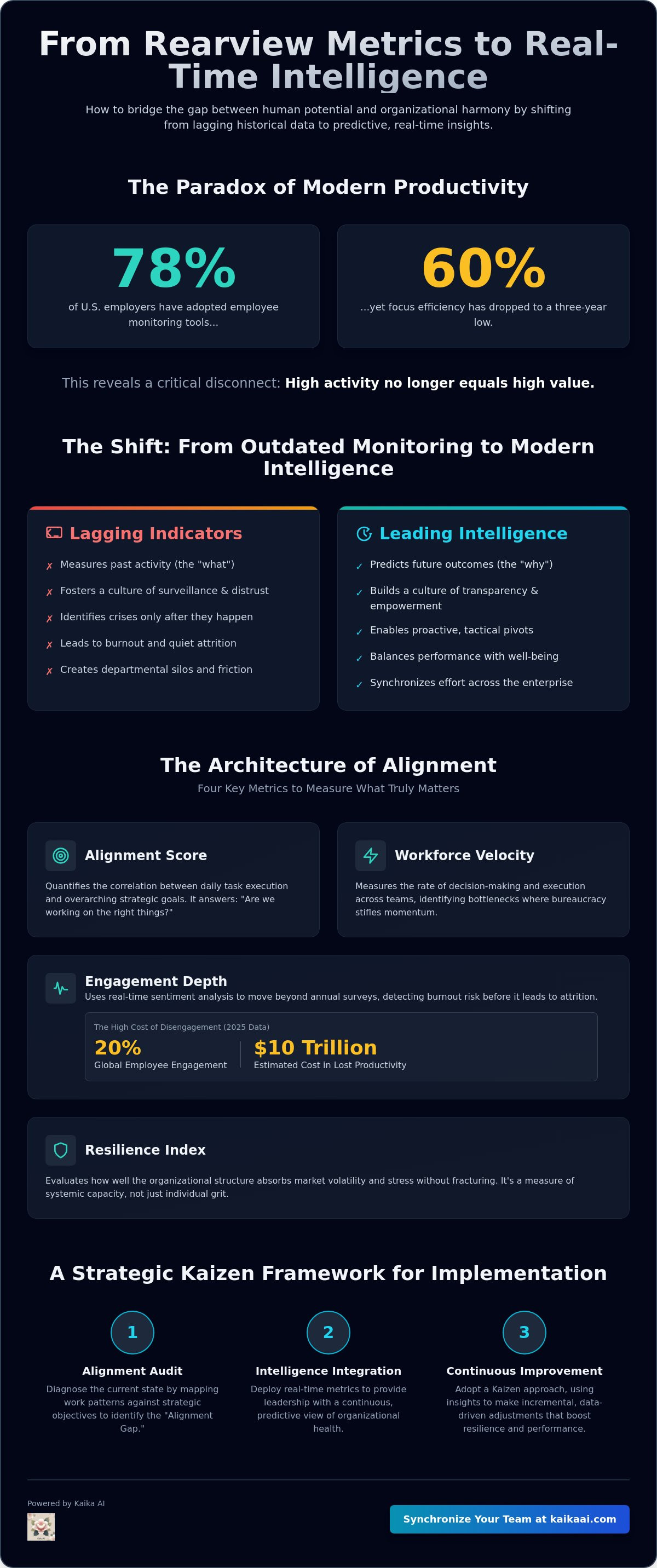
The era of the quarterly review as a primary steering mechanism is over. Modern leadership requires an immediate transition from lagging indicators, which merely catalog historical performance, to leading indicators that predict future outcomes. While 78% of U.S. employers now use some form of monitoring, focus efficiency has simultaneously dropped to a three-year low of 60% according to recent industry data. This gap suggests that raw activity data isn't enough. We must distinguish between superficial busyness and actual workforce velocity. In a global enterprise, busyness often manifests as friction, while velocity represents the frictionless movement of a team toward a shared objective. Traditional time-tracking fails here because it cannot quantify the nuances of cognitive output or the creative breakthroughs that drive high-value innovation.
By leveraging AI to synthesize disparate data points into cohesive real-time productivity metrics, executives can finally see the invisible architecture of their organization. This isn't about counting keystrokes; it's about understanding the health of the collective system. Achieving high-level Workforce productivity in 2026 requires looking past the individual to the synchronization of the whole. AI serves as the architect, identifying patterns in work rhythms that human observation would miss, allowing for a more nuanced view of how value is actually created within complex digital workflows.
The Shift from Monitoring to Workforce Intelligence
The term "productivity monitoring" has become obsolete in high-trust, mission-driven cultures. It implies a surveillance-based lack of trust that erodes morale and triggers resistance. Instead, we advocate for workforce intelligence. This is the architectural understanding of how work actually happens within your specific ecosystem. It's the science of connecting the individual "Why" with the organizational "What." When leadership understands the flow of work, they can remove structural barriers rather than simply demanding more effort from an exhausted staff. This intelligence fosters a culture where transparency is viewed as a tool for empowerment rather than a mechanism for control.
The Cost of Misalignment: A Strategic Crisis
Misalignment is a silent thief of enterprise ROI. When departments operate in silos, effort is duplicated and energy is dissipated across conflicting priorities. The "Alignment Gap" isn't just an HR issue; it's a strategic crisis that prevents rapid pivots in a volatile market. Using real-time productivity metrics allows leaders to identify these silos before they become permanent structural barriers that stifle growth. Workforce alignment is the synchronization of effort, energy, and executive intent. By closing this gap, organizations achieve the operational resilience necessary to maintain high performance without sacrificing the well-being of their top talent.
The Architecture of Alignment: Key Metrics That Matter
To build a resilient enterprise, leadership must look beyond the surface of activity. True structural integrity relies on the precision of your measurement. We're moving from measuring time to measuring impact. The Alignment Score is the definitive metric of 2026. It quantifies the correlation between granular daily task execution and the overarching strategic pillars of the organization. Real-time productivity metrics provide the visibility needed to ensure that effort isn't just present, but directed. When you track Workforce Velocity, you aren't just looking at speed. You're measuring the rate of decision-making and the subsequent execution across disparate departments to identify where bureaucracy stifles momentum.
Engagement Depth utilizes real-time sentiment analysis to replace the lagging data of annual surveys. Global employee engagement fell to 20% in 2025, costing an estimated $10 trillion in lost productivity according to industry research. Monitoring this depth allows for a Resilience Index. This index evaluates how well your organizational structure absorbs market volatility without fracturing. It's a measure of capacity, showing how much stress the system can handle before performance degrades. By focusing on these four pillars, executives move from reactive management to proactive architectural design.
Measuring Purpose-Performance Correlation
AI now identifies subtle deviations where an employee’s work drifts from their core purpose. This drift is often a leading indicator of disengagement. There's a documented statistical link between purpose alignment and high-performance outcomes. By using Kaika AI, executives can visualize this purpose-performance map in real time. This visualization allows you to identify where talent is underutilized or misdirected, ensuring that every contributor remains synchronized with the mission. It transforms abstract potential into measurable organizational harmony.
Cross-Departmental Synergy Tracking
Friction often occurs at the handoff between silos. Tracking the Synergy Coefficient between sales, engineering, and marketing reveals where communication breaks down or where priorities clash. This is the essence of Data-Driven Kaizen, where small, continuous adjustments lead to massive structural improvements. Integrating these insights into your high-performance culture software ensures that synchronization becomes a permanent feature of your operational model. You'll find that as synergy increases, the cost of execution decreases. It's a natural byproduct of a perfectly aligned system.
The Productivity-Burnout Paradox: Identifying Risks Before Attrition
Executives often misinterpret a surge in output as a sign of organizational health. In reality, peak performance frequently masks imminent structural failure within the workforce. High-performers often exhibit "Toxic Productivity," where they maintain high volume at the expense of cognitive recovery and long-term stamina. By utilizing real-time productivity metrics, leadership can see beyond the raw output to evaluate the physiological and psychological cost of that work. It's about monitoring the work rhythm, not just the result. If the rhythm becomes erratic or excessively dense, the system is nearing its breaking point regardless of the current ROI.
The phenomenon of "Quiet Quitting" isn't a sudden event; it's a gradual erosion of engagement that leaves digital footprints. AI detects these subtle shifts in communication patterns and work rhythms long before they manifest in a formal resignation. You might see a decline in "deep work" hours or a reduction in spontaneous cross-departmental collaboration. These are real-time indicators of disengagement that allow for a transition from reactive HR interventions to proactive operational resilience. The integration of real-time productivity metrics into your governance framework ensures that you aren't just measuring what people do, but how they're doing it.
Predictive Analytics for Attrition Risk
Sustaining a high-performance culture requires more than just grit; it requires a sustainable workload architecture. Our burnout prediction platform analyzes these patterns to determine the long-term viability of current output levels. We identify "Toxic Productivity" by looking for signs of chronic overextension that lead to talent loss. Advanced machine learning identifies complex burnout patterns 60 days before a resignation occurs by analyzing subtle shifts in digital engagement and task velocity. This foresight ensures that your most vital human assets remain aligned and energized.
Mental Health Risk Prediction in Corporate Governance
Tracking psychological stamina has moved from a wellness perk to a strategic imperative in corporate governance. When 71% of employees are digitally monitored in 2026, the ethical use of that data is paramount. We use real-time mental health risk metrics to trigger intervention strategies when the system detects a drop in resilience scores. This maintains the delicate balance between high-stakes performance and long-term workforce sustainability. It's a disciplined approach to excellence that acknowledges the human element as the foundation of all structural integrity. Organizations that prioritize this balance see a measurable increase in their capacity to handle market volatility.
Executing Data-Driven Kaizen: A Strategic Implementation Framework
Implementation is more than a technical deployment; it's a structural evolution. Executives must adopt a specific Leadership Mindset that views real-time productivity metrics as instruments of empowerment rather than mechanisms of control. This shift moves the organization away from the friction of surveillance and toward the fluid synchronization of shared intelligence. It requires a methodical, phase-based approach rooted in lean management principles to ensure that every data point serves a high-level strategic purpose. Without this framework, data remains raw noise. With it, data becomes the blueprint for institutional excellence and long-term operational resilience.
The Three-Phase Strategic Integration
- Step 1: Audit mission alignment gaps. We begin with an Alignment Audit to establish a baseline of structural integrity. This process pinpoints exactly where mission-critical effort is being dissipated into unproductive silos, moving past superficial activity logs to reveal the deep-seated gaps between executive intent and departmental execution.
- Step 2: Deploy performance dashboards. The next phase involves an Architectural Consultation to map real-time productivity metrics directly to executive-level goals. By deploying AI-powered dashboards, leadership gains the real-time visibility necessary for agile decision-making and precise resource allocation.
- Step 3: Train for resilience. The final phase focuses on operational resilience and data-driven Kaizen. We train leadership to interpret data through the lens of sustainability, ensuring that high performance never comes at the cost of workforce health.
Workshops for Collective Kaizen
Collective Kaizen Workshops bridge the gap between high-level strategy and daily execution. In these sessions, teams use real-time data to identify their own operational bottlenecks and propose Micro-Kaizen wins. These small, incremental improvements accumulate into massive structural shifts over time. This bottom-up approach to synchronization complements top-down executive intent, creating a self-correcting ecosystem where misalignment is rectified at the source. Transparency serves as the catalyst for this evolution. When every contributor understands how their work fits into the larger architecture, engagement deepens and institutional reliability becomes the new standard. It's a disciplined path toward organizational harmony.
To begin your journey toward structural synchronization, schedule your Alignment Audit today.
Kaika AI: Synchronizing Purpose and Performance at Scale
Kaika AI represents the culmination of workforce intelligence, designed specifically for the complexities of the global executive suite. Unlike generic tools that offer fragmented data, our platform provides a unified architecture for real-time productivity metrics. It functions as a strategic layer above your existing SaaS ecosystem, integrating seamlessly with Slack, Office 365, and other enterprise staples. This allows for a frictionless transition from raw activity to actionable alignment without disrupting the established workflows of your teams. It's the difference between seeing a list of tasks and understanding the velocity of your mission. By synthesizing disparate data points into a single source of truth, Kaika AI empowers leaders to make high-stakes decisions with composed, data-driven confidence.
Uncompromising Security and Privacy
Trust is the cornerstone of any high-performance culture. Kaika AI adheres to the world’s most stringent Japanese privacy standards, providing a superior framework for global HR data management. These standards emphasize data minimization and rigorous protection, ensuring that individual privacy is never sacrificed for executive visibility. We utilize advanced anonymization techniques that preserve the integrity of the data while shielding the identity of the individual contributors. This balance is critical for maintaining workforce trust and ensuring high adoption rates across diverse geographical regions. Compliance isn't a hurdle; it's the foundation of institutional reliability. In an era of increasing regulatory complexity, our commitment to these high-tech security principles ensures your organizational data remains both a strategic asset and a protected trust.
The Path to Organizational Harmony
The ultimate goal of workforce intelligence is the transformation of "human capital" into "human potential." When individual purpose is synchronized with organizational performance, the result is a high-velocity enterprise that is both resilient and agile. Kaika AI doesn't just measure output; it fosters a state of organizational harmony where every effort is meaningful and every contributor is aligned. By closing the gap between intent and execution, you build a structure capable of sustained excellence in a volatile market. It's time to move beyond the limitations of legacy monitoring and embrace the future of strategic alignment. This is the evolution of leadership, where technology and human behavior intersect to create measurable, structural impact.
For leaders looking to further automate their strategic intelligence workflows, SynTerraAI GmbH provides the specialized business intelligence and automation solutions necessary to scale these insights across a global enterprise.
We invite you to experience the future of leadership. Request early access to Kaika AI and begin the journey toward a truly synchronized organization. By deploying our Workforce Alignment Intelligence Platform, you aren't just buying software. You're investing in the structural integrity of your mission and the long-term vitality of your workforce.
Architectural Synchronization: The Future of Global Leadership
The transition from reactive management to proactive architectural synchronization is a structural necessity. By moving beyond raw activity tracking toward sophisticated real-time productivity metrics, you empower your organization to maintain peak velocity without sacrificing human potential. We've defined the path from fragmented effort to a unified, mission-driven force. True operational resilience now rests on the intersection of deep data intelligence and uncompromising organizational trust. It's about building a system that self-corrects before misalignment becomes a crisis.
The path to global harmony requires a partner that understands the nuances of scale and the criticality of privacy. Kaika AI provides a sophisticated framework for this evolution. Our platform combines AI-driven burnout prediction and resilience training with the world's most stringent Japanese privacy standards. Through our three-phase strategic integration methodology, we help you transform raw data into institutional excellence. Secure your place at the forefront of this leadership evolution today.
Request early access to the Kaika AI Workforce Alignment Platform and begin the process of structural synchronization. Your organization's future depends on the precision of its alignment.
Frequently Asked Questions
How do real-time productivity metrics differ from employee monitoring?
Real-time productivity metrics focus on the architectural health of the organization rather than the surveillance of the individual. While traditional monitoring often seeks to catalog raw hours or keystrokes, these sophisticated metrics measure the synchronization between daily activity and strategic intent. It's a shift from operational oversight to workforce intelligence. We prioritize the flow of work and the removal of structural barriers over the simple tracking of presence.
Can AI actually predict employee burnout before it happens?
AI identifies subtle shifts in work rhythms and communication density that human observation often misses. By analyzing these patterns, the system can detect signs of chronic overextension up to 60 days before a resignation occurs. This predictive capability allows leadership to intervene with resilience training or workload adjustments before talent loss becomes inevitable. It transforms burnout from an HR crisis into a manageable variable in your operational strategy.
How does Kaika AI ensure compliance with global privacy standards like GDPR?
Our platform is built upon the foundation of stringent Japanese privacy standards, which emphasize data minimization and institutional trust. We utilize advanced anonymization protocols to ensure that executive insights never come at the expense of individual privacy. This architectural commitment to security ensures compliance with GDPR and other global regulations while maintaining the actionable data necessary for high-level decision-making. Trust is treated as a core component of your organization's structural integrity.
What is the "Alignment Score" and how is it calculated?
The Alignment Score is a correlation coefficient that quantifies how closely daily tasks mirror your organization's strategic pillars. It's calculated by using AI to map digital workflows and output against the specific goals defined during your executive consultation. This score provides a clear, numerical representation of workforce velocity and mission synchronization. It allows you to see exactly where effort is being dissipated into unproductive silos.
How much time does it take to implement a workforce alignment platform?
Implementation follows a methodical, three-phase strategic integration methodology designed for minimal disruption. We begin with an initial Alignment Audit to establish your baseline, followed by an architectural consultation to map your specific metrics. The final integration phase synchronizes the platform with your existing SaaS ecosystem. While the timeline varies based on enterprise scale, our focus is always on achieving rapid visibility and long-term institutional reliability.
Is real-time tracking suitable for creative or non-linear roles?
Real-time tracking is exceptionally valuable for non-linear roles because it measures engagement depth and cognitive flow rather than raw volume. For creative professionals, real-time productivity metrics help identify the conditions that lead to "deep work" and high-value innovation. By understanding when and how these breakthroughs happen, leadership can protect creative time and reduce the administrative friction that often stifles original thought. It's about optimizing the environment for excellence.
How can executives use productivity metrics to reduce attrition?
Executives use these metrics to identify the "Quiet Quitting" early warning signs that precede physical departure. By monitoring real-time productivity metrics, you can detect a decline in collaborative synergy or a shift in work rhythms that suggests disengagement. This allows for proactive adjustments to workload sustainability and purpose alignment. When employees feel their work is both manageable and meaningful, institutional loyalty increases and attrition rates naturally decline.
What is the role of "Kaizen" in modern workforce management?
Kaizen represents the philosophy of continuous, data-driven improvement across every level of the organization. In modern management, this means using real-time data to identify and rectify small misalignments before they become structural failures. We facilitate this through Collective Kaizen Workshops, where teams participate in their own synchronization process. It moves the organization away from rigid, top-down control toward a self-correcting ecosystem that values agility and excellence.
Disclaimer
#Disclaimer
At Kaika AI, we believe the future belongs to organizations that combine human wisdom with artificial intelligence responsibly. The articles, research, insights, and thought leadership published on this website are intended to educate, inform, and encourage meaningful conversations about the future of work, organizational intelligence, AI, leadership, and innovation.
While our content is developed through rigorous research and may be generated, curated, or enhanced using artificial intelligence, every effort is made to ensure it reflects thoughtful analysis, practical relevance, and responsible AI practices. However, no representation or warranty is made regarding the completeness, accuracy, or suitability of the information for every individual or organizational circumstance.
The ideas, opinions, frameworks, and recommendations shared by Kaika AI are provided for educational and informational purposes only. They should not be interpreted as legal, financial, medical, psychological, human resources, cybersecurity, or other professional advice. Organizations and individuals should seek qualified professional guidance before making strategic, legal, or operational decisions.
Where articles reference third-party organizations, products, services, academic research, industry reports, or public data, such references are provided solely to support discussion and analysis. Unless explicitly stated, they do not imply endorsement, partnership, or affiliation.
Artificial intelligence is a powerful decision-support technology—not a replacement for human judgment. Kaika AI advocates for responsible, transparent, and human-centered AI adoption. We encourage readers to critically evaluate information, consider their unique context, and combine AI-generated insights with professional expertise and sound decision-making.
The content published on this website may be updated, revised, or removed as knowledge, technology, regulations, and best practices continue to evolve.
To the fullest extent permitted by applicable law, Kaika AI, its affiliates, contributors, and partners disclaim liability for any direct, indirect, incidental, consequential, or other losses arising from the use of, or reliance upon, the information provided on this website.
By accessing or using this website, you acknowledge that you have read, understood, and agree to this Disclaimer.
Kaika AI
'Building trusted organizational intelligence for the AI Era'


