
What if the most significant risk to your 2026 growth isn't a competitor's move, but the silent, structural erosion of your top performers that you only detect once their resignation hits your desk? You likely recognize that traditional sentiment analysis has become an exercise in historical reporting rather than strategic foresight. Relying on a static enterprise engagement platform that only captures past data leaves your organization vulnerable to misalignment and burnout. You need a more disciplined, data-driven framework to manage human potential at scale.
This guide demonstrates how to transition from passive feedback loops to sophisticated workforce alignment intelligence. We’ll explore the transition from measuring past dissatisfaction to engineering future organizational velocity. You’ll learn to deploy predictive attrition alerts and establish a measurable connection between employee purpose and ROI. We’re moving beyond corporate buzzwords to build a resilient, synchronized workforce capable of navigating the complexities of a 28 billion dollar engagement market. The goal is total structural integrity across every departmental silo.
Key Takeaways
- Transform your perspective from superficial communication metrics to a structural system of intelligence that synchronizes human purpose with organizational velocity.
- Understand why a modern enterprise engagement platform must prioritize real-time workforce alignment over the reactive, historical snapshots provided by legacy annual surveys.
- Discover how to deploy predictive attrition alerts and burnout detection to safeguard your top talent before performance erosion occurs.
- Master a methodical three-phase implementation strategy that utilizes Alignment Audits and Executive Consultation to build a foundation for operational resilience.
- Establish a measurable, data-driven connection between individual employee mission and your organization’s total ROI.
Redefining the Enterprise Engagement Platform for 2026
The concept of an enterprise engagement platform has evolved from a static repository of employee surveys into a dynamic system of intelligence designed for workforce alignment. Modern leadership demands more than historical sentiment. It requires a structural framework that synchronizes individual human potential with the high-velocity demands of global scale. While external customer engagement focuses on CRM-led messaging to drive transactions, internal workforce engagement is purpose-led. It focuses on the psychological and operational integrity of the organization itself. This distinction is critical for 2026. Enterprise engagement now serves as the architectural foundation for organizations that refuse to accept "Silent Attrition" as an inevitable byproduct of growth. Legacy HR portals fail because they are transactional rather than transformational. They lack the predictive capabilities to identify misalignment before it manifests as attrition. They detect burnout only after the resignation is signed. True resilience is found in "Structural Harmony," where every node of the enterprise moves with precision, shared intent, and measurable velocity.
The Shift from Communication to Alignment
High-performance cultures recognize that messaging frequency is a vanity metric. Flooding an organization with notifications does not create connection; it creates noise. A sophisticated enterprise engagement platform utilizes AI to bridge the gap between individual employee purpose and specific corporate milestones. This ensures that every team member understands their role within the broader strategic trajectory. It moves the needle from "staying informed" to "becoming invested." Workforce alignment is the synchronization of human intent and executive strategy.
The Economic Impact of Disengaged Workforces
The financial consequences of departmental silos and mission-drift are often hidden within the balance sheet. These inefficiencies manifest as sluggish decision-making and redundant operational cycles that drain institutional energy. Alignment intelligence mitigates these risks by providing real-time visibility into the health of the organizational structure. This transparency leads to measurable improvements in enterprise-wide ROI and operational velocity. Market valuation in 2026 is increasingly tied to workforce resilience. Investors prioritize organizations that can demonstrate a systematic, data-driven approach to maintaining human capital integrity. By establishing a predictive engagement model, leadership can prevent the catastrophic loss of tribal knowledge and the high costs associated with talent replacement. The result is a leaner, more responsive enterprise that treats human alignment as a primary competitive advantage.
Legacy Surveys vs. Modern Alignment Intelligence
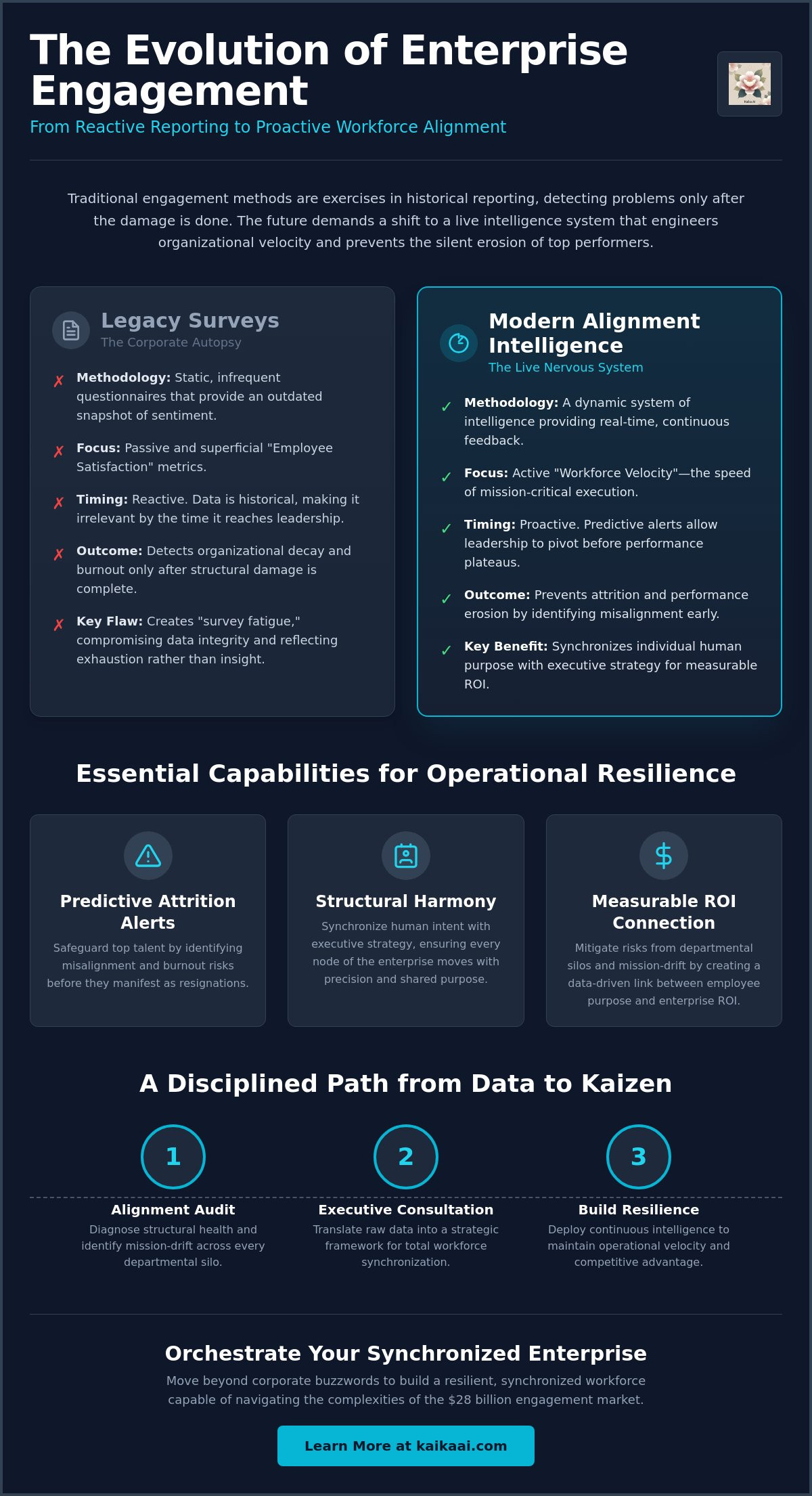
Legacy surveys are corporate autopsies. They provide a static, historical view of workforce sentiment that is often irrelevant by the time the data reaches the executive suite. This reactive posture is a fundamental flaw in traditional management; it detects organizational decay only after the structural damage is complete. In contrast, a modern enterprise engagement platform functions as a live nervous system. It provides real-time alignment metrics that allow leadership to pivot before performance plateaus. We're witnessing a necessary transition from "Employee Satisfaction," a passive and often superficial metric, to "Workforce Velocity." Velocity measures the speed of mission-critical execution powered by genuine human intent. It's the difference between knowing your team is happy and knowing they're synchronized for high-stakes performance.
Why Traditional Engagement Surveys Are Obsolete
The phenomenon of survey fatigue has compromised the integrity of traditional data collection. When employees are subjected to lengthy, infrequent questionnaires, the responses reflect exhaustion rather than insight. These static snapshots fail to capture the dynamic, non-linear progression of burnout risk. Traditional Employee engagement strategies often rely on top-down goal cascading. This approach creates a mechanical hierarchy but fails to foster the bottom-up purpose alignment required for true innovation. Without a continuous feedback loop, the gap between executive vision and operational reality remains dangerously wide. Data integrity requires a more fluid, integrated approach to gathering workforce intelligence.
The Predictive Power of Alignment Intelligence
Modern intelligence platforms utilize sophisticated AI to identify burnout patterns weeks before they culminate in a resignation. This isn't about surveillance; it's about structural preservation. By shifting from time-tracking to value-tracking, leadership gains a precise understanding of how human effort translates into enterprise-wide ROI. Trust is the essential foundation for this data-driven evolution. Incorporating high-level privacy standards, influenced by rigorous Japanese data protection philosophies, ensures that workforce intelligence never compromises individual dignity. Organizations that prioritize this balance find it easier to maintain synchronization across global teams. For leaders ready to move beyond snapshots, performing a comprehensive Alignment Audit is the first step toward building a resilient, high-velocity enterprise. This strategic realization marks the end of the survey era and the beginning of the alignment age.
Essential Capabilities for Operational Resilience
Operational resilience is not a static state of being; it’s a dynamic capability forged through structural precision and real-time intelligence. To achieve this, an enterprise engagement platform must transcend simple communication to become the architectural backbone of the organization. It requires a sophisticated suite of features designed to detect friction, predict erosion, and synchronize effort across disparate departmental silos. Leadership can't afford to manage by intuition alone when the stakes involve global scale and high-velocity execution. You need a centralized system that provides a single version of the truth regarding your organization’s human health. This involves moving beyond vanity metrics toward deep-tissue analytics that reveal the actual integrity of your workforce. By integrating cross-departmental synergy tracking, executives can finally visualize where silos are obstructing progress and where alignment is driving momentum. Real-time dashboards must serve both the visionary at the top and the member on the front lines, creating a shared language of performance and purpose.
Burnout Prediction and Attrition Risk Analytics
The most dangerous threat to enterprise stability is the invisible depletion of your most valuable talent. Modern AI now analyzes subtle engagement variance to signal shifts in psychological stamina long before they manifest as a decline in output. This isn't surveillance; it’s a mission-critical safety net. By integrating these burnout alerts into executive decision-making frameworks, leadership can intervene with strategic resource adjustments or targeted support. Burnout prediction software serves as an early warning system for human capital. It allows for a proactive preservation of institutional knowledge and prevents the catastrophic costs associated with high-performer attrition. This predictive layer ensures that the organization’s human engine remains primed for long-term resilience rather than short-term burnout.
Workforce Velocity and Productivity Tracking
Velocity is the ultimate measure of organizational health. It represents the speed at which strategic goals are met through a perfectly synchronized workforce. It’s vital to differentiate between superficial busy-ness and strategic workforce velocity. While busy-ness often masks inefficiency through a high volume of low-impact activity, velocity focuses on the rapid completion of mission-critical milestones. A high-performance enterprise engagement platform provides the metrics necessary to see this distinction clearly. Real-time data allows executives to adjust resource allocation dynamically, shifting focus and talent to where they can generate the highest ROI. This level of agility is only possible when human intent is fully aligned with corporate strategy. By tracking these metrics, you transform a fragmented group of individuals into a unified, high-velocity enterprise capable of outlasting any market disruption.
Implementation Strategy: Moving from Data to Kaizen
Integrating a high-performance enterprise engagement platform is an architectural undertaking, not a mere IT checklist. It requires a fundamental shift from viewing employees as resources to seeing them as the core drivers of organizational velocity. Executive Consultation serves as the necessary foundation for this transition, ensuring that the technology aligns with the high-level strategic vision. Without this leadership mindset development, even the most advanced AI intelligence remains a dormant tool. True evolution occurs when individual alignment matures into a collective organizational Kaizen, where continuous improvement is the standard rather than a project goal. This methodical approach ensures that your technological investment translates into structural integrity and measurable resilience.
Phase 1: The Alignment Audit
The process begins with a rigorous Alignment Audit to expose the hidden "Purpose Disconnect" within specialized divisions. We look beyond surface-level metrics to identify mission-critical gaps that stall progress and drain institutional energy. By establishing this baseline, leadership gains a clear view of current velocity and engagement levels across the entire structure. This diagnostic stage is essential for tailoring the enterprise engagement platform to the unique operational needs of the enterprise. It ensures that the subsequent data collection is targeted and strategically relevant.
Phase 2: Structural Framework Integration
Once the foundation is set, we deploy the AI platform to capture real-time performance and engagement data. This phase focuses on training leadership to interpret complex alignment scores and high-stakes burnout alerts. We establish cross-departmental feedback loops that ensure information flows seamlessly across silos, preventing the isolation that leads to mission-drift. This integration transforms raw data into actionable intelligence, allowing for rapid strategic adjustments that preserve human capital. It's the point where the organization begins to function as a unified, synchronized system.
Phase 3: Collective Kaizen and Optimization
The final phase moves the organization toward Collective Kaizen, where data-driven workshops refine synergy at every level. This is where we scale the alignment framework across global divisions, ensuring consistent resilience and high-velocity execution. Continuous monitoring of workforce sustainability metrics allows the enterprise to thrive in a state of perpetual optimization. To begin this transformation, your leadership team should engage in Operational Resilience Training to master the methodology of synchronized growth. This ensures the alignment engine remains tuned for maximum impact as the organization evolves.
Kaika AI: Orchestrating the Synchronized Enterprise
Kaika AI represents the definitive evolution of the enterprise engagement platform. It's not a mere utility; it's a comprehensive framework for organizational evolution. By merging high-precision AI intelligence with a disciplined strategic methodology, Kaika AI transforms fragmented workforces into synchronized entities. This platform serves as the structural bridge between individual human intent and executive strategy. It provides the clarity needed to navigate an engagement market projected to reach 28.13 billion dollars in 2026. Leadership requires more than sentiment; it requires a results-driven system that ensures total mission alignment across every departmental node. The goal is total structural integrity, where organizational velocity and human potential exist in perfect harmony.
Beyond Engagement: Achieving Workforce Alignment
Traditional tools measure activity, but Kaika AI measures the velocity of purpose. The platform identifies burnout risk profiles with surgical precision, allowing leadership to intervene weeks before top talent considers resignation. This predictive capability preserves institutional knowledge and maintains operational momentum. Real-time metrics illuminate cross-departmental synergy, turning isolated silos into collaborative nodes of high performance. This is the role of the Strategic Sage. Kaika AI doesn't just provide data; it offers a partner in organizational resilience. It creates a seamless narrative between technical intelligence and human-centric outcomes, ensuring that every effort contributes to enterprise-wide ROI. We're moving beyond simple communication to achieve true workforce synchronization.
Secure, Scalable, and Visionary
Global enterprises require uncompromising security and institutional reliability. Kaika AI adheres to the most rigorous privacy standards, including the CPRA updates effective January 1, 2026, and the latest rules regarding neural data and sensitive information. This ensures total peace of mind for leadership managing global teams across diverse regulatory landscapes. Our three-phase integration methodology guarantees that specialized divisions remain resilient through every stage of growth. We move from the initial Alignment Audit through structural integration into a state of Collective Kaizen. This disciplined approach ensures that your organization doesn't just survive market shifts but thrives through them. To secure your organization's future and drive measurable alignment, Request early access to the Kaika AI Workforce Alignment Intelligence Platform and begin the transition to active workforce intelligence.
Engineering the Future of Organizational Velocity
The era of reactive sentiment analysis has reached its terminal point. Strategic leaders in 2026 recognize that institutional resilience depends on a structural synchronization of human purpose and high-stakes operational velocity. By deploying a sophisticated enterprise engagement platform, your organization moves beyond historical snapshots and into the realm of predictive workforce intelligence. You now understand how real-time burnout prediction alerts safeguard your most valuable human capital before performance erosion occurs. True evolution requires a disciplined, three-phase strategic integration methodology rather than superficial software adoption. We prioritize your institutional integrity through rigorous Japanese privacy standard compliance. This ensures that your data remains a secure, uncompromising foundation for global growth. The transition from fragmented departmental silos to collective Kaizen is the definitive competitive advantage of our time. It's time to orchestrate a synchronized enterprise that thrives on structural precision and shared intent. We invite you to lead this transformation and unlock the full potential of your workforce.
Request Early Access to the Kaika AI Workforce Alignment Intelligence Platform
Frequently Asked Questions
What is the difference between an employee engagement platform and an alignment platform?
An alignment platform prioritizes the synchronization of human intent with executive strategy, whereas a traditional employee engagement platform often focuses on superficial sentiment and historical happiness metrics. While engagement measures how someone feels about their environment, alignment measures the precision with which their efforts drive corporate milestones. This distinction is critical for high-performance cultures that require more than just satisfied workers; they require a unified workforce moving with shared purpose and measurable velocity.
How does AI predict employee burnout without violating privacy?
Kaika AI identifies burnout patterns by analyzing subtle variances in engagement data rather than monitoring individual private communications or activities. This methodology prioritizes structural preservation over intrusive surveillance. Our systems are designed to comply with rigorous 2026 privacy regulations, including the CPRA and established Japanese data protection philosophies. This ensures that leadership gains actionable intelligence regarding human capital health without compromising the trust or dignity of the individual.
Can an enterprise engagement platform help reduce turnover in 2026?
Yes, an enterprise engagement platform reduces turnover by surfacing "Silent Attrition" risks before they manifest as formal resignations. By detecting shifts in psychological stamina and mission alignment early, executives can implement strategic interventions and resource adjustments. This proactive posture prevents the loss of tribal knowledge and the high costs associated with talent replacement, especially for top-tier performers who are most susceptible to mission-drift and burnout.
What are workforce velocity metrics and why do they matter to executives?
Workforce velocity metrics track the speed at which an organization completes mission-critical strategic objectives through aligned effort. Executives use these metrics to differentiate between superficial busy-ness and actual progress toward corporate milestones. Velocity provides a data-driven view of organizational health, allowing for dynamic resource allocation and ensuring that human energy is focused on high-impact outcomes rather than redundant administrative cycles.
How long does it take to implement a workforce alignment framework?
Implementation follows a methodical three-phase methodology designed to ensure long-term structural integrity rather than a rushed software deployment. The timeline varies based on the scale of the enterprise and the complexity of existing departmental silos. We begin with a diagnostic Alignment Audit and move toward full framework integration and Collective Kaizen. This architectural approach ensures that the platform is deeply embedded in the organization's leadership mindset and operational rhythm.
Is Kaika AI compliant with global enterprise security standards?
Kaika AI is engineered to meet and exceed global enterprise security standards, providing a foundation of institutional reliability for large-scale organizations. We maintain strict compliance with the latest 2026 privacy mandates, including new state laws in Indiana, Kentucky, and Rhode Island. Our commitment to data integrity is influenced by rigorous systems engineering principles, ensuring that workforce intelligence is gathered and stored within a highly secure, resilient environment.
What is an Alignment Audit and how does it benefit my organization?
An Alignment Audit is a comprehensive diagnostic deep-dive that identifies mission-critical gaps and "Purpose Disconnect" within your organization. It establishes a baseline for workforce velocity by analyzing how well individual effort currently synchronizes with strategic goals. This audit provides the architectural blueprint for your enterprise engagement platform, ensuring that the subsequent intelligence gathering is targeted at the specific friction points obstructing your organizational growth.
How does "Collective Kaizen" improve cross-departmental synergy?
Collective Kaizen improves synergy by transforming data-driven insights into continuous, collaborative improvement workshops across departmental boundaries. This process breaks down silos by creating a shared language of performance and purpose among disparate teams. By focusing on systematic refinement rather than isolated fixes, Collective Kaizen ensures that every part of the enterprise moves in harmony. This leads to a more resilient, synchronized workforce capable of executing complex strategies at global scale.
Disclaimer
#Disclaimer
At Kaika AI, we believe the future belongs to organizations that combine human wisdom with artificial intelligence responsibly. The articles, research, insights, and thought leadership published on this website are intended to educate, inform, and encourage meaningful conversations about the future of work, organizational intelligence, AI, leadership, and innovation.
While our content is developed through rigorous research and may be generated, curated, or enhanced using artificial intelligence, every effort is made to ensure it reflects thoughtful analysis, practical relevance, and responsible AI practices. However, no representation or warranty is made regarding the completeness, accuracy, or suitability of the information for every individual or organizational circumstance.
The ideas, opinions, frameworks, and recommendations shared by Kaika AI are provided for educational and informational purposes only. They should not be interpreted as legal, financial, medical, psychological, human resources, cybersecurity, or other professional advice. Organizations and individuals should seek qualified professional guidance before making strategic, legal, or operational decisions.
Where articles reference third-party organizations, products, services, academic research, industry reports, or public data, such references are provided solely to support discussion and analysis. Unless explicitly stated, they do not imply endorsement, partnership, or affiliation.
Artificial intelligence is a powerful decision-support technology—not a replacement for human judgment. Kaika AI advocates for responsible, transparent, and human-centered AI adoption. We encourage readers to critically evaluate information, consider their unique context, and combine AI-generated insights with professional expertise and sound decision-making.
The content published on this website may be updated, revised, or removed as knowledge, technology, regulations, and best practices continue to evolve.
To the fullest extent permitted by applicable law, Kaika AI, its affiliates, contributors, and partners disclaim liability for any direct, indirect, incidental, consequential, or other losses arising from the use of, or reliance upon, the information provided on this website.
By accessing or using this website, you acknowledge that you have read, understood, and agree to this Disclaimer.
Kaika AI
'Building trusted organizational intelligence for the AI Era'


