
What if you could hear the signal of a high-performer's departure before the silence of their resignation? In a high-stakes environment where replacing specialized talent costs up to 200% of an annual salary, relying on delayed annual surveys is a strategic liability. You likely recognize that by the time burnout signals reach leadership through traditional channels, the cultural and operational damage is often irreversible. The gap between corporate mission and individual purpose shouldn't be a mystery solved during an exit interview.
This article demonstrates how a sophisticated employee retention analytics platform moves beyond descriptive data to provide predictive workforce alignment intelligence. You'll discover how the Ikigai Intelligence Framework (IIF) identifies burnout risks and mission-alignment gaps in real time. We'll examine the structural methodologies required to synchronize performance with human potential. By the end of this guide, you'll understand how to maintain organizational velocity while reducing voluntary turnover through measurable, data-driven harmony.
Key Takeaways
- Identify "silent attrition" signals before they impact specialized talent retention by moving beyond reactive annual surveys.
- Discover how a dedicated employee retention analytics platform uses the Ikigai Intelligence Framework (IIF) to measure the precise alignment between personal purpose and organizational mission.
- Detect real-time burnout risks using the EHSI index to intervene strategically before high-pressure divisions experience voluntary turnover.
- Utilize the Sugihara Bridge Model to transition from a baseline alignment audit to full strategic integration within your corporate architecture.
- Access high-fidelity workforce insights supported by an 87% employee honesty rate to ensure leadership decisions are grounded in human truth.
The Architecture of Silent Attrition: Why Traditional Analytics Fail
Silent attrition is the structural decay of a modern enterprise. It occurs when high-performers disengage mentally and emotionally months before they formally resign. For executive leadership, this represents a profound loss of organizational velocity. Traditional methods of monitoring this decay often rely on reactive data points that arrive far too late to influence the outcome. When a resignation letter hits a desk, the opportunity for intervention has already passed.
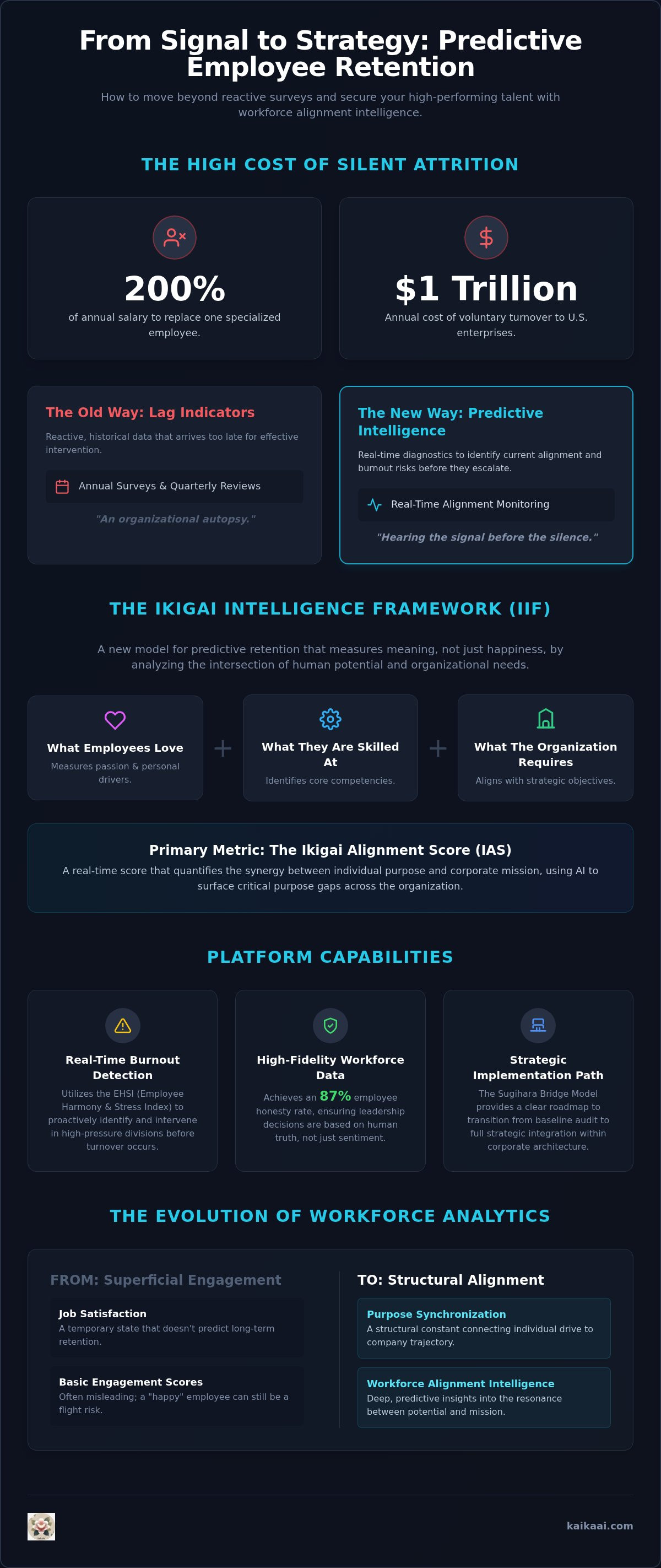
The failure of the standard employee retention analytics platform often stems from a reliance on lag indicators. Annual surveys and quarterly reviews act as organizational autopsies rather than real-time diagnostic tools. To maintain operational resilience, leaders must develop the capability of hearing the signal before the silence of a departure. This requires a shift from measuring historical sentiment to identifying the current alignment of purpose.
To better understand the mechanics of workforce data, watch this helpful video:
The Hidden Cost of Misalignment
Industry data suggests that voluntary turnover costs enterprises nearly $1 trillion annually. While the direct replacement of a specialized role often requires 1.5 to 2 times the employee's annual salary, these figures only represent the visible surface. The true damage lies in the erosion of institutional knowledge and the disruption of team synchronization. A deep understanding employee retention reveals that when a key contributor leaves, the remaining workforce often experiences a dip in motivation that further slows organizational momentum. This architectural instability creates a cycle of attrition that traditional metrics fail to capture.
Moving Beyond Engagement Scores
Engagement scores are frequently misleading. A "happy" employee who enjoys the corporate culture may still be a flight risk if their personal mission no longer aligns with the company's trajectory. There is a fundamental difference between job satisfaction and purpose synchronization. While satisfaction is a temporary state, alignment is a structural constant. Executive leadership must look beneath the surface of superficial engagement to find the human truth. This requires a transition from basic engagement tracking to workforce alignment intelligence. Data must reflect the actual resonance between an individual’s potential and the organization’s mission to be truly predictive.
The Science of Predictive Retention: The Ikigai Intelligence Framework
Predictive retention transcends simple pattern recognition. It requires a deep structural understanding of the human element within the enterprise. The Ikigai Intelligence Framework (IIF) provides this foundation by moving beyond engagement toward workforce sustainability. While competitors focus on "happiness," a truly effective employee retention analytics platform measures meaning. By analyzing the intersection of what employees love, what they are skilled at, and what the organization requires, the IIF creates a multidimensional view of organizational health.
Measuring Purpose with the IAS
The Ikigai Alignment Score (IAS) serves as the primary metric for organizational synergy by quantifying the synchronization between individual potential and corporate mission. This score doesn't just track sentiment; it monitors the alignment of personal purpose with high-level strategic objectives. Using advanced AI, the platform identifies purpose gaps across global divisions, surfacing areas where the corporate mission has become disconnected from the daily reality of the workforce. This capability is increasingly vital as organizations scale. Research into Predictive Analytics for Public Sector Retention suggests that AI can effectively bridge these gaps by identifying turnover drivers before they escalate. By mapping these scores against departmental performance, executives can pinpoint exactly where structural friction is hindering velocity.
Burnout Detection with Clinical Rigor
Attrition is often the final stage of a prolonged psychological decline. To prevent it, leadership needs the Employee Human Signal Index (EHSI). This index utilizes a clinically informed approach developed in collaboration with clinical psychologists to identify behavioral shifts before disengagement occurs. Unlike standard surveys, the EHSI detects subtle changes in the Human Signal Index (HSI), providing a proactive warning system for executive teams. By identifying the leading indicators of employee burnout, the platform allows for strategic intervention while the workforce is still intact. This clinical rigor transforms the platform from a simple monitoring tool into a diagnostic framework for human potential.
This level of precision ensures that interventions are surgical rather than broad. It replaces guesswork with a systematic methodology for maintaining operational resilience. A sophisticated employee retention analytics platform provides the clarity needed to lead with both empathy and data-driven confidence. Leaders who implement these frameworks gain a significant competitive advantage in talent density and institutional stability. To see how these indices function in a live environment, you can explore the capabilities of our Workforce Alignment Intelligence Platform. This approach ensures that performance and purpose remain permanently synchronized.
Evaluating Employee Retention Analytics Platforms: A Decision Framework
Selecting an employee retention analytics platform represents a critical investment in organizational stability. It's a high-stakes decision that requires more than a basic checklist of features. Executives must evaluate these tools based on three primary pillars: structural privacy, global scalability, and clinical rigor. While many vendors offer simple pulse survey functionality, these tools often capture fleeting sentiments rather than deep-seated alignment. A continuous alignment platform focuses on the persistent synchronization of purpose, providing a more reliable foundation for long-term growth.
Ethical data use and AI transparency are no longer optional in the modern enterprise. Black box models that hide their logic behind proprietary algorithms often fail to gain executive trust because they can't explain the "why" behind a flight risk signal. Responsible platforms prioritize explainable AI and maintain rigorous compliance with global privacy standards. This transparency ensures that leadership can act on workforce signals with confidence, knowing the data is both ethically sourced and structurally sound.
Platform Architecture: AI vs. Hybrid Models
Pure AI models frequently overlook the nuance of human behavior. A hybrid approach integrates machine velocity with human judgment to interpret sensitive signals correctly. This architecture allows for a more sophisticated analysis of the behavioral shifts mentioned earlier in our discussion of the Human Signal Index. It ensures that the platform doesn't just output numbers but provides actionable intelligence that respects the complexity of the modern workforce. Without this human-centric layer, data risks becoming cold and disconnected from the reality of the high-pressure division.
Integration and Operational Resilience
The right platform acts as a catalyst for institutional strength. It should provide cross-departmental synergy metrics that show how different divisions are aligning with the overarching corporate mission. Key features like real-time dashboards and predictive scoring are essential for maintaining a high-velocity environment. By monitoring workforce resilience metrics, leaders can build a structural buffer against external market volatility. This strategic integration transforms an employee retention analytics platform from a simple HR tool into a core component of the enterprise's operational resilience. It's about building a system that identifies friction points before they compromise the integrity of the entire organization.
Implementing a Proactive Retention Strategy: The Sugihara Bridge Model
The Sugihara Bridge Model represents a departure from generic, AI-only solutions that often feel disconnected from organizational reality. It provides a structured, phase-based methodology for embedding workforce intelligence into the corporate architecture. By pairing a high-fidelity employee retention analytics platform with human-led executive consultation, this model ensures that data becomes a catalyst for structural evolution. It moves through three distinct phases: surfacing the human truth, integrating intelligence into operations, and developing a leadership mindset capable of acting on early signals.
The Strategic Alignment Audit
Phase 1 begins with the Alignment Audit. This assessment surfaces mission-critical gaps before they manifest as performance failures or attrition. Leaders can conduct this audit across specialized divisions to identify where individual purpose has drifted from the corporate mission. During enterprise pilots, this approach achieved an 87% employee honesty rate. This high fidelity ensures that the baseline data reflects the actual state of the workforce rather than curated responses. Validating traction through pilot data allows for a surgical implementation that minimizes organizational friction.
Continuous Performance Reimagined
Static annual reviews are insufficient for high-velocity environments. This model transitions organizations toward data-driven Kaizen. This shift requires an employee retention analytics platform that prioritizes user-centric design and behavioral science. Utilizing continuous performance management software ensures that the feedback loop remains tight and actionable. Results from Tokyo-based pilots demonstrate the effectiveness of this approach, achieving a 74% weekly completion rate and a Net Promoter Score (NPS) of 72. By maintaining this consistent rhythm, leadership can identify and address burnout risks in real time.
Integrating this framework requires a commitment to excellence and a willingness to evolve beyond legacy management principles. Organizations that successfully embed these methodologies build a foundation of operational resilience that is difficult for competitors to replicate. If you're ready to transform your workforce architecture, you can begin by scheduling an Alignment Audit to identify your organization's hidden friction points. This proactive stance ensures that your high-performers remain synchronized with your strategic vision.
Kaika AI represents the pinnacle of workforce alignment intelligence. It's built on a singular, urgent mission: to hear the signal before the silence of a high-performer's departure. While a standard employee retention analytics platform might offer basic sentiment analysis, Kaika AI provides the clinical rigor necessary for enterprise-level decision-making. This foundation is the result of strategic partnerships with Waseda University and the Tokyo Innovation Base. By co-developing our framework with clinical psychologists, we've created a system that respects the complexity of human motivation.The efficacy of this approach is reflected in our pilot data. Tokyo-based enterprise pilots achieved an 87% employee honesty rate and a Net Promoter Score (NPS) of 72. These numbers demonstrate that employees don't just use the platform; they trust it. This trust is essential for surfacing the human truth required to prevent attrition in high-pressure divisions. As we move toward a dual TSE/ASX listing by 2032, we're scaling this intelligence to serve global leadership teams who demand measurable structural impact.
Enterprise-Grade Intelligence for CHROs
CHROs undergoing workforce transformation need tools that connect individual purpose with high-level organizational goals. Kaika AI provides customized integration for large-scale Japanese and global corporations, ensuring that intelligence is embedded directly into the corporate architecture. This isn't a bolt-on survey tool. It's a comprehensive workforce alignment software solution designed to maintain organizational velocity. By synchronizing the Ikigai Intelligence Framework (IIF) with your strategic objectives, you can ensure that your talent density remains high even during periods of rapid change.
Requesting Early Access
We're building a community of visionary leaders who prioritize responsible AI and ethical data use. Early-signal detection isn't just about saving recruitment costs. It's about long-term strategic growth and the preservation of institutional knowledge. Leaders who adopt these frameworks today will define the standards of excellence for the next decade. If you're ready to move beyond reactive management, we invite you to explore our framework through an Executive Consultation. Join us in evolving the intersection of technology and human potential to ensure your performance and purpose remain permanently synchronized.
Strategic Evolution: Securing the Future of Human Potential
The pursuit of organizational excellence requires more than just monitoring turnover; it demands a fundamental shift toward workforce alignment. You've seen that legacy engagement tools often miss the silent attrition that precedes a formal resignation. By implementing a sophisticated employee retention analytics platform grounded in the Ikigai Intelligence Framework, you gain the ability to hear the signal before the silence. This clinical approach, co-developed with Waseda University, ensures that your leadership decisions are backed by structural truth rather than superficial sentiment.
Our methodology has already proven its resilience, achieving an 87% honesty rate among 340+ participants and a Net Promoter Score of 72 in enterprise pilots. These metrics confirm that when you prioritize human potential and organizational harmony, performance naturally follows. The road to 2032 requires a proactive stance on talent density and operational resilience. Secure your competitive advantage by transitioning from reactive surveys to predictive alignment intelligence today.
Request early access to the Kaika AI Workforce Alignment Intelligence Platform to begin your organizational transformation. We look forward to helping you synchronize purpose and performance within your global workforce.
Frequently Asked Questions
What is the difference between employee engagement and workforce alignment?
Engagement tracks how an employee feels about their current environment. Workforce alignment measures the structural resonance between individual purpose and corporate mission. An engaged worker might enjoy their perks but still represent a flight risk if their personal trajectory diverges from the company's goals. Alignment intelligence provides a deeper diagnostic of organizational health. It ensures that performance is anchored in a shared sense of meaning and long-term commitment.
How does Kaika AI predict employee attrition without compromising privacy?
The platform utilizes the Human Signal Index (HSI) to detect aggregate behavioral patterns and sentiment shifts without resorting to individual surveillance. We prioritize ethical data use by focusing on departmental trends. This methodology respects the autonomy of the workforce while providing CHROs with the intelligence needed to hear the signal before the silence. Our approach adheres to the highest Japanese privacy standards for enterprise security and data integrity.
What is the Ikigai Alignment Score (IAS) and how is it calculated?
The Ikigai Alignment Score (IAS) quantifies how closely an individual’s sense of purpose mirrors the organization’s strategic objectives. It's calculated through the Ikigai Intelligence Framework by evaluating the intersection of four dimensions: love, skill, societal need, and organizational value. This creates a multidimensional synergy metric that identifies mission-alignment gaps across specialized divisions. It allows leaders to identify exactly where the corporate mission has become disconnected from the daily workforce.
Can an employee retention analytics platform actually prevent burnout?
A dedicated employee retention analytics platform can prevent burnout by identifying psychological strain before it escalates into silent attrition. Kaika AI uses the Employee Human Signal Index (EHSI), which was co-developed with clinical psychologists to flag early burnout risks. By detecting these leading indicators, leadership can implement structural changes to workload or environment. This proactive stance replaces reactive wellness programs that often arrive too late to save high-performing talent.
How does the Sugihara Bridge Model combine AI with human expertise?
The Sugihara Bridge Model is a hybrid architecture that pairs AI-driven measurement with the expertise of trained human consultants. This model ensures that sensitive workforce signals are interpreted with human judgment rather than cold algorithms alone. By combining machine velocity with psychological nuance, the framework provides a balanced approach to workforce transformation. It creates a reliable bridge between data-driven insights and the empathetic leadership actions required for long-term operational resilience.
Is Kaika AI compliant with enterprise-grade security and privacy standards?
Kaika AI is fully compliant with enterprise-grade security and Japanese privacy standards to ensure the integrity of all workforce data. We've built our infrastructure to prioritize transparency and ethical AI use. This commitment resulted in an 87% employee honesty rate during our Tokyo-based pilots. Our strategic partnership with Waseda University further reinforces our commitment to rigorous, evidence-based data handling. We ensure that every signal is handled with institutional reliability.
What kind of ROI can an organization expect from alignment intelligence?
Organizations using an employee retention analytics platform can expect a significant return on investment by reducing the high cost of replacing specialized talent. Replacing a senior role can cost up to 200% of an annual salary. Preventing even a few departures provides immediate financial relief and preserves institutional knowledge. Our pilots have demonstrated high user trust, reflected in a Net Promoter Score of 72. This suggests a measurable improvement in organizational velocity.
How do I request early access to the Kaika AI platform?
Visionary leaders can request early access by scheduling an Alignment Audit or an Executive Consultation through our official website. This process allows your organization to join an exclusive community of CHROs implementing responsible, alignment-focused AI. By acting now, you position your firm as a category leader in workforce intelligence and talent density. We're currently scaling our operations in preparation for a dual TSE/ASX listing by 2032.
Disclaimer
#Disclaimer
At Kaika AI, we believe the future belongs to organizations that combine human wisdom with artificial intelligence responsibly. The articles, research, insights, and thought leadership published on this website are intended to educate, inform, and encourage meaningful conversations about the future of work, organizational intelligence, AI, leadership, and innovation.
While our content is developed through rigorous research and may be generated, curated, or enhanced using artificial intelligence, every effort is made to ensure it reflects thoughtful analysis, practical relevance, and responsible AI practices. However, no representation or warranty is made regarding the completeness, accuracy, or suitability of the information for every individual or organizational circumstance.
The ideas, opinions, frameworks, and recommendations shared by Kaika AI are provided for educational and informational purposes only. They should not be interpreted as legal, financial, medical, psychological, human resources, cybersecurity, or other professional advice. Organizations and individuals should seek qualified professional guidance before making strategic, legal, or operational decisions.
Where articles reference third-party organizations, products, services, academic research, industry reports, or public data, such references are provided solely to support discussion and analysis. Unless explicitly stated, they do not imply endorsement, partnership, or affiliation.
Artificial intelligence is a powerful decision-support technology—not a replacement for human judgment. Kaika AI advocates for responsible, transparent, and human-centered AI adoption. We encourage readers to critically evaluate information, consider their unique context, and combine AI-generated insights with professional expertise and sound decision-making.
The content published on this website may be updated, revised, or removed as knowledge, technology, regulations, and best practices continue to evolve.
To the fullest extent permitted by applicable law, Kaika AI, its affiliates, contributors, and partners disclaim liability for any direct, indirect, incidental, consequential, or other losses arising from the use of, or reliance upon, the information provided on this website.
By accessing or using this website, you acknowledge that you have read, understood, and agree to this Disclaimer.
Kaika AI
'Building trusted organizational intelligence for the AI Era'


