
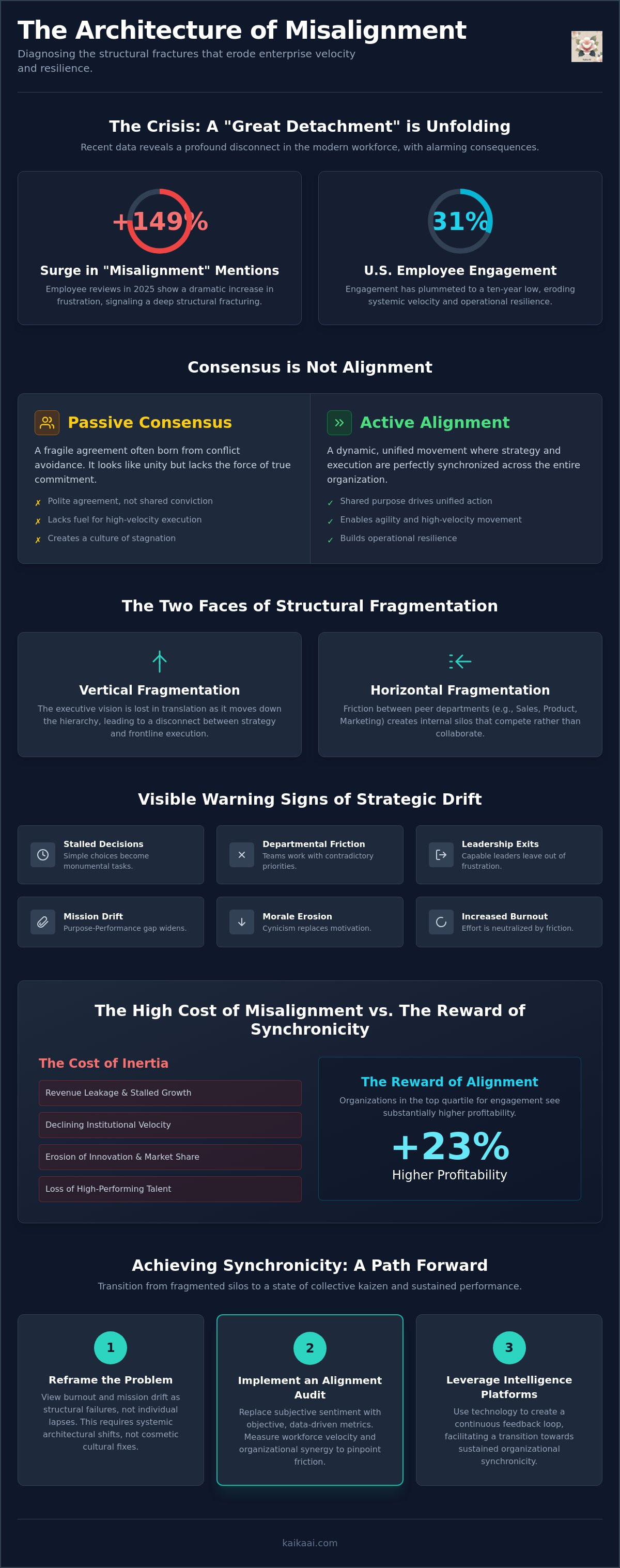
In 2025, mentions of "misalignment" in employee reviews surged by a staggering 149 percent, signaling a profound structural fracturing within the modern enterprise. This data reflects a broader "Great Detachment" where U.S. employee engagement has regressed to a ten-year low of 31 percent. You likely recognize the weight of this inertia through stalled decision cycles, cross-departmental friction, and the quiet exit of your most capable leaders. These aren't merely cultural grievances; they're the visible symptoms of poor organizational alignment that erode systemic velocity and threaten long-term operational resilience.
Success requires more than static agreement; it demands a dynamic synchronicity between your strategic vision and your human architecture. This article provides a sophisticated diagnostic framework to identify these critical markers of misalignment and offers a path toward structural harmony. You'll discover how to transition from fragmented operational silos to a state of collective kaizen, effectively reducing burnout while accelerating workforce velocity. We'll examine the specific architectural flaws that impede performance and the strategic interventions necessary to restore organizational health.
Key Takeaways
- Distinguish between passive consensus and active alignment to ensure strategic intent translates into unified, high-velocity operational movement.
- Identify the critical symptoms of poor organizational alignment, ranging from overt departmental friction to the subtle erosion of leadership morale and strategic drift.
- Reframe employee burnout and mission drift as structural failures rather than individual lapses, necessitating systemic architectural shifts rather than cosmetic cultural fixes.
- Implement a data-driven Alignment Audit to replace subjective sentiment with objective metrics for measuring workforce velocity and organizational synergy.
- Leverage a Workforce Alignment Intelligence Platform to facilitate a transition from fragmented silos toward a state of collective kaizen and sustained synchronicity.
The Anatomy of Misalignment: Defining the Architecture of Inertia
Organizational alignment is the precise synchronization of purpose, strategy, and execution. It's the structural integrity that allows a global enterprise to move with the agility of a startup. Many executives mistake consensus for true alignment, yet these concepts are fundamentally different. Consensus is often a passive agreement born of conflict avoidance; it's a polite nod in a boardroom that lacks the fuel of commitment. True Strategic alignment is an active, unified movement where every department, team, and individual operates as a cohesive system. Without this unity, the organization drifts into a state of structural inertia.
Inertia is the natural consequence of a misaligned enterprise. It's the friction that makes simple decisions feel like monumental tasks. Leaders who ignore the early symptoms of poor organizational alignment often find themselves managing a crisis of stagnation rather than a strategy of growth. Alignment isn't a peripheral HR concern; it's a core leadership responsibility and a structural necessity for survival. When the human architecture of a company isn't calibrated to its strategic intent, the resulting drag consumes resources, kills innovation, and creates an environment where high performers feel like they're running through sand.
Vertical vs. Horizontal Fragmentation
Structural misalignment typically manifests in two distinct directions. Vertical fragmentation occurs when the executive vision is lost in translation before it reaches the frontline. This disconnect creates a workforce that executes tasks without understanding the broader strategic "why," leading to wasted effort and missed opportunities. Horizontal fragmentation is the friction between peer departments. When Sales, Product, and Marketing operate with contradictory priorities, they create internal silos that compete for resources rather than collaborating for market share. These fragmentations aren't just inconveniences. They're systemic failures that lead to contradictory KPIs and operational gridlock.
The Purpose-Performance Gap
The gap between individual employee purpose and the corporate mission is a primary driver of the "Great Detachment." When there's a lack of purpose-alignment, engagement scores plummet and "quiet quitting" becomes the cultural norm. This disconnect reduces systemic velocity and turns a once-vibrant workforce into a collection of disengaged units. Workforce alignment is the bridge between individual intent and organizational outcomes. By closing this gap, leadership can transform individual potential into collective momentum, ensuring that personal growth and corporate success are inextricably linked. This synchronization is the only way to achieve lasting operational resilience in a volatile market.
Visible Warning Signs: The Surface Symptoms of Strategic Drift
Identifying the symptoms of poor organizational alignment requires looking beyond superficial friction to the structural rot beneath. These markers are lagging indicators; they appear only after the architecture of the enterprise has already begun to buckle under strategic drift. When mentions of "misalignment" in employee reviews surge by 149 percent, as documented in 2025, it indicates that the friction has become palpable to the frontline. This erosion isn't just a cultural nuisance. It's a direct threat to market competitiveness that manifests as measurable revenue leakage and a decline in institutional velocity. For leadership, the psychological toll is equally severe, manifesting as a pervasive sense of powerlessness as high-stakes initiatives stall despite significant capital investment.
The impact of this drift is often felt before it's measured. Executives find themselves trapped in a cycle of reactive firefighting, where the urgency of the immediate obscures the importance of the strategic. This environment breeds a culture of cynicism. When top performers realize that their efforts are being neutralized by structural friction, they don't just disengage; they leave. Organizations in the top quartile for engagement see 23 percent higher profitability, yet achieving this requires a level of synchronicity that surface-level fixes cannot provide. Leaders must recognize that these visible signs are calls for a fundamental architectural reassessment.
Decision Paralysis and Executional Drag
Strategic clarity should accelerate action, yet in misaligned environments, the opposite occurs. Decision paralysis stems from a systemic fear of trade-offs where leaders, lacking a unified compass, prioritize local optimization over global impact. This results in "Executional Drag," a state where the organization's kinetic energy is consumed by internal navigation rather than market disruption. When decision rights are opaque, projects enter a state of permanent stagnation. They wait for approvals that never arrive because no one is certain how the outcome serves the primary mission. This drag is the silent killer of innovation, turning visionary strategies into bureaucratic exercises.
Departmental Silos and Information Asymmetry
While many discuss "silos" as a communication issue, the reality is often more clinical: information asymmetry. Peer departments frequently hoard strategic data to protect their specific KPIs, creating "islands of excellence" that may perform well in isolation but fail the collective objective. This asymmetry breeds an "us vs. them" mentality, turning potential collaborators into internal competitors. To move beyond these structural barriers, leaders often require an objective Alignment Audit to expose where data is being weaponized rather than shared. When Sales and Product metrics conflict, the resulting friction doesn't just slow down production; it creates a fractured customer experience that no amount of marketing can fix.
The Silent Attrition: Predictive Symptoms of Workforce Disconnect
While surface-level friction is loud and disruptive, the most dangerous symptoms of poor organizational alignment are often silent. They manifest as a slow, corrosive loss of human potential known as Silent Attrition. This phenomenon isn't just the moment an employee hands in their resignation; it's the months of declining productivity and emotional detachment that precede the physical exit. Worldwide employee engagement has plummeted to 20 percent as of 2026, a figure that represents more than a simple lack of motivation. It represents a fundamental structural disconnect between the individual and the enterprise. When top talent perceives that their efforts are being neutralized by a fractured architecture, they begin to seek alignment elsewhere, long before they officially leave their posts.
This predictive drift is the ultimate metric of a failed alignment strategy. The global economy loses approximately $10 trillion annually due to low engagement, a cost that equals 9 percent of the world's GDP. These aren't just abstract figures. They're the tangible price of failing to synchronize human intent with organizational strategy. Leaders who wait for high attrition rates to signal a problem are already too late. They're looking at a catastrophe in the rearview mirror rather than diagnosing the structural weaknesses that caused the crash.
Burnout Patterns as a Structural Failure
Burnout is the physiological manifestation of working against an unaligned system. It occurs when high performers are forced to navigate conflicting goals and opaque priorities that drain their cognitive reserves. When an organization's architecture is fractured, the resulting role ambiguity creates chronic stress that no "wellness initiative" can solve. Modern enterprises now utilize a Workforce Alignment Intelligence Platform to identify these burnout patterns through real-time productivity and engagement metrics. By monitoring fluctuations in workforce velocity and systemic friction, executives can finally diagnose structural failures rather than blaming a perceived lack of individual resilience.
The Erosion of Individual Purpose
The erosion of individual purpose turns a mission-driven culture into a collection of transactional relationships. Employees begin doing the bare minimum because they no longer see the "why" behind their daily actions, leading to a state of transactional engagement. This detachment is often accelerated by the failure of legacy corporate goal cascading software, which creates a superficial hierarchy of tasks without fostering true synchronization. When misalignment devalues individual contributions, emotional detachment follows. Top talent inevitably seeks an environment where their efforts have measurable, structural meaning, leaving the misaligned organization to struggle with the remaining culture of detachment. To reverse this trend, many enterprises leverage the organizational culture expertise of Culture Of Belonging Global INC. to ensure every team member feels fundamentally connected to the collective vision.
Diagnosing the Friction: A Framework for Alignment Audits
Subjective engagement surveys often mask structural rot. They measure how people feel today, not how effectively the system moves tomorrow. Leadership requires a more clinical approach. An objective, data-driven Alignment Audit bypasses the bias of self-reporting to expose the actual symptoms of poor organizational alignment. This diagnostic process treats the enterprise as a complex machine, identifying where friction points generate heat and waste energy. By moving beyond sentiment, executives can visualize the structural integrity of their strategy and identify the exact coordinates where symptoms are most corrosive.
Diagnosis is merely the first phase of evolution. Once the symptoms are identified and the gaps mapped, the roadmap moves toward architectural correction. This involves a fundamental redesign of how goals are cascaded and how success is measured. It's about building a system that rewards synchronicity over individual heroism. By establishing this framework, organizations can stop reacting to crises and start engineering a state of permanent alignment. This transition is the difference between a company that survives market volatility and one that defines the market itself.
Measuring Workforce Velocity and Synergy
Workforce Velocity is the specific rate at which an organization converts strategic intent into realized outcomes. It's not about raw activity; it's about movement in a unified direction. When velocity drops, it signals that the human architecture is working against itself. Synergy Scores provide a quantitative measure of cross-functional health, tracking how effectively peer departments synchronize their efforts. By analyzing real-time productivity metrics, leadership can pinpoint where the symptoms of poor organizational alignment manifest as executional drag. This visibility allows for precise calibration, ensuring every unit of effort contributes to the collective mission.
Identifying Mission-Critical Gaps
A robust diagnostic framework must uncover where individual purpose and organizational goals diverge. This gap analysis reveals the mission-critical vulnerabilities that threaten operational resilience. While data provides the map, Executive Consultation provides the context, validating diagnostic findings against the nuances of leadership mindset and market reality. Prioritizing these gaps is a strategic imperative. You can't fix everything at once. Focusing on the fractures that pose the highest risk to your core objectives ensures that architectural corrections yield the maximum impact on systemic stability and growth.
Achieving Synchronicity: The Kaika AI Approach to Alignment
The transition from structural diagnosis to systemic synchronization requires a technological partner capable of bridging the gap between strategic intent and human execution. The Kaika AI Workforce Alignment Intelligence Platform provides this essential bridge, transforming the symptoms of poor organizational alignment into precise, data-driven opportunities for architectural refinement. This isn't a peripheral management utility; it's a comprehensive framework for evolution designed for the complexities of global scale. By utilizing a three-phase strategic integration methodology, Kaika AI ensures that alignment isn't a one-time event but a permanent state of high-velocity synchronization. This process moves the enterprise from the inertia of fragmented silos toward a resilient state of collective momentum.
Strategic success in a volatile market demands more than just vision. It requires a disciplined, visionary partner that understands the nuances of leadership mindset and the physics of organizational movement. Kaika AI positions itself at this intersection, offering executive leadership a serious, results-driven tool that emphasizes measurable structural impact over trendy corporate buzzwords. Through this partnership, organizations can finally close the purpose-performance gap, ensuring that every individual contribution is calibrated to the primary mission. This is the path to achieving operational resilience and sustaining a culture uncompromisingly focused on excellence.
Real-Time Intelligence and Predictive Analytics
Predictive analytics allow leaders to move from reactive firefighting to proactive architectural stewardship. The platform's Early Warning System identifies the symptoms of poor organizational alignment before they escalate into systemic failures, specifically monitoring for burnout patterns and attrition risk. By analyzing subtle shifts in workforce velocity and communication friction, the AI provides a high-stakes urgency regarding performance while maintaining a composed, strategic focus. This real-time intelligence is grounded in rigorous security and privacy standards, adhering to stringent Japanese compliance protocols to ensure institutional reliability and intellectual depth. It offers a futuristic yet grounded approach to managing human potential at scale.
Data-Driven Kaizen for Cultural Resilience
Cultural resilience is forged through continuous, incremental refinement rather than periodic overhauls. Our Collective Kaizen Workshops utilize objective platform data to facilitate a shared realization of strategic intent across all organizational tiers, fostering a sense of systematic order. This methodology facilitates Leadership Mindset Development by providing executives with the objective clarity needed to navigate complex human behaviors and structural roadblocks. It's an uncompromisingly focused approach that replaces subjective intuition with data-driven precision. Request early access to the Kaika AI platform and begin your Alignment Audit today to initiate your journey toward systemic synchronicity.
Engineering Systemic Synchronicity
Strategic drift isn't an inevitability; it's a design flaw that you can correct through rigorous structural diagnosis. By identifying the early symptoms of poor organizational alignment, you transition from the friction of departmental silos to a state of high-velocity synchronicity. This evolution requires moving beyond subjective sentiment toward objective, real-time intelligence that bridges the gap between individual purpose and corporate mission. You've seen the cost of inertia; now, it's time to architect resilience.
The Kaika AI platform provides the structural framework necessary for this transformation. Our three-phase strategic integration methodology, coupled with AI-powered burnout prediction and enterprise-grade security compliant with Japanese standards, empowers you to build a resilient human architecture. You possess the vision; we provide the precision tools to ensure your execution matches your ambition. Recalibrate your organization for sustained excellence and unlock the true potential of your collective workforce.
Request Early Access to the Kaika AI Alignment Platform
The future of the global enterprise belongs to those who successfully synchronize intent with action. You have the vision to lead; now, you have the framework to endure.
Frequently Asked Questions
What are the most common symptoms of poor organizational alignment?
The most prevalent symptoms of poor organizational alignment include chronic decision paralysis, persistent cross-departmental friction, and the visible erosion of high-performer engagement. These markers represent a failure in the human architecture to translate executive vision into frontline velocity. When peer departments operate with contradictory KPIs, the resulting structural drag neutralizes individual potential and stalls strategic momentum.
How does organizational misalignment lead to employee burnout?
Misalignment forces employees to navigate a landscape of contradictory priorities and opaque role expectations. This structural friction creates a state of permanent cognitive load, as individuals must expend energy on internal navigation rather than productive impact. It's the physiological consequence of working against a fractured system that devalues effort through systemic inefficiency.
Can AI really predict when an organization is becoming misaligned?
Modern platforms utilize predictive analytics to detect deviations in systemic synchronicity before they result in operational failure. The Workforce Alignment Intelligence Platform identifies these symptoms of poor organizational alignment by monitoring fluctuations in workforce velocity and communication patterns. This provides leadership with a high-stakes early warning system to address structural rot before it manifests as attrition.
What is the difference between a lack of communication and true misalignment?
Communication is the delivery mechanism for information, whereas alignment is the structural integrity of the message and its execution. You can communicate with high frequency and still remain structurally fractured if your internal units are optimizing for conflicting objectives. True alignment requires the synchronization of purpose, strategy, and execution, not just the exchange of data.
How do you measure the ROI of improving workforce alignment?
Measuring ROI involves tracking improvements in workforce velocity, reduction in turnover-related capital loss, and the acceleration of strategic milestones. Highly aligned teams demonstrate 23 percent higher profitability than those in the bottom quartile. These financial gains result from the elimination of executional drag and the optimization of human capital toward a unified mission.
Why do departmental silos form even in well-funded organizations?
Silos are a structural byproduct of localized optimization where departments prioritize their specific metrics over the global mission. Funding often exacerbates this by providing the resources to build independent, misaligned infrastructures. Without a central framework for synchronicity, these well-funded units become entrenched islands of excellence that fail to contribute to the collective objective.
How can I align individual employee purpose with our corporate mission?
Synchronizing individual purpose requires a bridge between personal intent and organizational outcomes, often facilitated through Collective Kaizen Workshops. This process ensures that personal growth and corporate success are inextricably linked within the human architecture. When employees see their specific contributions reflected in the broader strategic evolution, transactional engagement transforms into systemic synchronicity.
What is an Alignment Audit and how long does it take?
An Alignment Audit is a rigorous, data-driven diagnostic that identifies mission-critical fractures within your organizational architecture. It replaces subjective sentiment with objective metrics to map structural gaps and velocity inhibitors. While the timeline depends on the complexity of the enterprise, it's designed to provide a comprehensive roadmap for architectural correction within a defined strategic window.
Disclaimer
#Disclaimer
At Kaika AI, we believe the future belongs to organizations that combine human wisdom with artificial intelligence responsibly. The articles, research, insights, and thought leadership published on this website are intended to educate, inform, and encourage meaningful conversations about the future of work, organizational intelligence, AI, leadership, and innovation.
While our content is developed through rigorous research and may be generated, curated, or enhanced using artificial intelligence, every effort is made to ensure it reflects thoughtful analysis, practical relevance, and responsible AI practices. However, no representation or warranty is made regarding the completeness, accuracy, or suitability of the information for every individual or organizational circumstance.
The ideas, opinions, frameworks, and recommendations shared by Kaika AI are provided for educational and informational purposes only. They should not be interpreted as legal, financial, medical, psychological, human resources, cybersecurity, or other professional advice. Organizations and individuals should seek qualified professional guidance before making strategic, legal, or operational decisions.
Where articles reference third-party organizations, products, services, academic research, industry reports, or public data, such references are provided solely to support discussion and analysis. Unless explicitly stated, they do not imply endorsement, partnership, or affiliation.
Artificial intelligence is a powerful decision-support technology—not a replacement for human judgment. Kaika AI advocates for responsible, transparent, and human-centered AI adoption. We encourage readers to critically evaluate information, consider their unique context, and combine AI-generated insights with professional expertise and sound decision-making.
The content published on this website may be updated, revised, or removed as knowledge, technology, regulations, and best practices continue to evolve.
To the fullest extent permitted by applicable law, Kaika AI, its affiliates, contributors, and partners disclaim liability for any direct, indirect, incidental, consequential, or other losses arising from the use of, or reliance upon, the information provided on this website.
By accessing or using this website, you acknowledge that you have read, understood, and agree to this Disclaimer.
Kaika AI
'Building trusted organizational intelligence for the AI Era'


