
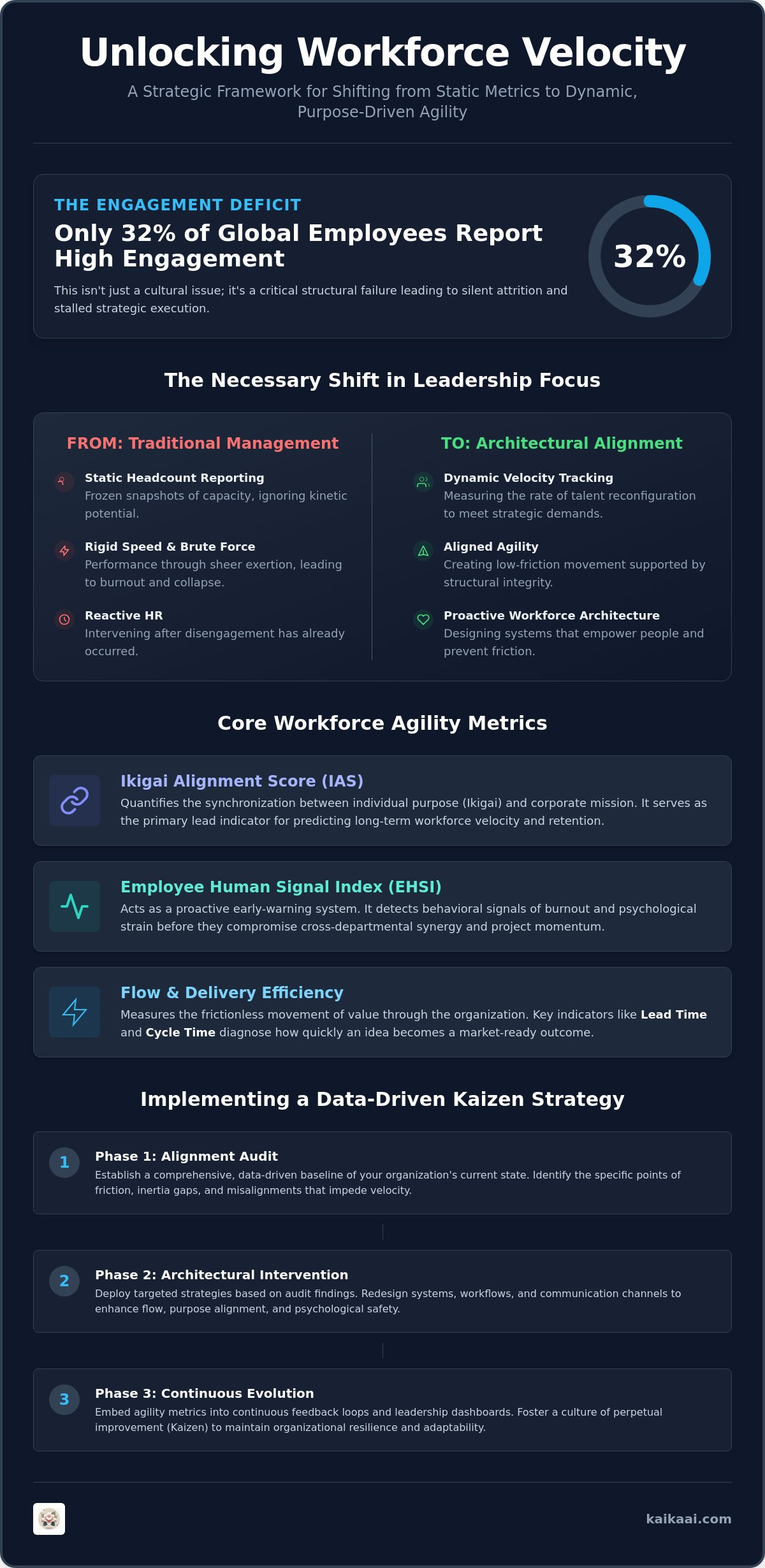
Only 32% of global employees report being highly engaged at work. For the modern executive, this figure represents more than a cultural deficit; it's a critical structural failure that manifests as silent attrition and stalled strategic execution. You recognize that traditional, rigid hierarchies are no longer sufficient to navigate the complexities of global market shifts. To maintain institutional resilience, leadership must move beyond static reporting and adopt dynamic workforce agility metrics that capture the real-time velocity of talent and intent. This shift requires a transition from reactive management to architectural alignment.
In this article, you'll master a strategic framework designed to transform invisible risks into measurable opportunities for growth. We'll examine the synchronization of individual Ikigai with corporate mission through specific indices such as the Internal Alignment Score (IAS) and the Employee Health and Safety Index (EHSI). This guide provides a methodical roadmap to achieve organizational velocity. You'll gain the precise tools required to detect early signals of burnout and disengagement before they compromise your strategic mission, ensuring your workforce remains a fluid, purpose-driven engine of performance.
Key Takeaways
- Shift from static headcount reporting to dynamic velocity tracking to distinguish between unsustainable speed and resilient organizational agility.
- Identify and measure the frictionless movement of value using specific workforce agility metrics that focus on flow, competency mapping, and strategic outcomes.
- Utilize the Ikigai Alignment Score (IAS) to quantify the synchronization between individual purpose and corporate mission, serving as a primary predictor of long-term velocity.
- Deploy the Employee Human Signal Index (EHSI) as a proactive early-warning system to detect burnout and psychological strain before they compromise cross-departmental synergy.
- Adopt a three-phase Kaizen strategy, beginning with an Alignment Audit, to establish a data-driven baseline for continuous organizational evolution and resilience.
The Architecture of Agility: Defining Workforce Velocity
Traditional management models often mistake activity for progress. They rely on static headcount reporting that provides a frozen snapshot of an organization's capacity while ignoring its kinetic potential. To achieve true Business Agility, executive leadership must pivot toward dynamic workforce agility metrics. This shift focuses on workforce velocity, the rate at which an organization reconfigures its human capital to meet shifting strategic demands. Unlike rigid speed, which forces performance through sheer exertion and leads to inevitable collapse, aligned agility creates a state of low-friction movement. It ensures that every operational pivot is supported by structural integrity rather than brute force.
Annual engagement surveys frequently fail because they capture data too late. By the time a survey identifies dissatisfaction, the talent has already emotionally detached. We call this the silence that follows the missed signal. Proactive leadership requires a framework that detects the symptoms of poor organizational alignment before they solidify into structural inertia. Systemic alignment reduces these symptoms by synchronizing individual intent with the corporate mission, creating a harmonious engine of execution. It replaces the friction of misalignment with the fluid energy of shared purpose.
From Performance to Alignment Intelligence
Alignment serves as the definitive lead indicator for all secondary performance outcomes. When strategy and execution diverge, an Inertia Gap forms. This gap is where high-level vision dissipates into operational confusion. Transitioning from reactive HR to proactive workforce architecture allows leaders to close this gap. It moves the focus from managing people to designing the systems that empower them. This architectural approach ensures that agility is a built-in feature of the organization. It's the difference between a temporary response to crisis and a permanent state of readiness.
The Executive Need for Real-Time Human Truth
Executive decision-making requires a continuous sentiment stream rather than periodic snapshots. Traditional annual reviews are historical artifacts with limited predictive value. Modern AI-driven platforms surface behavioral signals that precede disengagement, allowing for intervention at the point of friction. In high-velocity environments, psychological stamina is as critical as technical skill. Understanding the human truth behind the data enables leaders to maintain organizational harmony while pursuing aggressive growth targets. It's about achieving a state of collective flow where individual Ikigai powers the corporate engine.
Core Workforce Agility Metrics: Flow, Competency, and Outcome
To move from architectural theory to operational reality, executives must implement a rigorous measurement system that identifies the specific variables driving organizational velocity. A recent systematic literature review of workforce agility highlights how agility is no longer a peripheral advantage but a core survival trait for enterprise resilience. By focusing on workforce agility metrics, leadership can visualize the invisible currents of productivity and identify where structural friction impedes progress. This data-driven approach replaces intuition with precision, ensuring that talent allocation mirrors strategic priority.
Team synergy isn't a vague cultural aspiration; it's a measurable accelerator of project delivery. When individual purpose aligns with team objectives, the velocity of value creation increases. This synergy reduces the cognitive load on leadership by fostering self-synchronizing units that operate with minimal oversight. It's the difference between a collection of individuals and a unified engine of execution. If you're ready to evaluate your current state, an Alignment Audit can reveal the hidden bottlenecks currently slowing your progress.
Quantifying Flow and Delivery Efficiency
Agility manifests as the frictionless movement of value through the organization. We track lead time and cycle time to assess how quickly an idea transforms into a market-ready outcome. These metrics serve as diagnostic tools for identifying bottleneck behaviors that stall departmental progress. Flow distribution analysis ensures that talent isn't merely busy but is consistently allocated to high-leverage strategic goals. It reveals the structural health of your delivery pipeline.
The Competency-Agility Matrix
Static job descriptions are the enemies of fluid talent pools. We measure the rate of upskilling against the accelerating rate of technological change to determine organizational resilience. High internal mobility rates act as a proxy for flexibility, indicating that the workforce can pivot without external recruitment. Modern workforce alignment software automates this competency synchronization by mapping individual skills to evolving strategic needs in real time, ensuring modular adaptability.
The final pillar of this framework is the transition to outcome-based KPIs. Measuring hours worked is a legacy of the industrial age that fails to account for mission-critical impact in a knowledge economy. High-velocity organizations prioritize impact density, rewarding the achievement of strategic milestones over the performance of routine tasks. This shift in focus ensures that every unit of effort contributes directly to the overarching corporate mission, providing a clear window into the effectiveness of your workforce agility metrics and long-term strategic health.
Measuring Workforce Velocity through Purpose Alignment
While technical skills and operational flow provide the mechanical basis for agility, they lack the intrinsic motivation required for sustained high performance. True organizational momentum occurs when individual purpose synchronizes with the corporate mission. This is where workforce agility metrics must evolve to include the dimension of intent. Without purpose, speed is merely chaotic movement that leads to burnout. With it, an organization achieves a state of structural harmony where every employee acts as a proactive stakeholder in the strategic outcome.
The Ikigai Intelligence Framework (IIF)
The Ikigai Intelligence Framework (IIF) quantifies the intersection of individual passion, professional skill, and organizational mission. At the center of this framework lies the Ikigai Alignment Score (IAS), a definitive metric for predicting long-term workforce velocity. The IAS identifies silent attrition risk by surfacing the emotional detachment that precedes a formal resignation. In our recent 340-person Tokyo pilot program, this approach achieved an 87% employee honesty rate in sentiment analysis. This high level of "Human Signal" ensures that the data driving your executive decisions is grounded in human truth rather than corporate compliance.
Workforce Velocity vs. Raw Speed
Executives often mistake raw speed for progress. However, speed without direction is inefficient and often destructive. In a strategic context, velocity is a vector that combines speed with a clear, aligned direction. Purpose-aligned employees demonstrate significantly higher resilience in volatile markets because their work is anchored in a personal sense of meaning. This alignment creates a mathematical multiplier for organizational throughput, reducing the friction of oversight and internal conflict. Workforce Velocity is the rate at which an organization converts aligned human potential into strategic outcomes.
Integrating employee purpose alignment software into your executive dashboard allows for the real-time visualization of these human signals. It transforms abstract cultural concepts into actionable workforce agility metrics. By monitoring the IAS alongside traditional performance data, leadership can detect the subtle shifts in alignment that indicate a need for strategic recalibration. This proactive stance ensures that the organization remains not just fast, but focused and resilient in the face of market disruption.
Organizational Resilience: The EHSI Early-Warning System
True organizational velocity is unsustainable without a corresponding framework for human preservation. If workforce agility metrics focus solely on throughput and flow, they risk incentivizing a pace that leads to systemic collapse. Resilience is the structural capacity to absorb stress without losing strategic integrity. To measure this, leadership requires the Employee Human Signal Index (EHSI), a clinically-informed metric that quantifies burnout risk and psychological strain. By surfacing these signals early, executives can protect cross-departmental synergy before it erodes under the weight of digital exhaustion. It's about maintaining the health of the engine while increasing its speed.
The ethics of predictive attrition intelligence demand a foundation of transparency and trust. If employees perceive monitoring as a punitive tool, the honesty of the "Human Signal" vanishes. However, when deployed as a support mechanism, AI for organizational health creates a sustainable high-performance culture. It allows leaders to intervene with empathy rather than reacting to a resignation letter. This ethical alignment ensures that data remains a bridge between leadership and talent, not a barrier. If you're ready to secure your foundation, our Operational Resilience Training provides the specific methodologies needed to manage these high-stakes human variables.
Predicting Burnout through Behavioral Signals
Burnout does not occur in a vacuum; it leaves a trail of behavioral breadcrumbs. We identify patterns of withdrawal and digital exhaustion that precede a decline in productivity. By integrating clinical psychology into responsible AI indices, we can distinguish between temporary fatigue and chronic structural strain. This proactive detection allows for the redistribution of cognitive load, ensuring that high-leverage talent remains engaged. Addressing the human truth beneath the data is the only way to reduce silent attrition in a volatile market.
Building Institutional Resilience
Institutional resilience moves the organization from reactive crisis management to proactive organizational Kaizen. Real-time metrics allow for targeted interventions that strengthen the collective stamina of the workforce. We utilize the Sugihara Bridge Model, a framework where human judgment interprets AI-driven resilience signals to ensure context-aware decision-making. This synergy between technical intelligence and leadership intuition creates a robust defense against market volatility. It ensures that your agility is not just a temporary burst of speed but a permanent capability for evolution. By monitoring these workforce agility metrics through a lens of resilience, you build an organization that thrives under pressure rather than breaking under it.
Implementing a Data-Driven Kaizen Strategy
Transitioning from theoretical measurement to operational transformation requires a disciplined, phase-based methodology. Organizations cannot simply adopt workforce agility metrics and expect immediate evolution; they must integrate these insights into their core architectural rhythm. This process utilizes a data-driven Kaizen strategy to ensure that the synchronization of human potential and corporate mission is permanent rather than performative. By following a structured roadmap, executive leadership moves the organization toward a state of self-correcting velocity where strategic execution becomes a fluid, low-friction reality.
The ultimate objective is to build an environment that thrives on change. This involves more than just software implementation. It requires a fundamental shift in how leadership perceives and responds to human signals. When you align individual intent with institutional goals, you create a resilient engine capable of navigating the most volatile market conditions. This is the final state of organizational evolution: a high-velocity architecture that remains grounded in human truth.
Phase 1: The Alignment Audit
The journey toward agility begins with an Alignment Audit to establish an objective baseline of the current structural health. This phase maps existing mission-critical gaps between executive vision and frontline execution, identifying where strategy dissipates into operational inertia. We establish the initial Ikigai Alignment Score (IAS) to quantify the current level of purpose synchronization across the enterprise. Simultaneously, leadership utilizes the EHSI to identify high-risk burnout zones that may be invisible to traditional reporting. This audit provides the blueprint for all subsequent interventions, ensuring that every strategic pivot is informed by human data.
Phase 2 & 3: Integration and Optimization
Following the audit, the organization enters the integration phase by deploying the Workforce Alignment Intelligence Platform. This tool provides real-time tracking of workforce agility metrics, allowing leaders to monitor the flow of value and the health of the talent pool continuously. To bridge departmental silos, we conduct Collective Kaizen Workshops that transform individual insights into collective operational improvements. These workshops ensure that every team member understands their role in the broader mission.
Scaling these efforts across diverse regions introduces specific global workforce alignment challenges that require a modular and adaptive approach. Continuous optimization relies on hearing the signal before the silence, a proactive stance that allows for micro-adjustments before disengagement impacts performance. This iterative cycle of measurement and refinement ensures that the organization maintains its velocity. It creates a self-correcting system where the workforce remains synchronized, resilient, and focused on achieving high-leverage strategic outcomes.
Architecting the Future of Organizational Velocity
Strategic excellence is no longer defined by static stability but by the precision of its movement. By integrating advanced workforce agility metrics into your executive framework, you move beyond reactive management toward a state of proactive architectural alignment. This transition ensures that individual purpose and corporate mission operate in a synchronized, high-velocity rhythm. You've seen how specific indices provide the human truth necessary to detect silent attrition and burnout risks before they compromise strategic integrity. It's a shift from managing people to designing the systems that empower them.
Now is the moment to transform these insights into measurable structural impact. Our platform, developed in academic partnership with Waseda University, maintains a 72 Net Promoter Score (NPS) and adheres strictly to Japanese Privacy Standards. It's time to hear the signal before the silence. We invite you to Request Early Access to the Kaika AI Workforce Alignment Platform and begin your journey toward resilient growth. Your organization possesses untapped kinetic potential. Let's architect the system that releases it.
Frequently Asked Questions
What is the difference between workforce agility and workforce velocity?
Workforce agility represents the organizational capacity to reconfigure resources and talent in response to external market shifts. In contrast, workforce velocity measures the rate at which an organization converts that aligned potential into specific strategic outcomes. While agility provides the structural flexibility, velocity acts as a vector, combining speed with a clear, mission-driven direction to ensure progress isn't just fast, but purposeful and resilient.
How does the Ikigai Alignment Score (IAS) actually measure employee purpose?
The Ikigai Alignment Score (IAS) utilizes the Ikigai Intelligence Framework to quantify the intersection of individual passion, technical proficiency, and the corporate mission. It moves beyond qualitative sentiment by assigning numerical values to the degree of synchronization between a worker's personal passion and their operational tasks. This data allows leadership to visualize the invisible threads of motivation that drive long-term organizational performance and high-velocity execution.
Is burnout prediction software compliant with global privacy standards?
Responsible burnout prediction systems must adhere to rigorous global privacy standards to maintain institutional trust. Kaika AI ensures full compliance with Japanese Privacy Standards and global data protection regulations. By anonymizing behavioral signals and focusing on aggregate structural risks rather than individual surveillance, the platform protects employee anonymity while providing executives with the high-level intelligence needed to safeguard organizational health and prevent systemic exhaustion.
Can workforce agility metrics be applied to non-tech industries?
These workforce agility metrics are universally applicable to any complex organization requiring structural synchronization. In sectors like manufacturing or healthcare, agility manifests as the ability to reallocate specialized labor to meet fluctuating demand or regulatory changes. The underlying principles of flow, competency mapping, and purpose alignment remain constant across industries, providing a standardized framework for measuring and accelerating organizational throughput regardless of the specific technical output.
How often should an organization conduct an Alignment Audit?
Organizations should conduct an initial Alignment Audit to establish a baseline of their structural health and purpose synchronization. Following this baseline, an annual audit is recommended to track long-term evolution and resilience. Leadership should also trigger additional audits during significant strategic pivots, mergers, or periods of rapid scaling to ensure that the workforce remains architecturally aligned with the shifting mission-critical objectives of the enterprise.
What is the Human Signal Index and why does it matter for CHROs?
The Human Signal Index (HSI) measures the honesty and completion rates of workforce sentiment data, providing CHROs with a definitive metric for data integrity. It matters because it reveals the level of trust between the workforce and leadership. High HSI scores indicate that employees feel safe providing authentic feedback, which is the prerequisite for any accurate analysis of workforce agility metrics and subsequent strategic interventions.
How does Kaika AI ensure employee honesty in sentiment data?
Ensuring honesty requires a foundation of psychological safety and a clear value proposition for the employee. In pilot programs, Kaika AI achieved an 87% honesty rate by demonstrating that data is used for structural support rather than individual monitoring. When employees see that their signals lead to reduced burnout and better alignment with their own Ikigai, they become active, transparent participants in the intelligence-gathering process.
What is the Sugihara Bridge Model in the context of workforce analytics?
The Sugihara Bridge Model is a strategic framework where human intuition and leadership judgment act as the final interpretive layer for AI-driven analytics. It recognizes that while algorithms can detect behavioral patterns and resilience risks, the nuances of organizational culture require human context. This model ensures that executive decisions are data-informed but human-led, bridging the gap between cold technical intelligence and the complex realities of human behavior.
Disclaimer
#Disclaimer
At Kaika AI, we believe the future belongs to organizations that combine human wisdom with artificial intelligence responsibly. The articles, research, insights, and thought leadership published on this website are intended to educate, inform, and encourage meaningful conversations about the future of work, organizational intelligence, AI, leadership, and innovation.
While our content is developed through rigorous research and may be generated, curated, or enhanced using artificial intelligence, every effort is made to ensure it reflects thoughtful analysis, practical relevance, and responsible AI practices. However, no representation or warranty is made regarding the completeness, accuracy, or suitability of the information for every individual or organizational circumstance.
The ideas, opinions, frameworks, and recommendations shared by Kaika AI are provided for educational and informational purposes only. They should not be interpreted as legal, financial, medical, psychological, human resources, cybersecurity, or other professional advice. Organizations and individuals should seek qualified professional guidance before making strategic, legal, or operational decisions.
Where articles reference third-party organizations, products, services, academic research, industry reports, or public data, such references are provided solely to support discussion and analysis. Unless explicitly stated, they do not imply endorsement, partnership, or affiliation.
Artificial intelligence is a powerful decision-support technology—not a replacement for human judgment. Kaika AI advocates for responsible, transparent, and human-centered AI adoption. We encourage readers to critically evaluate information, consider their unique context, and combine AI-generated insights with professional expertise and sound decision-making.
The content published on this website may be updated, revised, or removed as knowledge, technology, regulations, and best practices continue to evolve.
To the fullest extent permitted by applicable law, Kaika AI, its affiliates, contributors, and partners disclaim liability for any direct, indirect, incidental, consequential, or other losses arising from the use of, or reliance upon, the information provided on this website.
By accessing or using this website, you acknowledge that you have read, understood, and agree to this Disclaimer.
Kaika AI
'Building trusted organizational intelligence for the AI Era'


